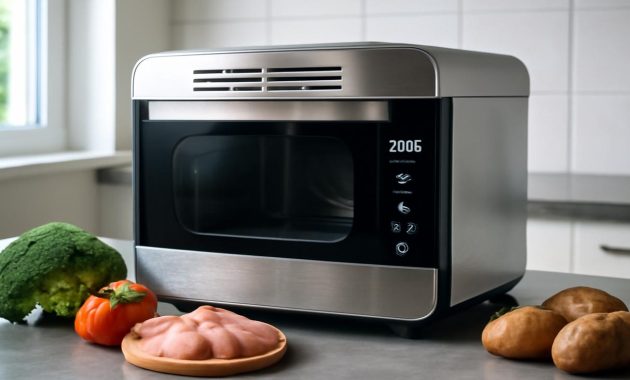
The first thing you notice is the sound—or rather, the lack of it. No familiar microwave hum, no impatient beeping. Just a soft rush, like distant rain on leaves, and a warm glow that seems to wrap itself around the food instead of blasting through it. On the kitchen counter sits a device that looks more like a sleek speaker than an appliance, its curved surface lit by a quiet halo of light. You tap the screen, slide a tray inside, and in less time than it takes to scroll through your notifications, steam is rising, aromas are blooming, and something astonishing is happening: your leftovers look, smell, and taste like they did the first time around.
The Day the Microwave Started to Feel Old
For decades, the microwave has been the impatient heart of the modern kitchen. It reanimated cold pizza, thawed bricks of frozen soup, and reheated coffee you forgot half an hour ago. It got us through late-night study sessions, office lunches, and long, tired evenings. But it also did something else we rarely admit out loud: it made food worse.
We tolerated rubbery chicken and soggy fries because, well, that was the trade-off for speed. We watched the edges of lasagna bubble into a molten lava field while the center stayed suspiciously icy. Sometimes we covered plates with damp paper towels or used elaborate tricks, like creating little wells in mashed potatoes, hoping the heat would magically distribute itself more kindly.
Meanwhile, ovens were slow, air fryers were loud, and stovetops demanded attention we didn’t always have to give. For all our love of innovation, the basic choice never shifted much: fast and mediocre, or slow and delicious. Then came a new kind of device, one that quietly set out to question the rules we’d accepted for too long.
The Device That Cooks Like a Chef — and Thinks Like a Scientist
This new kitchen breakthrough is not just a faster oven, not just a smarter air fryer, and definitely not a spinning plate behind a plastic door. Imagine an appliance the size of a compact microwave, but inside, the science looks completely different.
Instead of blasting food with uneven microwave radiation, it uses a tight choreography of advanced heating technologies: high-precision conduction from a special tray, radiant heat that mimics a traditional oven, and finely controlled convection air currents. Layered over that is a system of sensors and algorithms that read your food like a story, not just an object to be zapped.
Open the door mid-cycle and you’ll see no rotating plate, no bubbling chaos. Instead, there’s an amber warmth, a hush of air moving in patterns you can’t see but can absolutely taste. The device knows where the cold spots are forming and nudges heat toward them. It tracks moisture and adjusts the energy delivery in milliseconds. Reheating isn’t really reheating anymore; it’s something closer to time travel for your dinner.
The Secret Language of Heat
Inside this device, heat behaves differently. Traditional microwaves excite water molecules randomly and aggressively, which is why delicate textures get wrecked. Here, the heat is guided. Sensors track the surface temperature of your food, sometimes even its internal temperature, adjusting power in tiny increments so that the outside doesn’t overcook while the inside catches up.
It doesn’t just blast everything the same way. A slice of pizza gets a crisping boost to the crust; a bowl of soup gets layered heating from the bottom up and gentle stirring convection; a piece of salmon receives a slow, even warmth that respects its fragile flakes. It’s still fast. But it’s not brute-force fast. It’s attentive, almost considerate.
A Day in the Life With a Post-Microwave Kitchen
Picture a Tuesday night. You’re exhausted, you open the fridge, and there it is: last night’s roasted vegetables and grilled chicken in a glass container, looking a little sad and congealed. The old you would have sighed, peeled back the lid, tossed it in the microwave, and hoped for the best. But now, you slide the whole thing (yes, even in its storage bowl) into the new device.
On the touchscreen, you tap “Reheat Plate.” A soft chime, a pulse of warm light. For a moment, nothing looks different. Then the scent begins to shift—rosemary, a faint char from the edges of the vegetables, the deep, comforting aroma of cooked garlic revived as if someone had just pulled a pan from the oven.
When the device chimes again, you touch the side of the bowl; it’s hot, but not dangerously so. The food, on the other hand, is alive. The chicken is still moist, the vegetables haven’t collapsed into mush, and the olive oil that clung to them has melted back into a glossy sheen. You sit down and take that first decisive bite—and you’re back at last night’s dinner, not some distant, dull imitation of it.
Later that week, your friend drops by, hungry and half-joking. “Got anything that isn’t instant noodles?” you grin, slide open the device, and pull out a tray of frozen empanadas you stashed away last month. No preheat, no juggling pans. You tap “Bake & Crisp.” In barely the time it takes to catch up on each other’s weeks, your kitchen smells like a street food stall: warm spices, crisp dough, a faint buttery note flirting with the edges of the air.
From Panic Meals to Tiny Rituals
What changes first is not the food; it’s you. You start taking leftovers more seriously. You cook slightly larger batches, knowing that tomorrow’s reheated dish won’t feel like an afterthought. You stop hovering as much, because the device isn’t just heating blindly; it’s guiding the process.
Instead of frantically poking at over-hot plates or stirring half-frozen middles, you develop tiny rituals: tapping in a quick setting for “Crisp” when you rescue yesterday’s fries, choosing “Gentle Reheat” for that delicate mushroom risotto you were so proud of. The panic that often clings to weeknight cooking — the rush, the corner-cutting, the resigned reach for instant options — starts to slide away.
Why This Device Might Actually Retire the Microwave
We’ve met plenty of so-called microwave killers before: toaster ovens, convection ovens, air fryers, smart multi-cookers. They each did something well, but none could truly replace the one thing the microwave offered that felt irreplaceable: speed.
This new device doesn’t just match that speed; it sharpens it. Most foods reach eating temperature as quickly as they do in a microwave — sometimes faster — but the difference is in what you get at the end. Instead of a hot-then-cold bowl of pasta, you get even heat throughout. Instead of dried-out rice, you get fluffy grains that still taste like rice, not like warmed-up filler.
Here’s how it stacks up in everyday use:
| Task | Traditional Microwave | New Device |
|---|---|---|
| Reheating leftovers | Fast but uneven; risk of rubbery texture | Fast, even, textures close to freshly cooked |
| Crisping food (pizza, fries) | Often soggy or tough | Restores crunch and browning |
| Cooking from frozen | Edges overcooked before center is hot | Sensors adjust heat to thaw and cook evenly |
| Delicate foods (fish, custards) | Easy to overcook, unpredictable | Gentle cycles tailored for precision |
| Energy use | Short bursts, but inefficient for quality | Optimized for time and doneness; often less wasteful |
This isn’t about winning a tech spec war. It’s about how often you reach for it without thinking. When an appliance becomes the default choice for everything from a cup of soup to baking a small batch of cookies, the old one quietly starts collecting dust.
Speed, But Not at the Expense of Soul
There’s a particular kind of hunger that hits at odd hours. The sort that sends you towards the freezer at midnight, in search of something warm and real. With a microwave, that midnight hunger is usually met by compromises: spongy leftovers, limp vegetables, plastic-tasting convenience meals.
With this new device, that same hunger might lead to a small tray of roasted potatoes, crisp at the edges and soft at the center, shimmering with a bit of olive oil and salt. Or a quickly baked piece of seasoned tofu, the exterior gently caramelized. Or that slice of pie warmed so evenly that the crust stays buttery and flaky instead of turning leathery. It’s still speed. But it’s speed that remembers you’re a human being, not just a stomach in a hurry.
Cooking for One, Cooking for Many
There’s a quiet revolution happening in how we eat. More of us are cooking for one, or for two, instead of for big families every night. Conventional ovens feel oversized for a single baked potato or a small pan of brownies. Microwaves feel underqualified when flavor actually matters.
This device lives in the sweet spot. It’s small enough that heating a single bowl of soup feels reasonable, but powerful and smart enough to handle a small roast or a tray of vegetables for a gathering. It eliminates the guilt of “wasting” oven energy for a small meal, and the disappointment of settling for microwave texture.
On a rainy Sunday, you might slide in a single ramekin of mac and cheese, watching the top turn golden and bubbly, browned just enough at the edges. On a Friday night, you might line up four small flatbreads, each topped differently for friends, and let the device crisp them all to a perfect, blistered chew.
A Quiet Helper, Not a Shouting Gadget
So many modern kitchen tools come with noise. Not just literal noise, but mental noise: too many modes, too much complexity. They promise the world, then sit unused because no one wants to fight with menus and presets at the end of a long day.
This new device leans the other way. Its presets are conversational: “Reheat Bowl,” “Re-crisp,” “Bake,” “Gentle Cook.” Underneath those simple names is a tangle of timing, temperature curves, and sensor feedback. But you don’t see the tangle. You see food that comes out the way you hoped it would.
Less Waste, More Wonder
There’s another kind of revolution tucked quietly into this invention: what it does to your trash bin. When reheated food actually tastes good, you stop throwing as much of it away. That half-eaten burger from lunch becomes dinner without a sad apology. Those roasted vegetables find new life next to a fried egg the next morning, crisped again at the edges, not wilted into surrender.
Even pre-made frozen foods, often the last resort of the overworked and underslept, start to transform. A frozen burrito no longer emerges with a molten core of lava and icy corners. Instead, it’s gently thawed, then cooked through with a balance of heat that feels more like an oven than a ray gun. Convenience food doesn’t have to mean low expectations.
And perhaps most quietly revolutionary of all, you begin to think a little more about ingredients. When you know you can reheat roasted carrots and still enjoy their sweetness two days later, you’re more likely to make them in the first place. Leftovers become invitations, not inevitabilities.
Bending Time in a Busy World
In a sense, what this device really offers is not just better food, but better time. It lets you cook when you have the energy, and eat well when you don’t. You can roast a tray of chicken thighs on Sunday afternoon, then revisit them on Wednesday night without that heavy feeling of culinary déjà vu.
The technology blurs the hard line between “fresh” and “leftover.” It honors the work you already did at the cutting board and the stove, preserving the textures and flavors as if the meal had just stepped out of the pan again. It’s a kind of time bending, and once you get used to it, going back to a microwave feels almost crude.
The Kitchen, Reimagined
Walk into a future kitchen and you might notice what’s missing before you notice what’s new. The old beige box with the fogged-up door and peeling keypad is gone. In its place is something quieter, more intentional, sitting comfortably between form and function.
It may not shout its presence; it doesn’t need to. Its proof is in the first bite of yesterday’s risotto, the second life of a slice of pie, the way cold roasted potatoes regain their crispness and humility at the touch of its guided heat. It’s the way you hesitated, once, before reheating something precious — homemade dumplings or that last piece of perfectly baked salmon — and then relaxed as you realized: this device is not here to punish your food for having cooled down.
Will it replace every microwave overnight? Probably not. Microwaves are cheap, entrenched, familiar. They’re in offices, dorms, break rooms, hotel rooms, all the spaces where we ask the bare minimum from what we eat. But in the kitchens where we’re slowly learning to expect more from our food — more flavor, more texture, more respect — this new invention may quietly become the first choice, the one that makes the old box feel like something from a slightly less thoughtful time.
In the end, the promise isn’t that your kitchen becomes a lab, or that every meal turns into an event. The promise is simpler, and maybe more radical: that even on the busiest days, even in the smallest homes, warmth and care can coexist with speed. That the leftovers you reheat at 9:30 p.m., in your slippers and your oldest t-shirt, can still taste like a small act of kindness to yourself.
Frequently Asked Questions
Does this new device cook food as quickly as a microwave?
For most everyday tasks, yes. Reheating a plate of leftovers, warming soup, or cooking many frozen items is comparable in time to a microwave, and sometimes even faster. The difference is that it manages heat more intelligently, so the result is usually more even and far better in texture.
Can it replace my oven as well as my microwave?
For small to medium portions, it can handle many tasks you’d normally use an oven for: baking, roasting, and crisping. For large roasts or baking multiple trays at once, a full-sized oven is still useful. But for everyday cooking, it can become the primary heat source.
Is it complicated to use all the advanced features?
No. While the technology inside is complex, the controls are designed to be intuitive. Most people rely on a few core modes like “Reheat,” “Crisp,” and “Bake,” and let the sensors and algorithms handle the rest.
What types of food benefit most from this device?
Anything that suffers in a microwave tends to shine here: pizza, fries, roasted vegetables, sandwiches, pastries, and delicate proteins like fish or chicken. Even simple leftovers like rice, pasta, and casseroles come out closer to their original state.
Is it energy efficient compared to a microwave?
While exact energy use depends on the model and what you’re cooking, the device is generally designed to be efficient by heating quickly, targeting where heat is needed, and avoiding overcooking. For many real-world uses, it can be similar or more efficient than a microwave, especially when it prevents you from firing up a large oven for small portions.