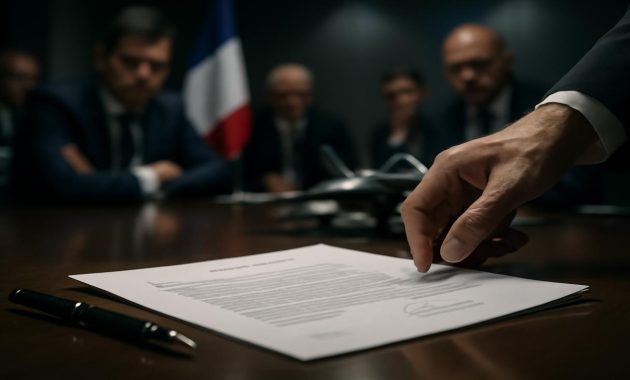
The news landed like a sudden gust of wind through an open hangar door. One moment, the French were certain victory was in their grasp – a gleaming €3.2 billion contract for Rafale fighter jets all but signed, the champagne almost cold, the speeches half-prepared. The next, the deal was gone. A last-minute twist, a phone call in a darkened office, the faint rustle of political calculations recalibrating elsewhere – and the sky over France’s fighter jet dreams dimmed by a cloud they never quite saw coming.
The Rafale, the Runway, and a Vanishing Deal
If you have ever stood on the edge of a runway and felt a fighter jet roar past, you know that it’s not just sound. It’s pressure on your chest, heat on your face, a tearing of the air that feels like it passes through your bones. The Dassault Rafale is built to create that feeling – a multirole fighter, sleek as a knife, bristling with technology, and wrapped in the quiet pride of French engineering.
For France, every Rafale sale is more than another line in an industrial ledger. It’s a validation of national ingenuity, a reaffirmation that a mid-sized European power can still design and export cutting-edge combat aircraft in a world crowded with giants. So when word spread that a lucrative €3.2 billion contract was effectively in the bag – another foreign air force ready to join the Rafale “club” – there was a familiar current of confidence in Paris and at Dassault Aviation’s headquarters.
Diplomats had made their rounds. Test pilots had flown their dazzling aerobatics in blue skies over air shows. Technical teams had spent late nights in conference rooms, adjusting specs, recalculating payload options, running through life-cycle maintenance costs. Behind the scenes, bankers and lawyers drafted the skeleton of a deal: a particular number of aircraft, a timeframe for delivery, training packages, local industrial offsets, the choreography of payments.
And then, almost on the threshold, the customer walked away.
The Anatomy of a Last-Minute U-Turn
In arms deals of this scale, nothing ever truly happens in an instant. The last-minute U-turn that jolted France and Dassault was more like a slow-motion avalanche that finally broke loose at the edge. The public sees the final moment – a defense minister announcing a “change of direction,” or a presidential office releasing a dry statement about “reassessing strategic needs.” But the tremors start far earlier.
Behind closed doors, the buyer’s negotiators would have been fielding pressure from every angle. Domestic politicians asking pointed questions about cost. Generals divided between legacy relationships and new alliances. Economists warning of ballooning defense budgets. And always, always, the subtle but unmistakable gravitational pull of other players – from Washington, Moscow, Beijing, or rival European capitals – each armed with their own competing jets and their own persuasive arguments.
The Rafale is not a cheap aircraft. It is a premium solution in a world where many governments are caught between high ambitions and tight budgets. A €3.2 billion contract is not just a buy – it is a commitment, a promise that will shape procurement, maintenance, and geopolitics for decades. As negotiations deepen, the glow of the air show can begin to fade under the fluorescent lights of treasury departments.
One can imagine the scene: a late briefing slide, a revised cost forecast, perhaps a subtle nudge from another powerful capital promising better terms or broader security guarantees if the buyer were to choose differently. Maybe a domestic election suddenly loomed closer, turning any large military purchase into political dynamite. Somewhere in the tangle of numbers and national priorities, the pivot began. By the time France saw it clearly, it was a decision already set in motion.
Counting the Cost: Numbers Behind the Narrative
It’s easy to forget, amid talk of strategy and prestige, that these deals are painstaking, numerical creatures. They live and die in spreadsheets as much as in airfields. To understand the stakes, it helps to look at how a deal of this magnitude might break down over its life.
| Component | Estimated Share of €3.2B | What It Typically Includes |
|---|---|---|
| Aircraft Acquisition | 50%–60% | Airframes, engines, basic mission systems, initial spares |
| Weapons & Mission Kits | 15%–20% | Air-to-air and air-to-ground munitions, targeting pods, EW pods |
| Training & Simulation | 5%–10% | Pilot training, ground crew training, simulators, courseware |
| Support & Maintenance | 10%–15% | Maintenance contracts, spare parts pipeline, technical support |
| Offsets & Industrial Cooperation | 5%–10% | Local assembly, technology transfer, industrial partnerships |
For France, those columns represent thousands of jobs, years of production stability, and a cascade of smaller contracts for companies threaded through the aerospace supply chain. For the buyer, they represent not just an airplane, but a long-term ecosystem of dependence: on French parts, French expertise, French political goodwill.
This is why such decisions are rarely just about capability. They are about who you intend to stand with when the weather turns bad.
Rafale vs. the World: A Crowded Sky
The Rafale’s story has always been one of resilience. When Dassault first launched it, the aircraft was often overshadowed by louder, more politically backed competitors: the American F-16 and F-18, the Eurofighter Typhoon, later the F-35 stealth fighter. For years, France struggled to find foreign buyers, despite a fighter that many pilots quietly admired for its agility, versatility, and reliability.
Then, almost like a tide turning, the Rafale began to carve out its own space. Deals with India, Egypt, Qatar, Greece, Croatia, and others slowly accumulated. Each contract became a reference, each foreign pilot a quiet ambassador. The message spread: this is a jet that can do almost everything – air superiority, ground attack, reconnaissance, nuclear deterrence – and do it with a certain French flair for custom solutions.
But in this market, success invites even sharper competition. The U-turn on the €3.2 billion deal unfolded in a world where buyers have more options – and more leverage – than ever before. The United States offers aircraft wrapped in the larger fabric of security alliances and intelligence sharing. Russia and China offer lower prices, generous offsets, and, at times, fewer political conditions. European partners press their own projects, keen to keep industrial benefits closer to home.
Layer onto that a rising interest in drones, loitering munitions, and integrated air defense networks, and the buyer’s question shifts from “Which jet?” to “Which ecosystem?” The Rafale, as formidable as it is, must now live inside that bigger picture.
The Politics in the Cockpit
Every fighter jet sale is, in its own way, a treaty. It ties two nations together through logistics, training, software updates, and weapons integration for decades. It is an exchange of trust as much as technology.
For the would-be buyer walking away from France, the last-minute reversal likely came down to a recalculation of such trust and alignment. Perhaps there were doubts about France’s political consistency, or concerns about potential export restrictions under certain circumstances. Or maybe it was the opposite: the appeal of another supplier who could package its jets with explicit defense pacts, intelligence sharing, or regional security guarantees.
France, proud of its strategic autonomy, plays a subtler game. It does not anchor itself to Washington’s policies nor Moscow’s ambitions. That independence can be a virtue, but it can also complicate sales in regions where buyers want explicit, heavyweight umbrellas above their newly purchased wings.
In that sense, the lost deal isn’t only about Rafale versus another aircraft. It is about a vision of the world – a set of alignments and assurances written in the language of contracts and cockpit displays.
The Human Side of a Lost Contract
Zoom in from the geopolitical map to the factory floor and the airbase. You start to see different faces in this story: the engineer in Mérignac who has spent the last year refining avionics modules for export configurations. The test pilot who flew demonstration sorties for visiting delegations, pulling high-G turns over sun-struck tarmac to show what the Rafale could do. The translator who sat in long technical meetings, carrying meaning back and forth across languages rich with acronyms and cautious promises.
For them, the cancelled deal is not an abstract “€3.2 billion” but the echo of months, sometimes years, of effort suddenly slipping out of reach. There is the quiet reassigning of teams, the careful rewriting of production schedules, the phone calls from suppliers asking if the rumored cancellation is true. In boardrooms, charts that once had confident upward arcs are redrawn, their lines a little flatter, their colors more subdued.
At the same time, in the airfields of the would-be buyer, pilots who had begun to imagine themselves sitting inside a Rafale cockpit – learning its flight envelope, trusting its sensors, calling out targets in a new language of systems and displays – must recalibrate their own expectations. They may instead end up in another jet, another system, another strategic orbit.
The power of this story lies in these small, almost invisible ripples. They remind us that behind every headline about a deal lost or won are thousands of lives bent slightly into new shapes.
Resilience in a Turbulent Market
France and Dassault have been here before. The Rafale program has survived droughts more severe than the loss of a single, even sizable, contract. It has transitioned from a jet that many saw as an expensive national indulgence to one that stands as a cornerstone of French diplomacy and defense exports.
In the wake of this U-turn, the conversation in Paris is unlikely to be one of defeat, but of recalibration. Where else can the Rafale find a foothold? Which air forces are quietly weighing upgrades to older fleets? How might France adjust its offer – in financing, training, or industrial cooperation – to better match the anxieties of a world increasingly caught between rising tensions and limited budgets?
There is also a broader European question hovering above the runway: how will this loss shape debates over future combat air systems? Joint projects like the Franco-German-Spanish Future Combat Air System (FCAS) are meant to carry Europe’s aerospace ambitions into the next generation. The Rafale, even as it remains potent and relevant, is not eternal. Each lost or won deal subtly reshuffles the political momentum behind what comes next.
What This Means for the Future of Fighter Deals
As defense budgets in many regions swell in response to new conflicts and perceived threats, the market for fighter jets is entering a paradoxical era: more money, more urgency, but also more scrutiny. Societies increasingly ask where their tax euros and dollars go. Environmental concerns cast a long, questioning shadow over industries that burn jet fuel by the barrel. And digital warfare – cyberattacks, satellites, electronic jamming – challenges old assumptions about what airpower alone can achieve.
The Rafale’s lost deal feels like a snapshot of this new complexity. A capable, battle-tested jet, backed by a technologically advanced country, can still lose out at the eleventh hour because the factors in play extend so far beyond performance charts. Decisions now fuse economics, climate pressures, regional optics, alliance politics, and the hard, unromantic constraints of long-term sustainment.
In that landscape, France will likely lean even harder into what sets it apart: flexibility, custom solutions, and a willingness to speak with countries that sit uneasily between larger power blocs. The Rafale will remain a key instrument in that outreach, a flying business card that says: we can partner with you on your own terms, not only through someone else’s vision of the world.
Yet the message from this €3.2 billion reversal is clear: even the best instrument can slip from your grasp if the tune changes faster than you realize.
The Quiet Lessons in the Slipstream
Stand again by that runway in your mind. The Rafale powers past, afterburners blazing, a streak of noise and heat carving through the cool morning air. It climbs, rolls, and disappears into a pale sky. The empty space it leaves behind is still vibrating with its passage.
That is where France finds itself now: in the charged quiet after a departure that didn’t quite happen, in the echo of what a €3.2 billion deal would have meant. There is disappointment, undoubtedly. But there is also information – about how the winds are shifting, about what buyers now demand, about which arguments no longer land as they once did.
The Rafale will fly on. Somewhere, in another capital, another delegation will arrive at an airbase, eyes tilted upward as a French pilot puts the jet through its paces under a hot sun. New spreadsheets will open. New negotiating rooms will smell faintly of coffee and printer ink as numbers crawl and change. Another potential deal will take shape in the space between ambition and fear.
And somewhere, in the back of French minds, there will be the memory of this lost contract, this last-minute turn away. Not as a wound to nurse, but as a warning light on the instrument panel: pay attention. The air is more turbulent than it looks.
FAQ
Why was the €3.2 billion Rafale deal cancelled at the last minute?
The precise motives have not been fully disclosed, but such reversals typically stem from a mix of political pressure, budget concerns, and competing offers. As negotiations deepen, domestic politics, alliance considerations, and alternative packages from rival suppliers can prompt a government to change course even very late in the process.
Does losing this deal mean the Rafale program is in trouble?
No. While a €3.2 billion loss is significant, the Rafale has a solid track record of exports and remains central to France’s air force. The program has weathered setbacks before and continues to attract interest from a range of countries, even as competition intensifies.
What makes the Rafale attractive to foreign buyers?
The Rafale is valued for its versatility – it can perform air superiority, ground attack, reconnaissance, and even nuclear deterrence missions. It is known for agility, advanced avionics, and the option for tailored configurations. France’s willingness to negotiate flexible industrial and training arrangements also appeals to many buyers.
How important are politics in fighter jet sales?
Politics are central. Fighter jets bind countries together through decades of training, support, and shared technology. Choices often reflect not just technical performance but desired alliances, strategic autonomy, and the diplomatic benefits that accompany a particular supplier.
What happens next for France and Dassault after this lost deal?
France and Dassault will likely redirect their efforts toward other potential customers, refine their offers, and reassess how they package financing, training, and industrial cooperation. The setback will inform how they position the Rafale – and future aircraft programs – in a rapidly changing global defense market.
Originally posted 2026-03-05 00:00:00.