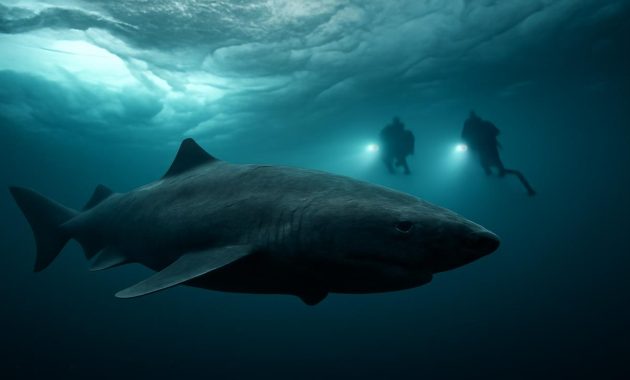
The sea ice was closing in when the shark appeared on the screen.
Outside, the Antarctic wind screamed across a frozen bay, rattling cables and crusting the ship’s railings with a skin of ice. Inside the control room, a small cluster of scientists leaned toward a glowing monitor, breaths held, as a gray shape drifted into view, pale as moonlight and impossibly out of place. A dorsal fin. The slow sweep of a tail. Eyes like dark, patient lanterns in the deep. Someone whispered before they even knew they were saying it:
“That’s a shark.”
For a few seconds, nobody moved. The Antarctic had just given up one of its last secrets.
An Ocean That Was Never Supposed to Have Sharks
For most of human history, the very idea of a shark gliding through Antarctic waters felt like a contradiction. This is a world defined by the absence of things: no trees, no soil, no soft summer twilight. Only ice sheets that scrape the sky, winds that can strip warmth from skin in seconds, and an ocean so cold it might as well be another planet.
Scientists knew that fish lived here, of course. Strange, antifreeze-blooded fish that glide through dark water at temperatures that would flash-freeze most life. There were penguins, diving like feathered torpedoes. Weddell seals, ghost pale, exhaling silver spirals of air beneath the ice. Orcas, bold and strategic, the apex hunters everyone expected to see. But sharks? Not here. Not this far south. Not in water hovering around the freezing point of saltwater.
Yet here it was on the monitor: the ghostly outline of a shark, preserved in pixels and time-stamped, the first solid proof that these ancient predators had crossed into the final fringe of the world’s ocean. For the scientists on that ship, and for the rest of us listening to their astonished retellings, it felt as if a locked door in the natural world had just creaked open.
The Ship at the Edge of the Map
The story begins, as so many polar stories do, with a ship wedged into a wilderness of ice. Picture a research vessel painted a tired red, its name dusted with snow, hull pressing against drifting floes that groan and crackle like old bones. The air smells faintly of diesel, sea salt, and cold iron. On deck, everything is stiff with frost: ropes frozen into hard coils, metal ladders slick with ice, the kind of cold that makes fingertips burn after a few seconds of exposure.
Below decks, a different world hums. Banks of screens blink softly in the low light: sonar maps, live camera feeds, glowing graphs that dance with tiny signals from the deep. A team of biologists, oceanographers, and marine technicians moves between them, murmuring over readings, jotting notes, cradling mugs of coffee that cool too fast in the chill.
They are here for the animals most people never see: the ones that spend their lives hundreds or thousands of meters below the surface, in a permanent twilight just above the seafloor. Without sunlight, without warmth, these creatures live in a pressure-crushed world that feels strangely separate from the bright, charismatic Antarctic of documentaries and postcards.
To reach this world, the scientists rely on a remotely operated vehicle: a heavy, yellow submersible bristling with cameras, lights, and sampling gear. Lowered through a hole in the ice, it descends on a cable into a thick, velvety darkness. Its lights cut a cone of visibility only a few meters wide, revealing drifting snowfalls of organic particles, faint shadows of sea stars clinging to the sediment, and now and then, the flick of a fin vanishing into blackness.
On this particular dive, the ROV had settled near the seafloor, its cameras steady, its lights pooling over a flat, silty bottom. It was just after this quiet, methodical moment that the shark arrived.
When the Shark Steps Out of Myth
The video, when you finally see it, is almost subdued in its drama. There is no sudden lunge, no teeth bared against the camera. Instead, a shape eases into the frame with the calm inevitability of a tide. A long, pale body. A gently pointed snout. Fins held low and steady, like a glider on a slow descent.
At first, the team thought it might be a trick of scale—a smaller fish, closer to the lens. But as it moves nearer, the details sharpen. The shark is big, maybe a couple of meters long. Its skin is a muted gray-brown, mottled and worn. This isn’t a tropical reef hunter or a quick, darting coastal species. It has the sluggish, poised presence of an animal built for endurance, not speed.
There’s something almost ancient about its movement. It doesn’t panic at the lights. It doesn’t rush the camera. It simply drifts past, tail sweeping in lazy arcs, indifferent to the human gaze watching it from a ship far above. It feels less like spotting an animal and more like catching a brief glimpse of a story that has been unfolding for thousands of years, only now brushing against our awareness.
Later, reviewing the footage, shark specialists would pause on still frames, tracing outlines with a finger, comparing the shape of the head and fins to sketchbooks and reference images. Their best guess pointed toward a member of a group known as sleeper sharks—deep-sea wanderers famous for their slow metabolism and almost ghostly presence in cold waters. It’s the kind of shark you could imagine drifting beneath Arctic ice or lingering along the slopes of northern continental shelves. But here, in Antarctic seas, it felt like finding a familiar footprint in completely foreign snow.
Life in Water That Should Kill You
To understand just how startling this sighting is, you have to feel the water it was filmed in. This is not simply “cold” in the sense we know from dipping a toe into winter surf. Antarctic waters hover around -1.8°C, just shy of the freezing point of saltwater. It’s the kind of temperature that steals the heat from your skin so quickly your nerves can’t keep up; the kind that stuns limbs and slows hearts.
For animals that live here, survival is a biochemical balancing act. Many Antarctic fish carry natural antifreeze proteins in their blood, preventing ice crystals from forming inside their bodies. Their metabolisms crawl at a careful, deliberate pace. Muscles contract more slowly. Growth takes years longer. Every movement, every heartbeat, is a compromise with the cold.
Sharks face their own special challenges in such conditions. Many species are designed for relatively warmer, temperate seas, their bodies tuned to a narrower thermal band. Muscles stiffen when chilled. Enzymes slow. Nerve signals lag. In most of the world’s oceans, shark distribution narrows as water temperatures drop, tracing broad, comfortable arcs around the poles.
But some sharks have learned another way of being. Deep-sea species, like the probable sleeper shark seen on that Antarctic feed, trade speed for endurance. Their hearts beat slower. Their movements are measured, patient. They sink into a rhythm that matches the darkness and chill. In the Arctic, Greenland sharks are known to drift through near-freezing waters, their lives ticking by so slowly that some may outlive centuries of human history.
The Antarctic shark filmed that day may share a similar story. A life stretched thin across decades. Long, silent migrations along the continental slope. Feeding opportunities taken in slow, opportunistic gulps: a fish here, a squid there, perhaps the softened remains of a fallen whale. It is a world built on scarcity and patience, and this shark has clearly learned the script.
The Quiet Wonder of the Data
Back on the ship, once the first shock of recognition had ebbed, the mood shifted from awe to focus. The video was saved, backed up, and backed up again. Times and coordinates were logged, temperatures recorded, depths double-checked. In science, wonder is the spark; data is the fuel.
On laptops, the team began to map exactly where and when the shark had appeared. It wasn’t just a lonely image; it was a point on a growing constellation of observations that might reshape how we understand Antarctic ecosystems. If one shark had been filmed here, there were almost certainly more. If they were here now, how long had they been coming? Had they always been part of this world, or were they new arrivals in a changing ocean?
To make sense of this, scientists often balance emotion with structure. They step back from that visceral first encounter and begin asking the questions that will matter to the wider story. What species is it exactly? How deep was it swimming? What was the seafloor like there: bare sediment, scattered rocks, signs of prey? Was the water slightly warmer than usual? Was this near a current boundary or an underwater slope that might funnel nutrients?
Those questions, in turn, begin to populate the tables and charts that quietly underpin every breakthrough. Below is a simplified snapshot of how such key details might be organized from that single, history-making encounter:
| Observation Detail | Recorded Value |
|---|---|
| Approximate Location | Antarctic continental slope (Southern Ocean) |
| Estimated Depth | Hundreds to over 1,000 meters below surface |
| Water Temperature | Near -1.8°C (typical for Antarctic deep water) |
| Likely Shark Group | Deep-sea “sleeper shark” type |
| Behavior During Filming | Slow, steady swimming; no rapid escape or approach |
Each of these details is a thread that scientists can tug on in the months and years after the ship returns to port. Put together, they help transform a single, extraordinary moment into a piece of a broader, evolving puzzle.
Climate, Currents, and an Uncertain Frontier
It’s tempting to see the arrival of a shark in Antarctic waters as a simple symbol: wildlife pushing into new territory as the planet warms. In truth, the story is more subtle, and also more unsettling.
The Southern Ocean is changing. Sea ice patterns are shifting. Some regions are losing ice faster than predicted, while others see surprising short-term gains. Ocean currents that used to lock cold water in place are wobbling, blending layers, drawing slightly warmer water up from below or in from lower latitudes. These changes are quiet to the human senses—we don’t feel a half-degree difference in ocean temperature—but to cold-adapted species, they can be the difference between comfort and stress, survival and decline.
If sleeper-type sharks have been here all along, hiding in the blind spots of our technology, then we are simply catching up to a reality that has existed for ages. Our instruments are finally good enough, our curiosity deep enough, to notice them. If, however, they are newcomers, following subtle temperature shifts or prey movements southward, then their arrival marks a line being crossed in real time.
Either way, the presence of a shark adds a new layer to the Antarctic food web. These are apex or near-apex predators, capable of influencing which species thrive and which dwindle. They can alter the behavior of prey fish simply by existing—a lingering pressure that shapes when and where those animals feed, breed, or hide.
In a place as finely balanced as the Antarctic deep, even small changes can echo. If sharks start to appear more often, what does that mean for long-lived fish already under strain from subtle warming? For squids that rise at night in vast, shadowy migrations? For the scavenger communities that gather around the bones of a fallen whale?
The answers are not here yet. They will arrive slowly, stitched together from future dives, genetic samples, tracking tags, and the careful patience that polar research demands. But it all starts with this first confirmed glimpse: a shark ghosting past the camera under the ice.
Why This Moment Matters to People Far From the Ice
On a human level, the image of a shark in Antarctic waters resonates for reasons that go beyond pure science. It touches something deeper—our sense of where things belong.
We build mental maps of the planet as we grow up. Sharks are stamped into our minds as warm-water creatures, circling coral reefs or cruising tropical coasts. The Antarctic, in contrast, is a domain of penguins tumbling over ice ledges and seals dozing on floes. When those mental categories blur, when a shark appears where our stories say it never should, we’re reminded that nature’s borders are less rigid than we pretend.
There’s another, quieter thread here, too: humility. For decades, we’ve sent ships and satellites and scientists to the Antarctic, and still, a large predator was able to live its life in those waters without us having any clear evidence. That should shift something in us. It should remind us that “discovered” and “understood” are not the same, and that vast swaths of our planet—especially its oceans—are still more mystery than map.
In a world where so much feels overexplored, overanalyzed, reduced to satellite imagery and live feeds, the simple fact that a large shark could glide past humanity’s attention until now is oddly comforting. The wild, even at the edge of a warming world, still has room to surprise us.
A Future Written in Deep Water
In the months after that first Antarctic shark footage made its way into the scientific community, the story rippled outward. Conference talks picked up the thread. Papers began to sketch hypotheses. Plans were drafted for new expeditions that might deploy baited remote cameras, deeper-diving ROVs, or passive acoustic monitors to listen for the faint signatures of large animals in the black.
There is urgency woven through this next chapter. The window to understand Antarctica’s ecosystems as they have existed for millennia is starting to narrow. As ice shelves thin and current patterns warp, the baseline keeps shifting. To know how sharks, and everything else in these waters, respond to change, we have to catch them in the act of simply being—right now, in this moment on the cusp.
On some future winter’s day, another crew will gather around another glowing screen, somewhere in the Southern Ocean. Maybe they’ll see not just one shark, but several. Maybe they’ll have tags ready, or better cameras, or fine-meshed nets to collect environmental DNA from the water—a ghostly fingerprint of everything that has passed through a given patch of sea.
And yet, even with sharper tools, the essence will be the same: a small group of humans listening in on a world that goes about its business entirely unconcerned with our astonishment.
Some stories end with an answer. This one ends with an invitation.
An invitation to reconsider what we think we know about where life can thrive. To recognize that even the most inhospitable edges of our planet are bound into the same web as the beaches we walk and the cities we build. And perhaps most importantly, to protect these cold, dark, distant places not because we fully understand them, but precisely because we do not.
Somewhere beneath the Southern Ocean’s skin of ice, a shark is swimming as you read this—unaware that, for the first time in history, its kind has been seen, recorded, and woven into our collective story. It moves through the water with the same slow certainty it has always known, exploring a realm that, to it, is not extreme or exotic.
For the shark, this is simply home.
Frequently Asked Questions
Why is filming a shark in Antarctic waters such a big deal?
Because it is the first confirmed visual evidence of a shark in this region. It challenges long-held assumptions about which large predators inhabit Antarctic waters and forces scientists to reconsider how cold, deep ecosystems are structured and who the top players really are.
Do sharks normally live in very cold water?
Most shark species prefer temperate or warm seas, but some, especially deep-sea species like sleeper sharks, can tolerate or even prefer near-freezing waters. The Antarctic record shows that at least one such cold-adapted shark has reached, or has long inhabited, these extreme southern latitudes.
Does this mean climate change is driving sharks into Antarctic waters?
Not necessarily, at least not based on one sighting. The shark could be part of a long-established, but previously undocumented, deep-sea community. However, changing temperatures and currents may be reshaping the distribution of many species, and future research will focus on whether sharks are expanding into the region or have simply been overlooked.
Are these Antarctic sharks dangerous to humans?
The sharks likely inhabiting Antarctic deep waters are slow-moving, deep-sea species that rarely, if ever, come near the surface where humans might be. They pose virtually no risk to people; the only humans likely to “meet” them are those watching them on camera feeds from research equipment.
What will scientists do next to study these sharks?
Researchers will plan targeted expeditions with more deep-sea cameras, environmental DNA sampling, and possibly tagging technologies. They’ll aim to determine which shark species are present, how many there are, what they eat, and how they fit into the Antarctic food web—building a clearer picture from this first historic glimpse.
Originally posted 2026-03-05 00:00:00.