The first thing you notice is the silence. A Swiss valley in early winter has a particular kind of quiet—a silence of woolen clouds snagged on jagged peaks, of farmhouses breathing wood smoke into still air, of cowbells clinking somewhere far enough away to sound almost imagined. You stand at the edge of a village whose church steeple has watched over centuries of avalanche and spring thaw and slow, careful human living. Then, beside a grassy slope, the mountain opens its mouth.
It isn’t a dramatic, dragon’s-lair sort of opening. More like an oversized doorway cut into the stone—clean-edged, lit by a washed glow of artificial light. Trucks slide in and out. A train sighs past with barely more sound than the wind. Behind that rectangular dark, there is not just a tunnel, but an entire hidden world: service galleries, caverns tall as cathedrals, drainage tunnels, emergency passages, fiber-optic arteries. For three decades, Switzerland has been carving its second country inside the mountains—an underground world that, in sheer volume and complexity, rivals the cities above.
The Day the Mountain Blinked
When the Gotthard Base Tunnel opened in 2016, most headlines focused on a single number: 57 kilometers. The longest railway tunnel on Earth, burrowing almost perfectly straight beneath the Alps. News clips showed sleek trains, ribbon-cuttings, and dancers in hardhats. But the true astonishment lies in what you don’t see on those broadcasts: the supporting labyrinth that makes such a tunnel function safely—for decades, in shifting rock, under mountains that shed ice and water like living things.
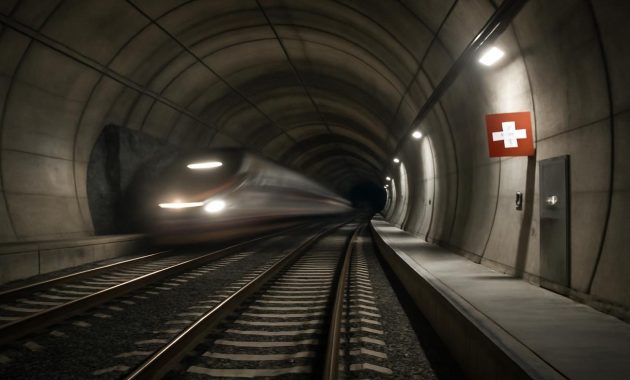
On a gray morning in late autumn, I ride a small maintenance train into that labyrinth. The carriage hums forward into ashen light. Behind us, the entrance shrinks until the alpine landscape is just a postcard-sized memory, then a stamp, then nothing. A different world replaces it. Concrete walls; the faint tang of diesel, metal dust, and wet stone; fluorescent lights trailing away in an orderly vanishing point. The air is cool and unnervingly stable, as if weather has been switched off.
“People think it’s one tunnel,” says Markus, an engineer who has spent nearly half his career down here. “Actually, it’s like a hollow tree with many rings.” He names them off: two single-track tubes for trains, cross passages every 325 meters linking those tubes for evacuation, parallel service galleries, drainage channels, ventilation shafts climbing up through the massif, underground substations, control rooms. The mountain, once solid, is now a sponge of purposeful emptiness.
At one point we step out into a cross passage. It is tall enough to park a truck upright and long enough that the far end dissolves into perspective. When a freight train thunders by in the main bore, the wall nearest it throbs softly, like the flank of some slumbering giant. The train flashes past at 200 kilometers an hour, its roar tamed to a muffled rush, the sound soaked up by rock.
It is here, in these peripheral spaces the public rarely sees, that the scale of Switzerland’s underground transformation becomes startling. Gotthard alone contains over 150 kilometers of galleries, ducts, and bypasses if you count everything. And it is only one star in a constellation.
The 30-Year Dig: How a Quiet Nation Went Underground
In the early 1990s, while much of Europe was debating highways and airports, Switzerland looked at its mountains and asked a different question: What if we simply moved the traffic through them, instead of over them?
Road freight was choking alpine passes. Winters snarled transport networks. Villages trembled under the constant crawl of trucks. In response, Swiss voters did something improbable in a world of short-term politics: they approved a multi-decade, multi-billion-franc commitment to reimagine national infrastructure in three dimensions—up on the surface and deep below it.
They called it the New Railway Link through the Alps (NRLA). The vision: shift freight from road to rail and straighten Europe’s north–south routes by drilling nearly flat, base-level tunnels that ignored the roller-coaster contours of the high passes above. It was as much a cultural decision as an engineering one—a declaration that the Alps were not just scenic wallpaper but a living structure that could be partners in, rather than obstacles to, movement.
Construction on the Lötschberg Base Tunnel began first, followed by Gotthard and then the Ceneri tunnel, the southern keystone. Between them, these tunnels would stitch a straight rail spine from the ports of the Mediterranean to the industrial plains of northern Europe. But each project also triggered a cascade of secondary works: access adits, ventilation shafts, emergency refuges, caverns for transformers and power supply, drainage galleries, monitoring bunkers.
The scale is easy to miss from the outside because the Swiss aesthetic, culturally and architecturally, leans toward understatement. You don’t get flamboyant portals or triumphal arches. Instead, mountain faces simply sprout discreet doors, like utility closets for giants.
| Underground Work | Approx. Length / Size | Main Purpose |
|---|---|---|
| Gotthard Base Tunnel (twin tubes + galleries) | 150+ km of tunnels | High-speed rail, freight corridor, alpine bypass |
| Lötschberg Base Tunnel network | 60+ km including access and service tunnels | Rail link between Bern and Valais/Italy |
| Ceneri Base Tunnel system | 40+ km total underground structures | Completes flat alpine rail axis |
| Urban road & rail tunnels (Zurich, Geneva, etc.) | Hundreds of km combined | Traffic relief, metro-style rail, bypass routes |
| Utility, security & service galleries | Thousands of smaller passages | Water, power, data, defense, maintenance |
Piece by piece, decade by decade, Switzerland translated its topography into a negative space—a reversed Alps of voids and corridors, designed not to impress but to work.
Inside the Hidden City Beneath the Peaks
Most Swiss people will never see more than the clean platforms and punctual trains that skim through these tunnels. But move aside with a keycard and a hardhat, and the mountaintop country reveals its shadow self.
We walk along a service gallery that runs roughly parallel to the main rail tube, separated by thick concrete. The floor is a blur of utility: colored pipes, labeled conduits, fiber cables tied in patient bundles. At regular intervals, doors open into cavernous rooms where transformers hum with a sound you feel more in your ribs than your ears. In another, deep ventilation fans sleep, silent for now but capable of lunging to life with hurricane force to clear smoke or regulate air during an emergency.
Emergency shelters punctuate the route—underground rooms with benches, medical kits, communication gear. A safety engineer gestures around one such chamber. “If something happens in the main tunnel,” she explains, “people come here. We can survive down here for days if we need to.” The place looks like a cross between a subway station and a spaceship set: sterile, functional, strangely calm.
It dawns on me that in any Swiss valley, what you see—chalet, school, bakery, church—is only the uppermost layer. Below, out of sight, run separate but densely intertwined lives of water, data, current, and motion. Lakes are ringed by subterranean flood defenses and power tunnels. Cities like Zurich have webs of underground shopping arcades, parking decks, tram links, and pedestrian ways. Even modest towns hide stormwater reservoirs carved into rock, or utility corridors big enough to drive a van through.
This is the part few visitors consider as they wander tidy streets and perfect lakeshores: the sense of order, the punctuality of trains, the unflustered management of snow and flood—much of it is supported by decisions made in darkness, during years of drilling and blasting and grouting far beneath our shoes.
The Sound of Rock Giving Way
Ask anyone who worked through the long years of tunneling and they will talk about the sound. Not the explosive crack of dynamite—that is tightly controlled, muffled, almost surgical—but the subtler, more unnerving noises: rock creaking like ice on a frozen lake; a sudden flurry of grit as a seam shifts; the low, living sigh of the mountain adjusting to the new emptiness inside it.
In a construction diary from the Gotthard works, a foreman describes nights where the tunnel face wept constantly, water hissing into pumps and channels. Entire mini-industries sprang up below ground: drilling crews, surveying teams, geologists, ventilation experts, concrete sprayers, electricians, cooks for workers who might not see full daylight for days. Small locomotives ferried spoil rock back to the surface, where it was sorted, reused, or piled into geometric mountains of its own.
Yet for all the brute force—the drills, the blast holes, the conveyor belts—tunneling in Switzerland is, at its core, an exercise in negotiation rather than conquest. Engineers adjust alignments to dodge weak rock. They inject grout to calm seams. They pause work to reassess when unexpected water pours in from a forgotten fracture. The Alps are not a blank wall; they are an ancient library of stone. Every page turned adds knowledge: this layer won’t stand without support, that one contains fossilized reefs, this granite will ring like steel when you tap it.
By the time the last meter of rock was removed from the Gotthard Base Tunnel, Swiss engineers knew that mountain from the inside out—in some ways better than any geologist ever had. And in return, the mountain granted passage, provided it was treated with the right mixture of respect and reinforcement.
Why Build a Country Twice?
There is something almost audacious in the idea of duplicating a nation—one version bathed in light, the other entirely man-made, lit by LEDs and run on sensors. But from a Swiss point of view, building this underground twin follows a simple logic: space is limited, mountains are immovable, and the weather will always have the last word. So you learn to think in cross-sections instead of just maps.
On the surface: a narrow mountain valley with a river, a road, a cluster of houses, maybe a railway line hugging the slope. Then imagine slicing beneath it: a road tunnel bypassing winter avalanches, a rail base tunnel running nearly level to save energy, a water transfer conduit, perhaps a cable gallery carrying power from a hydroelectric plant higher up. Stacked like this, the valley becomes not a bottleneck, but a vertical arrangement of solutions.
Environmental arguments also run deep here. Long-distance freight trains that glide under the Alps mean fewer trucks grinding over them, less noise in mountain villages, fewer exhaust plumes trapped in temp inversions. Long tunnels allow gentler gradients, which lowers energy use and enables heavier trains. Some of the excavated rock—carefully sorted—ends up as building material, lake infill, or even artificial islands for wildlife habitat.
Then there is safety. Mountain passes can close under snow, rockfall, or landslides, isolating communities. A base tunnel, shielded from weather, becomes a kind of guarantee. Hospitals receive supplies on time; commuters can rely on trains in all seasons. For a country that prizes predictability in the best sense of the word—reliability, stability—these are not luxuries but foundations.
Invisible as a Compliment
The deepest compliment you can pay to infrastructure is to forget it exists. Swiss underground works aim for precisely this kind of anonymity. The entrance to a major road tunnel might be framed by a simple concrete mouth and a handful of warning signs. The portal to a cavernous underground station is often an understated glass box plunked beside a city street.
In Lucerne, tourists drift past a tidy plaza with no idea that below their feet, road tunnels and parking decks weave around the foundations of old buildings and the edge of the lake. In Zurich, you can step from a street-level tram into an underground shopping concourse, then straight onto a train that disappears under hills, emerging in a completely different valley without your ever glimpsing a rocky slope.
When something is that seamless, it stops feeling like infrastructure and starts feeling like landscape—a human-made extension of terrain. That is perhaps Switzerland’s greatest underground achievement: to build an entire second layer of the country and make it feel, to the people who live there, like the most natural thing in the world.
The Future Alps Are Hollow
Thirty years on from the first blast for the NRLA, talk has shifted from “if” to “what next.” Extending the Lötschberg tunnel to full double-track, drilling new road bypasses, expanding metro-style tunnels in Swiss cities—these are no longer extraordinary national projects but iterations on a familiar theme. The country has, quite literally, learned to think underground.
Climate change is rewriting the high mountains at a speed that would have horrified the engineers of the 1990s. Permafrost melts, destabilizing rock faces. Glaciers shrink, altering water flow. Paradoxically, all this makes the controlled environment of deep tunnels more attractive—not just for travel, but for potential data centers, research labs, or even emergency shelters from extreme heat.
One can imagine a near-future Switzerland where the map gains another layer of legends: dotted lines not for surface roads, but for pedestrian tubes between districts; symbols not only for summits, but for major underground junctions. Perhaps one day a child will learn, in school, that “this is Zurich above ground, and this is Zurich below,” both indistinguishably parts of what makes the city itself.
Of course, there are limits—geological, financial, ethical. Creating voids on such a scale always carries risk. The Swiss approach so far has been incremental: test, measure, adjust. Underground construction is slow and expensive, and that very friction may be its best safeguard against hubris.
Yet walk out of a tunnel portal on a winter evening and watch a freight train vanish under the mountains without disturbing a single snowflake on the peaks, and you feel a subtle shift in what seems possible. People once crossed these ranges with mules and prayers, then with cog railways and early automobiles. Now, they cross in silence, inside the mountain’s body itself, in a space we have taught the rock to share.
What We Don’t See, But Stand On
Later, when our maintenance train brings us back toward daylight, the transition is almost shocking. The tunnel’s cool air gives way to a gust that smells of pine needles and cold river. The rectangle of light widens, and suddenly the world is noisy again: river rushing, crows heckling from a distant tree, a dog barking at nothing in particular.
Behind us, the mountain closes its concrete lips and goes back to pretending it is solid. It is an illusion now, but a useful one. Life on the surface depends on believing that ground is ground, not an intricate honeycomb of decisions made over decades, calculations buried in concrete, and cables humming in the dark.
Switzerland has quietly built one of the most extensive underground infrastructures on Earth—not as a spectacle, but as a promise. A promise that freight will arrive, that valleys will stay livable, that mountains can remain both barrier and bridge. It’s a place where the vertical dimension of a map matters as much as the horizontal, where every tunnel is also a story about patience, geology, and the ability of a small country to think in deep time.
We step out into the valley, boots crunching on gravel, and the tunnel disappears into the hillside as if it were never there. Somewhere below, trains are already streaking through concrete tubes, signals blinking, fans turning lazily. The hidden city beneath the peaks is wide awake, even as the village above begins to light its evening candles. And in between them, in the thickness of stone, the last faint vibrations of our passing are already fading, absorbed into the long memory of the mountain.
FAQ
How long did it take Switzerland to build its major base tunnels?
Planning and construction for the New Railway Link through the Alps spanned roughly three decades. Individual projects varied: the Lötschberg Base Tunnel took about 14 years from start of construction to opening, while the Gotthard Base Tunnel required 17 years of drilling, blasting, and fitting out before trains could use it.
Is the Gotthard Base Tunnel really the longest tunnel in the world?
As of the mid-2020s, the Gotthard Base Tunnel is the world’s longest railway tunnel, with a main length of 57 kilometers and a much larger total length when all side galleries and service tunnels are included. A few longer underground works exist if you count entire metro systems or mining networks, but as a single through-transport tunnel, Gotthard remains unmatched.
Why did Switzerland choose tunnels instead of expanding mountain roads?
Several reasons converged: limited surface space in narrow valleys, a desire to protect alpine environments from excessive truck traffic, the need for reliable year-round transport regardless of snow and avalanches, and strong public support for shifting freight from road to rail. Long base tunnels allow gentler gradients and higher capacity, making them more efficient over time than constantly widening surface roads.
Are these underground structures safe in case of emergencies?
Safety is central to Swiss tunnel design. Long tunnels have parallel tubes, frequent cross passages for evacuation, underground emergency stations, redundant ventilation systems, and extensive monitoring. Regular drills train staff for fires, breakdowns, or other incidents, and the infrastructure is continually inspected and upgraded as standards evolve.
Can ordinary visitors see any of this underground world?
Most technical galleries and service tunnels are restricted to staff for safety and security reasons. However, the public experiences parts of the underground network every day when traveling through base tunnels, urban rail tunnels, and underground stations. Occasionally, on special open days before a new tunnel opens, guided tours allow visitors to walk sections that will later be reserved for trains and maintenance crews.