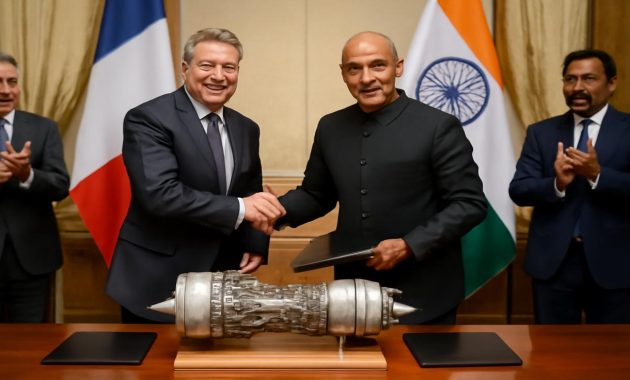
The news drifted across New Delhi’s late-monsoon haze the way a fighter jet slips through high clouds—first as a distant rumble, then suddenly loud and clear. France had edged out the United Kingdom to clinch a €6.7 billion deal with India for a cutting-edge, 6th‑generation fighter engine program. On paper, it was another big-ticket defense contract. In reality, it felt like a quiet turning point: a story of ambition, technology, and geopolitics, written not on paper but in contrails high above the subcontinent.
From Hangars to Horizons: A Deal That Redraws the Sky
Stand for a moment on the edge of any Indian Air Force base at dawn. The air is cool, smelling faintly of jet fuel and baked tarmac that’s finally exhaling the previous day’s heat. In the half-light, hulking silhouettes of Sukhois and Rafales sit like patient predators, their canopies beaded with dew. Ground crews move around them with choreographed precision—checking hydraulics, tightening bolts, sweeping hands along metal surfaces that will soon slice the sky at supersonic speeds.
This is the world that the new engine deal is about to reshape. India’s decision to work with France on a next‑generation fighter engine is not just an upgrade of hardware; it’s a bet on the kind of sky the country wants above it for the next 40 to 50 years. If the 20th century belonged to whoever controlled the sea lanes, the 21st is increasingly about who owns the invisible corridors of air and space.
The €6.7 billion partnership centers on developing a 6th‑generation engine for India’s future fighter platforms—often framed around the Advanced Medium Combat Aircraft (AMCA) program and other long‑range plans. The details are wrapped in the usual cloak of confidentiality, but the outline is clear: higher thrust, better fuel efficiency, stealthier thermal signatures, and the brain of a jet engine that can talk, learn, and adapt through sensors and data—almost like a living creature of metal and flame.
The Quiet Rivalry: How France Slipped Past the UK
Behind closed doors, the competition was fierce. In conference rooms from New Delhi to Paris to London, the air would have smelled not of jet fuel, but of coffee, printer ink, and quiet urgency. PowerPoint slides flicked past: thrust-to-weight ratios, turbine inlet temperatures, life-cycle costs, technology transfer frameworks. It’s in these unromantic settings that the future of aerial combat is negotiated.
The United Kingdom came to the table with history on its side. Rolls‑Royce engines have long powered both civil and military icons, from transatlantic airliners to supersonic fighters. London pitched not just an engine, but integration with broader European programs and possible linkages to the UK‑Japan‑Italy GCAP (Global Combat Air Programme). On paper, it looked like a bridge into a wider net of partnerships.
France, however, played a subtler game. Safran—its flagship engine manufacturer—arrived not as a stranger, but as a known partner. The Rafale, already flying in Indian colors, purrs with French power. Over years of maintenance contracts, training programs, and high-altitude testing in the Himalayas, trust had been quietly built, almost like a patina on often-handled metal. India had seen French engineers sweating on its airfields, tweaking engines to handle dust, heat, and high‑altitude bases.
Trust, in defense deals, is a kind of invisible currency. It’s measured in delayed flights avoided, spare parts delivered on time, and the sense that a partner will keep supporting you when the headlines have moved on. France’s willingness to talk about meaningful technology transfer—letting India learn how the secret heart of the engine truly works—became a decisive factor. The UK’s offer, by comparison, reportedly felt more guarded, shaped by layers of export controls and shared ownership across multiple nations.
In an age when fighter jets are as much about software and data as about steel and titanium, India wasn’t just shopping for a product; it was shopping for a long-term co‑author of its aerospace future. France, quietly and persistently, promised exactly that.
Why This Engine Matters So Much
To understand why this deal is so significant, you have to zoom in—not on the global map, but on the core of the engine itself. Imagine standing next to a test stand deep inside a secure French facility. Before you is a cylindrical beast of blades and vanes, wires snaking from its casing to racks of computers. When it roars to life, there’s a moment when the air itself seems to tense, as if bracing for something elemental. Then the sound hits—a layered howl that you don’t just hear, you feel in your bones.
A 6th‑generation fighter engine is more than a more powerful version of what came before. It has to meet a set of almost contradictory demands: immense thrust, low fuel consumption, reduced infrared signature to confuse enemy sensors, and the robustness to handle years of stress in harsh environments. It must work seamlessly with stealthy airframes, advanced radar systems, electronic warfare suites, and possibly even loyal wingman drones that fly alongside a manned fighter.
Now add India’s specific conditions to the mix: runways that bake at 48°C in Rajasthan summers, dusty airfields, moisture‑laden coastal bases, takeoffs from Himalayan heights where the air is thin and unforgiving. An engine designed in temperate Europe has to be re‑imagined for a land of extremes. That re‑imagining is where India is determined not just to be a customer, but a co‑creator.
| Key Aspect | France–India Engine Deal | Broader Significance |
|---|---|---|
| Estimated Value | Around €6.7 billion | One of India’s largest aerospace R&D collaborations |
| Generation | 6th‑generation fighter engine | Prepares India for post‑Rafale, post‑Sukhoi era |
| Core Partner | France (Safran) with Indian agencies/industry | Deepens France–India strategic aerospace corridor |
| Focus Areas | High thrust, stealthier exhaust, advanced materials, digital control | Pushes Indian ecosystem into high‑end turbine tech |
| UK’s Position | Lost out after competitive discussions | Signals shifting defense-industrial alignments |
Inside the Engine Room of Geopolitics
On the surface, this is a story about who builds what with whom. Beneath that surface, it is very much about how power is distributed in a world that is quietly rearranging itself. India, France, and the UK are all feeling the tremors of this rearrangement—each from a different vantage point.
For India, the engine deal is another deliberate step away from over‑reliance on any single supplier. Its aircraft lineage already reads like a global catalog: Russian‑origin Sukhoi‑30MKIs and MiG‑29s, French Rafales, Anglo‑French Jaguars, indigenous Tejas fighters with American engines. Every new conflict, every supply chain shock, every diplomatic chill has reinforced a simple lesson: true strategic autonomy demands mastery over the beating heart of your own aircraft.
France, for its part, is playing a long game that many observers underestimate. In a world where major powers often bundle political lectures with defense offers, Paris has quietly cultivated a reputation in New Delhi as a partner who brings high technology without high‑handedness. From nuclear reactors to satellites to fighters, France has steadily become a kind of niche ally—small enough to be flexible, big enough to matter.
For the UK, the loss stings beyond the headline. Post‑Brexit Britain has been looking for major partnerships to signal that it remains a central node in global defense and technology networks. Losing a marquee program in a market as important as India’s is not just a missed business opportunity; it’s a dent in narrative. The British defense industry is still formidable, but this episode is a reminder that relationships and risk‑sharing proposals now matter as much as engineering prowess.
Somewhere between these capitals, above the hum of diplomatic chatter, you can almost picture the airspace itself shifting—new corridors of cooperation being sketched out, old ones fading like vapor trails in high winds.
What 6th‑Generation Really Means Up There
“6th‑generation” has become one of those terms that gets casually tossed around, like “AI” or “quantum,” often without much grounding. On the tarmac, though, generation labels translate into very real design philosophies.
A 4th‑generation fighter—think classic Mirage 2000s or F‑16s—focused on agility, speed, and raw pilot skill. With 5th‑generation aircraft like the F‑35 or the under‑development AMCA, stealth and sensor fusion took center stage: aircraft that see first, stay hidden longer, and compress vast streams of data into something a pilot can act on in seconds.
6th‑generation, where this engine aims to belong, is less about a single revolutionary feature and more about an orchestra of changes:
- Engines that can run hotter and cleaner, yet be harder to detect in infrared.
- Digital brains—full‑authority digital engine controls—that can self‑diagnose, adjust in real time, and talk to the rest of the aircraft as part of a networked whole.
- Potential variable cycle features, where the engine can adapt between high‑thrust and high‑efficiency modes almost like changing gears.
- Materials that endure punishing temperatures without deforming, cracking, or shedding microscopic shards into turbines spinning at impossible speeds.
In the cockpit, the pilot might never see the exotic alloys or complex rotors. What they will feel is different: shorter takeoff runs from remote forward airstrips, higher climbs to where the air is thin and the threats are fewer, longer range into contested airspace with a better chance of coming home unseen.
On the ground, Indian engineers and technicians will increasingly be part of the engine’s life story—not just tightening bolts, but designing, testing, simulating, and eventually innovating in directions that suit uniquely Indian requirements.
Workshops, Wind Tunnels, and a Future Being Machined
Picture a young graduate engineer walking into a new test facility somewhere on the outskirts of Bengaluru or Pune a decade from now. Outside, the landscape is familiar: auto rickshaws rattling past tea stalls, the smell of idlis steaming in metal pots, a haze of dust and diesel under the mid‑morning sun. Inside, the world changes. Streak‑free white floors. Warning signs about static discharge. Rooms humming with the cool breath of climate control and the high‑pitched whine of test equipment.
In one hall, a scaled compressor stage for the Franco‑Indian engine spins inside a transparent casing, air screaming through its blades as sensors map every vibration, every flicker of instability. In another, computer screens glow with CFD (computational fluid dynamics) simulations of airflow at supersonic speeds, streaked with color-coded vortices and shockwaves. The acrid tang of heated metal blends with the clean, chemical scent of advanced lubricants.
This is the ecosystem the deal is meant to nourish: a domestic industrial‑scientific lattice where foreign technology is not a black box, but a learning curve. For decades, India has watched propulsion supremacy from the outside, its own indigenous jet engine programs struggling against the brutal physics and fine tolerances involved. With this partnership, the country is doing something different: stepping into the workshop while the future is being machined, rather than buying it off the shelf once it’s complete.
The benefits won’t only be military. High‑temperature turbine tech seeps into civilian aviation, power generation, materials science, even space launch vehicles. Every gain in efficiency at the extreme edge tends to echo downstream, where everyday machines quietly get lighter, tougher, and hungrier for less fuel.
Between Noise and Silence: The Human Layer
Strip away the political speeches and glossy brochures, and what’s left are people and their craft. A French engineer who has spent half his career tuning turbines for Rafale fighters will one day find himself sitting across from an Indian counterpart, poring over test data line by line. A young Indian test pilot will strap into a prototype aircraft, heart thumping as the new engine spools up behind him, the runway disappearing faster than he’s used to. A logistics officer will notice that the number of unscheduled engine removals is dropping, that spares are arriving a bit quicker, that some panels on the engine are stamped “Made in India” instead of “Imported.”
There will be frustrations, too: delays, arguments over intellectual property clauses, components that fail unexpectedly, test runs that end early with a shower of sparks. High‑end engine development is one of the most unforgiving engineering challenges humanity has ever attempted. A small design flaw can turn into a major failure at tens of thousands of RPM. Yet those are the moments when real collaboration is tested—when partners decide whether to double down on solving the problem together or retreat into caution and blame.
Somewhere far from these test bays, in the desert near Jaisalmer or the high cold of Leh, a fully matured engine will eventually scream down a runway, lifting a sleek new Indian fighter into a sky that has grown familiar with conflict and competition. On that day, the roar will carry with it not just the breath of burning fuel, but a story: of a time when France edged out the UK, yes—but more importantly, when India chose to step closer to owning the engines of its own destiny.
Frequently Asked Questions
Why is the France–India engine deal considered such a big milestone?
Because it goes beyond buying finished engines. It opens doors for deep technology collaboration, letting India participate in the design, materials, and digital control systems of a 6th‑generation powerplant. That moves India closer to long‑sought propulsion self‑reliance.
What exactly is meant by a “6th‑generation” fighter engine?
There’s no single universal definition, but 6th‑generation engines typically aim for higher thrust, better fuel efficiency, reduced infrared signatures, more intelligent digital control, and compatibility with advanced stealth and networked combat concepts. They’re designed to serve aircraft that may operate alongside drones, in highly contested airspace, across long ranges.
Why did France win over the UK in this competition?
Publicly available information points to a mix of factors: France’s existing track record with India (especially through the Rafale), a reputation for more flexible technology transfer, and a focused bilateral partnership. The UK’s proposal, while strong technically, appears to have been constrained by more complex export and IP structures.
Will this deal help India develop fully indigenous fighter engines in the future?
It won’t make India instantly self‑sufficient, but it significantly accelerates the learning curve. By co‑developing crucial modules, materials, and control systems, Indian engineers and industry gain the experience and infrastructure needed to eventually design and mature engines with far less foreign input.
How does this deal affect India’s existing fighter projects like AMCA?
The Franco‑Indian engine program is widely seen as a pillar for future platforms like AMCA and follow‑on aircraft. While transitional solutions may power early prototypes, the long‑term plan is to field indigenous or co‑developed engines that match the performance and stealth needs of next‑generation Indian fighters.
Originally posted 2026-03-05 00:00:00.