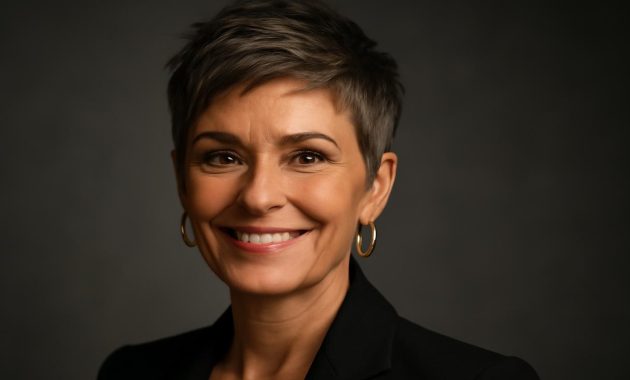
The hairdresser’s cape rustled around her shoulders as Marie watched silver clippings fall like tiny snowflakes to the floor. At 56, she’d walked into the salon with hair that had faithfully brushed her collarbones for decades—and a quiet ache she couldn’t quite name. “Let’s do it,” she told the stylist, fingers gripping the armrests. Twenty minutes later, the mirror showed a different woman: cheekbones higher, eyes brighter, jawline suddenly defined. Marie didn’t look like a stranger; she looked like herself, just suddenly…lighter. Younger. As she turned her head and her new pixie cut caught the light, she laughed, low and surprised. “Why,” she said, “did I wait so long?”
The Secret Power of a Pixie Cut After 50
There is something quietly rebellious about cutting your hair short after 50. Not a loud, “I’m trying to be 25 again,” kind of rebellion—more like a deep exhale, a shedding of shoulds. You’ve lived enough life to know what suits you, and yet, sometimes, your reflection hasn’t caught up with the woman you feel like inside.
That’s where the pixie comes in. A well-cut pixie does more than crop your hair; it carves out space for your features to reappear. Eyes come forward. Smile lines soften. Neck and shoulders suddenly look elegant, even regal. The right pixie can absolutely make you look 10 years younger—but not in a “who is she pretending to be?” way. More in a “oh, there she is” way.
But here’s the key: not every pixie is a magic wand. There’s a world of difference between a harsh, boxy crop that feels severe and a modern, softly sculpted cut that flatters every angle. The good news? You don’t need celebrity stylists or endless time to figure it out. You just need a few intentional choices.
Let’s walk through four powerful tips that can help you not only pull off a pixie cut after 50 but truly glow in it—so your short hair doesn’t just feel “brave,” it feels beautifully, unmistakably you.
Tip 1: Choose a Pixie Shape That Lifts, Not Flattens
The first secret to a youthful pixie after 50 is shape—the architecture of the cut. If you’ve ever tried on a pair of glasses and suddenly your whole face looked more awake, you already understand this. A good pixie frame does the same thing for your features.
Soft volume at the crown
One of the easiest ways to “lose” 10 visual years is to add gentle height where it matters. Hair that sits too flat on top can make the face look wider and more tired, especially if you’re concerned about jowls or softening around the jawline. A little crown volume, sculpted by your stylist—not teased into a stiff helmet—creates the illusion of lift.
Ask your stylist for subtle layers at the crown that can be coaxed upward with a bit of mousse or styling cream. Think “soft cloud” rather than “spiky peak.” You’re aiming for movement, not crunch.
Soft edges over sharp lines
Very blunt, razor-sharp lines around the ears and nape can sometimes harden the face, especially if you have delicate features or fine lines you’d rather not spotlight. Softer, slightly feathered edges give a gentle, modern frame that looks romantic rather than severe.
If you’re nervous about going “too short,” ask for a pixie with slightly longer sides that graze the top of your ears and blend into the back. You’ll still get that fresh, light feeling without feeling exposed.
Side-swept fringe for instant softness
Bangs can be the difference between “strict librarian” and “French cinema icon.” For many women over 50, a slightly longer, side-swept fringe is the most universally flattering version of a pixie. It draws the eye diagonally, which softens forehead lines and shifts attention to your eyes.
A choppy or micro-fringe can be fun, but it demands more styling and confidence. If you’re easing into your first pixie, side-swept is usually your most forgiving, face-brightening option.
Quick reference: Pixie shapes vs. face features
Use this as a gentle guide—not a rule book. The best pixie is the one that makes you feel like standing a little taller.
| If you want to… | Ask your stylist for… |
|---|---|
| Soften forehead lines | Side-swept fringe that hits between eyebrow and cheekbone |
| Slim the jawline | Subtle volume at the crown, slightly tapered sides |
| Brighten tired eyes | Soft layers that curve toward the eyes; no heavy, straight-across fringe |
| Balance a long face | A bit more fullness at the sides, not too much height on top |
| Add structure to a rounder face | Slightly longer top layers you can tousle for vertical lift |
Tip 2: Play With Color and Texture to Brighten Your Glow
Once the shape is right, color and texture become your secret allies. Light behaves differently on short hair: it catches, glints, and dances in a way long hair sometimes hides. That becomes a huge advantage when you want your skin to look brighter and your whole face more alive.
Embrace dimension, not one flat shade
A single, solid block of color on a pixie can read as harsh and aging—especially if it’s very dark. Multi-tonal color, on the other hand, mimics how hair naturally lightens and deepens. It tricks the eye into seeing movement and youth.
If you have grey or white hair, you don’t have to “fight” it. Ask your stylist for a gloss or toner that softens any yellow tones and adds a pearl, silver, or soft champagne sheen. The result can be striking: bright, elegant, and effortlessly modern.
If you color your hair, consider:
- Soft highlights around the face to illuminate your skin tone.
- A slightly lighter shade at the top and front to lift your features.
- Leaving some natural grey in the mix for believable dimension.
Texture: your built-in soft-focus filter
The best pixies over 50 rarely look stiff or over-styled. A bit of texture is like a soft-focus filter for your entire face. Tousled layers, finger-styling, and lightweight products create a kind of controlled imperfection that feels youthful and alive.
Consider your natural hair type:
- Fine hair: Ask for soft, stacked layers and avoid heavy products. A lightweight volumizing mousse or root spray can keep things bouncy, not limp.
- Thick hair: Strategically thinned or texturized sections will help your pixie fall close to the head instead of puffing out.
- Wavy or curly hair: A slightly longer pixie with carved, intentional layers can celebrate your natural movement instead of fighting it.
The goal is always the same: hair that looks like it’s moving, even when you’re standing still.
Tip 3: Match Your Pixie to Your Lifestyle (So You Actually Love It)
A pixie might be short, but it isn’t automatically “low maintenance.” This is where expectations matter. The right cut after 50 shouldn’t just look great on salon day; it should fit your real life—your mornings, your energy, your patience level.
Be honest about styling time
If you like to be out the door in 10 minutes, say so—clearly. Your stylist can adjust the cut to work with air-drying, minimal products, and quick finger-styling. That might mean slightly longer top layers that fall into place, or a shape that doesn’t require daily heat tools.
If you enjoy playing with your look, you might opt for a pixie that can be styled two or three different ways: smoothed down and classic, tousled and piecey, or lifted and textured on top for nights out. In that case, ask your stylist to show you at least two styling options before you leave the chair.
Keep trims simple and realistic
Short hair needs more frequent trims to keep its shape—typically every 4–8 weeks, depending on how fast your hair grows and how precise the style is. A very sculpted, ultra-short pixie might need more salon visits; a slightly grown-out, shaggy pixie can stretch your appointments further.
Think about:
- How often you’re willing to sit in a salon chair.
- Your budget for regular haircuts.
- Whether you can pop into a neighborhood salon for “maintenance” between major cuts.
Tell your stylist up front: “I’d like this cut to look intentional even as it grows.” A thoughtful stylist will create a shape that morphs attractively over time instead of collapsing into an awkward in-between stage.
Let the pixie show off who you are now
At 50, 60, 70, you’re likely less interested in trends and more interested in truth. A pixie that truly suits you will echo how you move through the world.
If you’re outdoorsy and always on the go, a simple, easy pixie with airy layers may feel right. If you’re artistic or bold, you might find joy in an asymmetrical fringe, a dramatic side part, or an unexpected color nuance. The more your cut reflects your actual life, the younger and more authentic you’ll look—because you won’t be fighting it.
Tip 4: Use Styling and Self-Care to “Turn the Lights On”
You know that moment in a room when someone quietly turns on a lamp in the corner and suddenly everything feels warmer, more inviting? That’s what the right styling can do for your pixie after 50. You don’t need a dozen products or a brand-new makeup bag—just a few intentional tweaks that bring out the best in your short hair and your features.
Lightweight products, big payoff
Heavy gels and sticky sprays can make a pixie look dated. What keeps the look modern is touchable, flexible hold. A few ideas:
- Styling cream: Ideal for smoothing flyaways and defining layers without stiffness.
- Volumizing mousse: Perfect for fine hair needing a gentle lift at the crown.
- Texturizing spray or dry wax: Great for creating that effortless, “I woke up fascinating” texture.
Use less than you think you need, start at the back of your head, and move forward. Short hair shows every product misstep, so think whisper, not shout.
Update what frames your face: brows, glasses, lips
When you cut your hair short, everything else around your face suddenly becomes more noticeable. That can be a gift, if you use it.
- Brows: A softly defined brow can balance the openness of a pixie. Even a light tint or gentle fill-in with a pencil can “turn up the volume” on your eyes.
- Glasses: If you wear glasses, try your frames with your new cut. Sometimes a pixie pairs beautifully with bold frames; other times, a lighter or more modern shape is more flattering.
- Lip color: A fresh, hydrating tint—rose, berry, soft coral—can make your whole face look rested and alive, especially with the crispness of short hair.
None of this is about masking age; it’s about focusing the eye on your expression, your spark. Short hair clears the stage; a few thoughtful details set the scene.
Tender care for scalp and strands
With a pixie, your scalp is more visible, and your hair’s health is suddenly front and center. A few simple habits can keep things looking vibrant:
- Use a gentle shampoo that doesn’t strip your hair of natural oils.
- Massage your scalp when washing to encourage circulation and that healthy, subtle glow.
- Protect your hair from excessive heat; short hair dries quickly, so you rarely need high settings.
You might find that your whole shower routine shifts: less time detangling, more time to actually enjoy the warm water on your shoulders, the quiet of those first minutes of the day. That, too, is youth in its own way—a kind of ease you can feel.
Letting Yourself Be Seen, Fully
The real magic of a pixie cut after 50 isn’t just in the mirror. It’s in the micro-moments that follow: the way your scarf brushes the back of your neck instead of catching in your hair. The way a breeze on a walk feels suddenly intimate, fingertips of air against your scalp. The way someone you love looks up at you and does a tiny double-take, as if realizing they’ve been taking your face for granted and are seeing it vibrant and new.
Looking “10 years younger” is rarely about erasing time. Time is the very thing that’s given you the courage to walk into that salon and say, “Let’s try something new.” What a good pixie can do is remove what’s been hiding you—extra weight from long layers, outdated shapes, colors that no longer match your skin—and reveal the woman who’s been there all along.
When Marie walked out of the salon that day, her hair no longer hid the small crinkles around her eyes or the soft curve of her jaw—and somehow, that made her look even more radiant. Short hair didn’t deny her age; it lit it up from within. She stepped onto the sidewalk lighter, head high, the late afternoon sun warm on her neck. Someone held the café door for her and said, “I love your hair.” She smiled, this time without surprise. “So do I,” she thought. “So do I.”
FAQ: Pixie Cuts After 50
Will a pixie cut make me look older instead of younger?
It can, if the cut is too harsh, too dark, or not suited to your face shape and hair texture. A youthful pixie usually has soft edges, some movement, and color dimension. Work with a stylist who understands how to add lift at the crown, soften the fringe, and avoid very heavy, flat color.
Is a pixie cut hard to style every day?
It depends on the shape you choose. Many women find that a well-cut pixie actually saves time: a quick wash, a bit of lightweight product, and some finger-styling are often enough. If you prefer very polished, sculpted looks, you may spend a few extra minutes—but still usually less time than with longer hair.
How often will I need trims with a pixie?
Most pixie cuts look best with trims every 4–8 weeks. Very short, precise styles may need more frequent maintenance; slightly longer, textured pixies can stretch further between appointments while still looking intentional.
Can I wear a pixie cut with thinning or fine hair?
Yes—and it can actually make fine or thinning hair look fuller. The trick is to keep the shape close to the head with carefully placed layers for volume at the crown, and to avoid heavy products that weigh hair down. A good stylist can tailor the cut to maximize the illusion of thickness.
What if I have grey or white hair—will a pixie still flatter me?
Absolutely. Grey or white hair in a chic pixie can be incredibly striking. A gloss or toner can enhance shine and neutralize any yellow tones, and soft layering can showcase the natural dimension in your silver strands. Many women find that short grey hair looks fresher and more modern than longer, faded lengths.
How do I know which pixie style is right for my face?
Look at your favorite features first: do you want to show off your eyes, cheekbones, jawline? Generally, side-swept fringe softens lines, crown volume lifts the face, and slightly longer sides can balance rounder or softer jaws. Bring photos of looks you like, and ask your stylist to explain how they’d adapt them to your face and hair.
What if I regret going so short?
Hair always grows, but planning ahead reduces regret. You can start with a “long pixie” or a short bob that hints at the shape you want without going ultra-short right away. Tell your stylist you’d like a cut that will still look good as it grows, and ask how it will transition over the next few months. Most women, once they experience the freedom and lightness of a pixie, find they don’t want to go back.