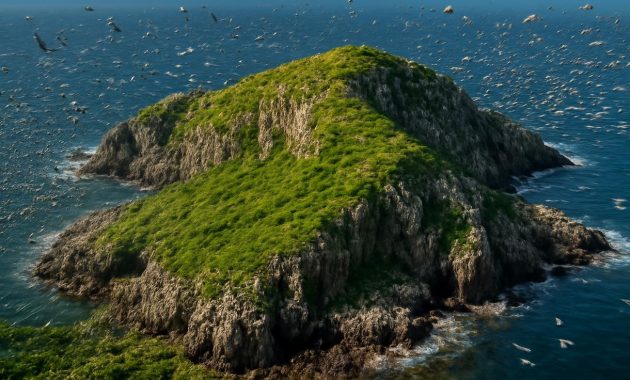
The first time the island went quiet, the researchers thought something had gone wrong. The nights, once stitched together by the thin, eerie cries of feral cats, had turned almost unnaturally still. No amber eyes glinting in the beam of a headlamp. No soft padding in the underbrush. Just wind, waves, and the soft rustle of leaves. It was the sound, or rather the absence of a familiar sound, that told them: the island was about to become something else entirely.
A Small Island, a Big Cat Problem
They called it a “small” eradication project—131 cats removed from a remote island barely large enough to merit a name on most maps. The island, a rocky speck in the sea, lay several hours by boat from the nearest port. Wind-bent shrubs clung to the slopes. Seabirds circled overhead in tight, screaming spirals. On paper, it looked straightforward: remove an invasive predator, protect the native birds, and monitor the recovery.
But islands, as ecologists will tell you, are rarely straightforward. They are tiny laboratories of evolution and accident, places where a single new species can tilt the entire system. The cats had arrived decades earlier—no one was quite sure how. Some said they came with fishermen, others whispered of a long-abandoned settlement. However they came, they stayed. And with no natural predators, they multiplied.
By the time the first full survey was carried out, the damage was obvious. Nesting seabirds were failing year after year. Ground-dwelling lizards hid deep in crevices and rarely ventured out. Even the island’s nocturnal crabs, once abundant, seemed to have thinned out. Everywhere researchers set motion-sensor cameras, they found the same thing: cats, their lean bodies slipping ghostlike between tufts of grass and rock, always hunting.
The decision to remove them was framed as a rescue mission for the birds. What no one fully anticipated was how deeply those 131 cats had woven themselves into the island’s story, and what would happen once they were gone.
The Night the Stars Came Back
The eradication itself was meticulous and slow. Humane traps. Remote cameras. Teams walking the island by moonlight, boots sinking into sponge-soft soil. It took months. Each cat was recorded, examined, and removed. Numbers dwindled: 90, then 50, then 10. Finally, cameras turned up nothing but birds, crabs, and restless foliage.
On that first cat-free night, a field assistant noticed something small but unforgettable. “It’s so bright,” she said, craning her neck toward the sky. Without the furtive movements of cats disturbing them, seabirds were returning earlier to roost. The boats had left, generators were off, and the night felt bigger somehow. The stars seemed closer, the Milky Way smeared across the sky like luminous dust. For the first time in years, no pair of eyes glowed back when a flashlight swept across the slope.
Yet the most dramatic reactions weren’t in the sky. They were unfolding quietly, at ground level, among creatures no one had expected to change this fast.
More Than Just Birds: A Web Starts to Tremble
In planning documents, the project goal was clear: protect threatened seabirds and allow their colonies to recover. Scientists predicted a slow rebound—more successful nests after a few years, gradual population growth over a decade or more. What they did not predict was how quickly, and how broadly, the island would respond.
Within the first nesting season after the last cat disappeared, the numbers started to shift. Nest success didn’t just improve; in some areas, it doubled. On cliff edges where researchers had grown used to counting a handful of chicks, there were suddenly dozens—downy bodies huddled against each other, parents shuttling back and forth in a ceaseless commute to the sea.
But birds were only the beginning. At night, the researchers’ headlamps began catching new patterns: a flick of movement among leaf litter, the glossy backs of land crabs scuttling out to feed, geckos lingering longer on exposed rock faces. Animals that had survived by being invisible were starting to test the edges of their world again.
By the second year, it became obvious that the island’s recovery wasn’t a simple linear story of “fewer cats, more birds.” Entire relationships were shifting. The web was trembling in ways the scientists hadn’t forecasted, and some of those tremors reached surprising corners of the ecosystem.
The Island’s Hidden Engineers
One of the first unexpected heroes of the post-cat era was not a bird at all, but a crab. The island’s land crabs, once a minor footnote in reports, suddenly seemed everywhere. Sturdy, palm-sized, and perpetually busy, they emerged in numbers that startled even the seasoned researchers.
Before the eradication, camera traps had occasionally caught cats stalking crabs, tapping at their shells, waiting for an opening. With the predators gone, the crabs poured into the open—digging burrows, dragging leaves, and dismantling dropped seeds with mechanical precision. At first, this looked like a simple “prey rebounds” story. Then something more subtle came into focus.
The soil was changing. In permanent plots across the island, scientists had hammered in markers, planning to track vegetation and erosion. What they found instead was a quiet revolution underground. Soil cores taken before and after the eradication showed shifts in loose organic material, burrow density, and nutrient mixing. The crabs, freed from constant cat patrol, were literally reworking the ground.
More burrows meant more aeration. More shredded leaf litter meant more nutrients cycling into the soil. And more soil turnover meant something else: a change in which plants were winning the battle for space.
| Indicator | Before Cat Removal | 5 Years After Removal |
|---|---|---|
| Active cat sightings per 100 camera-nights | 37 | 0 |
| Seabird nest success (average) | 38% | 74% |
| Night-time land crab counts (per transect) | 12 | 41 |
| Seedling diversity (species per plot) | 6 | 11 |
Some native seedlings, once scarce, began appearing more frequently in monitoring plots. Seeds dropped and carried by birds or blown by wind were now landing in soil that had been freshly loosened and enriched by crabs and other burrowing creatures. A few plants that the team assumed were on their way out—crowded by invasive grasses that thrived in compacted soil—started to regain ground.
It was as if the crabs, emboldened by the absence of cats, had stepped into a role as ecosystem engineers, reshaping the island in subtle but powerful ways. No one had put “crab-driven soil restoration” in the project proposal. Yet there it was, unfolding under their boots.
The Bird Boom, and Its Complications
Birds, of course, were still at the heart of the story. Their recovery was faster and louder than anyone dared hope. Burrow-nesting species, whose eggs and chicks had been easy targets for prowling cats, staged a dramatic comeback. The hillside that once echoed with just a scatter of calls now roared with a nightly chorus as adults returned from the ocean, wings slicing through the dark like whispers.
More birds meant more guano—rich, pungent, unmistakable. It coated rocks, seeped into soil, and washed downhill with the rains. From a distance, the cliffs developed pale streaks, like chalk brushed down their sides. Up close, the smell was sharp enough to sting the nose. It was, quite literally, the scent of recovery.
That guano brought another round of changes researchers hadn’t fully anticipated. Nutrient analyses revealed a steep rise in nitrogen levels in soils near major colonies. Plants there responded with a burst of growth, their leaves thickening, colors deepening. In some places, fast-growing, nutrient-loving species began to dominate, edging out slower, more delicate natives.
Where birds nested in dense clusters, the plant community shifted so strongly that you could stand at the edge of a colony and see the difference—a hard, almost invisible border where greener, denser foliage gave way to more modest vegetation beyond. The birds weren’t just beneficiaries of the cat removal; they were now reshaping the island themselves, throwing their own weight around in the ecosystem.
Even the sea felt the ripple. More chicks surviving meant more birds maturing, diving, and feeding offshore. Fish, plankton, and marine invertebrates became part of a feedback loop: ocean to bird to guano to soil to plants, and back again. The line between land and water blurred into a single, continuous circuit of nutrients.
When Predictions Fall Short
In their initial models, scientists had drawn neat diagrams—arrows flowing from predators to prey, from prey to vegetation, from vegetation to soil stability. Reality, as the island made clear, was a web far more tangled than lines on a page.
Some changes were positive beyond expectations. The rebound of certain insect species, for instance, was a pleasant surprise. Moths that had been scarce in light traps became regular visitors. Beetles, vital decomposers, turned up in higher numbers, breaking down leaf litter faster. Spiders spun thicker networks in low shrubs, capitalizing on the insect surge. Each of these shifts nudged the island closer to a richer, more intricate balance.
But not every consequence was straightforwardly “good.” The surge in land crabs began to worry some researchers. Would their burrowing, beneficial in moderation, eventually undermine nesting areas or erode delicate slopes? Would they start gobbling up seedlings faster than they could emerge, tipping the scale in a new, unintended direction?
Then there was the question of rodents. On some islands, removing cats has led to boom times for rats and mice, which can devastate nests as efficiently as any feline. This island, fortunately, had a relatively low rodent presence and strict biosecurity measures. Still, trapping grids were expanded, and monitoring intensified. The team knew that in conservation, every solved problem risks uncovering another.
The most sobering realization was how blind they had been to some of the cats’ indirect roles. While undeniably destructive to native fauna, the cats had also been preying on a few non-native species—small, introduced mammals and aggressive invertebrates that could themselves cause trouble if left unchecked. Removing the cats meant removing that pressure, too.
Nothing about the island’s transformation was as clean as a victory narrative. Instead, it was what ecosystems always are: messy, dynamic, and resistant to simple labels. Success, it turned out, looked like a constantly shifting mosaic.
Listening to an Island Relearn Itself
If you walk the island today, years after the last cat vanished, what you notice first is the sound. The air thrums with wings at dusk. Gulls bark from the cliffs. Somewhere in the low scrub, a gecko clicks—a tiny bark of a call. Crabs clatter faintly over rock. The silence that once followed the eradication has been replaced by a layered, pulsing soundscape.
A researcher crouches beside a monitoring stake, fingers pressed into soil softened by countless tiny claws and roots. Around her, seedlings quiver in the wind. She flips through a weather-beaten notebook, comparing numbers from the first years to the latest entries. There’s satisfaction in the upward trends, but also humility. For every pattern she thought she understood, another has emerged from the edges—a plant appearing where it hadn’t before, a bird shifting its nesting territory, a new insect turning up in pitfall traps.
“We came here to save the birds,” she says quietly, “and ended up watching an island relearn itself.”
That relearning is not a return to some pristine, pre-human past. Too much has changed for that—climate, ocean currents, even the chemistry of the air. Instead, the island is assembling a new version of balance from the pieces it still has: birds, crabs, lizards, plants, microbes, salt, and time.
It’s easy to reduce the story to a number: 131 cats. But the heart of it lies in everything that number fails to capture—the crabs tunneling beneath your feet; the seedlings scratching out a foothold; the chicks testing their wings on the cliff edge; the intricate choreography of cause and effect that sprawls far beyond any forecast.
What This Island Teaches Us About Control
We like to think of conservation as a kind of engineering: you identify the problem, remove a stressor, and watch the system move back toward health. But this island’s story reminds us that we are, at best, co-authors working with a wild, improvisational partner.
Removing the cats was an act of deliberate control—a decision rooted in data, ethics, and urgency. Yet the island’s response, while broadly hopeful, was not neatly contained within our expectations. It spilled over boundaries, calling attention to overlooked links and hidden dependencies. The more carefully the scientists watched, the more they saw that each intervention rearranged not just one relationship, but dozens.
That doesn’t mean such interventions aren’t worth doing. On the contrary, the thriving seabird colonies, the rebounding reptiles, and the restless, reworked soil are powerful evidence that thoughtful action can pull life back from the brink. But it does mean we must approach this work with a mix of courage and humility—willing to act, and equally willing to be surprised.
Standing at the island’s highest point, you can look down and see the story written into the landscape: bright greenery where guano has enriched the ground, paler stretches where plants are still fighting for purchase, dark mouths of crab burrows dotting the slope like punctuation marks. Above, birds carve white arcs against the sky, their routes tracing invisible loops between sea and shore.
The cats are gone, but their absence echoes in everything that has followed. Each chick that makes it to the ocean, each seed that finds freshly turned soil, each crab that survives another night above ground—all of them are part of a cascade that no model fully captured.
When 131 cats were removed from this island, scientists anticipated recovery. What they got was revelation: proof that an ecosystem, once unshackled from a single, dominant pressure, can respond with a creativity and force far beyond our best predictions. The island didn’t just heal; it reimagined itself.
FAQs
Why were the cats removed from the island?
The cats were removed because they were an invasive predator devastating native wildlife, especially ground-nesting seabirds and small reptiles. With no natural predators of their own, the cats had become a major cause of breeding failure and population decline for several threatened species.
How were the cats removed humanely?
Teams used a combination of humane live traps, remote cameras, and careful fieldwork to locate and capture the cats. Each animal was handled according to established animal welfare protocols. The process was gradual, monitored closely, and designed to avoid unnecessary suffering.
Did the wildlife recover immediately after cat removal?
Some changes were surprisingly fast. Within the first nesting season, seabird breeding success improved notably, and nocturnal activity of crabs and lizards increased. Other shifts—like changes in plant communities and soil conditions—unfolded over several years as the whole food web adjusted.
Were there any negative side effects of removing the cats?
Yes, or at least, there were complex side effects. Certain prey species, such as land crabs, increased dramatically and began reshaping soil and vegetation. Researchers also had to watch carefully for potential increases in other problematic species, like rodents, that cats had previously helped suppress.
What makes island ecosystems react so strongly to changes like this?
Islands are tightly linked systems with relatively few species, so each one often plays multiple roles. Introducing or removing a predator can send shockwaves through the entire food web. With fewer “backup” species to fill gaps, every shift is magnified, leading to pronounced, sometimes unexpected, cascading effects.
Can similar cat removal projects work on other islands?
They can, and many have. Island predator eradications have helped restore seabird colonies and native plants around the world. But each island is unique. Successful projects depend on detailed planning, long-term monitoring, and a readiness to manage unintended consequences as ecosystems respond in their own ways.
What is the main lesson from this island’s experience?
The main lesson is that ecosystems are far more interconnected and responsive than our models usually predict. Removing a single invasive species can trigger broad, cascading changes—some beneficial, some surprising. Effective conservation requires both decisive action and an ongoing willingness to listen to what nature does next.