The first thing they noticed was the sound—sharp, metallic, out of place on a sun-bleached cliff of limestone and silence. A climber’s cam slipped, rattled, and pinged against the rock, and then the wall itself seemed to answer back with a hollow crack. Dust spilled like pale smoke into the valley air. Below, a cluster of helmets tilted upward, squinting into the glare of an Italian afternoon. By evening, that same group of weekend climbers would be staring at the cliff in absolute disbelief, listening to a paleontologist whisper, “This can’t be right. There are too many of them.” What they had stumbled on, quite by accident, would soon ripple through labs and lecture halls around the world: explosive new evidence of an 80‑million‑year‑old sea turtle stampede that didn’t just challenge a few neat diagrams in textbooks—it threatened to unsettle the very story of how sea turtles evolved.
The Cliff That Remembered the Sea
The cliff is easy to overlook. It rises above a narrow road somewhere between olive groves and terraced vineyards in central Italy, its face the color of stale bread and old bone. From a distance, it’s just another piece of the Apennine spine, a quiet wall of rock that climbers love because the limestone is hard, the routes are clean, and the view from the anchors is the kind that steals the air from your lungs.
But the rock has a longer memory than the people who hang on it. Eighty million years ago, there was no road, no vines, no gear jangling against harnesses. This place was under a warm, shallow arm of the ancient Tethys Sea. Instead of corkscrewing swallows and distant church bells, there were the muffled clicks of crustaceans, the hiss of waves over carbonate mud, and something else—something frenzied—moving just above the seafloor.
On that particular day, or perhaps over a strange cluster of days, the mud did something it rarely does: it listened carefully and took perfect notes. It recorded pressure and movement, weight and direction. It preserved the chaos. Then time folded the seafloor upward, lifted it into the sky, and let humans hang ropes from it. The story it carried stayed mute until a cam slipped in the right crack at the right moment.
Rock Climbers, Cracks, and a Shiver of Shells
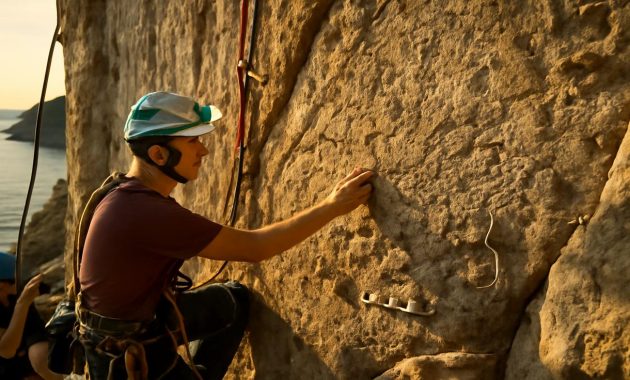
The climbers had come for the usual reasons: fresh air, friction, and that nervous thrill as your fingers search for a hold your eyes can’t quite see. The lead climber, Luca, reached a narrow band of softer rock and frowned. The crack looked good for a cam, but the texture was wrong—crumbly, almost chalky. He placed the gear anyway, weighted it, and heard that odd hollow sound.
Instead of moving on, he hesitated. “This section feels weird,” he called down to his partner. “Like it’s…patched?” He shifted, pressing his face closer to the rock. Under the smear of his fingertips, faint outlines emerged—curves and ridges, barely there, like the ghostly imprint of something long gone.
By midday, a small piece of the wall had broken free under gentle pressure, landing in the dust at the base. Embedded in the fragment were unmistakable shapes: the edge of a shell, a limb bone like a delicate paddle, and beneath that, something stranger—a series of shallow, repeating grooves crossing each other at wild angles.
Someone knew a local geologist. The geologist knew a paleontologist. Within forty-eight hours, the base of the climbing route looked more like a field camp than a crag. Out came measuring tapes, cameras, hand lenses, and the specific quiet that descends when scientists stand on the edge of a possible upheaval.
“This Isn’t Just One Turtle”
At first, everyone assumed the same thing: they were looking at a few scattered fossils, maybe a single ancient turtle that had settled into the mud and been buried. It would be a nice paper, a good story, nothing earth‑shattering.
Then they cleared more dust. Then more. Every new patch of cleaned rock revealed not one shell, but dozens of overlapping outlines, partial carapaces, limb impressions, and most surprisingly, trackways. The shallow grooves Luca had seen weren’t random—they were the drag marks of flippers, carved into the seafloor as turtles powered forward together in the same general direction, like ghostly traffic lines rushing toward an invisible horizon.
“This isn’t just one turtle,” whispered Dr. Mara Conti, the paleontologist leading the survey. “This is a crowd.” She ran gloved fingers along a minute ridge where a flipper had pushed into wet sediment. The impression was so clear it could have been made yesterday by a turtle leaving the beach.
The realization came in layers. First: the sheer number of individuals. Second: the fact that most of them were juveniles and subadults. Third: they were clearly moving at speed, their tracks long and purposeful, not the meandering loops of animals drifting about in calm water. And then, finally, the most jarring part: the age of the rock. It dated to roughly 80 million years ago—the late Cretaceous. According to the tidy diagrams in textbooks, sea turtles back then weren’t supposed to be behaving like this.
Stampede in Slow Motion
Long after the climbers had gone home, the cliff transformed into a vertical crime scene from another era. Technicians dangled in harnesses, documenting each track and shell fragment with laser scanners. Drones floated out in front of the wall to photograph it in immaculate detail. The digital model that emerged made jaws drop in labs thousands of kilometers away.
Across a vertical slice of rock nearly the height of a four‑story building, there were more than 120 distinct sea turtle trackways, many layered and crisscrossing. Several partial skeletons lay embedded at different depths, like bodies frozen mid‑motion. The direction of travel for the majority of the tracks was consistent, suggesting that—at least for a critical window of time—these animals were all moving in concert.
In other words: a stampede. Not on land with dust and pounding hooves, but underwater above the soft seafloor, a flurry of shells and flippers churning the water into a silent storm. It’s an image completely at odds with how we tend to picture ancient sea turtles: solitary gliders, slow, serene, drifting through warm seas like living fossils.
Yet the rock wasn’t lying. Every groove and track told the same story—movement, urgency, density. These weren’t a few animals wandering through. This was an event.
Running the Numbers
Back in the lab, the research team began to quantify the madness written in limestone. They measured flipper span from track width, estimated body size from carapace impressions, calculated direction, and even attempted to infer speed based on stride length and sediment properties. The picture that emerged was startlingly specific.
| Metric | Estimated Value | What It Suggests |
|---|---|---|
| Number of distinct trackways | 120+ in a 40 m-wide section | High-density group movement |
| Body length range | 0.5–1.4 m (juvenile to subadult) | Mixed age class aggregation |
| Dominant direction of travel | ~75% heading NNE | Coordinated or shared response |
| Track depth | Up to 4 cm into sediment | Strong, fast flipper strokes |
| Preservation layer thickness | ~30–40 cm of original seafloor | Snapshot of a short-lived event |
These weren’t elderly giants lumbering through their final years. This was a pulse of young, powerful swimmers—like a teenage marathon through prehistoric seas. The sedimentology suggested rapid burial, likely after a storm or sudden shift in conditions, freezing a brief interval of time with uncanny resolution.
The word “stampede” began to bounce around the research meetings—not as a metaphor, but as a working hypothesis. Something had triggered these 80‑million‑year‑old turtles to move together, quickly, across a particular corridor of seafloor. And whatever that something was, it rewrote assumptions about how, when, and why turtles began to behave like the migrants we know today.
What We Thought We Knew About Turtle Evolution
Before this cliff in Italy started talking, the story of sea turtle evolution followed a relatively comfortable script. Fossils told us that the ancestors of modern sea turtles emerged in the late Cretaceous. Shells gradually flattened. Limbs stretched and morphed into the elegant flippers we see slicing through water today. By the time the dinosaurs died out, sea turtles were already strong, capable ocean travelers.
Behavior, however, is harder to fossilize than bone. For decades, paleontologists leaned heavily on modern analogs. Today’s sea turtles are mostly solitary, reuniting only for mating or mass nesting. Their legendary migrations—from feeding grounds across entire ocean basins to nesting beaches and back—were thought to be a relatively recent elaboration of their capabilities, evolving in the context of modern ocean currents and climates.
Yes, we had scattered fossil evidence of groups of turtles, even mass death assemblages, but it was easy to explain those away as chance gatherings, storm-driven strandings, or the cumulative effect of animals dying in a good habitat over long stretches of time.
The Italian cliff refused to play along with that narrative.
A Cretaceous Migration Highway?
The data on the trackways forced a unsettling question: had we been underestimating the social and migratory behavior of ancient sea turtles all along? Here were dozens upon dozens of individuals, moving together in roughly the same direction within what appears to be a narrow window of time.
One emerging hypothesis is that this cliff represents the fossilized corridor of an ancient migration route—an underwater highway that turtles followed seasonally, perhaps to breeding or feeding grounds. If so, this would push complex, large‑scale coordination in sea turtles far deeper into the past than most models allowed.
Alternatively, it might record a panic response. A sudden drop in oxygen, a toxic algal bloom, or an underwater landslide could have driven animals en masse from one zone to another. Yet the orderly alignment of the majority of the tracks—and the lack of obvious thrashing or erratic direction changes—leans away from sheer chaos and toward purposeful movement.
Whether migration or mass escape, both scenarios imply that, 80 million years ago, sea turtles were already tuned into environmental signals, already capable of rapid, coordinated responses that echo the migrations orchestrated by their descendants today.
The Stampede That Shouldn’t Exist
To understand why this discovery is so disruptive, you have to picture the mental model many scientists carried: ancient seas populated by archetypes—early sharks, early fish, early turtles—each a simpler, quieter version of the modern forms. Behavior was presumed to ramp up in complexity as time went on, as if evolution were a staircase consistently leading upward to more intricate patterns.
The stampede frozen in this Italian cliff is like finding a fully choreographed dance in what was supposed to be a clumsy rehearsal hall. It suggests that, at least for sea turtles, the playbook for sophisticated, large‑scale movement was already well‑worn tens of millions of years earlier than predicted.
It also raises disquieting questions about extinction and resilience. If ancient turtles were already this capable—already navigating, coordinating, responding at scale—then what does it mean that so many of their lineages vanished? Complex behavior, it seems, is no guaranteed shield against the brute forces of plate tectonics, asteroid impacts, or runaway climate swings.
Echoes in Modern Seas
To marine biologists who spend their nights tracking sea turtles by satellite, the cliff feels almost eerie. The paths recorded in stone mirror, in ghost form, the spaghetti of colored lines on their computer screens—modern turtles tracing routes from Brazilian beaches to West African feeding grounds, from Australian reefs to distant archipelagos.
The new fossil evidence suggests that this wanderlust, this capacity for communal movement, is not a recent response to modern oceans but an ancient feature of their lineage. Migration might not be an innovation they stumbled into late in their history; it could be a core part of what made sea turtles so successful across deep time.
At the same time, the Italian site offers a sobering mirror. Today’s turtles make their long journeys through oceans increasingly cluttered by plastic, crisscrossed by shipping lanes, and warmed and acidified by human activity. The stampede in rock is a reminder that turtles have negotiated drastic shifts before—but it also hints, in those half‑buried skeletons, that not everyone makes it through.
From Cliff Face to Global Debate
Back at the crag, the climbing route that sliced across the main slab of trackways has a new name. The local community retired the old grade‑centric moniker and replaced it with something more reverent, a nod to shells and shadows and the fact that, for a moment, their hobby intersected with deep time.
The rock is now partly protected, bolts removed from the most sensitive areas. Instead of climbers, you see more helmets with logoed hardhats than with chalk streaks. School groups arrive, craning their necks toward the cliff as guides trace invisible lines in the air. Somewhere amid the scattered gear bags and lunch wrappers, you can still spot Luca from time to time, watching the scientists with a bemused expression, as if he still can’t quite believe that his slipped cam helped crack open 80 million years of secrecy.
In conference halls from Rome to Denver, the “Italian Turtle Stampede” has become shorthand for a broader challenge: how much of behavior’s history have we missed because we were looking for bones and ignoring the landscapes those bones once moved through? Trackways, burrows, nests—these trace fossils are suddenly front‑page material, capable of overturning long‑held assumptions about the tempo and texture of evolution.
And yet, away from the graphs and models, the discovery is also something more ordinary, more human. It’s a reminder that the Earth we cling to is layered with stories so improbable they sound like fiction until a piece of rock happens to break in just the right place.
Stand below that cliff on a quiet day and squint. Imagine the limestone turning soft beneath your boots, the valley filling with water the color of diluted milk. Now picture them: dozens, maybe hundreds of sea turtles, shells flashing in filtered sunlight, flippers beating like synchronized oars, all pushing toward some distant cue. The seafloor shivers under their passage. The mud listens, and remembers.
For 80 million years, that stampede ran only in one direction—forward, into the dark. Now, at last, a thin, improbable line in an Italian cliff is letting it run backward, straight into our waiting, astonished eyes.
Frequently Asked Questions
Did rock climbers really discover the fossil site by accident?
Yes. Recreational climbers first noticed unusual textures and shapes in a section of the cliff where the rock sounded hollow and fragile. Their curiosity and subsequent contact with local scientists led to the formal investigation and documentation of the fossil-rich wall.
How do scientists know these tracks belong to sea turtles?
The trackways and impressions match the distinctive pattern of sea turtle flippers and shells: paired, paddle-shaped marks with characteristic spacing, plus partial skeletons showing flattened carapaces and limb bones adapted for swimming. These features clearly distinguish them from other marine reptiles.
Why do researchers call it a “stampede” if it happened underwater?
“Stampede” is used to convey the density, directionality, and apparent urgency of the movement. While there was no dust cloud or thundering hooves, the mass of turtles moving rapidly across the seafloor left overlapping, deeply impressed trackways that strongly suggest a brief, high-intensity event.
Does this discovery change the timeline of sea turtle evolution?
It doesn’t shift when turtles first appeared, but it does challenge assumptions about when complex behaviors—like large-scale, coordinated movement or migration—evolved. The evidence indicates that such behaviors existed at least 80 million years ago, earlier and more elaborately than many models suggested.
What could have triggered the ancient turtle stampede?
Researchers are still debating this. Leading ideas include a seasonal migration corridor, a rapid environmental shift such as a storm or oxygen drop, or a combination of both. The orderly direction of most tracks points toward purposeful travel rather than random panic.
Can the site still be climbed?
Key fossil-bearing sections have been restricted to protect the trackways and skeletons. Some adjacent routes remain accessible, but management plans prioritize scientific study and conservation. Local climbing groups have largely supported the protections, recognizing the site’s global significance.
What does this mean for the conservation of modern sea turtles?
The discovery underscores how deeply rooted turtle migration and group movement are in their evolutionary history. It highlights that we’re not just protecting a species, but safeguarding a behavioral legacy tens of millions of years old—one that has persisted through mass extinctions and climate swings, and is now confronting human-driven change.