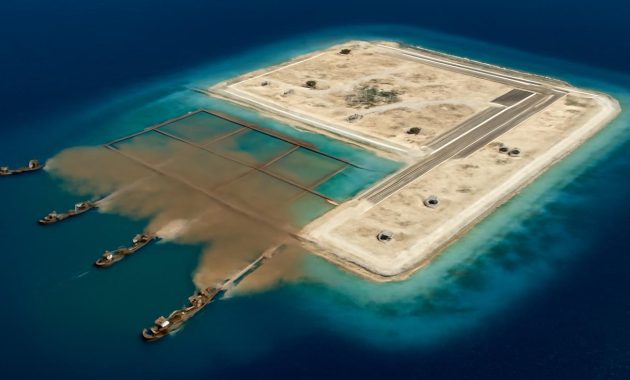
The first thing you notice is the sound. Not the soft, shushing cadence of waves stroking an untouched reef, but the mechanical roar of engines and the grind of metal against water. Floodlights glow through a haze of diesel and salt spray as a flotilla of ships huddles over a patch of dark sea in the middle of the night. Beneath them, pipes plunge into the depths, sucking sand and sediment from the seafloor and vomiting it into the open air. It arcs, golden under artificial light, and crashes back down in a growing mound that did not exist a decade ago. The map says this is the middle of the ocean. The map is now wrong.
The Art of Making Land from Water
There is something almost mythic about creating an island. For centuries, our stories reserved this power for gods, sea monsters, and the slow patient work of coral and volcanoes. But in the South China Sea, the process is startlingly industrial, stripped of romance and wrapped in urgency and geopolitics.
China’s “island-building” campaign began quietly in the early 2010s. To the untrained eye, these specks—reefs, shoals, and atolls scattered across warm turquoise water—were little more than postcard scenery, occasional resting spots for seabirds and fishermen. To governments and strategists, they were something else entirely: leverage points, legal anchors in disputed waters, potential platforms for runways, ports, and radars.
The technology itself isn’t new. Coastal cities all over the world have done land reclamation—Singapore expanded its shoreline with imported sand; Dubai conjured palm-shaped islands out of the Gulf. But the scale and speed in the South China Sea are something different. Here, the ocean is not just being hemmed in; it is being rewritten.
The process is as brutal as it is simple. Dredging ships—vast, tub-bellied vessels with iron mouths—drag suction heads along the seafloor, tearing up sand, coral fragments, and silt. Mixed with seawater, this slurry is pumped through floating pipes and sprayed over shallow reefs. Over months, and then years, those fragile coral crowns are smothered and raised, layer by layer, until the sea gives way to raw, pale sandbanks.
From a distance, it can look like a sandstorm frozen in mid-air, the spray arcs glowing softly in the sun or lights. Up close, the sensory experience is almost overwhelming: the metallic tang of fuel, the grinding whine of engines, the percussive whoosh of sand hitting newly born land. There is no birdsong, no rustle of leaves—only machines and the hiss of water being forced to obey.
Islands That Didn’t Exist—Until They Did
For more than a decade, China has moved millions of tonnes of sand in this way, transforming once-submerged features into sprawling artificial islands. Names that once meant almost nothing beyond nautical charts—Fiery Cross Reef, Mischief Reef, Subi Reef—have become shorthand for a sprawling engineering and political project.
Improbable as it sounds, you can now stand on what was previously only a flicker of coral in a restless sea. Under your feet, the grains of sand are recent arrivals; the foundations are a flattened, entombed reef. Ahead, instead of a horizon of uninterrupted blue, you might see a concrete pier, radar domes gleaming white like strange eggs, or the dark ribbon of an airstrip cutting a straight line through shimmering heat.
From satellite imagery, these islands look almost clinical: precise rectangular outlines carved into the watery chaos, straight roads and neat clusters of buildings. Seen from the water, they are more surreal. An expanse of concrete and steel rises abruptly out of the ocean, with breakwaters curving like outstretched arms to hold back waves that never used to break there at all.
To grasp what has changed, it helps to visualize it side by side.
| Feature | Before Sand Dumping | After Island Construction |
|---|---|---|
| Surface | Shallow reef, often submerged at high tide | Permanent dry land with raised seawalls |
| Ecosystem | Lively coral habitat, nursery for fish and invertebrates | Primarily concrete, imported soil, and fragmented habitat |
| Human Use | Occasional fishing or navigation marker | Runways, docks, radars, housing, and storage facilities |
| Legal Status (claimed) | Often too small or submerged to qualify as full “islands” | Used to bolster claims of inhabited or usable territory |
On some of these new islands, trees now sway in the wind—imported, of course. There are neat rows of housing blocks, communication towers, radar domes like bleached skulls against the sky. At night, the glow of electric light pools on concrete, casting long shadows along newly drawn streets. Where once only moonlight traced the waves, there are now floodlights and the red blink of aviation beacons.
What Gets Lost When You Bury a Reef
It’s tempting to describe this as “building” islands, but from nature’s point of view, it is more a process of burial. Before the sand arrives, a reef is alive—a bustling, three-dimensional city grown from calcium and time.
Imagine swimming just above one of those reefs at dawn, before the dredgers came. The water is warm and weightless against your skin. Below, the coral looks as if someone scattered an artist’s palette across the seafloor: branching staghorns, smooth domes, delicate fans trembling with the movement of fish. Schools of damselfish flicker in and out of crevices. Parrotfish scrape algae from the coral with audible crunches. The reef hums, clicks, and crackles with the sounds of snapping shrimp and distant fish calls—a kind of underwater static that signals health.
Then, gradually, the water clouds. Fine particles of disturbed sediment drift down like an underwater dust storm. Corals depend on clear water and sunlight; their symbiotic algae, which provide most of their food and color, are light-hungry. As sand and silt pile up, structures that took centuries to form are smothered in weeks or months.
Reefs are not just pretty rock gardens; they are nurseries, breakwaters, and pantries all at once. Fish lay eggs among their branches; larvae and juveniles shelter in their shadows. Many coastal communities in the region have, for generations, depended on reef fish—groupers, snappers, reef-dwelling invertebrates—for food and livelihood. When a reef dies, it is not only biodiversity that thins, but the human stories braided around it.
The loss is not always visible from the new island’s paved surfaces. Standing on fresh concrete, the ocean feels distant again, pushed to the edges by seawalls. But the quiet violence lies just beneath the hulls of ships that now dock here. The water, once prism-clear, often carries a persistent cloudiness, a haze of disturbed sediment. Currents that used to swirl freely around low reefs now slam against solid barriers, reshaping flow patterns, eroding some patches of seabed while dumping material on others.
If you look carefully, you may notice how life tries to adapt. Algae creep onto submerged concrete like the first moss on volcanic rock. Some hardy fish return, nosing around pier pilings and rubble. But complexity—the delicate, tangled architecture that sustained so much—is gone, replaced by a simpler, more impoverished community clinging to the edges of an engineered world.
Sand, Power, and the Politics of a Sea
Why move all this sand? Why pour such colossal effort into scattering military-grade islands across a semi-enclosed sea? Part of the answer lies in a line on a map that curves like a loose lasso: the “nine-dash line” that China uses to outline its sweeping claims in the South China Sea.
This stretch of water is not empty. It is one of the world’s busiest shipping lanes, a floating highway where tankers and cargo ships slide along invisible routes carrying oil, gas, and goods between East Asia and the rest of the world. Beneath the surface lie potential deposits of hydrocarbons. Above it hover overlapping claims by Vietnam, the Philippines, Malaysia, Brunei, Taiwan, and China.
In such a crowded arena, an island is not just land—it is a statement. International law draws special zones around land: territorial seas, exclusive economic zones. A natural island has more generous legal powers than a low-tide elevation or a submerged rock. Artificial islands, legally, do not create the same zones—but they do create facts: a radar station where there was once open sea; a runway that can host patrol aircraft; a harbour capable of sheltering naval vessels.
From the perspective of a sailor on a passing ship, the transformation is visceral. A decade ago, some of these routes wound past empty horizons broken only by the silhouettes of distant islets or the sudden rise of storm clouds. Now there are concrete shapes where your navigation charts still show blue. The radio crackles with new warnings. Coast guard vessels, painted in sharp white and blue, patrol waters that feel more crowded and watchful.
For fishermen from neighboring countries, the shift is even more personal. Areas once freely accessed for generations are now patrolled. Nets cast in familiar waters may suddenly draw the attention of vessels bristling with antennas and loudspeakers. Access, once governed by storms, seasons, and the habits of fish, is increasingly dictated by politics and patrol patterns.
If the making of these islands is a feat of engineering, their existence is also a form of cartographic persuasion. Look at enough satellite images of concrete footprints blooming across the sea, and it becomes easier—almost natural—to imagine that this water has always belonged to whoever poured the most sand into it.
Fragile Foundations in a Rising Sea
There is a soft irony in building islands in a century of rising seas. Every tonne of cement, every dredged grain of sand, is placed into a world where coastlines are already beginning to redraw themselves—slowly in some places, abruptly in others.
Engineers know this, of course. The new islands rise several meters above sea level, armored with robust seawalls that bite into the water like the teeth of a gear. They are designed to shrug off waves and the ordinary tantrums of tropical storms. Yet the ocean, patient and persistent, has a way of testing every assumption.
Storm surges ride higher on a swollen sea. Typhoons spin more erratically. Breakwaters, no matter how thick, must wrestle with forces measured not in tons, but in decades and centuries of pressure. Fine dredged sand compacts over time; land subsides, especially when built on what used to be porous reef and sediment rather than solid bedrock.
Stand on the margin of one of these artificial shores during a storm and watch the waves hurl themselves at the walls. The air tastes of salt and electricity, and the ground trembling under your boots exposes just how thin the line feels between control and concession. On the far side of that wall, the sea does not care that this is now—politically, humanly—an “island.” To the waves, it is simply an obstruction, a new shape to carve.
There is another, less visible fragility too. These islands depend on long supply lines. Every drop of fresh water, every bag of cement, every container of food arrives by ship. Strip away the politics and the military hardware, and you are left with an elemental truth: these are outposts held against a vast, encircling medium that is always one storm or one logistics failure away from reminding everyone who ultimately sets the rules here.
Listening for What the Sea Remembers
It is easy, when talk turns to dredgers and runways, to forget that the sea has its own slow memory. The South China Sea, like all great water bodies, holds layer upon layer of stories—traces of ancient trade routes, lost storms, migrations of turtles and birds, the invisible paths of plankton blooms and schooling fish.
For the people whose lives intersect with this water—Filipino and Vietnamese fishers, Malaysian and Chinese sailors, Indonesian traders, the crews of tankers and tiny wooden boats—the transformation is not abstract. It is something you see in the way light reflects off concrete instead of coral heads, in the new shadows cast on once-open waters, in the hum of engines where there used to be only wind and waves.
Step away from the machinery, though, and listen. Late at night, when ship traffic thins and the generators on the islands drop to a steady mechanical murmur, the sea’s older sounds push through again: the soft slap of waves on hulls, the far-off boom of surf on distant shoals, the high, questioning calls of seabirds wheeling through the dark.
Beneath the surface, the soundscape has shifted. Studies have shown that reefs damaged by sediment and dredging grow quieter; the crackling chorus of life that once guided larval fish back home fades. In time, new communities form, but they are simpler, more subdued. It’s as if an orchestra has lost half its instruments and is learning to play a thinner, more tentative music.
Future sailors may grow up navigating by these new islands, taking them for granted as fixed points in a fluid world. Future fish may learn to shelter under pier pilings instead of branching coral. Future maps will show more gray polygons in places where there were once only blue gradients.
But the sea remembers another version of itself—a time when storms broke unimpeded over low reefs, when seabirds nested on scraps of sand that vanished at high tide, when the brightest lights at night were not sodium lamps but the glimmer of stars on calm water.
Frequently Asked Questions
Why is China creating artificial islands with sand in the South China Sea?
China is building these islands to strengthen its presence and control in the South China Sea, a region that is rich in resources and crucial for global shipping. The islands support airstrips, ports, and military and civilian infrastructure, allowing China to project power and reinforce its territorial claims.
How are these artificial islands actually made?
Specialized dredging ships suck sand and sediment from the seafloor and pump the slurry onto shallow reefs or submerged features. Over time, the material accumulates above sea level, and engineers stabilize it with seawalls, concrete, and additional fill. Infrastructure—runways, buildings, and piers—is then constructed on the new land.
What environmental impacts does this island-building cause?
The process buries coral reefs under sand and sediment, killing the complex ecosystems they support. It destroys habitats for fish, invertebrates, and other marine life, clouds the water with suspended particles, alters currents, and can degrade fisheries that local communities depend on.
Are these artificial islands considered legal territory under international law?
Under international law, artificial islands do not generate the same territorial seas or exclusive economic zones as naturally formed islands. However, in practice, the presence of runways, ports, and stationed personnel can influence how control is asserted and challenged on the water, regardless of formal legal status.
Will these islands last in the face of climate change and sea-level rise?
The islands are engineered to be higher than current sea levels and protected by strong seawalls, so they are likely to endure in the near and medium term. However, subsidence, stronger storms, and rising seas will continually test their stability and the cost of maintaining them over coming decades.