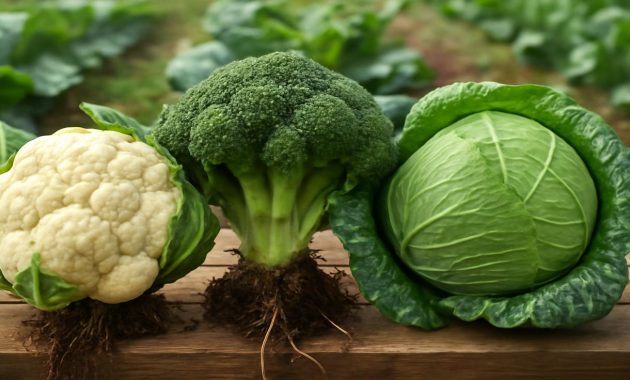
The cauliflower arrived first, pale as the inside of a seashell, stacked in a crate at the farmer’s market. Beside it hunched a tower of dark green broccoli, its crowns like miniature treetops. A little farther down the table, tight green cabbages waited, glossy and compact as if guarding some leafy secret. I watched people drift past, plucking one or another for dinner, and I wondered how many of them knew that, beneath all this variety, they were really looking at the same exact plant.
The One Plant Behind the Produce Aisle
At first, it sounds like a riddle: How can broccoli, cauliflower, and cabbage all be the same thing? In botanical terms, they’re not different species—they’re all cultivated forms of Brassica oleracea, the wild cabbage. That’s right: your roasted broccoli, your creamy cauliflower mash, the slaw tucked into your taco, even Brussels sprouts and kale—they all belong to a single species that humans have quietly sculpted for thousands of years.
Picture the wild ancestor, clinging to salty cliffs along the European Atlantic coast. It’s not impressive at first glance. Wild cabbage looks more like a scruffy, waxy-leaved weed than the glamorous, produce-aisle celebrities it eventually became. But what it did have was potential—an extraordinary genetic flexibility that allowed human curiosity, climate, and culture to tug it in different directions.
Farmers and foragers along the coast began paying attention. Maybe it started with a plant that had slightly thicker leaves, or a more tender stem, or a tighter cluster of buds. Over time, people saved seeds from the plants they liked best. Slowly, patiently, generation after generation, the plant we now call wild cabbage began to branch into an entire cast of characters.
The Slow Magic of Human Selection
Domestication is often described in dry, scientific language: genetic variation, artificial selection, phenotypic traits. But out in the fields or gardens, it feels more like storytelling. Every seed saved is a small vote for a particular future. Every plant chosen says: more of this, please.
Imagine a medieval farmer who notices a cabbage plant with especially thick, juicy leaves that hold up well to cooking. Those leaves might mean a more filling stew in winter, so that plant’s seeds are treasured. Over time, this quiet preference for leafy abundance helps carve out a path that leads us to kale and collard greens.
Somewhere else, another farmer becomes captivated not by leaves, but by buds—the tightly packed flower clusters that, in the wild plant, were small and unremarkable. But in one plant, they’re just a bit larger, or a bit denser. Seeds are saved. Those bigger buds, selected again and again, swell into what we now know as broccoli: the plant’s flower clusters magnified and frozen in time before they can fully bloom.
In another region, the same species takes on a different destiny. Instead of buds or leaves, growers favored a tightly folded cluster of inner leaves that formed a dense head. Those heads kept well, traveled well, and cooked into hearty, comforting dishes. Eventually, that inclination gave us cabbage—compact, layered, and durable, like a botanical storage unit for calories and crunch.
The Cast of Characters in the Brassica Story
It helps to see them side by side, not as strangers, but as relatives shaped by human preference:
| Variety | Part Emphasized | Familiar Use |
|---|---|---|
| Cabbage | Tight leafy head | Slaws, fermenting, soups |
| Broccoli | Flower buds and stalk | Steaming, roasting, stir-fries |
| Cauliflower | Densely packed flower tissue (curd) | Roasting, “rice,” mashes, steaks |
| Kale | Loose, leafy foliage | Salads, sautés, chips |
| Brussels Sprouts | Lateral buds along the stem | Roasting, pan-searing |
| Kohlrabi | Swollen stem | Raw slices, slaws, roasting |
Look down that list again: head, buds, curd, leaves, lateral buds, swollen stem. Each vegetable is like a spotlight shining on one part of the plant’s body, built up and exaggerated through centuries of patient selection. It’s as if humans took a single species and said: let’s see what happens if we turn the volume way up on this one feature.
What Makes Cauliflower, Broccoli, and Cabbage Feel So Different?
Stand in your kitchen and hold them one by one. Cabbage sits heavy in your hands, cool and solid, its outer leaves squeaking faintly against your fingers. Cut it open and it reveals lacy layers packed tight, like green paper origami. Cabbage is an exercise in density: water, fiber, and sugar compacted into a crisp, respectable sphere.
Broccoli feels more architectural. The stalk is firm, pale green, almost like young wood. The florets sprout from it in branching fractal patterns, each tiny bud a miniature dome. Steam it and the kitchen fills with a grassy, slightly sulfurous perfume, the scent of its cruciferous kinship. Bite into it and you get tender tops, then chew, then a crisp snap from the stalk if you’ve cooked it just right.
Cauliflower, though, is the strangest to hold. Its head—properly called a curd—seems almost unnatural, a cloud of creamy white or sometimes orange, purple, or green, tightly stitched together. It feels like a brain, some people say, or coral, or packed snow that never melts. When you cut it, the interior reveals ribs and branches hidden under that surface of clustered florets, a pale forest glimpsed in cross-section.
These textures and shapes make them feel worlds apart, and yet genetically, they’re close cousins. The differences lie in subtle shifts: genes that control how big buds get, how tightly leaves fold, when flowers try to open, how much energy flows into which structure. Over millennia, people quietly nudged those settings until they produced vegetables so different that most shoppers would never guess they share a wild grandparent clinging to sea cliffs.
A Family Resemblance in the Kitchen
If you listen closely while you cook, their shared heritage speaks up. Cut into any of them and a faintly mustardy smell rises—that’s the family of compounds that give all cruciferous vegetables their characteristic bite. Over a hot pan, they release that earthy, cabbagy aroma that makes some people swoon and others wrinkle their noses.
Roast them and the transformation is almost alchemical. The edges brown and blister, sugars concentrate, and that once-harsh scent softens into something sweet, nutty, and deep. A tray of mixed florets and wedges—broccoli trees, cauliflower clouds, cabbage petals—caramelizes into a pan of golden, mottled pieces that all seem to agree on one thing: heat plus time is their favorite language.
They even respond in similar ways to seasoning. A splash of lemon or vinegar brightens the bitterness. Garlic tucks itself into the nooks and crannies. Olive oil glosses their surfaces and helps the heat work its magic. You can treat them almost interchangeably in many recipes—thin-sliced cabbage roasted on a sheet pan behaves not unlike shredded Brussels sprouts; small cauliflower florets can stand in for broccoli in stir-fries.
The Hidden Drama Under the Soil
Out in the garden, the transformation from wild plant to cultivated variety feels more dramatic than in the grocery aisle. Plant a row of different Brassica oleracea varieties side by side and watch as they grow through the seasons. At first, they all look similar: sturdy stems, thick bluish-green leaves dusted with a waxy bloom that repels water. Rain beads and rolls off them like mercury.
Then the differences emerge. The cabbage starts packing energy inward, folding its leaves into a tight, swelling heart. You can feel it with your hands, cupping the forming head. Broccoli pushes its strength upward, elongating stems and hoisting a dark green crown of buds. Cauliflower gathers itself into a pale, curling knot, and gardeners often fold the outer leaves over the forming head to shield it from the sun and keep it tender and white.
Underground, though, the roots weave through the same soil, sipping from the same minerals, listening to the same subtle signals of temperature and daylight. This single species, stretched into so many forms, reminds you how plastic life can be—how capable of experimenting, especially when humans are part of the equation.
Brassica’s Long Partnership with People
The story of these vegetables is, in many ways, a story about migration and imagination. As humans moved and traded seeds, Brassica oleracea moved with them. In one region, the priority might be winter hardiness; in another, quick growth; in another, flavor that paired well with pork or preserved fish or fragrant spices.
Over centuries, what began as a humble coastal plant became essential to cuisines around the world. Cabbage wove itself into sauerkraut in Germany, kimchi in Korea, and stuffed rolls in Eastern Europe. Broccoli found its way from Italy into global stir-fries and pasta dishes. Cauliflower, once a luxury vegetable in some cultures, now appears roasted whole at the center of dinner tables, dressed in spices and sauces that would have astonished its wild ancestor.
Many of the people who first saved seeds from the odd, promising plants they noticed would never have heard of genetics. They might not have called what they were doing “breeding.” But they were paying attention, year after year, trusting that small differences mattered. That if you chose carefully, the future could taste a little better, store a little longer, feed more mouths.
Seeing the Secret Kinship on Your Plate
Once you know the connection, it’s hard not to see Brassica oleracea everywhere. The shredded slaw on your sandwich. The charred broccoli beside your tofu or steak. The cauliflower steaks taking up half the grill. They become less like separate items on a menu and more like different costumes worn by a single, very adaptable plant.
That realization can shift your cooking, too. Suddenly, you start to experiment: shaving raw Brussels sprouts into a salad because you know raw cabbage works; swapping broccoli for cauliflower in a creamy soup; pan-frying coin-thick slices of cabbage core the way you would treat a thick stalk of broccoli. Instead of thinking in terms of three vegetables, you’re working with one endlessly flexible species and a scattered toolkit of textures.
There’s something strangely comforting in that knowledge. In a world that feels splintered in so many ways, discovering hidden connections—even among the vegetables in your crisper drawer—offers a small, grounding sense of continuity. The boundaries between things are not always as solid as they appear.
A Different Way to Walk Through the Market
Next time you walk through a market, slow down a little at the brassica section. Run your fingers over a cabbage head; feel its smooth, cool weight. Brush the bumpy tops of broccoli, like a forest of tiny buds frozen mid-bloom. Lift a cauliflower and notice how the florets knit together, every swirl and whorl the result of choices made long before you picked it up.
You don’t have to remember the Latin name or the details of plant development to appreciate what you’re holding. Just knowing that these are not strangers, but siblings, can change the way you see them. It puts you in a long lineage of people who have looked at plants and thought: what else could this become?
And in that way, standing there under the grocery store lights, you’re not just a shopper. You’re the latest character in a very old story—one where a single scrappy wild plant met human curiosity, and together, they wrote an entire family of vegetables into existence.
Frequently Asked Questions
Are cauliflower, broccoli, and cabbage really the same species?
Yes. Cauliflower, broccoli, and cabbage are all varieties of one species, Brassica oleracea, also known as wild cabbage. Through centuries of selective breeding, humans emphasized different parts of the plant—buds, leaves, stems—until they looked and behaved like distinct vegetables.
If they’re the same species, why do they taste so different?
They share a common “brassica” flavor, but selective breeding shifted the balance of sugars, fibers, and sulfur-containing compounds in each variety. Texture also affects perception: dense cabbage leaves, airy cauliflower curds, and branching broccoli florets each deliver flavor in a different way.
Can I substitute one for another in recipes?
Often, yes. Broccoli and cauliflower can be swapped in many roasted, steamed, or pureed dishes. Thin-sliced cabbage can stand in for Brussels sprouts or kale in some recipes. Just keep in mind differences in water content and texture and adjust cooking time slightly.
Are they all equally nutritious?
They share many nutritional benefits—fiber, vitamin C, vitamin K, and various antioxidants. Exact levels differ: broccoli, for example, tends to be especially rich in certain compounds, while cabbage is a classic choice for vitamin C and fermenting. Eating a mix of them gives you the broadest range of nutrients.
Can I grow different brassicas together in the same garden?
You can grow them side by side, but remember they share pests and diseases. Rotating where you plant brassicas each year and giving them rich, well-drained soil helps keep them healthy. If you save seeds, be aware that they can cross-pollinate, leading to surprising combinations in the next generation.