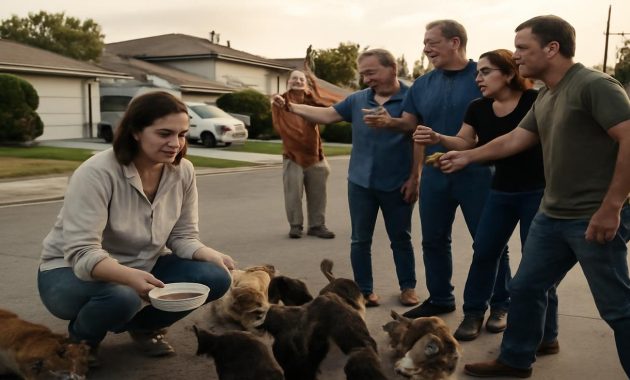
The first time the cats appeared, it felt almost magical. They slipped into the cul-de-sac at dusk, soft shadows moving along hedges and driveways, eyes like tiny lanterns in the half-light. Someone had left a dish of food near the mailboxes—a small white bowl with pink flowers on the rim—and within a week, more cats had arrived, drawn by the quiet promise of an easy meal. You might think that in a peaceful neighborhood, people would simply smile, shrug, and carry on. But that bowl would become the first shot fired in a war nobody saw coming—a war of whispered accusations, simmering fear, and friendships quietly shattering over the question: what do we owe the animals that live on the edges of our lives?
The First Bowl of Food
It started with Lena, the woman in the blue house with the overflowing garden. She was the kind of neighbor who remembered birthdays, who brought over fresh muffins “just because,” who knew every dog’s name on the block and always asked about sick grandparents. If compassion had a human shape, it might look a lot like her.
One chilly November afternoon, she spotted a skinny calico cat picking through the trash can by the oak tree. Its ribs were faintly visible beneath its coat, and when the wind blew, the cat shivered, curling tighter around itself. She watched from her kitchen window, hands damp from dishwater, heart snagging on the sight. It looked like the sort of creature that had fallen through the cracks, unclaimed and unseen.
That night she set out the bowl of food by the mailbox. Just a one-time thing, she told herself. A little kindness. The calico appeared again, cautiously at first, then with increasing confidence. Lena felt a small warmth each time she saw it. She named her Daisy.
The next week, a tabby tom showed up, scarred and wary. Then a sleek black cat with a torn ear. Within a month, five cats sat under the streetlamp like regulars at a late-night diner, waiting. Neighbors would drive by and catch the soft flash of their eyes in their headlights. A few smiled. A few frowned. And one night, someone snapped a photo through their windshield and posted it in the neighborhood group.
The Group Chat Erupts
The message was short, typed in the clipped tone of someone trying not to sound as annoyed as they were:
“Anyone know who’s feeding the stray cats on Oakview Court? We’re seeing more of them every night. This is becoming a problem.”
The responses came tumbling in, fast and sharp, like hailstones on a tin roof.
“They’re adorable!”
“They keep the mice away, leave them alone.”
“Those cats are going to spread disease. This is NOT okay.”
“My kid is allergic—why should we have to deal with this?”
“Someone is just trying to help. Seriously, what’s wrong with compassion?”
By the time Lena read the thread, there were nearly a hundred comments. Her heart thumped. She scrolled through strangers debating a problem she had quietly created. Some posts were kind, others bristling with accusation. The words “irresponsible” and “selfish” popped up more than once.
She didn’t respond that night. Instead, she went to the pantry, pulled out another can of cat food, and poured it into the little bowl by the mailbox. The sound of the metal spoon on porcelain felt louder than usual in the dark.
The cats came running.
Friendships on the Fence Line
The first crack in the neighborhood’s polite surface appeared along the hedge that separated Lena’s yard from Daniel’s. He had bought his house two years earlier, a quiet man who worked long hours and liked his lawn trimmed short and neat. He had a young son, Noah, a serious child with sky-blue eyes and an inhaler always close by.
One afternoon, while Lena was watering her dahlias, Daniel leaned over the hedge.
“Hey, Lena,” he began, voice careful. “Can we talk about the cats?”
She set down the hose and nodded. “Of course. You mean Daisy and the others?”
He frowned. “You’ve named them?”
She felt suddenly self-conscious. “Just… in my head.”
He shifted his weight. “Look, my son is highly allergic. He had an asthma attack last week after he was playing on the sidewalk. We found paw prints all over his scooter. I can’t be sure it was the cats, but… there are a lot more of them now.”
Lena’s stomach tightened. “I’m so sorry about Noah. I didn’t realize.”
“I know you’re trying to be kind,” he said. “But they’re not just staying by the mailbox. They’re roaming through our yards. They’re pooping in the sandbox, they’re under our car, they’re everywhere. What if they’re carrying something?”
He paused, then added quietly, “The neighbor down the street said you’re the one feeding them.”
Lena felt heat rush to her cheeks. “Yes. I am. I just… couldn’t stand seeing them so thin, you know? It feels cruel to do nothing.”
“And it feels dangerous to do something,” he replied. “For my kid, for other people’s kids, for other pets. Can you at least stop feeding them here?”
His voice wasn’t angry. If anything, it was pleading.
She hesitated. In her mind, Daisy’s green eyes looked up at her, trusting now, expecting food. “I don’t know that I can just stop. They rely on me.”
Something changed in his expression then—a small tightening at the corners of his mouth, a dimming in the eyes. It was the moment when a neighbor becomes something else, someone you have to navigate rather than simply greet.
“They wouldn’t rely on you if you hadn’t started,” he said. “We’re not a shelter, Lena. This is a neighborhood. There are health codes, there are responsibilities. Think about the bigger picture, not just the cats.”
She watched him walk back to his porch, a little boy’s scooter leaning against the steps, chalk drawings fading on the driveway. The hose continued to run at her feet, soaking the soil.
When Compassion Collides with Fear
What made the conflict so bitter wasn’t just the cats. It was what the cats represented: a clash between two legitimate fears.
On one side were people like Lena and Mrs. Han from the corner house, who had grown up in a village where animals were part of everyday life. “You don’t walk past a hungry creature,” she would say, shaking her head. “That’s bad luck for the soul.” Feeding the cats made her feel human, connected, purposeful. In a world full of abstract problems she couldn’t fix—rising rents, distant wars, melting ice somewhere on TV—this was something small and tangible she could do. A bowl of food. A little warmth against the dark.
On the other side were people who saw a different picture. To them, the growing colony of cats meant parasites hitching rides on little shoes, fleas jumping from fur to living room rugs, the acrid smell of urine along foundations. They googled words like toxoplasmosis and roundworm late at night, scrolling through articles about scratch infections, rabies, and their indoor cats bringing home more than just leaves in their fur.
Nobody was entirely wrong.
Cats are both adored and deeply complicated neighbors. When colonies form, they can wreak havoc on songbirds and local wildlife. Unneutered males fight, yowling under windows at 3 a.m., leaving behind wounds that fester. Sick or injured cats don’t always show their suffering clearly, and disease can spread quietly among them.
Yet it’s also true that those same cats didn’t ask to be born behind dumpsters and in abandoned sheds. Many were once pets, left behind after a move, or kittens of those pets, multiplying in the shadows. They exist because of human choices and neglect, yet they pay the price with short, harsh lives when we turn away.
In the neighborhood, each side stopped seeing the nuance. Kindness became “irresponsibility.” Concern became “cruelty.” Fear hardened into anger.
Group chats splintered into side conversations. One neighbor accused another of throwing rocks at the cats. Someone else started putting out bowls of water to “balance out” the food. People whose kids played together at the park suddenly avoided eye contact.
The cul-de-sac, once a place for block parties and shared ladders, became a quiet battlefield.
Numbers, Names, and What We Choose to See
What’s striking in conflicts like this is how quickly we shift from seeing individuals to seeing numbers—and back again, depending on our side.
Lena saw Daisy. The calico with the shy step. The first night she let Lena stroke her back, Lena had cried alone in the kitchen afterward, hand pressed to her chest, overwhelmed by the fragile trust of that small life.
Daniel saw seven cats yesterday, nine today, twelve tomorrow. A rising count, a pattern. He visualized risk spreading with each additional paw print.
To some neighbors, the cats were a population. To others, they were personalities.
That difference shaped everything—how much trouble felt “worth it,” how much mess felt tolerable, how much fear felt justified. Was one woman’s joy at a purring head-butt enough to offset another child’s asthma scare? Did a sense of moral obligation to abandoned animals outweigh the legal responsibility to keep a neighborhood safe and sanitary?
To make sense of it, a few more measured voices tried to pull real-world context into the shouting match. Someone in the group suggested looking at managed solutions, not just emotional reactions. They posted a simple breakdown, trying to move the conversation from “for” or “against” cats to “how do we live with reality?”
| Approach | What It Looks Like | Pros | Cons |
|---|---|---|---|
| Do Nothing | Ignore the cats, no feeding, no intervention. | No direct cost or effort for humans. | Cats breed, suffer from hunger and disease; population often grows anyway. |
| Feeding Only | Provide food and water, but no vet care. | Reduces visible suffering in the short term; cats appear healthier. | Population can explode; more noise, waste, and potential disease concerns. |
| Removal | Call authorities to trap and remove cats. | Short-term reduction in visible cats and complaints. | New cats often move in; removal can be inhumane and emotionally upsetting. |
| TNR (Trap–Neuter–Return) | Humanely trap, sterilize, vaccinate, then return and manage feeding. | Population stabilizes and declines over time; healthier cats, fewer kittens and fights. | Requires coordination, time, money, and cooperation from neighbors. |
The table didn’t solve the problem, but it shifted the tone of a few conversations. For the first time, some people paused to admit that every option had a cost—for the humans and for the cats.
A Different Kind of Feeding
In the weeks that followed, the neighborhood settled uneasily into its new identity as a place divided by paws. Some people kept arguing, resigned to their positions. Others grew quieter, tired of the tension.
But a small group, led by a woman named Priya from the yellow house, decided to try something else. She knocked on doors, including both Lena’s and Daniel’s, with a clipboard in hand.
“We can’t go on like this,” she told them. “The shouting isn’t helping the cats, and it’s not helping us. What if we try organizing trap-neuter-return? There are low-cost clinics. We could do scheduled feeding in one contained spot, at set times, not all over the street. No food left out overnight to attract raccoons. Vaccinations. Ear-tipping so we know who’s fixed.”
Daniel crossed his arms. “And that stops the asthma? The poop in the sandbox?”
“It stops the numbers from growing,” she said. “And if we manage it well, it should mean fewer sick animals, less roaming and fighting. We can add covered sandboxes, too, to keep all animals out. It’s not perfect. But it’s better than pretending we can just wish the cats away.”
When she visited Lena, the older woman’s eyes filled with tears of relief.
“I didn’t mean to cause all this,” Lena whispered. “I just couldn’t bear to see them starve.”
“Maybe,” Priya said gently, “we can feed more than their stomachs. Maybe we feed the problem with a bit of structure and responsibility, too.”
Over the next month, porch lights flicked on at odd hours as volunteers gently coaxed startled cats into humane traps. Kids peered from windows, wide-eyed, as adults loaded carriers into cars, heading to the clinic. When the cats returned, they bore the subtle marks of intervention: a small ear tip, a shaved patch where the injection went in.
Not everyone joined, but enough did. The tone in the group chat slowly shifted from “Who started this mess?” to “We still need a ride for two cats tomorrow morning” and “Does anyone have extra old towels?”
The cul-de-sac didn’t quite go back to what it was before. Some friendships remained tense, corners worn down but not fully smoothed. Some people would never approve of any cats on their street. Some would always slip an extra treat to Daisy, who began to look less like a shadow and more like a sleek, confident creature sunning herself on the warm pavement.
But in the uneasy compromise, something quieter emerged—an acknowledgement that this place belonged to more than humans and their ideas of order. It belonged, in some messy way, to the lives they had inadvertently shaped, and to the choices they made once they noticed.
What the Cats Leave Behind
By the next spring, there were fewer strident posts in the neighborhood group. The loudest voices had worn themselves out, or moved on to new topics—parking disputes, tree trimming, a proposed zoning change. The cats were no longer an emergency, just a part of the neighborhood’s background rhythm.
Kids learned to recognize them: “There’s Daisy!” “That one’s Tiger!” “Don’t chase them, give them space.”
Daniel installed a cover on Noah’s sandbox and taught his son how to watch the cats from a distance, explaining which ones had the clipped ears that meant they’d seen the vet. Noah still had allergies, but his world had more nuance now. Danger and beauty, risk and responsibility, tangled together in the same small bodies trotting down the sidewalk.
Lena still set out food, but only at the agreed-upon feeding station, at specific hours. She kept a notebook of the cats she’d seen, a little ledger of presence: “Daisy—good appetite. Black Tom—limping, watch. New gray cat—unfixed?”
Sometimes, on cool evenings, she and Daniel would find themselves standing on opposite sides of the street as the cats finished their meal. They didn’t say much, but they nodded. A small truce, maintained not by agreement but by the shared understanding that they were both, in their own ways, trying to protect something: a child’s lungs, a fragile life.
In the end, the cats did what cats always do. They passed through, leaving traces: paw prints in soft dirt, a long white hair caught on a fence post, a half-heard yowl on the wind. Some grew old under the vigilant eyes of their human guardians. Some disappeared one day and never came back, becoming part of the quiet ache of the street.
But the more lasting mark was on the people.
They learned that kindness alone wasn’t enough. That fear alone wasn’t either. That “love animals” and “protect health” were not opposing identities but two ribs of the same fragile chest, both trying to shelter life from harm.
Most of all, they learned that a neighborhood is not just a place where people share fences and trash pickup days. It’s a living system of decisions about who belongs, what risks are acceptable, and how far we’re willing to stretch our empathy before it snaps.
Sometimes, the spark for those decisions is as ordinary as a woman with a bowl, standing under a streetlamp, watching hungry shadows move out of the dark and into the small circle of light she’s created.
Frequently Asked Questions
Is it bad to feed stray or feral cats?
Feeding alone, without any plan for vet care or sterilization, can create problems: rapid population growth, more noise, waste, and potential disease concerns. However, completely ignoring cats doesn’t make them vanish. The most responsible approach is usually to combine feeding with a managed program like trap-neuter-return (TNR), which stabilizes and then reduces the population over time.
What is TNR and why do people recommend it?
Trap-neuter-return (TNR) involves humanely trapping outdoor cats, having them spayed or neutered and vaccinated, then returning them to their territory and managing feeding. This prevents new litters, reduces fighting and yowling, and improves the cats’ overall health. Over time, the colony typically shrinks through natural attrition.
Can outdoor cats spread diseases to people or pets?
Outdoor cats can carry parasites and diseases, just as many wild animals can. The main concerns include fleas, intestinal worms, and, in rare cases, serious infections. Regular vaccination, deworming, and health checks through a TNR or similar program greatly reduce these risks. Good hygiene—washing hands, covering sandboxes, keeping litter boxes indoors—also helps protect people and pets.
What if I’m worried about wildlife and birds in my neighborhood?
Cats are efficient predators and can impact birds and small mammals. A managed colony with TNR usually means fewer kittens and fewer roaming, hunting adults over time. Some areas also experiment with feeding stations placed away from sensitive wildlife spots and encourage neighbors to keep pet cats indoors, where they are safer and less likely to hunt.
How can neighbors find common ground when they disagree about feeding cats?
Start by acknowledging that both compassion for animals and concern for health and safety are valid. From there, look for practical middle paths: managed feeding areas, TNR programs, sandbox covers, clear feeding schedules, and open communication. Involving a local rescue group or animal welfare organization can bring expertise and structure to what might otherwise become a deeply personal, emotional clash.