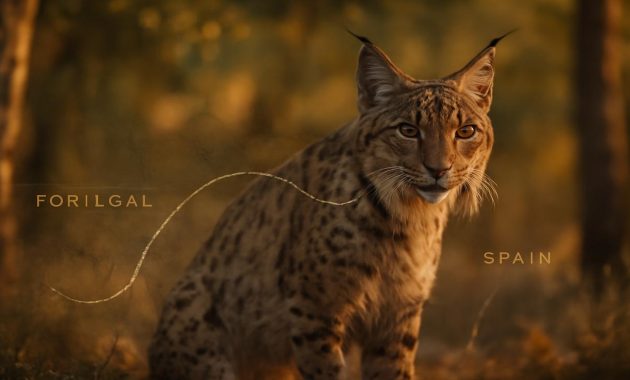
The first time you see an Iberian lynx, really see one, it’s the eyes that stay with you. Gold-rimmed, steady, almost old-fashioned in their patience. The cat stands in the half light of a dehesa clearing in southern Spain, black ear tufts sharp against the sky, whiskers trembling as if tuned to some frequency the human body can’t quite register. There is a smell of sun-warmed thyme and dust, the soft clatter of stones cooling after a hot day. Somewhere, a red-legged partridge calls once, twice, then goes quiet. And in that silence, the lynx slips away through a waist-high river of grass, moving in a world that—until very recently—was broken into pieces.
The Old Story: Islands of Lynx
For decades, conservationists told a simple and tragic story about the Iberian lynx: one species, marooned in tiny, isolated populations, each one like an island in a rising sea of roads, farms, and human towns.
By the early 2000s, fewer than a hundred Iberian lynx were left on Earth. They clung on in two main strongholds: Doñana in southwestern Spain, tucked around the shifting dunes and marshlands near the Atlantic coast, and Sierra Morena, a ragged spine of hills inland, patched with scrub and ancient oaks. On paper they were separated by only some tens of kilometers. In reality, the distance between them was measured in barriers, not in miles.
There were highways with unforgiving guardrails, fenced estates, olive groves managed like factories, and towns spreading out like ink on wet paper. The lynx in each pocket survived, bred, and hunted rabbits, but they did it in genetic isolation, each group spiraling down its own narrowing evolutionary hallway.
Scientists worried constantly about inbreeding: smaller litters, weaker immune systems, strange deformities, the quiet, invisible erosion of resilience. To save the lynx, they didn’t just need more animals—they needed connection. Corridors. Crossroads. A chance for one lynx from the west to meet another from the east and, without knowing it, rewrite the future of their species.
A Landscape Slowly Rewired
The rescue of the Iberian lynx is one of Europe’s most ambitious wildlife comeback stories. It didn’t happen in a single dramatic moment; it happened with a million patient acts.
Biologists crawled through thorn thickets to count rabbit pellets. Engineers studied roadkill maps and redesigned culverts so a lynx could pass beneath a busy highway unseen. Landowners were invited into cramped meeting rooms and asked to imagine their estates not as isolated properties, but as beads on a living necklace of habitat stretching across southern Spain and into Portugal.
Captive-breeding centers reared kitten after kitten, the air filled with the sharp smell of disinfectant and the soft, guttural calls of mothers in concrete dens. Young lynx were fitted with GPS collars—tiny satellites on furred necks—then released into newly restored land: scrub replanted, rabbits reintroduced, hunting rules rewritten.
Slowly, the map began to change. Those old, separated dots of lynx presence grew tendrils, then smudges, then larger patches. In Portugal, new populations were established, and over years, the once-empty spaces between them and their Spanish cousins began to fill with cautious paw prints.
The Moment the Data Blinked
Then, one day, the data did something new.
On a quiet afternoon in a research office, a biologist in front of a computer screen watched as dots flickered on a digital map of the Iberian Peninsula. Each dot was a lynx, each movement a day of its life, compressed into an animation of wandering, hunting, resting, surviving.
One male’s trace, born in a Portuguese release area, drifted toward the border with Spain. No surprise there—lynx roam. But he kept going, crossing farmland, skirting villages, using wooded streambeds like green threads through the human quilt. Eventually, his signal settled in a territory long considered part of the “old” Spanish population.
Other signals followed: a female from Spain turning up embedded in a Portuguese landscape; young dispersers slipping through the patchwork of oak forest and scrub that links both countries. Over months, then years, the pattern hardened into fact.
The Iberian lynx populations were mixing. What had been separate, almost symbolic, units—Spain’s lynx and Portugal’s lynx—were revealing themselves as something else entirely: a single, reconnecting population, stitched together by cautious, silent travelers no one had guaranteed would ever come.
From Theory to Fur and Bone
For years, the big hope on whiteboards and in scientific papers had been “functional connectivity”—the idea that animals could move freely enough between subpopulations to share genes. There were models suggesting it could happen. There were habitat maps that predicted the best routes. But prediction and reality are rarely the same in the wild.
This time, reality caught up. GPS data from collars, camera-trap photos, and genetic samples all pointed to the same conclusion: lynx born in Portugal were breeding in Spain, and vice versa. When scientists sequenced the DNA of kittens from litters in border zones, they found mixed ancestry, signatures of parents whose families had lived apart for generations.
The scientific community wasn’t just pleased; it was genuinely stunned. Europe isn’t exactly famous for large, intact wildernesses. The idea that a critically endangered cat had not only survived, but was now weaving its own genetic bridge across national borders, felt like the continent’s landscapes were quietly rewriting what was possible.
What Mixing Really Means for a Species on the Edge
To understand why this mixing matters, you have to zoom down to the invisible level of genes, where every new link in the population is like opening a window in a stuffy room.
When populations are isolated for too long, harmful recessive genes have a better chance of pairing up. That can mean eye problems, heart issues, reduced fertility, or less effective immune systems. Over time, this can trap a species in what conservationists call an “extinction vortex”: fewer healthy animals, less breeding, more vulnerability to disease or bad years, and eventually, collapse.
Mixing breaks that spiral. New arrivals carry different genetic variations—tiny changes in DNA that might make the immune system more versatile, metabolism more flexible, or reproduction more robust. It’s like shuffling a deck of cards that was getting dangerously close to running out of options.
| Aspect | Before Mixing | After Mixing Begins |
|---|---|---|
| Population Structure | Small, isolated groups in Spain and Portugal | Increasingly connected, one larger metapopulation |
| Genetic Diversity | Low, with risk of harmful inbreeding | Improving as genes flow between groups |
| Vulnerability to Disease | High, due to limited immune gene variation | Likely reduced over time |
| Conservation Strategy | Focus on each pocket separately | Landscape-scale management across borders |
On the ground, this shift changes how scientists work. Instead of managing lynx like patients in separate hospital wards, conservationists now think in terms of a single, fluid system—a metapopulation. Individuals move, settle, disappear, and are replaced, like currents in a slow river. Some areas act as sources, producing surplus cats that disperse. Others function as stepping stones or sinks. The challenge becomes keeping the entire network alive and flexible, not just defending a few strongholds.
The Human Thread in a Lynx’s Journey
Behind every GPS blip on a screen, there is a trail of human decisions—some made years earlier, by people who will never see the animal they helped.
A landowner who agreed not to clear a patch of thick scrub that “wasn’t worth much” for grazing. A road engineer who insisted on including an underpass and funneling fences in a highway upgrade. A ranger who spent months patiently talking to hunters about why rabbit populations needed time to bounce back, even if that meant tighter rules in the short term.
These people did not do it for headlines. Often, they did it out of a more modest conviction: that the landscape they’d inherited from their grandparents ought to remain, in some sense, alive. They might not have imagined that their choices would one day allow a lynx wearing a Portuguese collar to pad silently across the Spanish border by moonlight, invisible to everyone except a satellite and a few astonished scientists.
When a Border Becomes a Bend in the Road
On maps, the line between Spain and Portugal is sharp and final, a dark stroke looping around rivers and mountains. For an Iberian lynx, it is meaningless. A scent mark does not change its meaning at a customs post.
Yet in conservation planning, borders have always complicated things. Different laws, separate funding streams, different hunting traditions, different political moods. The fact that lynx are now demonstrably treating the peninsula as one connected space doesn’t just please biologists—it nudges policymakers toward something rare: true cross-border ecological thinking.
Already, joint monitoring programs have expanded, with Spanish and Portuguese teams comparing data, coordinating releases, and aligning their networks of camera traps and tracking stations. Veterinary protocols, reintroduction plans, even public-outreach campaigns are being reconsidered with this new reality in mind: we’re not managing two stories, but one.
And it’s not just about lynx. The same corridors that carry a spotted cat may also help genets, badgers, free-moving deer, and a cascade of less charismatic but equally essential species—reptiles, beetles, pollinating insects—find their own ways around the human-made obstacles of the modern countryside.
Night in the New Corridor Country
Imagine standing in the softly rolling hills somewhere between Badajoz and Évora, far from any big road. It’s late, the kind of rural darkness that makes the Milky Way look like frost scattered on black glass. The ground smells of dry grass and warm rock. Crickets rasp from the edges of a small ravine; an owl draws a pale line through the sky.
At your feet, the soil is crosshatched with tiny prints: rabbits, foxes, a hedgehog. And then, fresher, larger, padded ovals with retractable claws—lynx tracks, drifting along the shadowed side of a stone wall, vanishing into a stand of young cork oaks. You could draw a straight line from here into Spain, across a border only we have made, and today, there is a non-trivial chance that another lynx has walked that line in the last few weeks.
This is what the mixing of populations looks like in real life. Not fireworks, not dramatic chases—just the unremarkable, extraordinary presence of a predator reclaiming routes it had lost. The scientific community may be stunned by the confirmation, but in these quiet night landscapes, the return of connection feels less like a shock and more like a memory resurfacing.
The Fragility Behind the Good News
It would be tempting to treat this as a happy ending. The lynx are mixing, the graphs point in the right direction, and the phrase “no longer isolated populations” sounds almost like a cure. But nature rarely works in straight lines.
The Iberian lynx is still a species recovering from a near-death experience. Its success depends on a single, easily shaken resource: rabbits. When rabbit populations crash—as they have multiple times due to disease outbreaks like myxomatosis and rabbit hemorrhagic disease—the entire lynx system trembles. A few bad disease years, a drought that withers vegetation, a spike in roadkills along a key corridor, and the numbers could stall or slide.
Climate change is an added pressure, stretching droughts, twisting the delicate timing between plant growth, rabbit breeding, and lynx reproduction. Heatwaves turn once-shady ravines into ovens. Wildfires, now more intense and unpredictable, can cut brutal scars through newly functional corridors in a few days.
In this context, mixing is not a luxury; it’s a buffer. A connected population can handle local disasters better. If one area takes a hit, others can refill it, if corridors stay open. The scientific shock, then, is not so much that mixing is happening—they hoped for that—but that it’s happening soon enough to matter, while there’s still a chance to build on it.
What Comes Next: Living with a Returning Cat
As the Iberian lynx spreads, newly connected, it is also becoming more visible in the lives of rural communities that haven’t seen it in generations. That visibility brings pride, curiosity, and sometimes friction.
For livestock owners, even though lynx rarely pose a serious threat to domestic animals, the idea of a wild predator returning can stir old anxieties. For hunters, the strict rules around rabbit management and restrictions in key lynx zones can feel like an outside imposition, especially in regions where hunting is part of cultural identity.
Conservation groups and local authorities now have a fresh challenge: how to turn the stunning scientific news into a shared social success. That means fair compensation schemes, transparent communication, and, crucially, involving local people not as obstacles to be managed but as partners in shaping how a lynx-rich landscape looks and works.
Done right, the story of Iberian lynx mixing across Spain and Portugal could become not just a tale of ecological recovery, but one of rural renewal—where eco-tourism, landscape stewardship, and traditional land uses adapt together to the quiet presence of a spotted, tuft-eared neighbor.
More Than a Cat: A Different Way of Seeing a Continent
Stand again, for a moment, in that first clearing where the lynx slipped away through the grass. Listen to the insects ticking in the heat, the soft creak of an old cork oak in the wind. It is fashionable, sometimes, to talk about “rewilding” as if it’s a switch we can flip—animals released, fences removed, and nature returns as it was.
The Iberian lynx’s new, mixing population tells a more complicated—and more honest—story. It’s a story of negotiation: between fields and forests, between road safety and wildlife crossings, between villages and predators, between two nations that have learned to see a shared cat as a shared responsibility.
In that sense, the shock in the scientific community isn’t just about genetics. It’s about the proof that even in a continent etched with centuries of human use, with highways and high-speed trains and industrial agriculture, some wild patterns can still be rewoven—with enough patience, science, funding, and humility.
Somewhere tonight, a lynx born in Portugal will pause at the edge of a Spanish hillside, the air cool and clean against its whiskers. Its paws will touch dust packed by centuries of shepherds and soldiers, smugglers and surveyors, hunters and hikers. It won’t know about population models or international agreements. It will only know that ahead lies scent, cover, perhaps rabbits—a path that feels, in its bones, possible.
And when it steps forward, it carries more than its own fate. In that simple movement, it threads together history and future, science and story, two nations and one recovering wild heart of the Iberian Peninsula.
Frequently Asked Questions
Why is the mixing of Iberian lynx populations such a big deal?
Because the species was once split into tiny, isolated groups that risked inbreeding and collapse. Mixing means genes are now flowing across the peninsula, boosting genetic health and making the entire population more resilient to disease, environmental change, and random disasters.
Are Iberian lynx still endangered?
They are no longer at the very brink as they were in the early 2000s, but they remain threatened. Their numbers have grown, yet they still depend on fragile rabbit populations, safe corridors, and ongoing protection from habitat loss, roadkills, and illegal killing.
Do Iberian lynx pose a danger to people or livestock?
No. Iberian lynx are shy, medium-sized wild cats that avoid humans. Their main prey is wild rabbits. Attacks on livestock are extremely rare, and there is no record of them being dangerous to people.
How did scientists discover that Spanish and Portuguese lynx were mixing?
They combined data from GPS collars, camera traps, and genetic analyses. Collared animals were tracked crossing the Spain–Portugal border, and DNA tests on kittens showed parents from different regional lineages, confirming gene flow between formerly isolated groups.
What can ordinary people do to help Iberian lynx conservation?
Support organizations working on Mediterranean habitat restoration, drive carefully in known wildlife-crossing areas, respect local rules in lynx territories, and back policies that protect natural corridors and reduce habitat fragmentation. Even small actions, multiplied across many people, help keep the landscape permeable for wildlife.