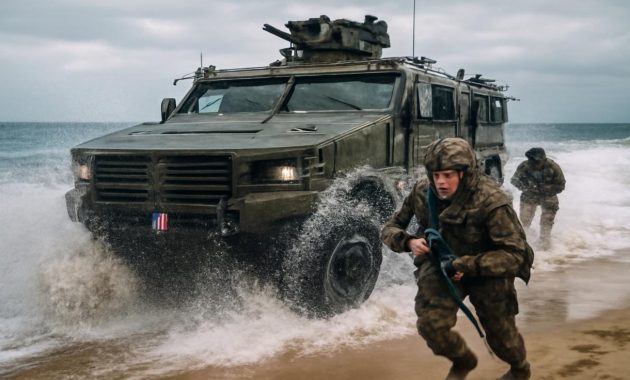
The sea is almost black at 03:17 in the morning, a low, breathing thing under a moon that keeps slipping in and out of clouds. In the well deck of a French amphibious assault ship, sodium lamps bathe steel, fuel, and salt spray in a sodium-yellow glow. Engines grumble somewhere in the belly of the vessel, and thirty-ton silhouettes crouch in the half-light like patient animals. One of them is the Griffon 6×6, France’s new armoured workhorse—a machine that, in the next few minutes, will be asked the most brutal question any vehicle can face: can you leave the relative safety of the sea, hit a hostile shore, and be in the fight before the first minute decides everything?
The Moment That Decides Everything
Everyone in that steel cavern knows about the minute. They talk about it in planning cells, in classrooms, in after-action reviews that drag late into the night. It’s the small, brutal window between landing and being able to move, shoot, and communicate like you meant to be there. Miss that window—stalled in the surf, blinded by sand, comms down, wheels spinning—and an operation that took months to plan can collapse in a heartbeat.
For decades, amphibious operations carried an unspoken dread: that the heavy kit meant to protect troops would become their prison at the shoreline, bogged in soft sand, cut off by waves, too cumbersome to improvise. France, with its long maritime borders and commitments, has never had the luxury of ignoring that dread. The Griffon, part of the French Army’s ambitious SCORPION modernization program, was not designed just to roll down clean highways. It was born with the expectation that one day it might be asked to jump from steel to surf to sand under fire—and not waste a second doing it.
That’s how you end up with a night like this: a well deck sloshing with seawater, the hulking shapes of amphibious landing craft waiting, and a crew of soldiers and engineers watching to see whether the promise written on glossy brochures holds under the weight of salt, stress, and gravity.
The Sea Trial Nobody Can Fake
The order to test the Griffon in full amphibious conditions did not come from a desk-bound fantasy. It came from a set of hard, almost impolite questions. What happens when the vehicle doors open and the first gust of ocean air swirls with diesel fumes? How fast can a platoon disembark from a landing craft, load up, and push inland before a theoretical enemy has time to react? What breaks when you mix seawater with hi-tech electronics, mud with sensors, panic with procedures?
The scenario is ruthless by design. France’s amphibious doctrine demands that forces arriving from the sea must be able to punch through a fragile shoreline zone—deep sand, shifting dunes, salt marsh, sudden drops—without waiting for the perfect piece of beach. For the Griffon, that means making the brutal transition from floating platform to wheeled assault in one smooth, almost uninterpreted movement.
The test planners decide there will be no gentle rehearsal. The landing craft will open directly onto a stretch of unforgiving, sloped sand on a cold Atlantic coastline. Tides will be rising, crosswinds stiff, surf untidy. The kind of conditions where older-generation wheeled armoured vehicles might once have dug themselves in up to the axles while the enemy watched from the tree line.
To make it harder, the minute is formalized. From the moment the ramp of the landing craft smashes down onto wet sand, clocks will start. Somewhere in a control room packed with Marines, Army officers, and engineers, a digital timer will begin counting the seconds between “doors open” and “Griffon fully combat-ready inland.” No one wants to be the reason that number creeps beyond the short window doctrine demands.
Inside The Beast: Smell Of Salt, Hum Of Data
Before the ramp drop, the Griffon doesn’t feel like a brute. Climb into it and you are met with something closer to a submarine-interior-meets-digital-command-post than a simple troop carrier. The air smells of nylon webbing, oil, rubber, and faintly of the last exercise’s mud, baked into crevices. A low electronic hum threads through the interior. Screens glow softly on swing arms. Cables are strapped in clean runs overhead.
The soldiers sit facing each other, packed but not crushed, helmets clipped to their chests, rifles angled between their knees, boots braced against the floor. Their world is a pulsing red light and the vibration under them. Some pretend to doze; others watch the digital map feeding them data via the SCORPION combat information system.
On the map, the beach is not a romantic curve of coastline. It is a grid of risks, waypoints, and timings. The Griffon is a tiny blue icon, stacked with others in the landing craft’s belly. Overlaid are meteorological data, known obstacles, and simulated enemy positions. Everything points to that one, thin line where deep water gasps itself into surf and fragile land. The place where heavily laden vehicles have always been tempted to hesitate.
The crew commander’s headset crackles with voices from the landing craft’s bridge, from troop HQ, from a distant operations center that could be a hundred kilometers away on land. Yet, in this moment, everything unravels into something simple: ramp down, check traction, nose up, find the route that keeps you moving. The Griffon’s 6×6 drivetrain and intricate suspension are about to learn whether the fine calculations made in design studios and laboratories are enough to beat gravity and sand.
The Minute Starts On A Bang Of Steel
It begins with a jolt: the entire landing craft shivers as its bow doors open. The sea air floods in—cold, aggressive, smelling of iron and salt and something green from long distances. Then comes the heavy mechanical crash as the ramp slams down onto the shore.
Light knifes into the dim cargo hold, white and ruthless, bouncing off angles of armour and puddles. The timer starts.
The driver feels the vibration change under the hull. Water slaps the sides of the landing craft, and then there’s the harsher scrape of metal meeting sand and stone. An audio cue on the intercom: “Go, go, go.” The Griffon’s engine answers with a deeper growl. The whole vehicle leans, rouses itself, and rolls.
The first meters are the most dangerous. Wet sand can be a liar—smooth and firm at the surface, soft and treacherous beneath. The Griffon’s weight presses down, distributing across six massive wheels. Traction control systems taste the surface thousands of times a second, adjusting torque, slipping power from one wheel to the next with micro-decisions that would have taken humans too long to get right.
The ramp angle is nasty, the transition from artificial steel slope to natural beach uneven. Older vehicles might have slammed their noses into the sand, paused, adjusting, wheels spinning. The Griffon’s suspension soaks the impact, main nose rising a fraction, then surging forward like it has found a path only it can feel.
Inside, the soldiers sway in their harnesses but don’t lose rhythm. They’ve rehearsed this drill until it feels like muscle memory: tighten straps, check weapon safety, glance at the digital display that now shifts from “embarked mode” to “land combat mode” as the vehicle’s systems recognize they’re off the boat.
The minute is ticking. Thirty seconds gone.
When Sand Isn’t Just Sand
The Griffon doesn’t simply drive; it reads the ground. French engineers had anticipated this nightmare zone—the mixture of wet and dry sand, hidden ruts left by previous landings, shallow water pockets that look solid until a wheel breaks through. In simulation labs far from the sea, they had poured virtual regiments across virtual beaches. But the Atlantic has its own personality, and tonight it has decided to be fickle.
As the Griffon clears the ramp and commits its full weight onto the beach, the front-right wheel hits a softer patch. There’s a half-second of drag. Everyone inside can feel the difference, a subtle but sinister tug on motion. In less advanced vehicles, this is the moment where panic starts—the fear of bogging down under the gaze of an unseen enemy.
Instead, the vehicle compensates. Sensors feeding data into the central computer instruct a delicate readjustment: a shade more power to the left, a marginal change in steering angle, suspension recalibrating to keep ground pressure optimal. To the driver, this feels like intuition. To the machine, it is simple math performed at blistering speed.
Outside, spray fans from the wheels, throwing saltwater and shattered shells out in arcs. The exhaust heat wavers in the night air, creating a mirage along the vehicle’s path. The Griffon claws up the slight incline of the beach, heading for a thin corridor defined in the mission data—a route that offers cover from direct line-of-sight while still being hard enough ground to keep the convoy moving.
In the back, a corporal watches the onboard displays while listening to the change in engine pitch. He knows from earlier generations how quickly things can go wrong, how a wheel stuck in hidden mud can turn a battle taxi into a steel coffin. Tonight, his eyes flick between the terrain overlay and the real-time feed from external cameras: a ghostly black-and-white shoreline, dunes rising like low ghosts on the horizon.
Forty-six seconds.
The First Firing Line Starts Inland
The mission profile is unforgiving. The Griffon is not just expected to hit the sand and roll a symbolic hundred meters. It must push beyond the fragile strip where the sea can still grab it, up to a point where it can debounce into its real purpose: ferrying its squad into a position from which they can influence whatever is unfolding inland.
In the tactical imagination of the French Army, the Griffon is a node—armour, transport, and data gateway rolled into one. Its SCORPION system links it to drones, artillery batteries, command posts, and sister vehicles in the same breath. To fail at the beach would not just be a mobility problem; it would be the failure of a network.
Fifty-eight seconds.
The sand gives way under the wheels to firmer ground, a strand of packed earth and gravel just beyond the high-tide line. The driver feels it instantly, the resistance easing, the steering sharpening. He breathes out—he didn’t know he’d been holding his breath since the ramp dropped.
“Beachline cleared,” the crew commander reports into the net, voice level but vibrating with controlled adrenaline.
Above them, in the operations room, a marker on a large display screen jumps from red to amber. The timer continues, but the worst of the transition is over. The Griffon has not only survived contact with the shore; it has done so in under a minute and kept its operational posture intact. No reset, no regroup, no lost cohesion.
At sixty-three seconds, the side hatch opens with a hiss. Cool, grainy air rushes in. Boots hit dirt. The squad pours out in a practiced, almost balletic sequence, fanning to preassigned arcs, weapons ready, comms live. To anyone watching from a distance, it looks as though they’ve simply appeared inland, fully composed.
The minute has come and gone. The operation, on this night at least, expands rather than dies.
Designing For That First Minute
None of this happened by accident. The Griffon is the product of a quiet revolution inside French land warfare thinking. Championed under the SCORPION program, it replaces older VAB armoured personnel carriers that, while reliable in their time, were never born in an age that expected vehicles to be smart, networked, and amphibiously agile all at once.
The design team—engineers from several French defence companies working with Army testers—began with unromantic constraints: weight versus protection, mobility versus payload, complexity versus reliability. Could you build a vehicle heavy enough to protect against improvised explosive devices and modern anti-armour threats, yet nimble enough to handle the shifting, soggy margins of a hostile coast?
The answer emerged from thousands of iterations: a 6×6 configuration with independent suspension, a powerful but efficient diesel engine, and a modular armour concept that could be tuned to mission profiles. Every cable routing, every seal, every breathing vent was tested against a hostile mix of dust, water, and pressure to ensure that the Griffon could shrug off the sea, not just the roadside bomb.
Digital architecture was as vital as steel. The combat information system—a secure, integrated suite that binds vehicles, drones, and command posts into a single nervous system—was given priority space inside the hull. To the uninitiated, this might look like a cluster of screens and switches. To a commander trying to coordinate an expanding beachhead, it is the difference between guessing and knowing.
At the same time, designers tried to remember something easy to forget when staring at CAD models: the human body. The Griffon’s interior, though utilitarian, is kinder to knees, backs, and nerves than many of its predecessors. If soldiers arrive at the shoreline already exhausted, the best engineering in the world won’t salvage the first minute.
| Feature | Griffon 6×6 Capability | Relevance From Sea To Shore |
|---|---|---|
| Drive Configuration | 6×6 all‑wheel drive, independent suspension | Maximizes traction on soft, mixed sand and uneven beach gradients. |
| Digital Battle Network | Integrated SCORPION combat information system | Ensures the vehicle is tactically “online” the moment it touches land. |
| Protection | Mine and ballistic protection, modular armour | Keeps troops safe in the vulnerable early phase of an amphibious landing. |
| Crew & Troop Capacity | Crew of 3 + up to 8 infantry | Delivers a full, coherent squad ashore in one protected package. |
| Mobility Tuning | Adjustable tire pressure, traction control | Helps prevent bogging down in mud, surf zones, and loose sand. |
Training The Human Half Of The Machine
Yet even the best machine is only half the equation. The night sea trial is as much about human reflex as technological prowess. French Marines and Army units have quietly rewritten the choreography of amphibious arrival to match what the Griffon can do.
On training beaches in Brittany and the Mediterranean, troops practice disembarking under time pressure, cycling through drills where landing craft ramps drop unexpectedly fast, or where simulated equipment failures force quick decisions. Drivers learn to “read” waterlines and sand colour the same way mountaineers read snow. Crew commanders rehearse talking through three radio nets at once without freezing, turning the Griffon from a simple carrier into a moving command node.
In after-action debriefs, they dissect each landing down to the heartbeat. How many seconds from ramp down to the first wheel touching sand? At what angle did the vehicle approach the softest patch? When did the first outbound radio message confirming beach clearance go out? Tiny efficiencies scraped from each step are banked like coins towards that single, brutal demand: no wasted minute.
The more the crews work with the Griffon, the more the machine takes on a personality. Some vehicles are “lucky” on bad sand, some are praised for the smoothness of their suspension after long sea journeys, others are notorious for a squeak somewhere deep in the hull that no one can quite locate. It’s the intimate, superstitious relationship soldiers have always developed with the objects that carry their fate.
Why This Minute Matters Beyond One Beach
On a map of global crises, the place where these tests happen is a small pin on a big, crowded board. But the logic behind them stretches across oceans. France’s commitment to alliances, to overseas territories, to crisis response far from its metropolitan heart, means that the question of how swiftly it can transition from sea presence to land effect is not academic.
The Griffon’s proving ground on French shores is a rehearsal for scenarios that might play out on unknown coasts: a humanitarian crisis in a flooded delta, an evacuation from a collapsing city with no viable airport, a rapid-reaction force landing on a contested littoral where hostile forces hold the roads inland.
In each of those, the first encounter between wheel and sand, between plan and friction, will have an outsized influence on everything that follows. If vehicles falter at the waterline, the entire logic of projecting force from the sea begins to wobble.
That is why, when the test convoy returns from the beach, dripping salt and dotted with sand, no one is simply satisfied they “made it.” Data is pulled, analyzed, argued over. Engineers peer at logs that capture tiny fluctuations in wheel torque. Officers replay helmet-camera footage to see where human reactions lagged behind what the machine could have tolerated.
France is not just checking whether the Griffon can survive the sea-to-shore transition. It is refining a promise: that when an operation’s fate hinges on a narrow window of time, its armoured spearhead will not squander it.
Back in the well deck, with the sea once again held at bay by steel doors, the Griffon cools. Drops of saltwater tick from its armour. Inside, the screens go dark one by one. Outside, in a world that doesn’t see these trials, people sleep, read the news, glance at maps. Very few will ever stand on a ramp between ocean and sand with thirty tons of steel behind them and a timer somewhere unseen.
But in the quiet after the engines die, the minute lingers in everyone’s mind—not as an abstraction, but as a lived thing. A weight. A challenge met. And a reminder that in modern warfare, victory often belongs not just to the strongest force, but to the one that wastes the least time when leaving the sea.
Frequently Asked Questions
What is the Griffon 6×6 armoured vehicle?
The Griffon 6×6 is a French multi‑role armoured vehicle developed under the SCORPION modernization program. It is designed to transport infantry squads safely while serving as a digitally networked node that connects troops, command posts, and supporting assets like drones and artillery.
Is the Griffon an amphibious vehicle itself?
The Griffon is not a swimming vehicle in the classic sense; it does not independently cross open water. Instead, it is designed to operate as part of an amphibious force, embarking on landing craft or amphibious ships and then transitioning rapidly from sea transport to fully capable land operations the moment it hits the shore.
Why is the sea‑to‑shore phase so critical for the Griffon?
The sea‑to‑shore phase is often the most vulnerable moment in an amphibious operation. Vehicles can bog down in soft sand, lose traction, or suffer from water and salt exposure. The Griffon is tested harshly in this zone because any delay or failure here can compromise the entire mission before it properly begins.
How does the Griffon handle soft sand and difficult beach terrain?
The Griffon’s 6×6 all‑wheel drive, independent suspension, modern traction control, and adjustable tire pressure allow it to maintain momentum over soft sand and uneven ground. Sensors feed data to onboard systems that constantly adjust power distribution to reduce the risk of becoming stuck at the shoreline.
What role does the SCORPION system play during a landing?
The SCORPION combat information system keeps the Griffon connected to the wider battle network. During a landing, it provides real‑time maps, updates on friendly and enemy positions, and coordination with other vehicles and support assets, so that the unit is tactically effective from the first moments ashore.
Who operates the Griffon during amphibious operations?
The Griffon is operated by trained French Army crews, often working closely with the French Navy and Marine units during amphibious missions. Drivers, commanders, and infantry squads undergo extensive drills to synchronize their actions with the vehicle’s capabilities in the demanding sea‑to‑shore environment.
Why does France invest in testing the Griffon in such harsh conditions?
France maintains overseas territories and global responsibilities that may require rapid intervention from the sea. Testing the Griffon in harsh, realistic beach conditions ensures that when a real crisis unfolds—whether combat or humanitarian—its forces can move from ship to shore without wasting the crucial minute that can decide if an operation succeeds or fails.