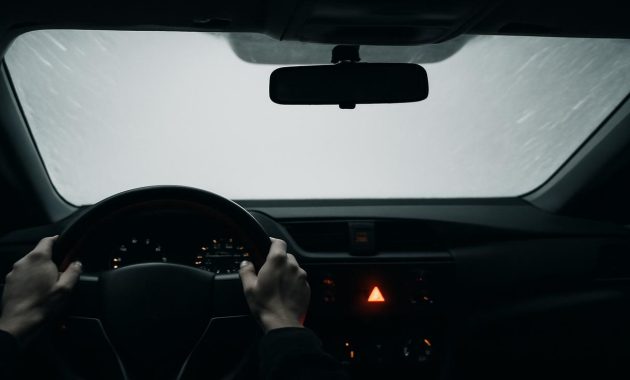
The news came in just after sunset, in that blue hour when the world feels briefly suspended between what was and what might be. A quiet ping on the phone, a line of text crawling across the bottom of the television, a neighbor’s hurried knock: heavy snow, officially confirmed, is expected to intensify into a high-impact storm overnight. Outside the window, the first flakes look innocent enough—weightless, unhurried, swirling in the glow of the streetlamp. But the air has that charged, metallic stillness that says something is building, something larger than routine winter weather. Meteorologists, suddenly more solemn in their tone, caution that visibility may collapse without warning. What you can see right now—the road, the trees, the porch light across the street—might soon dissolve into an indistinguishable white wall.
The Evening Before: When the Air Starts Talking
Listen carefully and the storm announces itself before the maps catch up. The wind forgets how to be gentle. It comes in experimental bursts, testing shutters, nosing its way down chimneys, brushing across your face with a damp, invasive cold. The sky, earlier a clean winter gray, thickens into a low, unbroken ceiling that seems to press down on rooftops. In the distance, traffic sounds dull, as though the first layers of snow are already soaking up the noise.
Inside, small rituals begin. Someone in the kitchen fills pitchers and bottles with water, just in case. The flashlight you haven’t touched since last summer’s camping trip is pulled from a drawer; its narrow beam slices the darkness, then clicks off again. Batteries gather in a small pile on the counter. Phones go on chargers. You move from room to room, flipping switches, noting which lamps make the space feel the warmest, the safest, imagining how it will look if the power shrugs off and the house is lit only by candles and the faint reflection of snow.
On the local station, meteorologists stand in front of churning, color-splashed radar loops. Their voices carry the quiet urgency of people who have watched storms like this before. What began the day as “heavy snow likely” has now matured into “a high-impact winter storm.” There’s a subtle but crucial difference. Heavy snow is an inconvenience, an extra twenty minutes on your morning commute, a few bent branches, a neighbor’s car stuck at the end of the driveway. A high-impact storm is an event that rearranges the map of what’s possible by morning.
The forecast models, once scattered and contradictory, have begun to align. Bands of snowfall coil across the map like white rivers, pinned down by the steady push of arctic air above and moist, rising air from the south below. Somewhere beneath those intersecting currents sits your town, your street, your own front step. You watch the projection of snowfall totals creep upward, inch by inch, as the meteorologist explains: “We’re now confident this will intensify overnight. Conditions could deteriorate very quickly. Visibility may collapse suddenly as heavy snow bands set up.”
A Storm You Can Feel in Your Chest
Outside, the night is thickening. The snowflakes, once scattered and discrete, knit themselves into a swirling curtain. They hit the windows with a faint, insistent hiss. If you step onto the porch, the snow finds every exposed inch of skin, melting instantly, sending thin rivulets of cold down your collar. Streetlights radiate blooming halos, their edges fuzzed by the falling white. The world’s sharp lines—fence posts, parked cars, distant rooftops—go slightly out of focus, as if viewed through frosted glass.
You can feel the pressure changing, not just in the air, but in your own chest. People text each other from across town: “You seeing this?” Photos of early accumulation start appearing in neighborhood chats. The language shifts from weather to story: “Remember the storm of ’09?” “This one feels like that time when we lost power for three days.” Shared memory becomes a kind of emotional sandbagging, a way to brace for what you can’t yet see.
On the highway, taillights glow like a string of distant embers. Drivers lean forward over steering wheels, watching flakes come straight at them in hypnotic streaks. The first slippery intersections announce themselves with a slow, unintentional slide through a stop sign, a sideways shimmy as a car tries to pull away from the curb. Snowplows idle in a lot beside the public works garage, orange beacons already spinning. The operators sip coffee from battered thermoses, waiting for the call that will send them into the growing white.
Inside homes, you can trace the storm in the shifting light. Heavy clouds reflect the brightness of streetlamps and porch lights, bouncing a ghostly glow back down to earth. The night never gets truly dark; instead, the sky becomes a soft, backlit sheet, a reminder of the billions of snowflakes silently making their way earthward. Time slows down. The world pulls inward.
How Quickly Visibility Can Disappear
“Sudden collapse of visibility” is a phrase that lives comfortably in a forecast discussion or a meteorology textbook. But out here, on a real night, it means something else entirely. It means one minute you’re looking across the street at a neighbor’s windows, and the next minute, the entire block has simply vanished, erased by a roaring white void.
In a high-impact winter storm, snowfall doesn’t just fall—it attacks in waves. Intense bands, narrow but ferocious, can spool up without warning. One moment you’re driving along a road you know by heart, able to see the familiar curve lined by maples and telephone poles; the next, the windshield fills with blinding white, and the world beyond the hood of your car ceases to exist. The horizon evaporates. Depth perception unravels.
The snow piles onto itself, each flake blurring into the next until the air becomes a single, seething substance. Headlights only make things worse, turning the chaos into a bright, spinning tunnel that seems to be collapsing in on you. It’s disorienting in a way that feels almost primal—your brain, deprived of visual anchors, gropes for something fixed to hold onto, and finds only more snow.
The same thing happens on foot. An ordinary walk to the corner store becomes an expedition. You set out wrapped in layers, following your own familiar sidewalk. Then a gust of wind arrives like a closing curtain, and suddenly you’re not sure if you’ve passed the third driveway or the fifth. The world shrinks to a small, circular bubble of awareness: your boots, your breath, the closest patches of swirling white, the muffled thud of snow landing on your hood. Everything beyond that bubble fades into an indistinct, humming silence.
And still, the storm deepens. Meteorologists call it “rates of one to three inches per hour,” but what you experience is the rapid transformation of a landscape in real time. The snow finds flat surfaces and devours them: the mailbox, the car roof, the porch steps. Lines between “up” and “down” blur as drifts grow tall enough to eat fences. Trees bend under the growing weight, their branches cracking with gunshot snaps that echo in the muffled dark.
The Anatomy of a High-Impact Winter Storm
To understand why this storm is different, you have to follow the invisible architecture of the atmosphere, the layered story written in temperature, pressure, and moisture. Thousands of feet above your roofline, cold, dry air slides down from the north—heavy, dense, and hungry. From the south, warmer, moisture-laden air surges forward, like a river pouring into a valley.
Where these masses meet, they clash and tangle, forced to rise together. As the warmer air ascends, it cools, and the moisture it carries condenses into ice crystals. What begins as microscopic shards of ice gather, collide, and lock together in intricate hexagonal designs. Snowflakes form, each one unique, yet all bound by the same geometry of temperature and pressure.
Down here at the surface, you don’t see the equations that govern their formation; you feel the result. A deepening low-pressure system tightens its grip on the region, spinning counterclockwise like a slow, grinding gear. As it strengthens, the pressure gradient increases, and the wind responds, pulling in colder air, pushing out milder pockets. This pressure drop is what the meteorologists mean when they say the storm is “intensifying overnight.” The engine of the storm is revving up while most of the town is trying to sleep.
In that invisible machinery, there are corridors—narrow channels where rising air is especially vigorous. These are the birthplaces of the heaviest snow bands. If your home happens to fall beneath one, you’ll see the difference right away. Snow that was falling at a gentle, storybook pace suddenly accelerates, thickening into a frenzy. In the span of an hour, your back deck might gain two new inches of powder. This is where visibility collapses, not as a metaphor, but as a physical reality.
| Storm Element | What It Feels Like | What Meteorologists See |
|---|---|---|
| Rapid Visibility Collapse | Streetlights vanish, horizon disappears, you can barely see past your hood. | Intense snow bands with very high snowfall rates, strong wind, and whiteout conditions. |
| Heavy, Fast Accumulation | Snow stacking up inch by inch in under an hour; shoveling feels endless. | Snowfall rates of 1–3 inches per hour, often beneath a deformation band. |
| Wind-Driven Snow | Drifts form, snow stings your face, footprints vanish quickly. | Strong pressure gradient, gusty winds, and blowing/drifting snow. |
| Power Flickers or Outages | Lights dim, appliances pause, the house falls silent except for the storm. | Heavy, wet snow or strong winds bringing down limbs and power lines. |
This is what the meteorologists are watching as they shift their language from “maybe” to “confirmed.” They look at cross sections of the atmosphere, at vertical motion, at bands of reflectivity on radar that glow brighter as flakes grow larger and denser. They see the storm’s skeleton; you feel its skin.
The Human Weather Inside the House
While the storm gathers its strength outdoors, another kind of weather develops inside. There’s a particular mix of anticipation and unease that only a serious winter storm can bring. It smells like wet wool and hot chocolate, like pizza boxes stacked on the counter “just in case we can’t cook later,” like the faint ozone tang of electronics being charged all at once.
Children, half-delirious at the prospect of a snow day, tape handwritten signs to windows: “LET IT SNOW.” They press their noses against the glass, leaving oval patches of fog as they watch a familiar world disappear inch by inch. They speak in countdowns: “If it keeps going like this, school is definitely canceled.” For them, the storm is an unexpected holiday, a sudden doorway into hours of sledding, fort-building, and the delicious chaos of unstructured time.
For those in charge of keeping everyone safe, the mood is different. Parents double-check the location of snow shovels, dust off the old ice melt, make sure the car’s gas tank is topped off. They calculate in their heads: If the snow starts stacking up at midnight and keeps going until noon, when will we need to shovel first? Should we move the car to the end of the driveway before it becomes a snow sculpture? Should we call the elderly neighbor now to make sure they have what they need?
There is a particular quiet that settles in just before the worst of it hits, a pause in the middle of the story. You stand at the window, hand resting against the cold pane, and watch the world soften. Traffic dwindles. Porch lights click off as one house after another decides that, for tonight at least, the outside world can wait. The snow keeps falling, patient and relentless.
On the Edge of a Whiteout: Choosing Stillness
The warnings are clear by now: “If you don’t need to be out, stay put.” The temptation to test the edges of the storm is powerful. There’s a stubborn part of us that wants to prove we can outdrive the snow, that our all-wheel drive or our experience on winter roads will be enough. The high-impact storm has other plans.
In weather like this, the bravest choice is often stillness. To delay that errand until morning, to accept that the road conditions may be beyond your personal threshold, to let the storm have the night. The power of intense snow is not just in the depth it leaves on your doorstep, but in the way it can suddenly erase your options. Visibility is more than just what you can physically see; it’s your ability to anticipate, to react, to navigate both the road and your own instincts.
When meteorologists talk about whiteout conditions, they are naming something that sits at the border between physics and psychology. It isn’t only the snowfall rate or the wind speed; it’s the moment your brain realizes it has lost track of where you are. The landscape turns blank, and with it, your confidence. In that moment, the most courageous act you can take might be pulling over, turning on your hazard lights, and letting the storm move through while you wait.
Back home, the decision to stay put has its own rewards. You become a witness, rather than a contestant. You hear the way the wind changes direction, pushing snow first against one side of the house, then the other. You notice how quickly the porch steps vanish. You learn, viscerally, what “one to three inches per hour” looks like when measured against the height of your boot prints or the progress of snow halfway up the door.
Morning After: A World Redrawn
At some point in the night, lulled by the rhythmic rush of wind and the soft tick of snow against the windows, you fall asleep. The storm does not. It continues its steady work while the town dreams. Plows growl through the small hours, steel blades scraping, engines roaring. Somewhere, a transformer pops with a sharp blue flash. Somewhere else, a tree limb surrenders, heavy with snow, and falls with a deep, splintering crack.
When morning comes, the world has been redrawn. The familiar landmarks of your street are transformed into rounded, anonymous shapes. Cars become smooth mounds with faint hints of side mirrors, mailboxes rise from drifts like solitary, snow-capped sentries. The air, for a brief time, is startlingly calm. The storm has moved on, leaving a vast, echoing quiet in its wake.
You open the door and the smell of the new snow hits you—clean, almost metallic, tinged with the cold scent of frozen iron and bark. Your first step off the porch plunges deeper than expected. The snow grabs at your boots, squeaking underfoot, clinging to your pants. As you wade into it, you become aware of the weight of the storm, measured not in inches, but in effort: each shovelful lifted, each car dug out, each path carved back into the whiteness.
Neighbors emerge one by one, bundled and unrecognizable at first, then revealed by their gait, their wave, the way they lean into their shovels. The storm, which pushed everyone indoors the night before, now nudges them outside into a communal choreography of clearing and checking in. “You okay over there?” “Lose any branches?” “You got power?” Stories from the night begin to circulate, braided into the sparkling air.
The meteorologists appear on screens again, this time less urgent, more reflective. They show time-lapse footage of the storm’s passage, the looping swirl that crossed the region while most people slept. They tally snowfall totals, point out where the heaviest bands parked themselves, where visibility dropped to near zero. Their maps confirm what your muscles already know: this one was real.
FAQs About High-Impact Snowstorms and Sudden Whiteouts
What makes a snowstorm “high impact” instead of just heavy snow?
A storm is considered “high impact” when it significantly disrupts daily life: dangerous travel, rapid snow accumulation, strong winds, potential power outages, and a high risk of sudden whiteout conditions. It is less about a single number of inches and more about how quickly conditions deteriorate and how long hazardous conditions last.
Why can visibility collapse so quickly in these storms?
Sudden visibility collapse usually happens under intense snow bands, where very heavy snowfall combines with wind. The air fills with dense, wind-blown flakes that scatter light in every direction. Without clear visual anchors—like visible road edges or landmarks—your brain loses depth perception, and it can feel like the world beyond a few feet no longer exists.
What should I do if I get caught driving in a whiteout?
If possible, slow down gradually and look for a safe place to pull far off the road, such as a parking lot or well-marked turnout. Turn on your hazard lights so others can see you. Avoid stopping in the driving lane or just over a hill or around a curve. Stay in the vehicle if it is safe to do so and wait until visibility improves rather than trying to walk in blinding snow.
How can I prepare at home for an overnight high-impact storm?
Charge devices fully, gather flashlights and extra batteries, and fill water containers. Make sure you have basic food that does not require extensive cooking, and check that you have necessary medications. Move shovels, ice melt, and winter gear where you can reach them easily. If you live near vulnerable trees or power lines, consider having extra blankets and a safe, alternative heat source available.
Why do meteorologists sometimes sound unsure at first, then suddenly “confirm” a big storm?
Forecast models often disagree in the early stages of a potential storm, especially about where the heaviest snow bands will form and how quickly a system will strengthen. As new data arrives—satellite images, radar trends, updated model runs—meteorologists gain confidence. When enough evidence aligns, they shift from cautious language (“potential for heavy snow”) to more definitive wording (“high-impact storm confirmed”). This change reflects increasing certainty, not a sudden change in the storm itself.