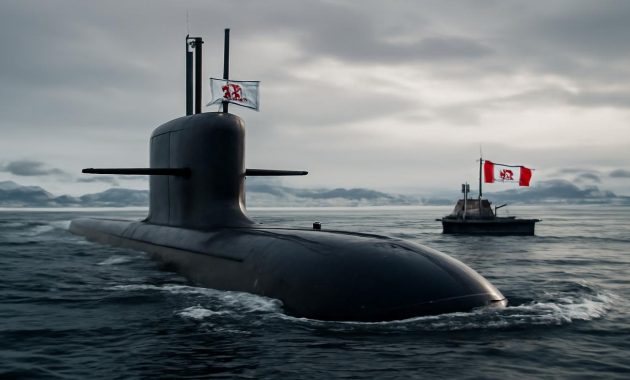
The ice looks solid from the airplane window, a white sheet folded over the top of the world. But down below—beneath that skin of frozen ocean, beneath the drifting floes and pressure ridges and seal-breathing holes—the Arctic is hollow with sound. Currents whisper along the seabed. Ice grinds, booms, and cracks. Whales trade long, mournful songs in the dark. And somewhere in those depths, if Canada says yes, a new kind of visitor could be listening: a quiet, black-hulled Korean submarine carrying a red maple leaf on its sail.
The Knock On Canada’s Door
In late 2023 and into 2024, a quiet but historic conversation began to grow louder between Ottawa and Seoul. South Korea, better known in the public mind for smartphones, K‑pop, and shipyards the size of small cities, made an offer that went far beyond trade statistics: it wants to build Canada’s next generation of submarines.
On the surface, it sounds like a straightforward defense contract—one country selling another a few very expensive machines. But the stakes, as Korean officials and Canadian strategists both know, are enormous. This is about the Arctic, where the ice is melting and shipping routes are slowly opening. It’s about an industry Canada once had but let fade. And it’s about whether the country can keep actually seeing—let alone controlling—what passes under its northern seas for the next 40 years.
South Korea’s pitch is bold. It doesn’t just say, “Buy our submarines.” It says, in effect, “Let us help you become a submarine power again.” In a way, it’s an invitation to rewrite Canada’s maritime story right where it matters most: along the invisible frontier of the High North.
The Arctic: A Quiet Ocean With Loud Consequences
Stand on the deck of a ship in the Beaufort Sea or the high reaches of Baffin Bay in winter, and the soundscape is as spare as the horizon. Wind. The low growl of ice rubbing against ice. Somewhere far away, the thump of a distant icebreaker. Yet beneath your boots lies one of the most contested and quietly watched regions on Earth.
As climate change thins sea ice and lengthens the summer navigation season, the Arctic is changing from fortress to corridor. New shipping paths, like the Northwest Passage, are becoming more navigable. Russia has already poured money into northern bases and icebreakers. The United States sails nuclear submarines under the ice. China calls itself a “near-Arctic state” and sends research vessels—some of them bristling with dual-use sensors—through polar waters.
Canada, by contrast, has only four aging Victoria-class diesel-electric submarines, bought used from the United Kingdom in the late 1990s. They are complex, capable vessels but famously temperamental, and they were never designed with prolonged Arctic under-ice operations in mind. Their patrols are limited by both age and environment.
In a region where so much activity occurs underwater and out of sight, that creates a particular kind of vulnerability: an information gap. You cannot assert sovereignty over what you cannot reach, cannot see, and cannot quietly track.
South Korea’s offer is tuned exactly to that anxiety. It suggests a way to give Canada a kind of underwater vision in the Arctic—lenses and ears made of steel and sonar arrays.
Why Submarines Matter More Than Icebreakers
The Canadian public conversation about the Arctic often revolves around icebreakers, polar ice, and Rangers on snowmobiles. These are visible, photogenic symbols of northern presence. Submarines, by design, are invisible, and so their political symbolism feels more muted. Yet for sovereignty, they are arguably more crucial.
A submarine can do three things that aircraft and surface ships struggle to combine: it can persist, it can hide, and it can watch. In the Arctic, where storms can pin aircraft to the ground and ice can choke even strong hulls, an underwater platform offers a kind of quiet freedom. It can listen for foreign submarines or undersea drones. It can monitor the approaches to the Northwest Passage. It can slip beneath ice floes instead of fighting through them.
Modern, air-independent propulsion (AIP) submarines—like the kind South Korea has built and refined—can stay submerged much longer than older diesel-electric boats, recharging less often and moving silently through cold, dense water. For a country like Canada, with a coastline that stretches across three oceans, that sort of endurance translates into a different quality of sovereignty: not just declaring you own the place, but actually being there, consistently, without drawing attention.
South Korea’s Offer: Steel, Skills, And A 40-Year Horizon
South Korea’s naval industry has become one of the world’s quiet success stories. Its shipyards—Hyundai Heavy Industries, Daewoo Shipbuilding, Hanwha Ocean and others—turn out everything from container ships to advanced destroyers and submarines. Over the last two decades, Seoul has invested heavily in naval technology not just for its own defense against North Korea, but as an export strategy.
Today, South Korean submarines patrol for navies as far away as Indonesia. The country’s designs blend German submarine heritage with Korean manufacturing and systems integration, producing vessels that are considered reliable, relatively cost-effective, and increasingly sophisticated. Unlike the nuclear-powered behemoths of the U.S. or Russia, these boats are smaller, but they are built for long patrols in difficult waters.
The “Made With Canada” Vision
In its pitch to Canada, South Korea is not simply proposing an off-the-shelf sale. The language from industry representatives and officials has emphasized something more ambitious: co-development, co-production, and technology transfer.
Translated into everyday terms, that means Canadian companies would not just bolt on antennas or paint the hulls; they would be wrapped into the core of the program. That could include hull fabrication, combat systems integration, maintenance hubs, and training centers on Canadian soil. The benefits would extend over the entire lifespan of the submarines—roughly 35 to 40 years.
For Canada, that horizon matters. Submarines are not just line items in a defense budget. They are industrial ecosystems. Over decades, they create a community of welders, naval architects, software engineers, sonar technicians, and test divers. They anchor jobs in coastal cities. They spin off skills that migrate into civilian sectors, from offshore energy to ocean science.
South Korea is, in essence, offering a kind of shared industrial future. But it is not alone.
| Key Factor | What Canada Needs | What South Korea Offers |
|---|---|---|
| Arctic Patrol Capability | Long-endurance, under-ice or ice-edge operations | AIP submarines and potential customization for cold waters |
| Sovereignty & Surveillance | Persistent presence, stealth, and robust sensors | Modern sonar suites, stealthy designs, integration with Canadian systems |
| Industrial Growth | Revitalized shipbuilding and marine tech jobs | Co-production, technology transfer, workshare in Canadian shipyards |
| Timeline & Risk | Deliveries before existing fleet is obsolete | Existing designs and export experience that reduce development delays |
The Competition Beneath The Ice
Canada’s project to replace the Victoria-class is not a quiet, single-bid affair. European submarine builders from countries like Germany, France, and Spain, along with others, have all signaled interest. Each comes with its own mix of promises: high-tech sensors, political partnerships, industrial offsets.
Germany, with its long tradition of diesel-electric boats, offers proven AIP designs that are in service with multiple NATO partners. France can tout advanced submarine know-how and a track record of tailoring boats to export clients. Others pitch flexibility, price, or specific design features tailored to icy waters.
South Korea’s strength is subtler. It can point to a dual story: a country that rebuilt itself from war and poverty into a high-tech manufacturing giant, and a navy that has learned to turn imported submarine know-how into domestic mastery. In some ways, the Korean trajectory echoes a path that Canada could take if it bet deeply on undersea capability and maritime industry again.
Why This Feels “Historic”
Defense deals are often labelled historic, usually by the politicians announcing them. This one, though, would mark a genuine shift for both countries.
For Canada, selecting South Korea could mean decoupling, at least partially, from the near-automatic reflex of turning first to traditional European suppliers. It would signal that Ottawa sees value in newer, Indo-Pacific partners whose industrial capacity rivals or even surpasses older players.
For South Korea, a Canadian decision in its favor would be a political and symbolic coup: a G7, NATO, and Arctic coastal state trusting its undersea frontiers to Korean steel and circuitry. It would strengthen Seoul’s emerging identity as a security partner beyond its immediate region.
And behind all that would be a quieter but equally important message: the Arctic is not a frozen afterthought. It is a central axis of future security, and both Asia and North America understand that their interests now literally meet under the ice.
Industry As The Hidden Current
Walk along the inside of a submarine hull under construction, and it feels like being inside a metal whale’s ribcage. Cables snake overhead. Welders in masks throw bursts of white-blue light against curved steel. Technicians move through hatches that will one day separate life from flooding water. This is not just production; it is craft, and it cannot be hurried into existence overnight.
Canada knows this from experience. The country once had more substantial naval construction, but has seen skills disperse and facilities atrophy during long gaps between big projects. The modern shipbuilding strategy—Arctic patrol ships, surface combatants, Coast Guard vessels—is as much about rebuilding that lost expertise as it is about raw hulls in the water.
A major submarine program would supercharge that effort. Submarines demand some of the highest tolerances and most complex integration the marine industry can handle. They are, in many ways, the PhDs of shipbuilding. A workforce that can build and maintain them can also build almost anything else that floats—or that needs to survive harsh, remote, or high-pressure environments.
A 40-Year Bet On People
The phrase “40 years of sovereignty” is really a shorthand for something more human: decades of paychecks, apprenticeships, small-town machine shops getting big contracts, and university labs focused on underwater acoustics or advanced materials because suddenly, there is a reason to.
Every maintenance cycle on a submarine pulls in local suppliers. Every systems upgrade spurs software work, sensor testing, and sea trials. Over time, those activities become a kind of low, steady hum in a coastal economy—a sound as constant as the shipyard horns at shift-change or the clank of steel on steel.
South Korea’s proposition recognizes that Canada is not just buying steel tubes with fins. It is deciding what kind of marine nation it wants to be when today’s students are tomorrow’s yard managers and chief engineers. And it is deciding how much of that future it is willing to share with a partner an ocean and a hemisphere away.
Under The Ice, The Clock Is Ticking
Somewhere north of Ellesmere Island, a lead opens in the sea ice like a slow, black zipper. The water beneath is just above freezing, dense and silent. In a few decades, scientists say, this place could look very different in summer: more open water, more traffic, more noise. Perhaps more periscopes, too.
Canada’s current submarines cannot patrol here for long. They were never built for this world. The decision about their replacements is being made now, but its consequences will unfold across the rest of the century. It will shape which flags, which hulls, which propellers move unseen through the cold green twilight under the ice.
Will those silent watchers be Canadian-crewed boats built in partnership with South Korea, drawing on Korean experience and Canadian ambition? Will they be designed in Europe but assembled on Canadian shores? Or will delays and indecision narrow the options until the country finds itself signing whatever contract fits the shrinking window between today’s aging fleet and tomorrow’s demands?
South Korea is pushing hard for an answer. It is sending delegations, polishing presentations, and emphasizing that its shipyards can deliver on time. Yet the ultimate question is not really about Seoul at all. It is about whether Ottawa sees the undersea Arctic not as an abstraction on a map, but as a real, pulsing place—one where sovereignty is exercised by those who can be present, persistently and invisibly, in the water itself.
Out on the landfast ice at dusk, the air is motionless. The snow absorbs sound, and the sky glows with a soft, electric blue. You hear nothing beneath your boots. But down below, the Arctic is already changing, every year a little less frozen, a little more crowded, a little less untouched. Somewhere, in a conference room far from this silence, a set of signatures on a submarine contract will decide how Canada listens, how it watches, and how it quietly marks its presence in this shifting, submerged frontier.
Frequently Asked Questions
Why does Canada need new submarines at all?
Canada’s current Victoria-class submarines are aging, maintenance-heavy, and not optimized for extended Arctic operations. Replacing them is essential to maintain underwater surveillance, deter potential adversaries, and uphold sovereignty across three oceans, especially as the Arctic becomes more accessible.
What makes South Korea’s submarine offer distinctive?
South Korea is proposing more than a simple sale. Its offer emphasizes co-production, technology transfer, and long-term industrial partnerships. That means Canadian companies and workers could be deeply involved in building, outfitting, and maintaining the submarines over their entire lifespan.
Can South Korean submarines really operate in Arctic conditions?
South Korea’s designs are not originally Arctic submarines, but they are modern AIP-equipped boats that can be adapted or customized for cold, demanding environments. Part of the ongoing discussion revolves around how to tailor such designs specifically to Canada’s Arctic needs.
How does this deal affect Canadian jobs and industry?
A major submarine program creates high-skilled jobs for decades, from welders and electricians to software engineers and naval architects. Co-production with South Korea could help rebuild Canadian shipbuilding capacity, stimulate research, and anchor long-term economic activity in coastal regions.
What does this have to do with Arctic sovereignty?
Sovereignty is more than a statement on paper; it requires real, persistent presence. Submarines can operate covertly under or near ice, monitor foreign activity, and gather intelligence. For Canada, having capable submarines means it can actually be there, underwater, where many of the most sensitive Arctic activities occur.
Is South Korea the only country competing for this contract?
No. Several European submarine builders are also vying for the deal. Each offers different designs, technologies, and industrial packages. Canada will weigh capability, cost, timing, political relationships, and industrial benefits before choosing a partner.
Why is the timeline so critical?
Designing, building, and commissioning submarines takes many years. Canada needs to start now to avoid a capability gap as the Victoria-class boats age out. Delays would mean fewer options, higher risk, and a period when Canadian underwater presence—and thus its effective Arctic sovereignty—could be weakened.