The vineyard is quiet until it isn’t. First you hear them—an angry, persistent humming, the sound of plastic wings worrying the sky. High above the ordered rows of vines, a handful of dark specks move like curious insects, but their curiosity is not innocent. In another era, a farmer might have waved a hand, squinted, and gone back to pruning. Today, in France, those specks are a strategic question, a legal knot, a military target. And somewhere beyond the fields, on the edge of an air base, a truck-mounted launcher quietly raises its nose toward the same sky. The system is called “Last Shield.” It was not built for vineyards. But it might be one of the reasons those rows of vines, and the people under them, remain just another quiet corner of Europe.
A Sky That Got Crowded Overnight
Not so long ago, the sky above France felt like a wide, distant thing, owned mostly by birds and airliners. There were rules, of course—flight paths, military corridors, restricted zones—but to most people, the air was more backdrop than battlefield. Then came the drone age, stealthy at first, then suddenly everywhere. Hobby pilots hovering over beaches, film crews tumbling through mountain valleys, delivery prototypes darting over suburbs. The sky, once a sparsely populated realm, had become busy.
But the real shock didn’t happen in France. It happened on screens—phones, televisions, laptops—where French officers and defense planners watched drone footage from Ukraine and the Middle East. Small, cheap quadcopters dropping grenades through open hatches. Swarms of loitering munitions streaking low over fields. Makeshift drones turned into kamikaze weapons, guided not by advanced avionics but by ordinary GPS and a determined operator with a joystick.
The lesson was hard to ignore: the future battlefield was buzzing. And it wasn’t just the future. European security suddenly felt closer, more fragile. If garage-built drones could cripple armored vehicles, what could a coordinated swarm do to an ammunition depot, a power plant, or a crowded stadium?
France, like many countries, had already dabbled in anti-drone measures—jammers, signal disruptors, detection radars. Yet there was an uncomfortable realization growing in defense circles: the problem was accelerating faster than the solutions. The country needed something not just clever, but decisive. A way to look at a threat, lock on, and remove it from the sky with the same certainty as swatting a mosquito—only at several kilometers’ distance and hundreds of kilometers per hour.
The Moment “Last Shield” Stepped Forward
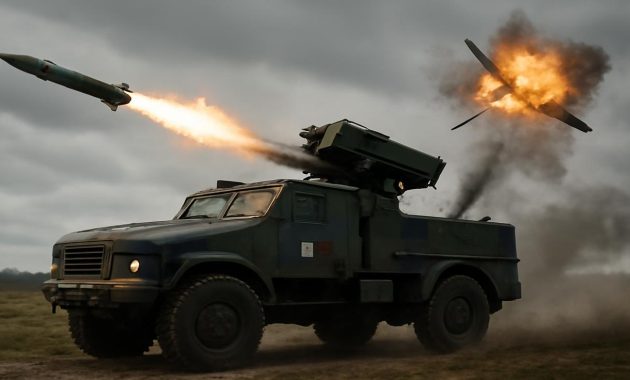
That’s where the system with the austere, almost cinematic name entered the story: “Last Shield,” France’s new laser-guided anti-drone rocket system. On paper, it sounds like a mash-up of old and new—rockets, something as old as modern warfare itself, married to precision laser guidance and high-speed tracking software.
In reality, it’s the answer to a pressing, uncomfortable question: what do you do when soft defenses fail? Jamming can be brilliant—until the drone is flying autonomously. Spoofing GPS can turn a threat into a confused toy—unless it’s programmed with an alternate guidance system. Nets, interceptors, and capture drones work—until the number of incoming targets doubles, then triples.
Last Shield is built for that final moment, when there’s no time left to negotiate with signals or dazzle sensors. It is, in the starkest sense, the final line. A launcher takes aim, a laser paints the target, and a rocket leaps away, adjusting its flight mid-air to follow that invisible beam. In a handful of heartbeats, something that was an active threat becomes a smudge of debris drifting downwind.
There’s a curious elegance to this brutality. No sprawling missile battery, no massive warhead streaking halfway across a continent. Instead, a lean, focused system designed not to dominate the airspace but to clean it, surgically, at the last possible moment. It’s air defense shrunk to the scale of a drone war.
A New Breed of Air Defense
Traditional air defense systems were never built with quadcopters and loitering munitions in mind. They were designed for jets, helicopters, maybe the occasional cruise missile. Their radars searched far and high, their interceptors were expensive, their engagement envelopes wide. Shooting down a cheap drone with a high-end surface-to-air missile is a bit like using a luxury sports car to deliver a pizza: technically possible, economically absurd.
Last Shield leans into a different logic. It accepts that small drones are not anomalies—they are the new normal. And if they’re the new normal, you need volume, affordability, and speed. A system capable of engaging multiple small targets, rapidly, without breaking the bank or exhausting your ammunition in a single busy afternoon.
So the French approach has been to blend what they already know—rocket technology, optical tracking, battlefield integration—with newer layers: artificial intelligence for target classification, refined sensors for low-signature detection, and algorithms that can tell a harmless delivery drone from something more ominous. At least, that’s the ambition. The exact specifications remain largely classified, but the intent has been openly spoken: make anti-drone defense as routine and scalable as artillery once was.
If that sounds like a quiet revolution, it is. Because once you can reliably and affordably swat drones from the sky, you change the mental map of modern conflict. The cheap advantage of the attacker becomes a more expensive gamble. The battlefield, physical and psychological, looks different.
Inside the “Last Shield” Experience
Imagine standing beside one of these systems during a live exercise. The vehicle looks functional, unromantic—a launcher, a sensor mast, cables neatly routed, protective covers swung aside. There’s wind, the harsh smell of dust and fuel, the faint electric buzz of electronics alive and listening.
Far above, a small drone enters the protected zone. It’s barely a twitch on the eye, but on the operators’ screen, it is a tight, glowing icon labeled with speed, bearing, altitude. An alert sounds, not dramatic, just firm. The targeting unit slews, following coordinates from radar and electro-optical sensors. A narrow, invisible beam of laser energy reaches out, steady, like a finger pointing: that one.
In the confined space of the control cabin, no one raises their voice. A confirmation. An authorization. The operator presses a trigger that feels more like a button on a keyboard than a weapon from a film. Outside, there is a violent bloom of energy and noise as the rocket leaves its rail, a flash bright enough to paint the underside of the passing clouds for a breathless instant.
The rocket arcs, then adjusts, nose twitching as micro-corrections keep it latched to the laser’s path. It doesn’t care what the drone is made of or how its software is written. It cares only about staying in the beam. And then, in a brief puff of expansion and metal, the threat is gone. The only evidence: a thin spiral of smoke unraveling in the wind and a new line of data on a log, marked “intercepted.”
It’s clinical, almost disturbingly so. Yet beneath that clinical calm lies something deeply human: the attempt to reclaim control over a chaotic, rapidly evolving sky. The attempt to say, we see you, even if you’re small, even if you’re cheap, even if you have no pilot aboard.
How It Fits into France’s Wider Drone Strategy
France is not fighting this battle with Last Shield alone. Instead, the system is being slotted into a layered architecture, something like rings radiating out from the center of a circle. At the outer edges: long-range radars, collaborating with allies, feeding data into shared networks. Closer in: electronic warfare units jamming control links, blinding GPS, tricking guidance systems.
Then you have the physical interceptors: guns firing smart ammunition, short-range missiles, high-energy lasers in experimental phases. Last Shield belongs in this ring, not as a solitary hero but as one more specialized tool. It is built to act when other measures are too slow, too blunt, or simply overwhelmed.
All of that has to be wired into something coherent. That’s where software is as important as steel. Systems like Last Shield are being developed to talk to command-and-control networks that stitch together battlefield awareness: what’s flying, where, how fast, and with what intent. Because you don’t want to be firing at everything; you want to be firing at the right things.
France’s defense planners know this isn’t just about raw capability; it’s about orchestration. The more drones clutter the airspace—civil, commercial, military—the more critical it becomes to distinguish risk from background noise. Last Shield’s real power, then, may be not only its rockets, but its ability to slot into a larger conversation the French military is having with itself and its allies about how to manage the skies of the 21st century.
Numbers, Tactics, and the Cost of Safety
Every new defense technology carries a ledger of questions: How many units do you deploy? Where? At what cost? What kind of training does it demand, and how easily can it be upgraded as threats evolve?
With Last Shield, the calculus is still unfolding, but a few broad strokes are already visible. The logic is simple: if drones are cheap and numerous, anti-drone systems must be modular, scalable, and cost-sensitive. This isn’t a world where you can afford a one-to-one duel between a missile and a toy-sized aircraft, at least not for long.
To visualize the balance, imagine a snapshot comparison of priorities in France’s modern anti-drone posture:
| Aspect | Traditional Air Defense | Anti-Drone Focus with Last Shield |
|---|---|---|
| Primary Target | Jets, helicopters, large missiles | Small drones, loitering munitions, swarms |
| Engagement Range | Medium to long range | Short to medium, focused on low altitude |
| Cost Per Shot | High (complex missiles) | Moderate (simpler guided rockets) |
| Deployment | Static sites, major bases | Mobile units, flexible positioning |
| Role | Shield against high-end threats | Last line vs. agile, massed low-cost threats |
Behind these rows lurk harder, more human calculations. Where do you park such a system during a major cultural event, a summit, a sporting final? How do you balance the risk of an incoming hostile drone against the danger of debris falling over a city? Who gets the authority to say, “fire,” when time is measured in seconds?
The French answer, so far, has been to lean into training and doctrine: refine the rules of engagement, simulate swarm attacks, practice decision-making under pressure. Because if the technology is the shield, humans are still the hand holding it. And in the crunch of a real crisis, it won’t be the engineering diagrams that matter; it will be the judgment of a handful of people in a dim control cabin, eyes locked on a glowing screen.
From Warzones to City Skylines
The sobering reality is that anti-drone systems no longer live solely on remote military ranges. As drones creep into civilian life—filming at concerts, mapping forests, inspecting buildings—the line between harmless and harmful grows thinner, almost translucent.
France’s acceleration of systems like Last Shield is driven as much by this blurred boundary as by any distant battlefield. Think of the stakes: a drone near a nuclear plant’s perimeter, a quadcopter drifting toward the flight path of an airport, a cluster of unexplained signals over the fan zones of a global sports tournament.
In these scenarios, anti-drone defense is not a theoretical exercise. It is urban security, critical infrastructure protection, and risk management rolled into one. And unlike in a warzone, the “backdrop” here is a living city: families on balconies, traffic on ring roads, people taking photographs with their own innocent drones in nearby parks.
So Last Shield and its cousins are being asked to do something subtle: be ready to act with military precision in environments that feel, look, and sound like everyday life. That tension is not easily resolved. But it’s shaping how France thinks about deploying these systems—stealthily, with tight legal oversight and clear chains of command, yet at a tempo that can match the pace of a fast, low-flying intruder.
The Ethics of a Hardened Sky
Somewhere in all this steel, code, and doctrine, a quieter debate is taking place—one that doesn’t show up in technical briefs. What does it mean to “weaponize” the sky against such small, often improvised machines? At what point does security cross into a sense of living under a hardened dome?
The paradox is uncomfortable. Drones offer astonishing civilian benefits: search-and-rescue, crop monitoring, disaster mapping, medical deliveries. At the same time, the same technology bends easily toward surveillance, sabotage, and targeted violence. Countries like France are trying to walk a line where skies remain open enough for innovation, yet guarded enough to avoid catastrophe.
Last Shield is, by design and by name, not a first response. It is a final measure. It slips into that space where all other measures—regulation, registration, detection, electronic countermeasures—have failed or been bypassed. It carries a kind of moral weight: when it fires, ambiguity should be gone. What’s in the crosshairs is no longer a hobbyist’s toy; it’s a clear, present danger.
The hope—unstated but evident—is that by making this last line strong and credible, fewer actors will test it. That the knowledge of such defenses will deter some of the worst impulses. Whether that hope holds as technology keeps galloping forward is an open question. But for now, it’s part of the story France is writing in the sky above its fields, cities, and bases.
Back in that vineyard, the day is coming to a close. The drones that do appear are more likely mapping soil moisture than spying on anything of military value. But over the horizon, on bases and in test centers, crews are rehearsing for a world where the sky is less forgiving. Their tools are precise, their mandate stark, their margin for error slim.
“Last Shield” may sound like a headline, but for them, it’s a daily discipline: listen to the sky, read its flickers and anomalies, and stand ready to act in those rare, dangerous seconds when a distant buzzing turns into something else entirely.
FAQ
What is the “Last Shield” system in France?
“Last Shield” is a French laser-guided rocket system designed specifically to intercept and destroy hostile drones and other small aerial threats at short to medium ranges. It combines fast-reacting rockets with precise laser guidance and advanced sensors to serve as a final defensive layer when softer countermeasures are not enough.
Why is France accelerating its anti-drone defenses now?
Recent conflicts have shown how cheap, small drones can cause disproportionate damage on the battlefield and around critical infrastructure. France has drawn lessons from these wars and from the rapid spread of drones in civilian airspace, prompting an urgent push to strengthen layered anti-drone defenses before similar threats appear closer to home.
How does a laser-guided anti-drone rocket work?
In systems like Last Shield, sensors first detect and track a drone. A laser then “paints” the target, creating a beam the rocket can follow during flight. Once launched, the rocket continuously adjusts its trajectory to stay in that beam, allowing a relatively small, agile interceptor to hit small, fast-moving drones with high precision.
Is Last Shield only for the military, or can it protect civilian sites too?
While it is a military system, Last Shield is intended to help protect both military and key civilian sites, such as critical infrastructure or major events that could be at risk from hostile drones. Its deployment in civilian contexts is governed by strict rules, legal frameworks, and careful coordination with other security measures.
Does this mean ordinary recreational drones will be targeted?
No. Recreational and commercial drones operating within regulations are not the targets of systems like Last Shield. The focus is on clear threats: drones entering restricted zones, behaving suspiciously, or operating in ways that suggest a hostile or dangerous intent. Detection, identification, and rules of engagement are designed to distinguish between normal use and genuine risk.
How does Last Shield fit into France’s broader air defense strategy?
Last Shield is one piece in a larger, layered architecture. France combines long-range radars, electronic warfare tools, jamming systems, smart guns, and other interceptors. Last Shield sits near the inner ring of this structure as a “last line” option when other approaches—like jamming or warning—are too slow or ineffective.
Will anti-drone systems affect the future of civilian drone use in France?
They are likely to shape it. As France tightens protections around sensitive airspace, regulations, geofencing, and identification requirements for civilian drones will evolve alongside these defenses. The goal is to allow innovation and everyday drone use to continue, while making it much harder for bad actors to exploit the same technologies for harm.