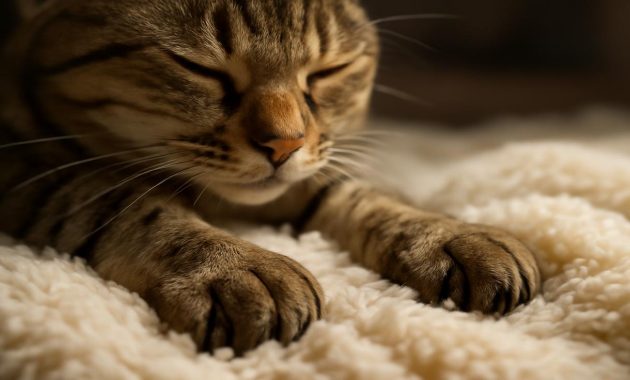
The blanket is breathing. At least, that’s what it looks like in the low light of a winter evening. Your cat has climbed onto your lap, found the softest fold of fabric, and begun that slow, rhythmic motion: press, press, press, alternating paws, claws just grazing your skin through the threads. Their eyes are half‑closed. A faint purr hums through their chest. Your legs are going numb, but you don’t dare move. You’ve told yourself a hundred stories about why they do this—because they’re happy, because they’re weird, because they think they’re baking bread. But under the cozy mythology, something more intricate is happening. Science has finally begun to catch up with this ancient, everyday mystery: why do cats knead?
The First Touch: How Kneading Begins
If you’ve ever watched a litter of kittens nursing, you’ve seen the origin story of kneading happen in miniature. Tiny paws, impossibly small, press rhythmically at their mother’s belly as they drink. This isn’t random flailing; it’s a deeply wired reflex. That kneading pressure stimulates the mother’s milk flow, while the kittens’ brains quietly wire the motion to comfort, warmth, and survival.
Researchers in animal behavior call this a “neotenous” behavior—something rooted in infancy that never completely disappears in adulthood. Just as adult humans still instinctively suck in a breath before submerging in water or cling reflexively when they lose balance, cats carry forward this motor memory from their first weeks of life. When your eight‑year‑old tabby kneads your blanket, they’re echoing that primal dance they did at their mother’s belly, except now the “milk bar” is a fleece throw, and the reward is not food but emotional safety.
What matters here isn’t just the movement. It’s the context. In the wild and in domestic life, cats only knead when they feel secure enough to let their guard down. A cat that kneads in your lap is making a quiet announcement: “For the moment, the world is safe. I can afford to remember being a baby.” It’s not sentimentality; it’s neurology. Comforted brains default to comfort scripts.
Inside the Purring Machine: What the Brain Is Doing
To understand kneading, scientists have looked at the neurochemistry behind that blissed‑out expression your cat gets when they’ve found the perfect blanket. Deep in the feline brain, certain patterns of touch paired with familiar smells and stable surroundings trigger the release of neurotransmitters like oxytocin and endorphins—the same kinds of chemicals that flood a kitten nursing or a cat grooming a trusted companion.
Oxytocin, often nicknamed the “bonding hormone,” is especially interesting here. In humans, it’s associated with parent‑infant bonding, trust, and social comfort. In cats, it appears to help reinforce positive connections with places, other animals, and yes, people. Kneading seems to be a switch that nudges the brain into a cozy, attachment-focused mode. Your cat presses down with their paws, and in return, their nervous system whispers back, “You’re home. You’re okay. Keep going.”
The purr that often accompanies kneading isn’t just a soundtrack; it’s part of the same physiological loop. Purring has been linked to self‑soothing, pain modulation, and even bone healing, thanks to its specific vibration frequencies. When a cat kneads and purrs together, they’re running a full internal spa circuit: tactile comfort, bonding chemistry, gentle vibration. That blanket is less an object and more a trigger—a soft button that sets the whole system in motion.
Not Just Cute: The Engineering of Those Paws
Under each furry paw lies an impressive bit of anatomy: soft pads rich with nerve endings, scent glands that leave behind chemical messages, and a delicate network of muscles and tendons that allow those slow, deliberate presses. When scientists talk about kneading, they aren’t describing a random gesture. It’s coordinated, patterned, and often quite targeted.
The sensory receptors in a cat’s paw pads detect texture, temperature, and subtle changes in surface resistance. A thick blanket, a plush sweater, or your thigh beneath the quilt—each sends a slightly different sensory signature. Over time, cats appear to learn which textures “feel” most like the warm, pliant surface of their mother’s body, and they return to those textures again and again when they’re seeking comfort.
From Forest Floors to Fleece Throws: The Evolutionary Theory
Long before cats discovered central heating and chenille blankets, their wild ancestors had to make beds from whatever the environment offered: tall grasses, piles of leaves, scraped‑out hollows in the earth. Behaviorists suspect that kneading may be the descendent of a practical survival strategy—softening or testing a resting spot before lying down.
Picture a small wildcat preparing to sleep. The ground might be littered with twigs or small stones; tall grass could hide insects or prickly seeds. Repeatedly pressing down with the paws would flatten the vegetation, test for hidden discomforts, and perhaps even release insect‑repelling scents from certain plants. That motion, over thousands of years, may have been so helpful that it became instinctive.
Now drop that same ancestral behavior into a modern living room. The tufts of uncut meadow grass have become a fleece blanket. The wildcat is now a fifteen‑pound domestic shorthair who has never met a twig in their life. But the brain pathway is unchanged: “Soft mound encountered. Press. Shape. Test. Settle.” Your blanket becomes a field to be tamed, a nest to be made, a microhabitat sculpted to perfect feline standards.
Making It Theirs: Scent, Territory, and Ownership
Cats experience the world primarily through scent. While we might think of kneading as a purely tactile act, there’s another layer invisibly stamped into every press of the paw: odor. Those little pads your cat is massaging into your blanket house scent glands that release pheromones—chemical signals used to mark territory and communicate subtle emotional states to other cats.
When your cat kneads, they’re not just getting comfortable; they’re signing the furniture. To other cats (or even to themselves, later), that blanket now smells distinctly like “safe, mine, familiar.” This scent tagging helps reduce anxiety. A spot saturated with their own smell is less uncertain, less risky. It’s like a traveling comfort object they continually recharge with each kneading session.
This might be why some cats are fiercely loyal to a particular blanket or sweater. That object isn’t random; it’s a deeply “edited” canvas layered with months or years of scent, memory, and repeated rituals of kneading. From a cat’s point of view, that fraying throw on your sofa isn’t old—it’s seasoned.
Reading the Signs: What Your Cat Is Telling You When They Knead
While kneading almost always skews positive, the nuances matter. Cats, as usual, fold a lot of meaning into small differences of behavior. Science doesn’t translate every paw press into an emotion, but patterns have emerged from studies and careful observation.
| Kneading Style | What You’ll Notice | Likely Meaning |
|---|---|---|
| Slow, deep kneading with loud purring | Relaxed face, half‑closed eyes, loose body | High contentment, strong trust, self‑soothing |
| Brief kneading before lying down | Quick nest‑making, immediate curl‑up | Bed preparation, comfort check, habit |
| Intense kneading with claws fully extended | Maybe restless tail, shifting position often | High arousal—could be excitement, mild stress, or over‑stimulation |
| Kneading on a person’s chest or face | Cat seeks eye contact, stays close | Strong social bonding, seeking warmth and heartbeat rhythm |
Occasionally, kneading can seem almost frantic. Some cats knead and suckle on fabric, especially wool or fleece, in a way that looks compulsive. Studies suggest this is more common in cats weaned very early or in certain breeds like Siamese and related oriental types. In many cases, it’s still a self‑soothing behavior, but if it interferes with daily life or the cat ingests fabric, a veterinarian or behaviorist should weigh in.
When Comfort Has Claws: Managing the Painful Side
For all its sweetness, kneading can hurt. Those gentle presses often come with needle‑sharp claws that pierce through the blanket and into your skin. From the cat’s perspective, they’re just doing what worked as a kitten: fully extending their tiny paws to maximize pressure. They have no idea that your thighs are less padded than their mother’s belly.
You don’t have to choose between pain and rejection. Behavior science suggests compromise. Instead of pushing your cat away—which can confuse or even distress them—you can quietly slide a thicker blanket, pillow, or folded towel between their paws and your body. Over time, many cats will favor that thicker, softer surface for kneading because it provides satisfying resistance.
Regular claw trims can also make a dramatic difference. The motion of kneading doesn’t rely on claws; the soft pads do the work. Keep the tips blunt, and you get all the affection with fewer involuntary acupuncture sessions. If your cat is sensitive about having their paws handled, slow desensitization—gentle touches, treats, and short, positive sessions—can shift the experience over time.
Science Steps In: What We Actually Know (and Don’t)
For an act as universal as kneading, you might expect shelves of detailed scientific papers dedicated to it. In truth, kneading lives in a half‑lit space between folklore and formal research. It’s been mentioned in textbooks, observed in behavior studies, and debated in veterinary circles, but only recently have scientists begun to examine it as part of a larger constellation of feline comfort behaviors.
What research does support strongly is this: many seemingly “odd” domestic cat behaviors are not quirks at all, but logical outgrowths of kittenhood patterns and ancestral survival tactics. Kneading fits this model beautifully. It stitches together at least four threads that science recognizes:
- Infant reflex and muscle memory from nursing.
- Comfort‑seeking and self‑soothing when safe.
- Scent marking and territory affirmation.
- Bed preparation and surface testing, inherited from wild ancestors.
Laboratory and field observations have confirmed related behaviors: wildcats treading down grass before resting, feral cats kneading soft ground or fabric scraps in colonies, and domestic cats showing more kneading in low‑stress, familiar environments. Brain imaging specific to kneading is rare—cats are notoriously uncooperative MRI subjects—but hormonal studies around purring, grooming, and close contact give indirect support to the idea that kneading is part of a broader “relax and bond” state.
What remains less certain, and still somewhat theoretical, is how much individual emotional nuance each cat layers into the act. Does one cat knead primarily for self‑comfort, another mostly to mark territory, another as a form of social affection? Likely, yes—and often in combination. But until we can ask them directly, we read their stories from posture, context, and pattern.
The Human Side of the Story
It’s easy to think of this as a one‑way behavior—a cat doing something to an object or a human. But look closely at what happens next time your cat settles in to knead. You probably shift your body to accommodate them, adjust the blanket, still your movements, maybe even synchronize your breathing to their purr. You, too, are changing your behavior, entering a quieter, softer state.
This reciprocal choreography is part of why kneading feels so intimate. Whether we realize it or not, we’re being trained just as subtly as the cat is reinforcing their own instincts. Over months and years, that recurring scene—cat, blanket, gentle press—can become one of the emotional landmarks of a home. People report that their stress drops, their hearts slow, their sense of loneliness eases when they become a living pillow for a kneading cat. Science has robust evidence that gentle, predictable touch and the presence of a companion animal can lower blood pressure and perceived anxiety in humans. Kneading may be one small, focused portal into that larger phenomenon.
And so, on one blanket, two nervous systems meet: one ancient hunter, one overthinking primate, both using touch, pressure, and repetition to steady themselves against the day.
Living With a Little Scientist on Your Lap
Once you see kneading as more than a whimsical quirk, it changes how you respond to it. Instead of rolling your eyes and calling your cat strange, you can watch them like a low‑key research project happening in your living room. Which blankets do they choose? Do they knead more when the house is noisy or quiet? Do they ever knead near a window during storms? Do they pick certain humans more than others?
Patterns emerge. Maybe your cat kneads the most on the evenings you return late from work, as if re‑anchoring their sense of home. Maybe they only knead on one old quilt that smells like a previous pet. Maybe they pause mid‑knead to glance at you, just checking, before closing their eyes again. Each detail is a clue to how they’re stitching together past and present, infant reflex and adult ritual, instinct and relationship.
Science has given us the broad strokes answer: kneading is rooted in kittenhood nursing, reinforced by comfort chemistry, shaped by evolution, and seasoned with scent. But the finer strokes belong to you and your particular cat—their history, habits, and trust. Every slow press of their paws on your blanket is both an echo of the oldest kind of safety and a present‑tense vote of confidence in you.
So the next time your legs go numb under the steady rhythm of those paws, you’ll know this isn’t a random quirk or a silly whim. It’s a small, living bridge between wild grass beds and modern couches, between newborn kittens and grown hunters, between careful science and daily magic. Your cat is not just kneading a blanket. They’re kneading time, memory, and comfort itself—into a shape both of you can live in.
Frequently Asked Questions
Why do cats knead only on certain blankets or people?
Cats tend to knead where they feel safest and where the texture and scent feel “right.” A favorite blanket usually has a familiar smell, a soft, yielding texture, and a long history of positive experiences. When they choose a particular person, it often reflects trust, warmth, and the association of that person with calm, predictable interactions.
Is kneading always a sign that my cat is happy?
Usually, kneading is linked to comfort and relaxation, especially when paired with purring and a loose body posture. However, in some cases, cats may knead when mildly stressed or seeking reassurance, much like humans fidget or hug a pillow. Context—body language, environment, and timing—helps you interpret it more accurately.
Should I stop my cat from kneading if their claws hurt me?
You don’t need to stop the behavior completely, but you can redirect it. Place a thicker blanket, cushion, or folded towel between your cat and your skin so they can keep kneading without causing pain. Keeping claws trimmed and providing dedicated soft items for them to knead can also help.
Why does my cat knead and then bite or lick the blanket?
This combination often echoes early nursing behavior. The cat may be mimicking the motions of kneading and suckling from kittenhood, especially if they were weaned early. Many cats use this as a powerful self‑soothing routine. If they don’t ingest fabric or become distressed, it’s usually harmless.
Can kneading ever be a problem or a sign of illness?
Most kneading is normal and healthy. It can become a concern if it’s extremely intense, constant, accompanied by vocal distress, or involves chewing and swallowing fabric. Sudden changes in kneading habits—either a dramatic increase or a complete stop—can also signal pain, stress, or underlying medical issues. In those cases, a veterinary checkup is wise.
Why do some cats never knead at all?
Not all cats express every instinctive behavior the same way. A cat’s individual temperament, early life experiences, and environment shape whether kneading appears and how strong it is. Some cats prefer other comfort rituals—grooming, curling tightly, or rubbing their cheeks on objects. A non‑kneading cat isn’t less happy; they just follow a different script.