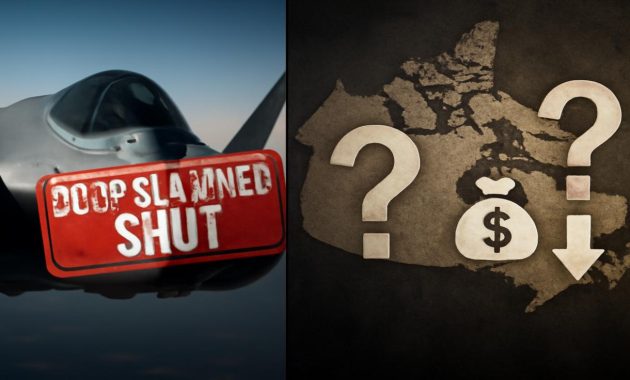
The jet banked left, a dark silhouette against the high blue over Cold Lake, engines carving a low thunder across the Alberta sky. Down on the tarmac, a group of young aircrew shaded their eyes, watching a machine that might never wear a Canadian roundel. For a moment, as the aircraft rolled level and vanished into a streak of sunlight, the question hanging over Canada’s air force felt almost painfully simple:
Do you embrace the world’s most connected fighter, or turn away and hope you haven’t just bet the country’s security, economy, and influence on a quieter path?
Canada at a Crossroads in the Northern Sky
Canada has been here before—standing at a junction where the sky isn’t just weather, but strategy, identity, and money all at once. The North isn’t an abstraction; it’s a living, moving frontier of ice, dark water, and long horizons patrolled by quiet grey jets. Those jets are aging CF‑18 Hornets, relics of the Cold War still grinding out daily missions while politicians in Ottawa debate what comes next.
On paper, the fork in the runway is stark. On one side sits the F‑35, the world’s most connected fighter jet: a flying sensor web, a node in a global digital nervous system built by the United States and its closest allies. On the other side are quieter options—newer, cheaper, or politically cleaner aircraft that promise sovereignty and savings but not the same deep plug‑in to the Western defense grid.
In meeting rooms that smell faintly of burnt coffee and dry-erase markers, officials talk in careful language—“capability sets,” “platform interoperability,” “through-life costs.” Outside those rooms, on the escort flights that shadow Russian bombers near the Arctic edge or run NORAD patrols over prairie skies, the question feels less academic. If Canada slams the door on the F‑35, does it also close the window on a decade of shared development, shared intelligence, and shared power?
The World’s Most Connected Fighter, Explained in Human Terms
To understand what’s at stake, it helps to imagine flying the F‑35 from the inside. The canopy closes with a soft clunk, the outside world dimming to a controlled glow of screens and holographic graphics. You don’t look down at a maze of analog dials; you look through the aircraft, your helmet painting the ground, sky, and targets in glowing outlines. Every radar sweep, every electronic whisper, every friendly aircraft in the region is stitched into one flowing picture.
That’s what “connected” really means. The F‑35 isn’t just a fighter; it’s a translator. It collects secrets from the invisible parts of the spectrum—radar, infrared, electronic signals—and merges them into a single, almost intuitive vision of what’s happening. Then, like the world’s most tightly guarded group chat, it shares all of that with other F‑35s, with ships, with ground systems, and with older jets while making them smarter too.
For a Canadian pilot flying over the Arctic, that level of awareness is the difference between guessing and knowing. Between detecting a radar ping and understanding the entire family of threats that radar might belong to. Between hoping your allies see what you see and knowing, in real time, that they already have.
In a century where conflict is less about who has the biggest engine and more about who can see, think, and act fastest, this digital wiring is the F‑35’s true engine. It isn’t just a plane; it’s an access card to a secure, constantly updated global defense network.
The Quiet Price of Staying Outside the Network
From a distance, rejecting the F‑35 can sound like an act of fiscal sanity. The jet has been haunted by headlines of cost overruns, software glitches, and maintenance headaches. It is not, by any stretch, a cheap machine. Alternative fighters—from Europe’s agile designs to updated legacy jets—offer sleek airframes, capable sensors, and price tags that, at first glance, seem kinder to a taxpayer’s wallet.
But defense spending is a long game, and some of the heaviest costs come quietly, disguised in missed opportunities and fraying alliances. Turn down the F‑35, and Canada doesn’t just forgo a plane; it steps aside from a club it helped build.
Canadian companies have already been woven into the F‑35 supply chain—fabricating parts, writing code, calibrating components that end up bolted under wings or buried in black boxes. Those contracts bring not only jobs, but high-end skills: advanced manufacturing, composites, precision electronics. Walking away risks handing that work to firms in countries that say yes.
Then there’s the daily business of defense cooperation. NATO exercises. NORAD patrols. Joint operations that rely on a shared operating picture. As more allies adopt the F‑35, the network effect grows. Like the early days of smartphones, sitting out might feel principled or practical—until everyone else is trading data you cannot see. Canada could end up in the strange position of flying capable jets that are, in digital terms, standing just outside the room where decisions are being made.
There’s also a more personal cost, hard to summarize in budget lines. It’s the pilot from Bagotville or Cold Lake flying into a complex multinational mission, watching the briefings unfold around technologies his or her jet simply can’t match. It’s the subtle but accumulating sense of being a respected partner… with slightly older tools.
Arctic Winds, Melting Ice, and Rising Stakes
All of this would matter less if Canada were just another mid‑sized country tucked safely behind someone else’s shield. It is not. Canada’s backyard is a receding Arctic, a blue‑white frontier where longer summers are unlocking shipping lanes, oil and mineral interests, and strategic anxieties in equal measure.
In this sprawling, harsh theater, distances are brutal and infrastructure thin. Sensors matter more because runways are few and ships take days to reposition. The F‑35’s long reach and stealth make sense here in a visceral way: detect first, decide first, and never send human beings into a fight they don’t fully understand.
When Russian long-range bombers skirt the edge of North American airspace, Canadian and American jets respond as a single, binational system under NORAD. As threats become more sophisticated—cruise missiles with stealth features, drones swarming at low level—the need for a combined, tightly integrated sensor web only grows. The F‑35 is designed to be a cornerstone of that evolving architecture.
Imagine, years from now, a future where U.S. and European F‑35s are fusing Arctic radar, satellite, and signals intelligence into a common picture while Canada contributes with older platforms. The country would still be part of the team—but more as a trusted relay runner in a relay now dominated by sprinters with jetpacks.
Counting Dollars in the Shadow of Jets
Of course, no government can ignore a price tag measured in tens of billions. The F‑35’s unit cost has fallen over the years, but the aircraft still demands expensive maintenance, specialized facilities, and an ocean of software updates. Critics worry that embracing such a complex system will create a dependency—on U.S. tech policies, on proprietary parts, on a global logistics network that may not always bend conveniently to Canadian needs.
There’s an environmental cost, too. Modern fighter jets are not subtle consumers of fuel, and the idea of tying Canada more deeply to a fossil-fuel-thirsty weapons platform makes some policymakers uneasy, especially in a country that likes to think of itself as a climate leader.
What often gets lost in the political thunder is the quieter math of “cost avoided.” A cheaper fighter bought today may demand more upgrades tomorrow to keep pace with emerging threats. Integration patches, software retrofits, defensive system overhauls—each layer of modernization brings fresh invoices. Over a service life of 30 or 40 years, an aircraft that seemed prudent at the start can quietly become the more expensive option, not just in dollars, but in risk.
To understand the tradeoff, it’s helpful to put the key issues side by side:
| Factor | Choosing F‑35 | Choosing Alternatives |
|---|---|---|
| Interoperability | Deep, seamless integration with major allies and NORAD/NATO networks. | Partial, reliant on add‑on systems and slower data sharing. |
| Industrial Benefits | Sustained access to global F‑35 supply chain and advanced tech work. | More national flexibility, but risk of losing high‑value F‑35 contracts. |
| Capability Growth | Continuous upgrades as part of a large user community. | Upgrades depend on national budgets and smaller user base. |
| Upfront Cost | Higher acquisition and setup costs. | Potentially lower initial purchase price. |
| Strategic Influence | Greater voice in allied planning built around F‑35. | Influence maintained, but not at the technological core. |
Numbers can be massaged, forecasts tweaked, graphs redrawn. But the underlying dilemma remains stubbornly human: where do you want your country to sit when the big decisions are being made—at the heart of the network, or just outside the door, hoping it’s thick enough to keep danger out and thin enough to let information in?
Identity, Sovereignty, and the Ghost of the Arrow
Upset a Canadian defense debate, and sooner or later the ghost of the Avro Arrow will float into the room. The Arrow—Canada’s homegrown, supersonic interceptor canceled in 1959—still haunts the national imagination. It symbolizes both ambition and loss: the dream of aerospace leadership, and the pain of watching that future dismantled with cutting torches and classified orders.
Turn the conversation to the F‑35, and the Arrow’s silhouette appears behind it like an afterimage. Some argue that tying Canada’s airpower so completely to an American‑led program is a betrayal of that old aspiration for sovereign capability. Shouldn’t a country with its own aerospace heritage at least keep part of its future independent—choosing platforms that allow more local control, more freedom to modify and adapt without checking in with Washington?
Others see the comparison as emotionally understandable but strategically misplaced. The world of the Arrow was a world of analog gauges and national programs. Today’s reality is networked, digital, and dense with code that crosses borders faster than any aircraft. In this environment, sovereignty can also mean having full access to the systems your allies rely on most, rather than standing proudly apart with your own bespoke tools that don’t quite plug in.
In a sense, the F‑35 debate is a referendum on how Canada sees its place in that web. Are you a connector—synced, wired, deeply embedded—or a careful neighbor, independent but occasionally left out of the tightest loops?
The Gamble: Slamming the Door, or Stepping Through It
Every gamble has, at its core, a story you tell yourself about the future. For those urging Canada to walk away from the F‑35, the story runs something like this: technology moves fast, and locking yourself to one expensive, complex aircraft could be a trap. Cheaper, more flexible platforms may allow Canada to adapt more quickly to drones, cyber defense, space‑based surveillance, and emerging tools we can’t yet name.
There’s also a hope—sometimes spoken, sometimes not—that the U.S. and NATO will continue to provide the deepest layers of high‑end capability anyway. That Canada can invest less in the sharpest spear tip and more in other parts of the arsenal, trusting the alliance to cover the gaps.
The opposing story is harsher, edged with the chill of the northern wind. It says: the world is entering a more dangerous, less predictable era. The Arctic is opening. Great‑power competition is back, slipping into the shadows of cyberspace and low‑orbit satellites. In this world, the countries closest to the United States—geographically and politically—cannot afford half‑measures in shared defense. Turn away from the tools that knit you to your allies, and you risk becoming a polite bystander when events turn sharp.
That’s the heart of the concern that “slamming the door” on the F‑35 could cost Canada dearly. Not only in industrial spinoffs, not only in tactical edge, but in something harder to measure: the quiet confidence of partners who look north and see a country as deeply committed, and as technologically invested, as they are.
In hangars from Cold Lake to Bagotville, where the air smells of jet fuel and hydraulic fluid, crews are less interested in abstract narratives and more in what will sit on the ramp a decade from now. They know that whatever Canada chooses, they will bend themselves to making it work. They’ll learn its quirks, trust its systems, and strap in when the order comes. But they also know that some machines open doors that others cannot.
Somewhere above the treeline, a pilot pushes the throttles forward, feeling the subtle shudder as afterburners light and the landscape blurs. In the years ahead, the cockpit view from which Canada sees its skies—its North, its coasts, its place beside its allies—will be shaped by the choice being argued today in committee rooms and cabinet meetings.
Doors like this don’t slam often. When they do, the echo can last for generations.
Frequently Asked Questions
Why is the F‑35 called the world’s most connected fighter?
Because it is designed as a flying sensor hub that constantly shares data with other aircraft, ships, ground systems, and command centers. Its advanced sensors and secure data links let it build and distribute a detailed picture of the battlespace in real time.
What makes this decision so important for Canada specifically?
Canada’s geography—especially its vast Arctic—and its role in NORAD and NATO mean it relies heavily on airpower and close cooperation with allies. The fighter it chooses will shape how effectively it can plug into shared defense networks for decades.
Are there real economic risks if Canada rejects the F‑35?
Yes. Canadian companies currently contribute to the F‑35 program and benefit from supply‑chain contracts. Walking away could shift that work to firms in other partner nations and limit future industrial opportunities tied to F‑35 upgrades and maintenance.
What are the main arguments against buying the F‑35?
Critics point to its high cost, maintenance complexity, and dependence on U.S. technology, as well as environmental concerns about fuel use. They argue that alternative fighters or other defense investments might offer more flexibility or better value.
Could Canada still cooperate closely with allies without the F‑35?
Yes, cooperation would continue, but likely with limitations. Without the same level of built‑in connectivity, Canada might rely more on workarounds and separate systems, making some aspects of joint operations slower or less efficient compared to full F‑35 partners.