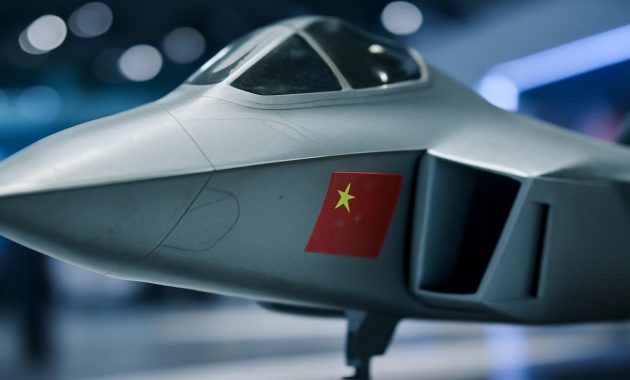
The jet sits under the hangar lights like a predator frozen mid‑pounce—angles sharp as broken glass, skin dull and dark, swallowing reflections instead of throwing them back. A few years ago, a blurry photo of a mysterious aircraft like this would have detonated across defense forums, sending armchair analysts scrambling to call it a “6th‑generation” fighter. In fact, that’s exactly what happened when images of a supposed Chinese next‑gen stealth jet began circulating online: a sleek, menacing craft that looked like it stepped straight out of a near‑future war movie.
But look longer and things start to unravel. The more the eye adjusts, the more the illusion thins. You begin to notice bolts where there should be seamless panels, shapes that look impressive but create impossible headaches in real aerodynamics, and landing gear that would make a ground crew chief wince. It’s a masterclass in something deeply modern: when a design is optimized not for flight, but for the camera—and when form, quite literally, beats feasibility.
The Jet That Looked Too Good To Be True
The first images arrived the way these things usually do: grainy, low‑angle shots from what looked like the corner of a hangar, the aircraft half in shadow, nose slightly turned as if it knew which way the drama was. The captions claimed it was a “Chinese 6th‑generation fighter prototype,” an evolution beyond the J‑20, designed to duel the F‑22, F‑35, and whatever secret projects might be hiding in Nevada deserts.
At a glance, it ticked every box in the modern stealth playbook. Twin engines, deeply buried. A diamond‑shaped fuselage. Canted vertical stabilizers that looked thinner than a credit card from certain angles. Intakes with S‑shaped ducts to hide the compressor faces—those bright radar reflectors engineers go to war with. If you’ve ever watched a big‑budget sci‑fi battle scene, you’ve seen this design language before; this was the Hollywood idea of a future jet, made solid.
That was part of the problem.
The more experienced observers, the ones who spend evenings poring over patent filings and runway photos, started to question it. They zoomed in on the rivet lines. They watched how light fell along the body. They followed the landing gear up into the fuselage and realized: the math didn’t add up.
The internet loves mystery aircraft. The more secretive a country’s defense program, the more fertile the ground for rumors, leaks, and hopeful interpretations of fuzzy pixels. But this “fighter” seemed to cross a strange line—too bold and over‑styled to be a real, flying machine, and too clumsy in key places to have rolled out of a world‑class aerospace program. It looked modern, lethal, and utterly cinematic. It also looked fake.
When Stealth Becomes A Costume
Stealth, in real life, is boring. Or rather, it becomes boring the longer you study it. Underneath the mythos of “invisible jets” is endless compromise: curves that soften radar returns but complicate manufacturing; internal bays that preserve clean outer lines but gobble up volume; coatings that demand constant, fussy maintenance. Every stealth aircraft—American, Chinese, Russian—bears the scars of those negotiations between dream and reality.
The supposed Chinese “6th‑gen” jet, by contrast, looked like stealth as imagined by a concept artist given a free brief and no engineering constraints. Its surfaces were aggressively faceted, as if scooped from the same design mood board that gave us angular electric pickup trucks and brutalist movie spaceships. The edges were razor neat. The joints, at least at first glance, hardly seemed to exist.
But stealth isn’t just about sharp edges and dark paint. It’s about managing radar energy across every possible angle, under physics that never care about how photogenic a design might be. That’s where this aircraft started betraying itself. In some places, the angles between surfaces were so tight and complex they would have created nightmare reflections. In others, you could see flat, exposed spots where stealth designers would typically insert clever shaping tricks or radar‑absorbent “cheats.”
And then there was the canopy. On truly stealthy jets, the canopy isn’t just transparent glass—it’s a carefully treated, often gold‑tinted surface that acts as a radar‑protective dome. Here, the canopy looked more like something lifted off a display mock‑up: thick, oddly framed, more like the clear bubble on an airshow demonstrator than the precision‑engineered cockpit of a multi‑billion‑dollar program.
Real stealth resembles a kind of industrial minimalism: fewer compromises visible, more work hidden under the paint. What we were looking at felt more like stealth cosplay—an impressive costume tailored for the eye, not for electromagnetic waves screaming in at Mach numbers.
The Tell‑Tale Clues: Where Reality Cracks
It’s not that movie props can’t look convincing. Some are so meticulously built they seem flight‑ready. But even the best fakes tend to slip up in the tiny, practical details: hinges, access panels, maintenance markings, fasteners, and the plain, ugly necessities of a machine that actually has to work for a living.
On this aircraft, those little betrayals stacked up.
Landing Gear That Tells On Itself
The landing gear, often an afterthought in dramatic photos, is one of the best places to spot what’s real. It has to support massive weight, absorb shocking impacts, fold in precise ways, and pack into spaces defined by everything else the designers prioritized first. That makes it an unforgiving teacher of truth.
Here, the gear looked… approximate. The struts appeared chunky in some angles, under‑engineered in others. The retraction paths, traced mentally by analysts, seemed to lead nowhere or collide with structural members that would, in a functioning aircraft, be absolutely non‑negotiable. Gear doors didn’t line up with where the wheels would logically need to disappear. It all had the feeling of something conceived visually, not mechanically—gear that looked “about right” until anyone tried to imagine cycling it up and down a few hundred times on a rainy airbase.
Surface Details From The Wrong World
Real combat aircraft are covered with the banal graffiti of necessity: stencil markings, warning labels, panel numbers, and the grim little symbols that say “do not stand here unless you enjoy engine ingestion.” Even when those markings are minimized for stealth, their logic is consistent and standardized.
On this jet, some markings seemed decorative more than functional—placed where they looked good rather than where a maintainer would need them. Panel gaps ran in odd directions, crossing obvious load paths. Some panels were too large to be practically removable by a ground crew, others too numerous to make sense on an aircraft where every seam is a liability.
Exhausts And Intakes: Where Fantasy Meets Physics
Engines are tyranny incarnate in aircraft design. You can try to hide them, tame them, or shape their signatures, but the fact remains: they are hot, loud, and hungry, and they bully the entire airframe around their needs.
The alleged “6th‑gen” jet featured highly stylized engine exhausts and intake inlets that looked slick in photos but questionable in practice. Exhaust nozzles appeared too close to structural members that would roast under sustained heat. The intakes had elegant, sinuous geometries that, while lovely on paper, would likely feed the engines with turbulent, inefficient air at high angles of attack.
It’s the kind of tradeoff you accept in a digital painting, where thrust is assumed and drag is a rumor. In a real fighter, those choices spell performance loss or catastrophic instability.
| Feature | Real Stealth Fighter | Movie‑Prop “Fighter” |
|---|---|---|
| Surface shaping | Complex but rational, with smooth compromises and proven angles | Visually extreme, with dramatic facets and sharp lines |
| Landing gear | Structurally logical, clear retraction path, realistic clearances | Looks “cool,” but retraction paths and strength seem off |
| Canopy and cockpit | Special coatings, tight framing, ergonomic but constrained | Thick, sometimes over‑styled, more display than combat ready |
| Panel lines and markings | Functional, standardized, oriented around maintenance | Decorative, sometimes illogical or inconsistent |
| Overall purpose | Survivability, maintainability, and performance under fire | Visual impact, narrative power, and intimidation factor |
Why “6th‑Generation” Is Mostly A Story, Not A Spec Sheet
The label attached to this aircraft—“6th‑generation”—is itself a kind of storytelling. Fighter “generations” aren’t formal categories accepted by some international board; they’re narratives built after the fact to explain leaps in technology and doctrine.
Fourth‑generation fighters: agile, heavily armed, bristling with sensors. Fifth‑generation: stealthy, deeply networked, designed to see without being seen. Sixth‑generation? That’s where the story becomes hazy and aspirational. People throw in buzzwords: manned‑unmanned teaming, adaptive engines, AI‑assisted pilots, drone swarms, directed energy weapons. It’s more a wishlist than a spec sheet.
China, like the United States and others, is undoubtedly exploring these ideas for real. But slapping “6th‑generation” on any angular, menacing airframe makes for easy headlines and quick clicks. The term becomes a costume—just like the aircraft itself may be.
That’s what makes this particular jet so interesting: it sits at the intersection of genuine military ambition, rampant speculation, and a global aesthetic of futurism. It looks like what we’ve been taught to expect from “the next big thing” in airpower. And precisely because of that, it reveals how powerful visual storytelling has become in the defense world.
Designing For Cameras: When Form Beats Feasibility
In an era where images travel faster than missiles, optics matter. That’s not just a metaphor. States understand that a single dramatic photograph of a new aircraft can shift perceptions of power, sway neighbors, and influence budgets. Theatricality has always shadowed military technology—parades, flyovers, missile rollouts—but digital culture has supercharged it.
You can imagine the brief: create something that looks one step beyond the J‑20, something that could plausibly be called a “6th‑gen” platform, something that makes a casual viewer think, we’re behind. It doesn’t have to fly. It just has to exist long enough for the lens.
Once you see it through that lens, everything about the aircraft starts to make a different kind of sense. The exaggerated stealth shaping isn’t about surviving contested airspace; it’s about dominating a photo frame. The aggressive stance—nose slightly bowed, wings knifing backward—is about projecting speed and lethality before a single line of code in a flight controller is ever written.
This is not unique to one country. Prototype‑like showpieces have appeared in many cultures: mock‑up tanks with cardboard armor, “next‑gen” drones that never move beyond the trade‑show floor, missile shells that conceal empty tubes. What’s newer is the tight coupling between these physical performances and the online worlds that amplify them.
The Chinese “6th‑generation” fighter, if it is indeed more prop than plane, fits into a category best described as strategic stagecraft. It exists in that in‑between space—too detailed to be dismissed as a simple model, too incoherent in its details to be a flight‑test article. It’s designed for a specific role: to occupy the imagination, and by extension, the calculus, of anyone watching.
The Human Eye, The Digital Age, And The Lure Of The Unreal
Stand in front of such an aircraft in person—regardless of where it was built—and the effect is visceral. The metal (or composite shell) drinks in the light. The nose stretches out like a spear. Even if you know nothing about aerodynamics, something about that geometry feels predatory. We’re wired to respond to certain shapes: swept‑back lines, narrow “eyes,” flared shoulders. A fighter jet is, in many ways, an airborne predator silhouette writ in titanium and carbon fiber.
Now translate that encounter to a phone screen. Compress it, darken the background, add just enough grain to imply secrecy, and the effect is heightened. The imperfections wash out. Dimensions distort. It suddenly feels like a leaked glimpse of tomorrow—as much science fiction as science fact, which only makes it more exciting.
That’s why it can be so hard, scrolling past such images, to resist the narrative they propose.
Look, they’ve built something we haven’t. Look, the next war will be fought by machines like these. Look, the future is arriving somewhere else first.
But the closer you lean in, the more you notice the seams—literal and metaphorical. The mistaken fasteners. The impossible hinge lines. The absence of all the gear, sensors, and scars that come with a machine meant not just to exist, but to endure.
There’s a quiet lesson here about how we see technology now: through stacked lenses of marketing, secrecy, fandom, nationalism, and film grammar. We are trained to expect certain shapes, and so when those shapes appear, we’re halfway convinced before we’ve even asked if they make sense.
What It Means When Props Enter The Power Conversation
If this Chinese “6th‑generation” fighter really is more cinematic than operational, does it matter? In a way, yes—and in several ways, more than we might be comfortable with.
First, it muddies the waters for serious analysis. Defense planners and independent researchers must constantly separate signal from noise. Every fake or over‑interpreted image consumes attention that could be focused on genuine capabilities: radar networks, electronic warfare, hardened infrastructure, and the far less photogenic realities of modern conflict.
Second, it contributes to arms‑race psychology. Even if experts know better, headlines travel farther than corrections. A public that repeatedly sees images of rival “6th‑generation” fighters may grow more anxious, more willing to accept higher budgets, more resigned to the idea that war is being prepped with unstoppable, exotic machines.
Third, it speaks to a deeper cultural shift: the gamification and cinematic framing of warfare. The line between concept art, movie design, video game models, and alleged prototypes grows thinner every year. Designers in one realm inspire those in another. The same visual tropes appear across entertainment and state media. The battlefield, in our collective imagination, becomes a stylized space of impossible angles, glowing HUDs, and immaculate jets screaming across synthetic skies.
Meanwhile, the real work of airpower—the grueling maintenance, the older platforms quietly upgraded, the slow, methodical testing of systems that will never trend on social media—goes almost unseen.
And in that gap, a prop can loom as large as a plane.
Questions & Answers
Is this Chinese “6th‑generation” fighter confirmed to be a movie prop?
There is no official confirmation that the aircraft is a film prop, but numerous design inconsistencies—particularly in landing gear, panel layout, and engine integration—strongly suggest it is not a functional prototype. Analysts widely view it as either a non‑flying mock‑up or a set piece tailored for visual impact rather than real flight.
What makes a real 6th‑generation fighter different from what we see here?
A true 6th‑generation fighter would be defined less by dramatic angles and more by systems: advanced networking, AI assistance, manned‑unmanned teaming, adaptive engines, and low‑observable design refined through exhaustive testing. It would show coherent engineering in every detail, especially around maintenance access, structural logic, and propulsion integration.
Why do countries or studios build such realistic mock‑ups?
They serve multiple purposes: visual storytelling in films, psychological signaling in geopolitics, trade‑show or museum display, and sometimes as low‑cost testbeds for cockpit layout or ergonomics. A convincing mock‑up can influence public perception even if it never flies.
How can non‑experts spot a likely mock‑up or prop aircraft?
Look closely at landing gear, panel lines, markings, and engine inlets/exhausts. If retraction paths seem impossible, panels look decorative rather than functional, or engines appear poorly integrated, you’re likely looking at something designed for the eye, not the sky.
Does this mean China isn’t working on real next‑gen fighters?
No. Like other major powers, China is almost certainly investing in future fighter concepts and enabling technologies. The questionable nature of this particular airframe simply means that not every dramatic image reflects a real, flyable capability. Reality is usually more measured, more incremental, and far less cinematic than the pictures suggest.