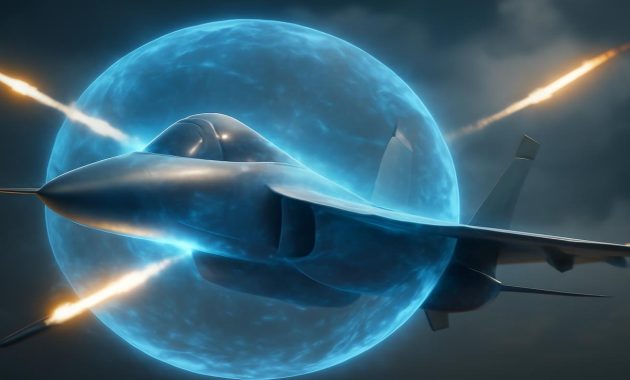
The first time you see it, it hardly looks like something that could decide the fate of an aircraft in combat. No roar, no smoke, no dramatic plume of fire. Just a silent, invisible beam—moving at the speed of light—reaching out across the sky. Somewhere far off, a small, hostile shape in the air shudders, flickers, and disappears in a puff of debris. There is no missile trail to follow, no spent shell casings clattering to the deck. Only a quiet hum, the glow of electronics, and a sense that something very old in aerial warfare has just changed forever.
The New Arms Race Written in Light
High above the desert of New Mexico, at an Air Force testing range where the horizon glows with heat, a small formation of aircraft sweeps across the sky. They carry no visible weapons under their wings. No chunky missile pods, no heavy gun barrels. To an observer on the ground, they look almost unarmed—sleek, pale shapes glinting in the sun.
But they are far from defenseless. Inside their fuselages, tucked behind panels and composite skins, are the machines that have drawn the eyes of the Pentagon—and the focus of a €62 million U.S. investment. Fiber-optic lasers. Compact, fierce, and unnervingly precise. They are the quiet answer to a noisy, chaotic new era of sky threats.
In the last decade, the sky above a battlefield has become cluttered with dangers. Swarms of cheap drones. Advanced air-to-air missiles that can think for themselves. Hypersonic weapons skimming the upper edge of the atmosphere. For decades, defending aircraft meant layering on more: more armor, more chaff, more flares, more jamming pods, more complex missiles to shoot down other missiles. Every new threat spawned another bulky, expensive countermeasure.
The United States, like every major military power, found itself in an arms race of mass and cost. Send a million-dollar missile to kill a thousand-dollar drone? It works—until you run out of million-dollar missiles.
The new technology promises to break that spiral by rewriting the rules. If it works as its architects hope, the skies of the future may be defended not by metal, fuel, and explosive, but by light itself.
The Promise of Fiber-Optic Lasers
Lasers funded under this €62 million push are not the clumsy, power-hungry beasts of science fiction movie sets. They are refined, tightly engineered tools born from the same world that gave us high-speed internet and precision manufacturing.
At their heart are fiber-optic cables—glass threads so thin you could mistake them for a hair. In civilian life, those fibers carry data. In this new application, they carry energy—immense, focused energy, braided and combined into a beam that can tear into a target’s skin or blind its sensitive sensors in a fraction of a second.
For aircraft, the appeal is almost irresistible. Instead of lugging around a small arsenal of missiles and countermeasures, a fighter jet or transport could sit within a cocoon of invisible defense, ready to strike down incoming threats without ever reloading. A laser can engage target after target so long as it has power and cooling. No reloads, no magazine limits, no telltale smoke spirals in the thin air.
Part of the €62 million bet is on shrinking and hardening these systems so they can be mounted on aircraft that already operate at the edge of physics—balancing weight, drag, heat, and structural stress with exquisite care. What was once a lab curiosity must become a compact, rugged guardian that can ride through turbulence, violent maneuvers, and bone-chilling cold at high altitude.
The Stakes in the Silent Sky
When you fly at 30,000 feet over hostile territory, danger doesn’t always announce itself. It might be a radar-guided missile launched 50 miles away, its seeker head sniffing for your heat signature. It might be a quadcopter-sized drone quietly orbiting above the battlefield, feeding coordinates to artillery. It might be something still classified, a weapon designed specifically to exploit the blind spots in current defenses.
Pilots talk about this unease—the feeling of being exposed to weapons you can’t see or hear. Modern warfare has transformed the sky from a wide-open frontier into a crowded, invisible tangle of data, signals, and lethal trajectories. Traditional defenses rely on intercepting or confusing threats with flares, jamming, and careful maneuvering. Those methods are still vital. But as threats multiply, the math starts to look grim.
A laser changes that math by giving an aircraft a new kind of agency. Instead of just dodging and deceiving, a pilot can reach out and physically alter the threat. Burn through the casing of an incoming missile. Fry the delicate electronics of a drone. Dazzle the optic sensors of a surveillance craft so it sees only white glare.
All of this happens at light speed. No need to estimate lead time for a missile. No waiting for a rocket motor to ignite. When the trigger is pressed—often a software trigger, not a finger on a stick—the effect is nearly instantaneous. In the blur of a real engagement, that difference matters.
The Money Trail: €62 Million and a Leap of Faith
Inside a conference room in Washington, D.C., the numbers are displayed on a neat slide deck. Line items. Milestones. Tranches of funding. Somewhere in that careful spreadsheet lies a line reading, in effect: “Directed-energy integration on tactical aircraft – €62 million.” It’s a tidy way of describing an enormous leap of faith.
To the engineers and program managers in the U.S. defense establishment, this investment isn’t just about buying gear. It’s about betting that fiber-laser technology has crossed a threshold—that it has left the realm of always-in-five-years and stepped into the now.
Where does the money actually go? It’s carved into a mosaic of challenges:
- Developing high-power fiber lasers that can be scaled up without becoming fragile or unstable.
- Designing compact power systems that can feed those lasers without compromising the aircraft’s core mission.
- Engineering cooling loops, radiators, and clever heat management solutions that can dissipate thermal loads in thin air.
- Building targeting and tracking systems sharp enough to keep a laser pinned on a fast-moving point the size of a pizza box, miles away, from a platform that itself is shaking and turning.
- Testing, testing, and more testing—because nothing on paper survives first contact with real-world weather, vibration, dust, and human error.
The table below offers a simplified snapshot of how that investment translates into capability goals:
| Focus Area | Objective | Target Timeline |
|---|---|---|
| High-Power Fiber Laser Modules | Achieve stable, aircraft-ready laser output in the 50–100 kW class | Near term (2–4 years) |
| Power & Thermal Management | Integrate compact power supplies and cooling without major airframe redesign | Near to mid term (3–6 years) |
| Targeting & Beam Control | Maintain precision tracking on fast, maneuvering aerial threats | Ongoing, incremental |
| Platform Integration | Flight-test lasers on fighter, bomber, and transport testbeds | Mid term (4–8 years) |
| Operational Concepts & Training | Write tactics, procedures, and safety rules for laser-armed aircraft | Mid to long term (5–10 years) |
It is, in many ways, a moonshot in slow motion. The United States is not alone—other nations are racing down the same path—but this particular tranche of funding is a clear signal: directed energy is no longer a back-of-the-lab curiosity. It is being groomed as an operational tool, as real as a radar or a missile rail.
What Makes a Laser “Unstoppable”?
The phrase “unstoppable” floats around defense conferences and glossy concept videos like a bold promise. Of course, no technology is truly unstoppable. Every shield invites a new spear. Yet compared to traditional weapons, fiber-optic lasers do have qualities that make them uniquely resilient and difficult to counter.
For one, you cannot easily outrun or outmaneuver light. If the laser system can see and track you, its beam gets there almost instantly. There’s no travel arc to hide behind, no curved path to predict, no explosive bloom to anticipate. The countermeasure playbook that pilots have relied on for decades—breaking missile lock, spoofing radars, dumping heat flares—doesn’t map cleanly onto a weapon that has no physical projectile.
Lasers are also stealthy in their own way. Fired from an aircraft, they produce no ballistic signature, no exhaust plume, no telltale radar reflection of a launched missile. If your sensors aren’t tuned for that particular kind of energy, you might not know you’re being targeted until your optics are blinded or your control surfaces begin to fail.
Then there’s the cost curve. Once built and installed, a laser’s “shot” can be astonishingly cheap—essentially the price of the energy it consumes. A few liters of jet fuel converted into electricity might be all it takes to swat down a drone that cost a fraction of that fuel, but far less than a traditional interceptor missile. Suddenly, swarms of cheap aerial threats—which were designed to overwhelm expensive defenses—face a weapon that is as scalable and repeatable as they are.
Yet the word “unstoppable” hides a universe of caveats: atmospheric distortion, clouds, dust, rain. Limitations in power, beam quality, and tracking. Every claim made in a polished briefing must pass through the brutal sieve of real conditions. Still, even with those limitations, the strategic advantage is undeniable. In clear air, within line-of-sight, with good tracking, a high-energy fiber laser is terrifyingly efficient.
The Human Side of a Light-Speed Weapon
It’s easy to get lost in the acronyms and physics. KW-class fiber modules. Adaptive optics. Spectral beam combining. Underneath all of that, though, are people—pilots standing on the tarmac, ground crews coaxing stubborn generators, engineers staring at thermal maps at 2 a.m.
Imagine being one of the first pilots to test a laser-equipped aircraft. You taxi down the runway knowing there’s something on board that no previous generation had. You climb, level out, and the test director’s voice crackles into your headset, guiding you toward a drone target. You don’t reach for a missile switch; instead, you watch a new set of symbology appear on your HUD, a subtle cue that your beam is locked, the target bracketed.
When you press the trigger, there’s no recoil. No roar. Somewhere in your field of view, a speck of light on the horizon flares and disappears. On your multi-function display, a line of data flips from “engaging” to “kill confirmed.” You’ve just fired a weapon that leaves no smoke trail.
That quietness changes the psychology of combat. There is something unnerving about power without drama. A missile launch is a visceral commitment: the flash, the streak, the knowledge that a piece of metal and fuel has left your wing and is now streaking toward another human or machine. A laser shot, by comparison, feels clinical. A toggle, a confirmation, a silent effect.
For the maintainers on the ground, the new systems are both marvel and headache. They must learn to baby high-precision optics that do not take kindly to dust or misalignment. They must watch thermal logs, check fiber interfaces, ensure that safety interlocks are perfect—because an invisible, high-energy beam that reflects unexpectedly can be as dangerous to friends as to foes.
The Ethics of a Cleaner Kill
There is a strange irony in the allure of laser weapons. They promise fewer explosions, less shrapnel, more discriminating engagements. They can, in theory, aim not at the fuel tank of an enemy aircraft but at its sensor pod, its antenna farm, its flight control computer—disabling rather than destroying.
In humanitarian terms, that sounds like progress. Reduce collateral damage. Neutralize threats without showering debris over the landscape. But every step that makes war more precise also risks making it more tempting. If you can project force with a sterile beam of light, if you can shut down a hostile aircraft or drone as tidily as closing a laptop lid, do you reach for that option more readily?
These questions are already being debated in think tanks and war colleges. A laser’s ability to blind sensors, for example, is technically useful—but blinding human pilots is constrained by international law. How do you ensure that a system designed for machines does not, intentionally or otherwise, target human eyes? Where is the line between disabling equipment and inflicting permanent injury?
As the United States pours its €62 million into this technology, part of the investment must be in doctrine and ethics, not just hardware. Rules of engagement, safety protocols, safeguards baked into software—all of these will determine whether lasers are tools of restraint or blunt instruments of domination.
From Prototype to Patrol
For now, most of the action is still in test ranges and labs. But the trajectory is clear. The U.S. military has a playbook for maturing radical technologies: small-scale experiments, limited field tests, quiet deployments on less glamorous platforms, then gradual expansion.
Large aircraft—transports, bombers, refueling tankers—may get operational lasers first. They have the space and power to host the early, bulkier systems. Their missions also make them valuable but vulnerable assets—high-value targets that need robust protection, but which rarely twist and turn like fighter jets.
Once the technology proves itself there, lighter, more agile variants will creep onto fighters. The dream is a future where a stealth jet carries an invisible shield, silently pruning the threats that try to close in. Not as a replacement for missiles and guns, but as a vital extra layer—an always-ready, near-limitless magazine of sky defense.
In that future, an enemy commander contemplating a mass launch of cheap, expendable drones will have to think twice. The defensive calculus will have shifted. The sky will still be dangerous—war never becomes safe—but it will be governed by new rules, new invisible lines of power.
And those first test flights, the ones happening today under the harsh sun of remote ranges, will be remembered as the quiet dawn of that new era: the moment when the United States decided that the next guardian of its aircraft would not ride on wings or fins, but travel on beams of light.
FAQ
Why is the United States investing around €62 million in aircraft laser defenses?
The investment is aimed at developing and integrating high-energy fiber-optic laser systems on aircraft to counter modern aerial threats like drones, advanced missiles, and surveillance platforms. Lasers offer rapid response, deep “magazines” (many shots without reload), and potentially lower per-shot costs compared to traditional missiles.
What exactly is a fiber-optic laser in this context?
In this defense role, a fiber-optic laser uses specially doped optical fibers to generate and amplify high-energy light. Multiple fibers can be combined to create a powerful, focused beam capable of damaging or disabling targets such as drones or incoming missiles.
Can these lasers really shoot down missiles?
In principle, yes. At sufficient power levels and with precise tracking, a laser can heat and weaken the structure or electronics of an incoming missile, causing it to fail. However, effectiveness depends on range, atmospheric conditions, and the sophistication of the missile’s design.
Are laser weapons already deployed on U.S. aircraft?
As of now, most laser systems for aircraft are in testing and development. Some ground and ship-based laser systems have seen limited operational use, but airborne versions are still moving from prototypes toward potential deployment.
What are the limitations of using lasers in the sky?
Lasers are affected by weather, dust, clouds, and atmospheric turbulence, all of which can scatter or weaken the beam. They also require substantial power and robust cooling systems, which are challenging to integrate on compact, high-performance aircraft.
Are there ethical concerns about laser weapons?
Yes. While lasers can, in theory, reduce collateral damage by targeting equipment rather than people, they raise issues such as the risk of blinding human operators and the possibility that “cleaner” weapons could lower the threshold for using force. International law already restricts blinding laser weapons.
Will lasers replace missiles and guns on future aircraft?
They are more likely to complement than replace traditional weapons. Missiles and guns still excel at many tasks, including long-range engagements and operations in poor weather. Lasers add a new layer of defense and precision for specific types of threats, especially smaller, cheaper, and more numerous ones.