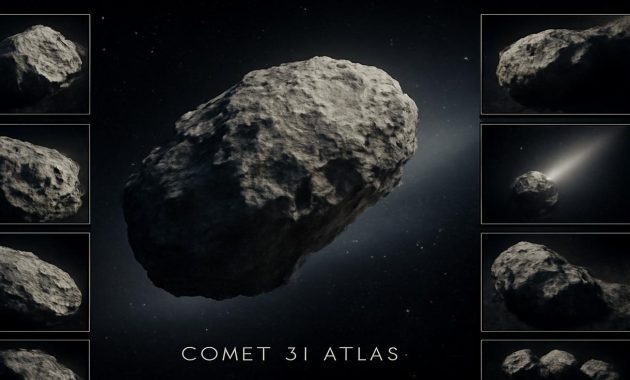
The first image looks almost disappointingly ordinary at a glance—a faint smudge against a grainy, star‑salted backdrop. You could scroll past it on your phone without a second thought. But then your eyes adjust, you zoom in, and the story starts to unfold. This isn’t just another icy wanderer from the outer reaches of our own Solar System. That pale streak is 3I ATLAS, an interstellar comet that began its journey in a completely different star system, wandering tens of millions of years through the dark before briefly crossing our skies. And now, for the first time, a new set of eight spacecraft images has captured it in a clarity that feels almost intimate—like the first real handshake with a traveler from another Sun.
Eight Glimpses of a Stranger
The images arrived on Earth like postcards from a distant road trip, beamed down as strings of radio whispers from a spacecraft trailing far from home. One by one, mission scientists watched as the frames sharpened into view. The same ghostly subject fills each shot, but the mood shifts: different filters, different angles, different distances. Together, they feel less like charts in a lab notebook and more like a contact sheet from an otherworldly photo shoot.
In several frames, 3I ATLAS is nothing more than a glowing knot wrapped in a hood of dust, the faint tail flaring away like smoke in a wind we cannot feel. In others, the light has been pushed and stretched to drag out structure—delicate jets of gas, a subtle asymmetry in the tail, hints of uneven outgassing from the spinning nucleus. The background stars blur into little streaks as the spacecraft tracks the comet, like time‑exposure images of city lights taken from a moving car.
These aren’t glossy, color‑saturated images made to win public popularity contests. They are raw, carefully calibrated measurements. But there’s something haunting about them nonetheless. Knowing what you’re looking at changes everything. This is not “one of ours.” It’s a loose, dusty remnant of some long‑ago dawn around a distant star, knocked free, exiled into the interstellar dark, and only now—by sheer accident—passing close enough for us to take a proper look.
The Taste of Another Solar System
Imagine standing in a snowstorm and catching a single snowflake on your glove. It’s tiny, intricate, and gone the moment it melts—but in that instant, you’re holding a pattern of the sky itself. Interstellar comets are like that, except the sky they fell from is not our own.
3I ATLAS is only the third confirmed visitor of its kind, following the cigar‑shaped 1I ‘Oumuamua and the more typical, fuzzy 2I/Borisov. Each of them is a clue, a stray sample from another cosmic workshop. Our own Solar System is full of icy debris in the Kuiper Belt and the Oort Cloud, leftovers of planet building. Other systems should have their own equivalents, and occasionally, some fragment gets kicked hard enough by gravitational encounters to escape entirely—flung into interstellar space like a stone from a catapult.
What makes 3I ATLAS so precious is what it carries. The dust in its coma, the gases boiling off its nucleus, the ratios of simple molecules—water, carbon monoxide, carbon dioxide, organics—are all fingerprints of the environment where it formed. When scientists spread its light into a spectrum, they’re essentially tasting the chemistry of another Sun’s nursery without leaving home.
In the new images, different filters isolate different slices of that chemistry. One filter lights up the glow of cyanogen and diatomic carbon, painting an invisible, spectral green in the minds of researchers. Another probes dust, showing how sunlight scatters off motes that might be older than our planet. Even brightness variations from frame to frame carry clues: slight flickers as jets rotate in and out of view, betraying the spin of the nucleus and the uneven landscape of ice and crust on its surface.
How You Photograph a Ghost Between the Stars
Trying to photograph 3I ATLAS is like trying to take a long‑exposure shot of a firefly while you’re riding a bicycle at twilight. Everything is moving. Everything is faint. And the precious target is changing even as you look at it.
The spacecraft that captured these eight images had to play a delicate game. First, it had to track the comet’s motion across the sky with exquisite accuracy, compensating for both the comet’s path and the spacecraft’s own orbit. Then, the camera systems had to take long exposures without smearing the comet into oblivion. Any small error would turn the image into a streaked mess of confusion.
Engineers worked with flight dynamics teams to choreograph this celestial dance. Thrusters fired in microscopic puffs. Reaction wheels spun up and down as the probe twisted, aligned, and held its gaze. Deep in the spacecraft’s belly, control software chased the comet’s predicted path, making course corrections on the fly. To an onlooker, it would have been an invisible ballet: a distant machine tilting its face toward a speck of moving light, hundreds of millions of kilometers away.
Meanwhile, back on Earth, the data trickled in. Not all at once, but in patient batches as ground stations rotated into view, as weather allowed, as bandwidth opened. The first previews came in low resolution, but even there, the elongated smudge of the comet was obvious—a sign that the tracking was working. Later, as full‑resolution frames were assembled and cleaned, the “ghost” sharpened and the science began.
| Image # | Phase of Encounter | Approx. Distance from Comet | Key Feature Visible |
|---|---|---|---|
| 1 | Initial acquisition | Tens of millions of km | Faint central condensation, emerging tail |
| 2 | Refined tracking | Slightly closer approach | Clearer coma, improved signal‑to‑noise |
| 3 | Multi‑filter imaging | Similar range | Gas emission highlighted in narrowband filter |
| 4 | Peak visibility | Near closest scientific opportunity | Asymmetric tail, possible jets |
| 5 | High‑contrast processing | Comparable distance | Fainter outer coma, dust structure |
| 6 | Rotational sampling | Comet slightly receding | Brightness variation as nucleus spins |
| 7 | Fading phase | Increasing separation | Tail lengthening, overall dimming |
| 8 | Final lookback | Farther outbound | Comet reduced to a star‑like point |
Reading the Comet’s Body Language
If you watch the eight images in sequence, something like personality emerges. The tail, for one thing, refuses to behave like a simple straight brushstroke. It bends slightly, kinked by the competing pulls of the solar wind and the comet’s own motion. In some frames, the coma looks lopsided, as though the nucleus were exhaling more strongly on one side than the other.
These are not artistic flourishes; they are physics in motion. The tail’s shape encodes the velocity of the solar wind, the flow of charged particles streaming outward from the Sun. The curvature reveals how long dust grains have been drifting away, how fast they were originally kicked off, and how sunlight has been shoving them around ever since.
The brightness profile across the coma—the way the light falls off from the center—tells researchers how densely packed the dust is and how quickly it thins with distance. That, in turn, helps estimate how vigorously the comet is sublimating its ices. A more active comet floods its surroundings with dust and gas; a quieter one wears a thinner cloak.
Most intriguingly, the slight changes in brightness between frames hint at rotation. As 3I ATLAS spins, different parts of its surface face the Sun and the camera. Some patches might be rich in fresh, untouched ice; others may be crusted over, darker, or exhausted. When a particularly active patch swings into sunlight, the comet brightens; when it rotates away, the glow sags. With enough images, astronomers can extract a rotation period and even begin to infer the shape of the nucleus—whether it’s more like a potato, a peanut, or some irregular shard.
For a visitor from another system, these seemingly small details are profound. They hint at the comet’s internal structure, how it has survived eons in the deep freeze between stars, and how much its outer layers have been reworked by its rare passages near any Sun.
What Makes an Interstellar Comet Different?
To the casual skywatcher, 3I ATLAS would look much like any other faint comet through a backyard telescope: a fuzzy core, a whisper of a tail, slipping quietly against the stars. The excitement comes from the trajectory and the chemistry, not the naked‑eye spectacle.
The orbit is the first giveaway. Comets bound to our Sun follow elliptical orbits, sometimes extremely stretched, but still closed loops. Interstellar visitors move on hyperbolic paths, open arcs that will never curve back. Their speeds are also telling: even far from the Sun’s grip, they move faster than anything native, carrying the excess energy of their long fall from somewhere else entirely.
Then there is what they are made of. With multiple spectra in hand, scientists can compare 3I ATLAS with known Solar System comets. Are its carbon monoxide levels typical, or strangely high? Does it carry familiar organic molecules—methanol, formaldehyde, simple hydrocarbons—or does it lean heavily into combinations we rarely see here? An interstellar comet that looks chemically ordinary might suggest that planetary systems across the galaxy churn out similar ices. A wildly unusual composition could hint at more exotic birthplaces.
Early indications from 3I ATLAS suggest a nuanced picture: not an alien outlier with entirely foreign chemistry, but not a perfect twin of our own comets either. Slight offsets in molecular ratios, subtle differences in dust grain properties, and variations in activity with distance from the Sun all feed into models of how and where it might have formed—perhaps farther from its star, or in a colder, thinner disk than the young Solar System enjoyed.
Why These Eight Images Matter More Than They Look
On a practical level, the new spacecraft images of 3I ATLAS are a validation of technique. They show that we can acquire, track, and study an object that appears in our cosmic neighborhood with little warning and disappears just as quickly. We are, in effect, practicing for a future in which these visitors may become regular scientific targets, not freak exceptions.
There is already quiet talk in mission design circles about “interstellar interceptors”—spacecraft launched in advance and parked in waiting orbits, ready to sprint toward the next incoming object. But to plan those missions intelligently, we need to understand how these bodies behave, how quickly they brighten, how close we need to get for meaningful measurements, and what kinds of instruments will make the most of those short windows. The 3I ATLAS images are part of that learning curve, a data‑rich rehearsal for a coming era of fast‑response astronomy.
On a more philosophical level, they tug at something older and more human. For millennia, comets were omens and mysteries, scribbles of light that seemed to arrive with no warning and disregard all order. Only in the past century or so have we come to see them as physical things—icy planetesimals, fossils of solar system formation. Now, with interstellar comets, the story opens up again. These are not fossils from our own history, but fragments of someone else’s.
Looking at the eight images laid out in sequence, it’s hard not to feel the distance folded into each photon. The light that bounced off 3I ATLAS carries the memory of another star’s cradle, of chaotic orbits, near‑misses, and eventual exile. Before it entered our telescopes and spacecraft cameras, it spent ages in the interstellar dark, racing through a void where stars are just lanterns on a distant horizon. And for a brief season, a machine built by a species on a small blue planet turned to greet it.
We often think of exploration as a one‑way effort—us going out there. Interstellar comets are a reminder that the galaxy, in its own slow and indifferent way, sometimes comes to us.
FAQ
What is 3I ATLAS?
3I ATLAS is an interstellar comet—an icy body that originated in another star system and is passing through our Solar System on a one‑time, hyperbolic trajectory. The “3I” designation means it is the third confirmed interstellar object detected, and “ATLAS” refers to the survey that first spotted it.
How do we know 3I ATLAS is from another star system?
Its orbit is hyperbolic, meaning it is not gravitationally bound to the Sun and will not return. It also entered the Solar System with an unusually high incoming speed that cannot be explained by interactions with our planets alone. Together, these properties point to an origin beyond our Solar System.
Why are the new eight spacecraft images important?
They provide the clearest, most detailed look yet at 3I ATLAS’s coma, tail, and activity. From these images, scientists can measure its rotation, estimate its dust and gas production, study its chemistry with different filters, and refine models of interstellar comets more generally.
Can I see 3I ATLAS with a backyard telescope?
Most interstellar comets are faint and move quickly across the sky. During its best visibility, a large amateur telescope under dark skies might glimpse 3I ATLAS as a dim, fuzzy patch. However, its prime viewing window is brief, and many people will experience it only through professional images and data.
How is 3I ATLAS different from comets in our Solar System?
Its path through space is the biggest difference—it is not bound to the Sun. Chemically, it appears broadly comet‑like but with subtle differences in molecular ratios and dust properties that may reflect a different environment of formation. These nuances are what make interstellar comets so scientifically valuable.
Could an interstellar comet ever hit Earth?
The chances are extremely low. Interstellar comets are rare visitors, and space is vast. While it is not impossible in principle, current observations suggest that the rate of such objects is far too low for impacts to be a realistic concern.
Will we ever send a spacecraft to intercept an interstellar comet up close?
Many mission concepts are being studied that would do exactly that. The challenge is speed: interstellar objects are detected late and move fast. The new observations of 3I ATLAS help engineers and scientists plan for future “ready‑to‑launch” or pre‑positioned spacecraft that could sprint toward the next interstellar visitor when it is found.