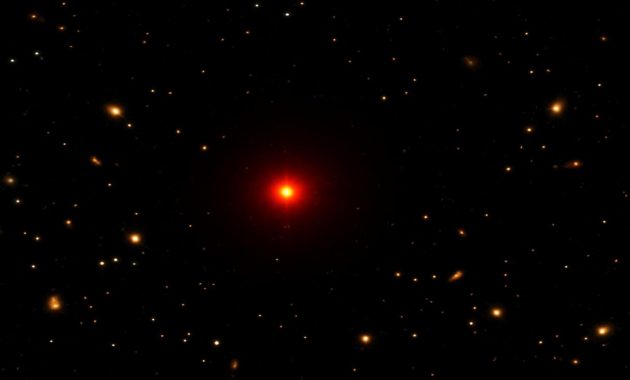
The image looks almost disappointingly simple at first glance: a faint, lonely pinprick of red in an ocean of black. No swirling spiral arms, no majestic rings, no cinematic cloud of gas and dust—just a dot. Yet buried in that tiny smear of crimson light, from a time when the universe was barely a toddler, astronomers think they might have found a new kind of cosmic monster.
The night the red dot appeared
Picture a control room lit mostly by screens, a soft blue glow shining on tired faces, half-drunk coffee cooling on the desks. Outside, the mountain air is thin and cold, but inside the telescope operations center, fingers quietly dance over keyboards. Long exposures from a powerful space telescope roll in, one after another—deep field images, where a single patch of sky has been stared at for hours, even days, letting in every photon the cosmos is willing to give.
Most of the frame is empty darkness. Then, if you zoom in far enough, the universe starts to bloom. Tiny galaxies, stretched and smeared by distance and time, crowd into view: golden ovals, scattered smudges, faint arcs distorted by gravity. And there, almost hiding in plain sight, is the object that makes one scientist lean a little closer to the screen.
It is absurdly small, barely more than a few pixels wide, but intensely red—red in a very specific way that suggests enormous distance. The farther away something is, the more its light has been stretched by the expansion of the universe, shifted toward longer wavelengths. In astronomy, red can mean old, dusty, or cold—but red like this, at this brightness, almost always means far. Far, and very, very early.
They tag it for follow-up, not yet knowing it’s about to unsettle some of the neat, comfortable categories they thought they understood.
A universe too young for something this big?
To understand why this tiny dot is such a big deal, you have to go back—way back—to a time when the universe was thick with hydrogen fog and newborn stars. Astronomers can do that using light as a time machine. The object’s red color tells them how much the universe has stretched its light during the journey. That “stretching” is described by a number called the redshift.
When they run the numbers, the conclusion lands like a quiet thunderclap: this dot comes from less than a billion years after the Big Bang. The universe, at that time, was still just getting used to the idea of having stars at all. Giant galaxies, we like to think, come later—built up slowly through mergers and star formation, piece by piece, over billions of years.
But this object? It looks like it’s already huge.
Its brightness suggests an enormous mass in stars or, at the very least, an incredible concentration of hot material. Some estimates make it heavier than many mature galaxies we see nearby today. It’s as if you walked into a maternity ward expecting to see only fragile newborns and found, instead, a full-grown adult pacing the room.
Something doesn’t quite add up. Either this object is not what we think it is… or parts of our cosmic story are wrong—or at least incomplete.
The puzzle in the pixels
On paper, one explanation jumps out first: perhaps it’s just a glitch. Data can be tricky, especially at the edges of detection. Maybe it’s a closer object wearing the disguise of distance. Maybe it’s two or three overlapping sources playing tricks on the detectors. Or the model that translated its red color into distance might be off.
But as more observations come in—from different filters, different instruments, even different telescopes—the dot refuses to behave like a mistake. Its color and brightness remain stubbornly consistent. If it’s a galaxy, it is too bright and too massive for its age. If it’s something else, that “something” might be unlike any cosmic citizen we’ve cataloged so far.
To keep their options open, astronomers start talking in careful terms. They call it a candidate for a new class of object. They compare notes with colleagues who specialize in theory, in simulations, in black holes, in early-universe chemistry. What emerges from those conversations is less an answer and more a menu of wild possibilities.
The suspects: what could this dot be?
There are a few leading contenders for what this tiny red dot might represent. None of them are boring.
1. A super-early giant galaxy: One option is that it really is what its light suggests: an extremely massive galaxy that formed far faster than standard models predict. That would mean the universe was astonishingly efficient at building big structures right out of the gate. Clouds of hydrogen must have collapsed with ferocious speed, igniting storms of star formation that turned raw gas into heavy, bright stars almost overnight.
2. A “monster” black hole in disguise: Another suspect is a supermassive black hole voraciously feeding on surrounding material. As gas spirals inward, it heats to ridiculous temperatures, blasting out light. If that feeding frenzy is intense enough, the glow could outshine any young galaxy and make the object appear much more massive than it really is. In that case, what we’re seeing would be one of the earliest active galactic nuclei—a cosmic engine already spinning in the universe’s first few hundred million years.
3. A compact, star-choked starburst: It could be a very dense, very compact region of star formation, where stars are being born at a rate many times higher than in typical galaxies. Imagine hundreds of millions of suns crammed into a region not much larger than some of the star clusters in our own Milky Way. This kind of extreme environment would glow intensely in the infrared, producing the kind of light profile we’re seeing.
4. Something we haven’t thought of yet: The possibility scientists are secretly most excited about is the strangest: that it’s a type of object we don’t have a name for yet, something that only existed briefly in the early universe. Maybe a short-lived phase between a collapsing gas cloud and a fully formed galaxy, or a new kind of halo-building structure predicted only vaguely by simulations.
Any of these explanations would teach us something profound. All of them, in their own way, deserve the label “cosmic monster.”
Seeing the invisible: how we read a red dot
From a distance, astronomy looks almost romantic: telescopes under the stars, the night sky wheeling silently overhead. Up close, it’s mostly numbers. Those pixels of red become tables of brightness at different wavelengths, statistical fits, lines of code running overnight on remote servers.
To turn the dot into a story, astronomers break its light apart. They look at how bright it is in one range of infrared compared to another. They check how sharply its brightness climbs or falls, looking for signatures of hydrogen absorption and emission that signal extreme distance. If they’re lucky enough to get detailed spectra—thin rainbows of its light spread into sharp bands—they can pick out little dips and spikes where atoms have left their fingerprints.
In practice, much of the early work happens through what’s called “photometric redshift”—estimating distance from the overall shape of the object’s energy across different filters. It’s like trying to guess what kind of song is playing in the next room just from the muffled pattern of bass and treble, long before you can hear the lyrics. Later, when enough telescope time is granted, a deeper spectrum might confirm whether the guess was right.
Meanwhile, simulations are running in parallel. Teams who model galaxy formation in powerful supercomputers feed in the known laws of physics and let gravity, gas, and radiation run wild in virtual universes. Then they ask a simple question: in any of these simulated cosmoses, do we ever see an object like this—this bright, this massive, this early?
Sometimes the answer is “barely, and only under extreme conditions.” Sometimes it’s “no, this shouldn’t exist.” Either reply hints that our understanding of cosmic history may be missing a crucial chapter.
A cosmic “monster” by the numbers
Here is a simplified look at how this tiny red dot stacks up against familiar benchmarks:
| Property | Tiny Red Dot Candidate | Milky Way (for comparison) |
|---|---|---|
| Cosmic age when observed | < 1 billion years after Big Bang | Today (≈13.8 billion years after Big Bang) |
| Estimated stellar mass | Comparable to or exceeding the Milky Way in some models | ≈1 trillion solar masses (including dark matter halo) |
| Size on the sky | Barely resolved, extremely compact | Spans the sky if viewed from within, ≈100,000 light-years across |
| Star formation | Likely extreme: rapid, intense bursts of new stars | Moderate, steady star formation |
| Dominant light | Infrared (stretched light from very early universe) | Visible and infrared |
Those numbers are not final, and they may change as new data comes in. But even in their rough form, they paint a portrait of something pushing right up against the limits of what our current models say is possible.
The early universe, re-imagined
If objects like this tiny red dot are common—and that’s still an “if”—they reshape our mental image of the young universe. We usually imagine it as a place of fragile firsts: the first stars flickering on, the first galaxies stumbling into shape, faint beacons in a thickening dark. But add in massive, compact giants forming at breakneck speed, and the early cosmos begins to look less like a gentle dawn and more like a turbulent, fiery boomtown.
That has consequences. Heavy stars live fast and die hard, exploding as supernovae that scatter metals—elements like carbon, oxygen, and iron—into the surrounding gas. If early structures were already gigantic and intense, then the process of seeding the universe with these building blocks must have gone into high gear quickly. Planets, life, chemistry: all of these depend on how soon and how abundantly those elements were spread.
Massive early black holes would also stir things up. As they feed, they unleash jets and winds that can both quench and trigger star formation around them. Their gravity warps the paths of light itself—another subtle way these monsters may be whispering their presence to us across time.
Pieces of this story are already built into theories of galaxy evolution. But observations like this red dot push on the details. Maybe dark matter clumps more efficiently in the early universe than we thought. Maybe gas can fall into those clumps faster, cooling and collapsing into stars in violent, rapid bursts. Or perhaps there are feedback processes—cosmic checks and balances—we’ve overestimated, allowing more runaway growth than our simulations have so far allowed.
Between awe and skepticism
In conversations among astronomers, reactions to the tiny red dot tend to oscillate between delight and doubt. There is a kind of professional reflex: if something looks too extraordinary, assume there’s a boring explanation hiding under a rock you haven’t turned over yet. Better calibration, deeper spectra, more targets—that’s the rhythm of careful science.
At the same time, there’s a quiet, shared excitement. Every era of astronomy has been marked by things that initially looked like errors: the odd wobble in a planet’s orbit that led to the discovery of Neptune, the mysterious shift in Mercury’s path that hinted at general relativity, the first quasars masquerading as stars with “impossible” radio signatures. Strange signals often herald big ideas.
In that lineage, a faint, reddened blob at the edge of the observable universe fits right in.
Our place in the red dot’s story
It’s tempting to treat such discoveries as distant curiosities, trivia from the deep past. Yet in a real sense, we are made from the outcomes of those ancient extremes. If the early universe had been slower, quieter, less capable of building these monster structures, the heavy elements that make up our bodies might have arrived much later—or in far different distributions. Our solar system, our planet, our particular story could have turned out differently, or not at all.
The light from that red dot traveled for more than 13 billion years to reach the detectors that first noticed it. In that time, entire generations of stars were born and died, galaxies collided and merged, black holes grew fat and then quiet. Dinosaurs rose and fell here on Earth in what counts as a cosmic afterthought. Humans appeared, learned to shape stone, then metal, then glass, then lenses… and finally built a machine sensitive enough to capture a few dozen photons that left this object before Earth itself existed.
That is the human-sized miracle hidden in every such image: a species of primates on a small rocky world, building tools that let them read the fossil light of the universe’s childhood. Somewhere inside that data may be the hint of an entirely new kind of cosmic structure—a monster born in the fog of the first billion years.
For now, in the catalogues and databases, it has a dry, forgettable name: a string of letters and numbers, coordinates in the sky. But around coffee tables and in hushed late-night video calls between teams, it already has a personality. The tiny terror. The overachiever. The problem child. The cosmic monster.
Whatever we end up calling it formally, its real power lies in what it forces us to ask: How quickly can something become enormous in a young universe? What unknown shortcuts might gravity and gas be taking? And what does that say about the pathways that eventually led to galaxies like our own—and to us watching, wondering, from so very far away?
Frequently Asked Questions
Is this tiny red dot definitely a new kind of object?
Not yet. Astronomers are cautious. Right now, it is a strong candidate for something unusual, but more detailed observations—especially high-quality spectra—are needed to confirm its distance, mass, and nature. It might still turn out to be an extreme example of something we already know, such as a very active black hole or a compact starburst galaxy.
Why is it called a “cosmic monster”?
The nickname comes from its apparent combination of youth and scale. If it really is as massive and bright as current data suggest, it would be far larger and more developed than we expect objects to be at such an early time in the universe. That outsized growth, happening so soon after the Big Bang, is what earns it the “monster” label.
How do astronomers know how old the universe was when the light left this object?
They estimate the age using its redshift—the amount its light has been stretched by the expansion of the universe. By comparing that redshift to models of cosmic expansion, astronomers can translate it into a look-back time, which tells them how many years after the Big Bang the light was emitted.
Could this just be an error in the data?
It’s possible, and scientists take that possibility seriously. They test for misalignments, overlapping sources, and incorrect model assumptions. The fact that this object appears consistently in multiple observations makes an error less likely, but not impossible. That’s why confirmation with independent methods is so important.
What happens next in studying this object?
The next steps include securing more observing time to obtain deeper spectra, refining estimates of its distance and mass, and searching for similar objects in other deep fields. At the same time, theorists are updating simulations to see whether such objects can form naturally with adjusted assumptions—or whether they point to gaps in our current understanding of how the early universe built its first giants.