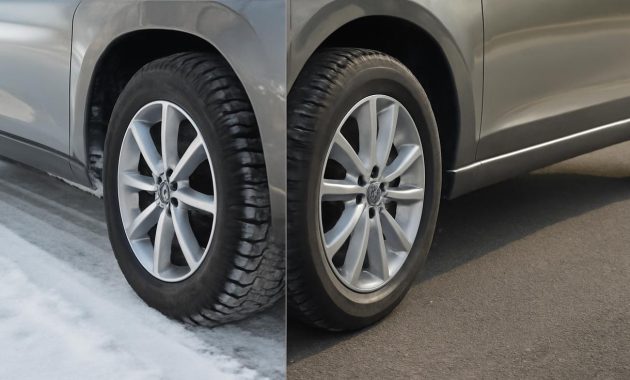
The first snow of the season never looks dangerous. It drifts down like confetti, softening the hard lines of parking lots and highway shoulders. You crack the door open on a late November morning and there it is: a muffled world, the hiss of distant tires on slush, the breath of cold air that smells faintly like metal and pine. You scrape your windshield with a gloved hand, slide into the driver’s seat, and ask yourself a question that thousands of drivers wrestle with every year: should you be rolling out on dedicated winter tires… or are your all-season tires “good enough” to carry you through?
The Morning the All-Seasons Lied to Me
It was one of those treacherous days that only looks harmless. The sky was a dull, bright white, and the road—a familiar, straight stretch along the river—seemed merely wet. The thermometer on the dash read just below freezing. I was rolling along on nearly new all-season tires, feeling smug that I’d saved money and skipped the hassle of the seasonal swap.
Then, up ahead, the brake lights bloomed red. A line of cars slowed for someone turning left. I eased onto the brake pedal, not panicking, just a smooth press, the way every winter driving tip tells you to do. Instead of slowing with me, the car began to glide—a gentle, horrifying sensation, like the road had melted into glass. The anti-lock brakes chattered; the steering wheel grew light, vague. I watched the gap to the car ahead shrink, heart pounding, until finally the tires bit into some rougher patch of asphalt and I came to a stop, sideways in the lane, hands shaking.
I hadn’t been speeding. I hadn’t slammed the brakes. I’d done “everything right.” The only thing wrong was my assumption that “all-season” meant “all winter.”
What Winter Really Does to Your Tires
When we talk about winter driving, we usually picture deep, fluffy snow or dramatic blizzards, but the most dangerous stuff often hides in plain sight: that thin invisible film of ice at an intersection, the refrozen meltwater at the end of your driveway, or the half-melted slurry the plows leave behind. To understand why your tire choice matters, you have to zoom in, all the way down to the rubber molecules.
Rubber is more like a living thing than we give it credit for. In summer, tire rubber is supple and grippy, bending and flexing around tiny imperfections in the road, digging in with thousands of microscopic edges. Drop the temperature, though, and ordinary rubber begins to stiffen. What once behaved like a firm, flexible eraser starts to feel more like hard plastic. That’s bad news when you’re trying to hang on to a slippery, frozen road.
All-season tires are built as a compromise. Their rubber is formulated to work reasonably well in a wide range of temperatures, from hot summer highways to cool autumn mornings. But as the mercury falls below about 7°C (45°F), they begin to lose that needed flexibility. Meanwhile, the shoulders of winter tires—made of softer, colder-loving compounds—stay pliable much deeper into winter, still able to deform, bite, and hold.
Then there’s tread design: the ridges, grooves, and tiny cuts, called sipes, that channel away water and slush and create gripping edges. All-season tires often have fewer, shallower sipes and tread blocks optimized for quiet, fuel-efficient cruising. Winter tires, by design, look a bit wilder—aggressive channels, densely packed sipes, and block patterns shaped to claw into snow, hold onto ice, and spit out slush before it becomes a slippery film.
The Tire Showdown: Winter vs. All-Season
Let’s pull into an imaginary test track on a crisp January afternoon. The air is sharp enough to sting your lungs. In the distance, you hear the whine of a car accelerating and the squeal of brakes. This is where the two main tire options step into the spotlight.
| Feature | Winter Tires | All-Season Tires |
|---|---|---|
| Rubber compound | Stays soft and flexible in cold temperatures | Hardens in cold, optimized for mild to warm conditions |
| Tread design | Deeper grooves, many sipes, aggressive patterns for snow and ice | Balanced for dry/wet roads, fewer sipes, less aggressive in snow |
| Braking on ice/snow | Significantly shorter stopping distances | Longer stopping distance; traction breaks earlier |
| Performance on dry cold roads | Good grip, slightly softer feel, can wear faster in warmer spells | Acceptable grip, but less effective below 7°C (45°F) |
| Seasonal use | Best for late fall to early spring in cold climates | Designed for spring, summer, and fall; light winter at best |
How They Stop: A Few Car Lengths That Matter
On a snow-packed road at city speeds, independent tests often find that a car on winter tires can stop several car lengths shorter than the same car on all-season tires. Picture that on your daily commute. The kid chasing a soccer ball into the street. The delivery van that hesitates at a yellow light. Those few car lengths aren’t just numbers; they’re the difference between a shaken breath and a phone call to emergency services.
On ice, things become even more dramatic. Winter tires, with their fierce little sipes and cold-happy rubber, find slivers of traction where all-seasons simply slide. You may still feel the anti-lock brakes buzzing under your foot, but the car responds, slows, obeys. On all-seasons, you’re more at the mercy of momentum.
What “All-Season” Really Means
There’s an uncomfortable truth buried in the name “all-season.” It was coined at a time when vehicles were lighter, traffic slower, and winter expectations different. In many regions, “all-season” has become a kind of shorthand for “all-compromise.” These tires will get you through autumn rainstorms and July heatwaves, and they might cope with the first dusting of snow if you’re careful. But they’re not designed to excel in sustained, serious winter.
If you flip your tires over and look for a symbol—a small mountain with a snowflake inside it, called the Three-Peak Mountain Snowflake (3PMSF)—that icon tells you the tire meets a tested standard for severe snow service. Most true winter tires carry it. Many plain all-season tires do not. The absence of that symbol is like a quiet disclaimer: these weren’t built for regular battles with ice and deep snow.
So… Which Should You Choose, Really?
This is the part where you want a clear, no-nonsense answer. So let’s cut through the slush.
If you live in a region where winter is not just a brief visitor but a long-term tenant—where temperatures linger near or below freezing, where snowplows are a daily sight and the roads frequently turn white or greasy gray—then winter tires are, quite simply, the right tool for the job. They’re not a luxury; they’re an investment in control.
Imagine your typical winter week. Do you often wake up to frosted windshields? Do you routinely drive before the sun has warmed the pavement? Does your route include hills, bridges, rural roads, or intersections where runoff freezes into hidden sheets? If you silently answered yes more than once, your car—and everyone in it—will be safer on dedicated winter tires.
On the other hand, there are places where true winter is rare. Maybe your coastal town gets a couple of light snowfalls a year, usually turning to slush by lunchtime. Maybe the local climate spends its winter hovering just above freezing, soggy rather than snowy. In such regions, good-quality all-season tires, driven with care, might be acceptable. You may never see the dramatic advantage of winter tires because your roads hardly ever cross that invisible line into real snow and ice.
But here’s the thing: climate is changing. Places that “never used to get snow” are suddenly flirting with strange winter storms. A once-every-ten-years ice event can turn your entire city into a skating rink overnight. During those rare days, all-season tires often reveal their limits in very public, very sideways ways—on social feeds filled with spinning cars and abandoned vehicles.
The Money Question: Are Winter Tires Worth the Cost?
At first glance, the idea of buying a second set of tires (and possibly wheels) can feel like an extravagance. But it helps to think of it not as adding something, but as dividing your wear and tear.
When you run winter tires during the cold months and all-season or summer tires in the warm months, you’re essentially splitting the job. Each set spends half the year resting in a garage or storage rack. They may last you almost twice as long in total mileage, because neither is doing all the work alone. Over the life of the vehicle, the cost difference often narrows more than people expect.
There’s also the hidden economy of avoiding disaster. A single low-speed slide into a curb can mean a bent suspension arm or a damaged wheel—repairs that can easily eclipse what you saved by skipping winter tires. Factor in insurance deductibles, rental cars, and missed work, and the math starts to favor preparedness pretty quickly.
Beyond the Specs: How Winter Tires Feel
Strip away the technical charts and certifications, and what you’re really buying with winter tires is a feeling. It’s the way your car responds when the road looks suspiciously dull and dark, when snow is blowing sideways past the streetlights, or when a plow has left ridges of icy slush at every intersection.
On proper winter tires, the steering stays more communicative; you feel the front end bite rather than skate. The car tracks straighter when you cross those carved ruts of packed snow—a common source of white-knuckled lane changes. On a slippery hill, you may still get some wheelspin, but the car finds traction more quickly, clawing its way forward instead of giving up and spinning helplessly.
None of this grants you superpowers. You still have to slow down in storms, leave bigger gaps, and respect physics. But winter tires shrink the gap between what you ask of your car and what it can realistically deliver when the world outside is frozen and unpredictable. They make winter driving feel less like a gamble and more like a manageable challenge.
Where All-Seasons Still Shine
All-season tires deserve some credit. In the right environment, they’re quiet, efficient, and convenient. If your winters are mild, your streets are quickly cleared, and you can simply stay home on the rare truly bad day, they might align perfectly with your needs.
They also make sense for drivers who log most of their miles in urban cores where roads stay black and wet rather than white and packed—think big coastal cities with good drainage and armies of salt trucks. Good all-seasons, kept properly inflated and not allowed to wear down to baldness, can be faithful companions for many years.
The challenge is honesty. You have to be brutally realistic about your weather, your routes, your habits, and your tolerance for risk. Are you the person who still has to get to the hospital for a night shift, or drive a long rural stretch before dawn? Or are you someone who can watch the storm from your window, keys staying safely in a bowl by the door? The right tire choice begins with that self-portrait.
The Verdict: Answering Once and for All
So here it is, clear and simple, without the marketing language or the wishful thinking.
If your winters regularly bring freezing temperatures, snow, or ice on the roads—even if plows and salt trucks fight hard against it—you should choose winter tires. Not because law or custom says so, but because physics does. Below that 7°C (45°F) threshold, winter tires are engineered to outperform all-season tires in the conditions that actually cause crashes: the surprise ice, the slushy intersections, the unplowed parking lots, the refrozen runoff on the shaded curve.
All-season tires are a good match only for drivers in regions where winter is mostly chilly rain with the occasional, short-lived dusting of snow—and where you can simply avoid driving during the brief spikes of truly hazardous weather. If that’s not the reality outside your window, then deep down, you already know which choice makes sense.
As you stand at the service counter or scroll through tire options on your phone, picture that first slippery morning—the muted crunch of snow under your boots, the sting in your nose as you exhale, the thin, deceptive sheen of the road ahead. Ask yourself what you want to feel when you tap the brakes on that day: doubt, or control.
Winter will come, in its own unpredictable way. The snow doesn’t care what your tires are called. But the road will answer, very clearly, to what they’re made of.
Frequently Asked Questions
Do I really need winter tires if I have all-wheel drive?
All-wheel drive helps you get moving, but it doesn’t help you stop or turn on ice and snow. Winter tires improve braking and cornering grip, which are critical for avoiding collisions. AWD plus winter tires is a strong combination; AWD with all-seasons can still slide straight through an intersection.
When should I switch to winter tires?
A good rule of thumb is to install winter tires when daily temperatures regularly fall below 7°C (45°F), not when the first snowstorm hits. The benefit comes from the cold-weather rubber compound as much as from the tread pattern.
Can I leave winter tires on all year?
Technically, yes, but it’s not a good idea. Winter tires wear faster in warm temperatures, can feel squirmy on hot pavement, and may increase fuel consumption. You’ll get better performance and value by switching back to all-season or summer tires in spring.
Do I need winter tires on all four wheels?
Absolutely. Mixing winter tires on one axle and all-seasons on the other creates unbalanced grip, which can lead to dangerous handling—such as the rear of the car swinging out under braking or in curves. For stability and safety, always equip all four wheels with the same type of tire.
How long do winter tires typically last?
With normal seasonal use, many drivers get four to six winters out of a set, sometimes more. Longevity depends on mileage, driving style, and how carefully you store them in the off-season. Even with good tread, consider replacing them around six years from the manufacturing date, as rubber ages over time.