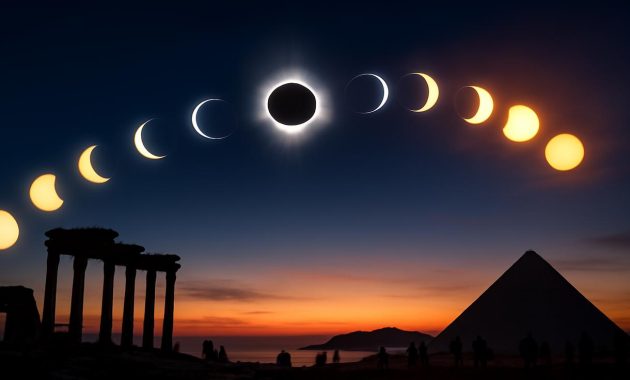
The first thing you’ll notice is the sound. Not the darkness—though that will come—but the sudden, uneasy quiet that sweeps across the landscape as if someone pressed mute on the world. Birds that moments ago stitched the sky with song go silent. Insects pause their endless hum. The warmth on your skin softens, then slips away. You look down, and your own shadow begins to blur at the edges, as if you’re fading from the day. You glance up—through safe eclipse glasses, of course—and see it: the Moon flexing its ancient muscle, shouldering itself into perfect alignment with the Sun. And you realize you are standing in the path of the eclipse of the century.
Why This Eclipse Is Different From Anything You’ve Seen
Total solar eclipses are not rare in the grand story of the cosmos; they happen somewhere on Earth roughly every 18 months. But not all eclipses are created equal. This one has astronomers, photographers, travelers, and dreamers whispering the same phrase: six full minutes of darkness.
For context, most total solar eclipses last just two or three minutes at any given place on Earth. Four minutes is considered generous. Anything longer than five minutes drifts into legend, like the celebrated eclipse of 1973 or the long-shadowed events of earlier centuries. To get a full six minutes of totality—six minutes with the Sun completely swallowed, the bright corona blazing out, the stars popping into sudden daylight—requires a near-perfect choreography of celestial mechanics.
Three variables must cooperate: the Earth’s distance from the Sun, the Moon’s distance from Earth, and where you are along the narrow ribbon of the Moon’s shadow sweeping across the planet. When the Moon is closer to us in its orbit, it appears larger in the sky and can cover the Sun more completely. When Earth is a bit farther from the Sun, the Sun appears smaller. Put those conditions together, and the Moon’s dark silhouette can hold its grip on the solar disk for longer. That is the rare cosmic geometry that will set the stage for this eclipse of the century.
You will not see a longer total solar eclipse in your lifetime. That realization settles somewhere deep in your chest. It transforms the event from “a cool thing to watch” into a once-in-a-world kind of invitation.
When It Will Happen: Marking the Cosmic Appointment
Eclipses are like celestial trains: they run on exact schedules, and they do not wait. The date and time of this six-minute marvel have been calculated years in advance by orbital models that can predict the positions of Earth, Moon, and Sun down to fractions of a second.
On the chosen day, the Moon’s umbra—the darkest part of its shadow—will first touch Earth at sunrise over the ocean. From there, the path of totality will slice across continents, seas, cities, and remote landscapes in a sweeping arc. In each location, the timing will be different, but the show will follow the same rough script: a slow partial phase lasting over an hour, a few breathless minutes of totality, and then a mirrored dance back to daylight.
To fully appreciate when to expect your moment of darkness, it helps to think in three layers of time:
- Global event time – the overall window when the eclipse occurs somewhere on Earth, from first shadow at sunrise to last contact near sunset.
- Local totality time – the brief interval when your specific location falls within the path of totality.
- Peak totality duration – the point along the path where totality lasts longest; this is usually over open ocean or remote land and may be close to six full minutes.
Even a few dozen kilometers can mean the difference between three minutes of darkness and the full, legendary six. That’s why eclipse chasers—those devoted travelers who collect totalities like rare stamps—spend months scrutinizing maps, timing charts, and weather records, searching for the sweet spot where timing, duration, and clear skies intersect.
The Best Places on Earth to Watch Six Minutes of Nightfall
Choosing where to stand for the eclipse of the century is like choosing the backdrop for the most surreal photograph of your life. The sky will be the same everywhere along the path of totality: Sun turned black disk, corona blazing, stars unveiling themselves in daytime. But what surrounds you on the ground—the horizon, the landscape, the human company you keep—can shape the feeling of the experience.
Below is a simplified overview of the kinds of locations likely to offer both long duration and striking scenery. Exact coordinates and minute-by-minute times will depend on final astronomical tables, but this gives a sense of the journey the Moon’s shadow will take and how you might follow it.
| Region | Appeal | Approx. Totality | Traveler Notes |
|---|---|---|---|
| Remote Oceanic Track | Likely longest totality (~6 min) | Around local midday | Best seen from eclipse cruises or expedition ships |
| Coastal Headlands | Wide horizons, dramatic seascapes | 5–6 minutes in prime spots | Popular with photographers; book early |
| High Plateaus & Deserts | Dry air, clear skies, intense twilight colors | 4–6 minutes | Ideal for stargazers; temperature drop is dramatic |
| Rolling Farmland & Plains | Unobstructed sky, easy access | 3–5+ minutes | Good for families, community events |
| Mountain Valleys | Surreal shadows sliding across peaks | Up to ~4–5 minutes | Mind the weather; valleys can trap clouds |
If you’re aiming for those mythical six minutes, you’ll be drawn toward the central line of the eclipse path, possibly over ocean or isolated stretches of land. This might mean signing onto a dedicated eclipse cruise, boarding a charter flight that races the shadow, or traveling to sparsely populated coasts and deserts where accommodations are limited but the sky is endless.
More accessible locations—cities near the path, road-trip-friendly rural areas, national parks—might offer slightly shorter totality but richer cultural experiences. Imagine standing in a vineyard as the sky goes night-dark, or on a quiet prairie where you can watch the Moon’s shadow sweep toward you like a great, invisible wave.
What It Feels Like When Daylight Switches Off
Those who have witnessed a total solar eclipse rarely talk about “seeing” it. They talk about feeling it. They talk about a collision of senses and instincts that no photograph can capture.
The day begins normally enough. The Sun climbs. People spread blankets and set up cameras. Then the Moon starts to nibble at the Sun’s edge—a little missing bite, barely noticeable without eye protection. Over the next hour or so, the bite grows into a crescent, then a narrowing arc. Shadows on the ground go strangely crisp, as if drawn with a finer pencil. If you stand under a tree, each tiny gap between leaves becomes a pinhole projector, casting hundreds of miniature crescent Suns onto the ground.
Temperature falls. It’s not an imagined chill; the Sun’s energy is literally being blocked. A breeze might stir as the air struggles to balance warm and cool layers. Animals get confused. Flowers that open for the day may close. Birds head for roosts. Cows and horses may drift toward barns or fencelines, uneasy in the fading light.
Then, in the final minute before totality, reality begins to bend. The light takes on an odd, metallic quality—too dim for day, too bright for night. Colors around you flatten into a kind of cinematic filter. You can feel the tension in the crowd: conversations falter, then stop. Some people start to cry before the darkness even arrives.
At the last instant, the Sun’s shriveling crescent breaks into beads of light shining through valleys along the Moon’s limb—“Baily’s beads,” they’re called. A final bright spot forms, a blazing diamond ring of light. And then, suddenly, the gems go out.
Totality.
You take off your eclipse glasses and look directly at the Sun, now a black circle punched out of the sky, framed by a crown of white fire: the solar corona, normally lost in the glare of full daylight. Streamers and loops of plasma arc out into space. Stars and planets appear—Venus bright, perhaps Jupiter or Mercury nearby. On the 360-degree horizon, the world glows in a band of deep twilight oranges and purples, as if a sunset has wrapped itself around you in all directions at once.
It will be quiet, but not silent. Some people whisper. Others laugh in disbelief. A few simply stand, hands to their mouths, as if the sky has confessed some secret it has been keeping for four and a half billion years. For six full minutes—or however long your spot on Earth is granted—the ordinary rules of day and night vanish. You are standing in a pause between two kinds of light, watching the machinery of the solar system work in plain sight.
Preparing for the Eclipse of a Lifetime
This is not an event to drift into casually. To give yourself fully to those six minutes, you’ll want to think carefully about the hours, days, and even months leading up to them.
Plan Your Location Early
Once the path of totality is published in detail, popular spots will begin to fill. Hotels along the line may sell out a year or more in advance. Eclipse tour operators will assemble packages: cruises, guided trips to deserts and plateaus, charter flights. Decide what kind of experience you want—remote solitude, communal festival, rugged adventure—and book as early as your budget and courage allow.
Watch the Weather
Climatology—long-term average weather—matters. Some regions have reliably clearer skies at that time of year. Others are notorious for clouds or storms. Many eclipse chasers treat location as a flexible target, arriving in the general region days ahead of time, studying weather forecasts obsessively, and then driving or repositioning at the last moment to slip under a promising patch of blue.
Pack for a Sudden Night
Even in hot climates, the temperature during totality can drop noticeably—sometimes by 5–10 degrees Celsius or more. Bring layers, especially if you’ll be at altitude or on open plains where wind can cut through clothing. A headlamp or small red-light flashlight can help once the darkness hits and you’re fumbling with cameras or notebooks.
Protect Your Eyes (and Your Experience)
During the partial phases, the Sun is still dangerously bright. Only when the Sun is completely covered—true totality—can you safely look with the naked eye. For every other moment, you need certified eclipse glasses or solar filters for binoculars and cameras. Never use improvised filters or regular sunglasses; they are not enough.
But equally important is protecting your attention. Many first-time viewers bury their faces in cameras and telescopes, trying to “capture” the eclipse, and later realize they barely saw it themselves. Consider keeping photography simple—a wide-angle shot of the landscape, a short video of the crowd’s reaction—and giving at least half of totality to your own eyes and senses alone.
Beyond the Spectacle: What Six Minutes of Darkness Does to Us
Long after the eclipse has passed, after the traffic jams unwind and the pop-up campsites empty, something lingers. It’s hard to name. A shift in scale, maybe. A new mental yardstick for what “a big event” means.
For all our technology, we’re still small creatures tethered to a bright star and an airless rock that orbits us. An eclipse makes that relationship visible. You can feel the alignment in your body. You can see the curved edge of the Moon slicing into the Sun and think: that is a sphere, hanging out there in space, just the right size and distance to block our star. On some level, we know this every day. But knowing and witnessing are different things.
There’s also something profoundly democratic about an eclipse. No ticket, no backstage pass, no VIP section in the sky. The Moon’s shadow sweeps over cities and farmland, over luxury cruise decks and lone hikers on dusty tracks, over people who have planned for years and those who simply stepped outside because the light went weird. For a brief interval, millions of human lives look up at the same darkened Sun.
And six minutes is long enough for that realization to sink in. Long enough for your mind to move from shock to curiosity to awe. Long enough to notice small details—the pink prominences flickering at the Sun’s edge, the way a distant dog’s bark changes, the particular shade of twilight over a line of mountains. Long enough to take a slow breath, and another, and decide that you will remember this.
When the first bead of sunlight reappears and the diamond ring explodes back into view, a cheer often rises from crowds, mixed with a little grief. The spell breaks. Glasses go back on. The bright world returns. Yet anyone who has ever stood in a shadow like that carries it forward, a small dark circle of memory ready to be placed against other moments and say: this is how big life can feel.
FaQ: Eclipse of the Century
How long will totality last during this eclipse?
At its maximum, totality is expected to approach six full minutes at or near the central line of the eclipse path. Most locations along the path will experience slightly shorter durations, ranging from about three to five minutes, depending on how close they are to that central track.
Is it safe to look at the eclipse with the naked eye?
It is only safe to look with the naked eye during the brief period of totality, when the Sun is completely covered by the Moon and no bright sliver of the solar disk is visible. During all partial phases—before and after totality—you must use proper, certified eclipse glasses or solar filters.
Do I have to travel to the exact point of maximum totality?
No. While the longest duration is tempting, anywhere within the path of totality will give you a transformative experience. The difference between, say, five minutes and six minutes is real but subtle compared to the difference between totality and no totality at all. Prioritize clear skies, safe access, and an environment that feels meaningful to you.
What’s the difference between a total and a partial solar eclipse?
In a partial solar eclipse, the Moon covers only part of the Sun, so the Sun never becomes a black disk and the corona never fully emerges. In a total solar eclipse, the Moon completely covers the Sun’s bright surface for a short time, revealing the corona and dramatically darkening the sky. Totality is the source of the “wow” factor eclipse chasers talk about.
Can I photograph the eclipse with my phone?
Yes, but with limitations. During the partial phases, you must use a proper solar filter over the phone’s lens to protect both the sensor and your eyes while aiming. During totality, you can briefly remove the filter and capture wide-angle shots of the darkened sky and landscape. Keep expectations modest; phone images rarely match the emotional impact of simply watching with your own eyes.
What should I bring to an eclipse-watching site?
At minimum, bring certified eclipse glasses, sun protection (hat, sunscreen), water, snacks, and a way to sit comfortably—blanket or chair. Add layers for the temperature drop, a small flashlight or headlamp, and perhaps a notebook to capture impressions right after totality, while the experience is still vibrating in your memory.
Why do people travel so far just to see a few minutes of darkness?
Because it’s not just darkness. It’s a rare alignment that makes the workings of the solar system visible in real time, an emotional and sensory shock that reorders scale and perspective. Many who experience one total solar eclipse find themselves planning their lives around the next. Six minutes under the eclipse of the century may quietly rearrange the way you think about time, distance, and your own place beneath the sky.