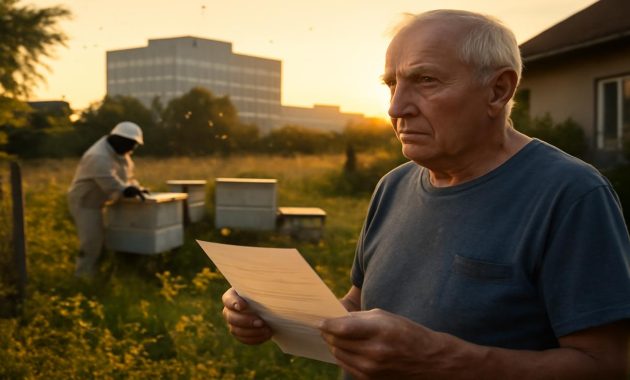
The bees arrived on a Tuesday in late spring, humming like a distant engine as the beekeeper’s truck rolled slowly up the dirt track. Irene, seventy-one years old and newly retired, stood at the edge of her small field in a faded straw hat, watching the boxes come down one by one. It smelled of damp soil and clover; the air trembled with wings. She had not expected, after a life behind an office desk, that her quiet years would be spent sharing a piece of land with thousands of honeybees. She also had not expected that a decision made out of simple neighborly kindness would bring the tax office to her door.
The Buzz Begins: A Gentle Favor with Stinging Consequences
Irene’s story starts the way many rural stories do: with a knock at the door and a favor asked in the soft, slightly apologetic tone of someone who knows they are asking for more than it sounds.
“I heard you don’t use the back lot anymore,” her neighbor, Stefan the beekeeper, had said. “It’s just sitting there. Would you mind if I put a few hives on it? Bees don’t bother much. I could even give you a few jars of honey for your trouble.”
She didn’t hesitate. The land wasn’t earning her anything. The vegetable rows she’d once planted with her late husband had collapsed into a patchwork of waist-high weeds and stubborn grasses. She had no appetite for tilling or sowing anymore, only for sitting on the porch and watching seasons slide past. So the idea that the land could hum back to life again—without her needing to do much more than say “yes”—felt like a small miracle.
There was no talk of rent, no contract thick with clauses and fine print. Just a handshake, an extra jar of honey at Christmas, and maybe a bottle of homemade mead on Irene’s birthday. A neighbor helping a neighbor, bees helping the orchards, land doing what land has always done: hosting life.
Then, one winter morning, the letter arrived. Official seal. Thick paper. A kind of stiff dignity that made Irene’s throat tighten as she pulled it from the mailbox. When she read the words “agricultural tax assessment,” her first thought was that the government had made a mistake.
“But I’m not farming,” she whispered to the empty kitchen. “I’m retired.”
Where the Taxman Sees Fields, Not Favors
The thing about land, especially land that once grew things, is that the tax office rarely sees it as neutral. In their ledgers and regulations, a field is a category, not a story. It is either residential, commercial, or agricultural. It is either active or lying fallow. It either yields produce—or, crucially—supports someone who does.
Irene, as it turned out, was still the legal owner of agricultural land. And in the quiet language of tax codes and land-use regulations, what you do with that land matters, even if you yourself never sell a single egg, berry, or carrot.
By allowing Stefan to place his beehives on her property, the land hadn’t stopped being “agricultural.” In the tax authority’s view, it had become part of an agricultural operation—beekeeping—whether or not money passed into Irene’s hands.
“But I don’t earn anything,” she told the clerk at the tax office, voice trembling with the confusion of someone who feels they’ve wandered into the wrong movie. “He’s the one with the bees. He sells the honey. I just… lend the ground. I get nothing.”
The clerk, kind but tired, shuffled papers, pointed at forms, gestured at rules that didn’t bend for sentiment or honey-sweet stories of neighborliness. The law, he explained, often cares less about who pockets the cash and more about what the land is being used for—and who, on paper, is responsible for it.
How the System Makes the Owner the Anchor
Most tax systems treat the landowner as the anchor point. It’s the simplest reference: one parcel, one owner, one person ultimately responsible. Whether that land is rented to a farmer, loaned to a beekeeper, or given over for grazing, the taxman comes to the door with the name on the deed.
Even if Irene had drawn no formal rent, the fact remained: her land was contributing to agricultural production. Bees collect nectar from miles around, but their legal “home base” sat squarely on her plot. The honey that Stefan jarred and sold at markets, the pollination services his bees silently provided to nearby orchards—those benefits, in the eyes of the law, were rooted in her property.
It doesn’t matter that Irene’s only tangible reward was watching the hives glow golden at dusk, hearing the dense chorus of insects pass overhead like a cloud with a rhythm. To the tax office, what matters is use. And “agricultural use” usually triggers “agricultural tax.”
In this way, a kind deed gets recast as a taxable choice. The land, once quiet and unproductive, now “does” something. And anything that “does” something in the economy tends to draw the gaze of the taxman.
Fairness in the Fields: Two Stories, Two Truths
So is it fair that a retiree like Irene has to pay an agricultural tax despite not earning a cent from bees, crops, or livestock? Fairness, here, is like a field viewed from two different hills. Stand on one, you see exploitation. Stand on the other, you see responsibility.
From Irene’s hill, the picture is simple. She helped. She wasn’t running a business. Her reward was a cleaner conscience and a few spoons of golden sweetness in her tea. For this, she is asked to pay more than she did when the land lay idle. Goodwill is punished. Generosity is priced.
From the tax authority’s hill, the image shifts. Here is a piece of land being used productively. It supports a trade. The beekeeper is making a livelihood, possibly even enjoying tax deductions or benefits that come with being a farmer. If such land—simply because the owner doesn’t directly earn—were exempt from certain taxes or reclassified, it could be a loophole exploited on a grand scale. Rich landowners could “lend” land to operations on paper, skirt obligations, and then quietly share profits via informal side agreements.
Uniform rules, the argument goes, protect the integrity of the system. The landowner is responsible because the alternative—chasing the web of informal agreements between neighbors, relatives, and friends—would turn every field into an investigative puzzle.
Fairness, then, seems to be split in two: the fairness of individual circumstances versus the fairness of a general rule applied the same way to everyone. Irene’s frustration lives in the gap between those two kinds of justice.
The Quiet Contract Hidden Beneath Goodwill
There is another layer to fairness, less visible and more uncomfortable. By allowing her land to be used for beekeeping, Irene was also, in a way, accepting a role in a quiet contract between herself, her neighbor, and the broader community.
Bees don’t respect property lines. They dart across hedges, dip into other people’s fruit trees, help clover set seed in fields Irene has never seen. The benefit of those hives spills outward into the ecosystem and, in economic terms, into other people’s harvests. That’s part of why many governments see agriculture as something beyond private hobby. It’s a public interest, a foundation of food systems, ecology, and rural economies.
When a piece of land steps back into that web of production and ecology—especially in a formal way, with hives or herds or planted crops—the state takes notice. Taxes, permits, declarations: they’re all ways of saying, “You’re no longer just a private owner. You’re part of a shared system now.”
For a retiree like Irene, this is an invisible line. She didn’t feel herself cross it. There was no dramatic moment. One week the field was quiet; the next it was humming. But for the tax office, that line is everything, and it’s written not in emotion but in land-use categories and agricultural codes.
The Emotional Cost of Being “The One on Paper”
On paper, Irene is the landowner. In life, she is a woman trying to stretch her pension, to keep the old house heated in winter and the well pump repaired. The tax bill may not be astronomical, but it is enough to interrupt sleep, to make her measure margarine more thinly on toast, to resent every envelope with a windowed address panel.
“I just wanted to help,” she says to a friend over coffee. “If I’d said no, my field would still be mine, still quiet, and I’d pay less. How is that right?”
There is a deeper fear beneath her words: that kindness is a luxury only the comfortably wealthy can afford. That for people like her, good deeds come with hidden price tags. It is a fear that nudges people into saying no more often, retreating behind hedges and locked gates.
And yet, from another angle, the state isn’t punishing her for generosity; it is merely indifferent to it. The rules were written for everyone: generous, selfish, calculating, or oblivious. They were drafted with the worst-case scenarios in mind—fraud, evasion, exploitation—not with Irene’s jar-of-honey arrangement.
This indifference is part of what makes tax letters feel so cold. They don’t know how to say, “We appreciate what you tried to do. But we still need you to pay.”
Numbers on a Page, Feelings in a Kitchen
Consider, for a moment, how this looks in pure arithmetic versus how it feels in a small kitchen bathed in afternoon light. The state sees a parcel, a classification, a rate:
| Aspect | How the Tax Office Sees It | How Irene Experiences It |
|---|---|---|
| Land Use | Agricultural activity present (beekeeping) | A neighbor’s hives quietly sitting in the corner |
| Owner’s Role | Legal owner responsible for due taxes | Just lending space, not running a business |
| Income | Income of user (beekeeper) is not decisive for land tax | No money received, only occasional honey |
| Fairness | Same rules for all agricultural landowners | Feels unfair to pay for helping a neighbor |
Numbers stabilize the system; they flatten the stories behind them. But stories are where we feel the impact.
Responsibility: Shared in Spirit, Unequal on Paper
Taxes like the one Irene now faces tell us something important about where responsibility is placed in modern societies. We talk a lot about shared responsibility—community, mutual aid, neighborliness. But when responsibilities are written into law, they tend to crystallize around whoever can be clearly identified and easily reached. In land matters, that is almost always the owner.
The beekeeper may feel, morally, that he should shoulder part of this burden. Perhaps he even offers to cover the extra tax. But unless that agreement is formalized, the state doesn’t care who passes cash to whom in the background. It cares that the bill it issued to the person on the deed gets paid.
There is, of course, another way to view this. Ownership, even of a sleepy corner of land, isn’t just a sentimental hold over memories and sunsets. It’s a bundle of rights paired with obligations. The right to decide what happens on that land comes tied to the duty to face the consequences of that decision—legal, financial, environmental.
Irene’s case dramatizes this: she used that right benevolently, but the obligation arrived all the same.
Could It Be Done Differently?
Some might argue that the system could be gentler, especially to retirees and small landowners who aren’t running businesses. Immunities, thresholds, or special exemptions could be carved out for those who earn nothing and act solely out of goodwill.
But even this kind of reform brings its own battles: Who decides what counts as “goodwill” and what counts as “hidden profit”? How do you verify that exactly zero money changes hands? How do you prove that a retiree isn’t, in fact, a silent partner in a profitable enterprise?
Every exception carved into the law creates shadows where abuse can hide. Policymakers, wary of loopholes, tend to favor bright lines—even if those lines slice through stories like Irene’s with a blunt edge.
The Quiet Battles: Goodwill, Distrust, and the Space Between
In the countryside, much still runs on trust. A handshake agreement to graze a neighbor’s sheep. A share of the harvest in exchange for borrowed pasture. Hives set along fence lines, pollinating more than they cost in formal rent. These arrangements keep small communities alive, stitching together people whose official incomes are thin but whose informal economies are rich.
The taxman, however, operates in a different climate: a world of suspicion, records, and precedents. The state has seen enough perfectly crafted “informal” arrangements that are, in truth, cleverly disguised profit-sharing schemes. It has developed a cautious lens, one that views every act of generosity as a potential mask.
And so there is a quiet battle—a tension, really—between two logics. The logic of the village lane, where favors are traded like seeds, and the logic of the administrative center, where clarity and traceability are prized above all else.
Irene is caught in the crossfire of these logics. Her story is not dramatic enough to spark protests or court cases. It is a small sting, like one bee out of thousands. But in aggregate, stories like hers shape how people feel about both community and state. They chip away at the desire to say, “Sure, you can use my field.” They make us ask, “Will this come back to bite me?”
What Her Story Says About Us
Perhaps the most unsettling part of Irene’s experience is what it reveals about how we balance private kindness and public systems. We want both: a society in which neighbors help each other without keeping score, and a state that funds hospitals, schools, and roads through fair, consistent taxation.
Yet when these two desires meet on a weedy old field behind an elderly woman’s house, they don’t always harmonize. The system doesn’t have a special category for “land used out of love.” It has “agricultural use,” and that is enough.
This gap between our moral instincts and our institutional tools is where disillusionment blooms. It is where people start to feel that “the rules” and “what’s right” are no longer on speaking terms.
Living with the Sting—and Still Choosing Honey
In the end, Irene did not evict the bees. She thought about it. She spent nights at the kitchen table with the tax bill, a calculator, and a pencil worn down to its nub. She talked to Stefan, who looked genuinely stricken and offered to help cover the extra cost, to formalize their arrangement so that part of his earnings officially compensated her.
Their solution was imperfect but human: a small written agreement, a modest annual rent declared on paper, the tax shared in a way that felt fair between them, if not perfectly reflected in the law’s categories. She registered part of the land use; he kept better records. The field stayed full of bees.
“I suppose this is what responsibility feels like,” she told herself one evening, standing at the edge of the hives as the sun dripped down behind the trees. There was a satisfaction in it, rough-edged but real. The land was not just memory now; it was part of a living system again, buzzing, necessary, acknowledged.
Her story does not resolve neatly into either outrage or acceptance. Instead, it leaves us with a set of questions that refuse to lie down quietly:
- How should we treat those who use their property for the common good, even if they don’t profit?
- Can laws ever fully honor the difference between exploitation and generosity?
- And what obligations come, quietly, with the right to own a piece of earth?
The bees don’t care, of course. They fly their long, patient circuits regardless of ownership or tax category, turning light into honey, pollinating futures they’ll never see. But for us—landowners, neighbors, citizens—the hum of their work now carries another note: a reminder that in the background of every simple good deed, the machinery of the state is still turning.
We live, always, in this in-between: between goodwill and regulation, between what seems fair in a kitchen and what seems fair in a courtroom. Irene’s field, with its aging fenceposts and light-struck hives, has become a small, quiet stage on which these tensions play out.
And perhaps that is the real lesson here: that fairness is not a feeling but a negotiation; that responsibility is not only about what we gain but what we are willing to bear; and that neighborly goodwill, while precious, does not float entirely free from the world of forms, categories, and taxes. Sometimes, even the sweetest honey comes with a sting.
Frequently Asked Questions
Why does the landowner have to pay agricultural tax if they earn nothing?
Because most tax systems tie land-related taxes to ownership and land use, not directly to who earns income. If the land is used for agriculture—crops, livestock, or beekeeping—it often falls into an agricultural tax category, and the registered owner becomes responsible, even if a neighbor is the one making money.
Could the beekeeper, not the landowner, be taxed instead?
The beekeeper may face income or business taxes on their honey sales, but land taxes and land-use obligations usually attach to the owner of the property, not the user. Private agreements can shift costs between them, but the legal responsibility remains with the owner unless the law provides specific alternatives.
Is there a way for a retiree to avoid such taxes when lending land out of goodwill?
Sometimes. Depending on the country or region, there may be exemptions, reduced rates, or special treatment for small plots, low-income owners, or noncommercial use. However, once land is clearly part of an ongoing agricultural operation, exemptions can be limited. Talking to a local tax advisor before lending land can prevent surprises.
Can a written agreement with the beekeeper change the tax situation?
A written agreement cannot usually change which taxes apply to the land itself, but it can specify who covers which costs. For example, the beekeeper can agree to reimburse the landowner for additional taxes. It may also help clarify whether the arrangement is commercial, rental, or purely neighborly in the eyes of the authorities.
What does this situation tell us about fairness and responsibility?
It shows that legal fairness is often about consistency and clear rules, while personal fairness is about context and intention. The system may treat everyone in similar situations the same way, but individuals like retirees can still feel deeply that the outcome is unfair. It also reminds us that ownership comes with obligations, even when we act out of generosity.