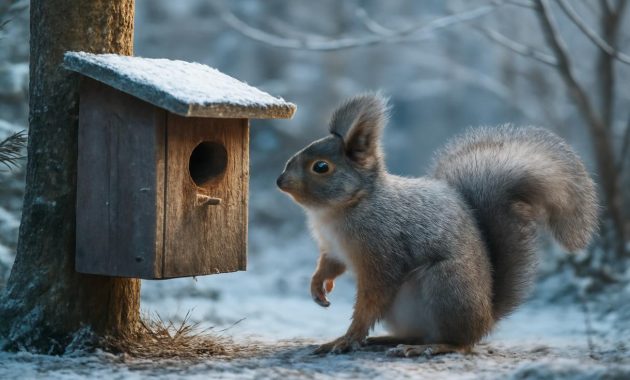
The first frost came quietly in the night. By morning, the world looked like it had been dusted with crushed diamonds, every branch outlined in white fire, every blade of grass locked in a thin, glittering shell. The kind of morning that makes you pull your coat tighter, breathe steam into your cupped hands, and pause—just for a second—to admire how winter can turn an ordinary street into something almost holy. And yet, that same beauty hides a cruel mechanic at work, one that very few of us ever notice. Somewhere beneath those trees, under decks and garden sheds, along fence lines and in forgotten corners of backyards, the frost has laid out invisible traps. And they’re waiting, in particular, for the smallest, most frantic hearts in the neighborhood: the squirrels.
The Hidden Winter Crisis in Your Own Backyard
Walk through any park on an autumn afternoon and it looks like squirrels are winning at life. Their tails are plumed and glossy, their bellies round, their movements decisively busy as they dig, bury, leap, and stash. They seem like tiny, hyper-competent survivalists with a built‑in winter plan. They know where the nuts are. They know where to hide them. They know when it’s time to fatten up and when it’s time to disappear into warm nests of leaves and fur.
But the picture we carry—of squirrels as tireless, perfectly adapted survivors—skips over all the places where human design quietly sabotages that instinctive preparation. When the air temperature drops below freezing, when melted snow refreezes overnight, when ice forms in places it shouldn’t, our modern yards and neighborhoods become complicated obstacle courses. Thin ice over water troughs. Metal gutters turned into freezing slides. Deep window wells glazed over with frost. Half‑frozen birdbaths. Open-top dumpsters with slick sides. All of these can become frost traps: situations where a small animal slips, falls, or becomes wet and chilled, and then simply can’t get back out.
The term “frost trap” isn’t one you’ll find in a biology textbook. It’s a phrase wildlife rehabilitators and observers use to describe the deadly mix of cold, moisture, and human-made structures that can turn an everyday landscape into a hazard. It’s what happens when an animal’s usual winter strategy collides with a world that was never designed with them in mind.
If you’ve never heard about this, you’re not alone. We tend to notice squirrels most in summer and fall, racing along power lines and chasing each other around tree trunks. But the real drama unfolds in the margins of winter—on the coldest nights, in the half-light of early morning, when a fall from a fence or a misjudged leap onto a frozen surface can become a death sentence the animal has no way to understand.
What Exactly Is a “Frost Trap” for Squirrels?
Imagine a young squirrel, born in late spring. By its first winter, it’s still learning the neighborhood, still memorizing food caches, still mapping the safe routes between trees and roofs. One icy morning, it races along a fence and tries to jump down onto what looks like solid ground—but the snow has drifted over a steep-sided window well. The squirrel hits the bottom, slides, and finds itself in a smooth, cold chamber with walls too high and too slippery to climb. The snow it landed on has caved in. There is no branch. No rough bark. Just concrete and glass, gradually losing heat to the air.
That’s a frost trap.
Or picture a decorative garden bucket that’s been left outside all year. It’s half filled with rainwater and leaves. Overnight, a crust of ice forms on top, thin but strong enough to trick a thirsty squirrel. The squirrel steps on the edge, leans toward the center, the ice cracks, and the animal falls into the frigid water. Wet fur loses its insulating power fast. The creature scrabbles at cold metal, slides back, again and again. Within minutes, it’s too cold to keep fighting.
That’s a frost trap too.
Frost traps aren’t elaborate or malicious. They’re ordinary objects: buckets, planters, plastic storage bins, window wells, open trash cans, high-sided birdbaths, even deep gutters. What turns them deadly is the cocktail of ice, water, and smooth, vertical surfaces. Squirrels are superb climbers on bark, brick, and branches. But on slick metal or iced plastic, their claws may as well be blunt. Add cold water or freezing slush, and they burn through precious body heat trying—and failing—to escape.
Wildlife experts see the consequences. Rehabilitators get calls about “frozen” squirrels, limp and soaked, found at the bottoms of bins or pulled out of half‑frozen ponds just in time. Many don’t make it. The sad part? So many of these situations are preventable if we simply notice how our belongings behave in winter.
The Science of Small Bodies and Big Cold
To understand why frost traps are so dangerous, it helps to feel winter from a squirrel’s perspective. Their bodies are small, their metabolism fast. That’s an advantage when food is abundant; they can dart, dash, and process energy quickly. But in the cold, it’s a liability. Smaller animals lose heat far more rapidly than larger ones. Their surface area, compared to their volume, is huge, like a tiny hot coal exposed to wind.
Fur is their first line of defense. A squirrel’s winter coat is thicker and denser than its summer one, a carefully woven barrier that traps pockets of warm air near the skin. But fur only works when it’s dry and fluffed. The moment it gets soaked, each hair shaft spreads and lies flat, letting cold air and water press right against the skin. It’s like going for a walk in a blizzard wearing a soaked cotton sweater instead of a down jacket.
In a frost trap—especially those with water or slush—that’s exactly what happens. The squirrel falls, panics, tries to climb, gets wetter, shivers harder, and burns energy in a losing battle. Their tiny bodies don’t have the reserves we do. A human in warm clothing might last hours in freezing weather; a soaked squirrel can slide into hypothermia in minutes. Once their muscles begin to fail, even a modest obstacle becomes an impossible wall.
There’s another layer to this. Winter is not a time of abundance. Squirrels have cached food, yes, but they’re also living day-to-day on a narrow margin of stored fat and what they can dig up. Every extra calorie they spend escaping a human-made problem is one they don’t have for basic survival. A slip into a frosty water trough may not kill them outright, but it can leave them weak and vulnerable to the next cold snap, the next predator, the next lean day.
We like to think “nature will take care of its own,” and in many cases that’s true. But we’ve altered the winter landscape in ways wild animals never evolved to navigate: smooth plastics, polished metals, glass-sided pits, straight-walled excavations, decorative features that hold water and freeze hard. Frost traps are a human invention, even if we didn’t mean them to be. That means the responsibility—and the opportunity—to fix them is ours.
| Common Frost Trap | Why It’s Dangerous | Simple Fix |
|---|---|---|
| Open buckets, barrels, or bins with rainwater | Ice crust breaks; animals fall in, get soaked and chilled | Empty or store upside down; add a sturdy stick ramp if left out |
| Window wells and basement light wells | Steep, smooth walls trap animals that fall or jump in | Install covers or place a wooden escape board at an angle |
| Deep birdbaths and decorative ponds | Partially frozen water; slick edges are hard to climb | Use shallow basins; add rocks or ramps that reach above ice level |
| Dumpsters and tall trash cans | Animals fall while foraging; cold metal speeds heat loss | Keep lids closed; avoid leaving food waste accessible |
| Uncovered water troughs and stock tanks | Thin ice, deep cold water, no escape footholds | Add permanent escape ramps; check and break ice daily |
Your Yard as a Winter Lifeline
When wildlife experts talk about preventing frost traps, they don’t begin with guilt. They begin with attention. The simple act of walking your property on a cold morning with an animal’s eye—lower, more cautious, more attuned to edges and corners—can completely change how you see it.
Start at the ground. Look into any depression that could collect water or trap an animal: window wells, stairwells, garden trenches, uncovered drains. Picture a squirrel racing along your fence or rooftop and misjudging a jump. Where would it land? Would it have something to grip if it did? If the answer is no, that’s a candidate for a simple intervention: a cover, a mesh guard, or an angled plank roughened with staples or tacked-on strips to provide traction.
Next, scan for containers. Buckets, planters, kiddie pools, wheelbarrows, large storage bins, even old coolers left outdoors. In summer, they’re just clutter. In winter, they’re potential ice pits. If they can hold water, they can become frost traps. Flip them over. Store them in a shed. Drill drainage holes if they’re always outside and not needed to hold liquids. If you truly must keep water in them, give any animal that falls in a way out: a branch, a length of rough wood, a piece of hardware cloth wired in place as a ladder.
Then there’s the water meant for wildlife and pets: birdbaths, heated bowls, backyard ponds. These can be gifts in a harsh season, but only when they’re shaped with safety in mind. Shallow basins are best. If the sides are steep, add large stones that break the water’s surface, giving any struggling creature a place to haul itself out. Check them daily in freezing weather; ice can transform a safe feature into a slippery trap overnight.
The changes are often small, almost embarrassingly simple. A scrap board here, a cover there, a quick emptying of forgotten containers. Yet each one redraws the survival map for the animals living alongside you, turning dead ends into narrow escapes, silent tragedies into nothing more than a scare and a story in squirrel language.
Why Squirrels, and Why Now?
At this point, you might be wondering: out of all the wild creatures that navigate winter, why focus on squirrels? Partly because we see them. They are, for many of us, the wild neighbors we know best. They’re the ones skittering across our roofs, raiding our bird feeders, stashing acorns in our potted plants. Their lives intertwine with ours in unmistakable, sometimes exasperating ways.
But there’s another, quieter reason: squirrels are environmental barometers. When their populations are stable, when juveniles make it through their first winter in decent numbers, it often signals that the larger urban ecosystem—trees, seed crops, predator balances—is more or less holding together. When they begin to struggle in noticeable ways, when numbers crash or injuries spike, it can be an early hint that something is off: food sources changing, habitats fragmented, or hazards multiplying faster than instincts can adapt.
Frost traps are one set of those hazards. And they’re increasing not just because there are more people and more houses, but because of how we build. Modern landscapes favor clean lines, sealed surfaces, and efficient drainage—features that move water away from us but sometimes corral small animals into tight, inescapable places. Climate variability compounds this: winters that swing between thaw and deep freeze create more ice, more meltwater, more chances for animals to misjudge the solidity of a surface.
Wildlife rehabilitators can treat the casualties that are found in time. But they can’t be everywhere. They can’t patrol every backyard, every alley, every farm lot and storage yard. That’s where you come in. Your daily movements—taking out the trash, feeding your dog, shoveling snow—take you past potential frost traps constantly. You are the one who can notice a half‑filled bin trying to freeze solid, or a window well slowly accumulating snow and leaves and the marks of tiny, desperate claws.
Helping squirrels isn’t about elevating them above other species. It’s about starting with the creatures we already share space with and using their needs as a guide to make our home ranges less punishing for all small wildlife. A board that saves a squirrel today might save a songbird or a chipmunk tomorrow. A covered window well keeps out not just one frantic animal, but a dozen future accidents you’ll never have to see.
Small Actions, Real Impact
If you’re feeling a tug to do something concrete, lean into it. Begin with a quick winter checklist:
- Walk your yard or building perimeter after a hard freeze and again after a thaw.
- Empty or invert any container that can hold water or snow.
- Cover or mesh over window wells and deep pits.
- Add simple wooden or mesh ramps to any permanent water feature or trough.
- Keep trash securely lidded; avoid enticing animals into risky structures.
These aren’t grand, heroic gestures. They’re adjustments, quiet and almost invisible. But every wildlife expert will tell you: this is where the real power lies, in the slow, steady reshaping of our habits and surroundings to reduce harm.
When You Find a Squirrel in Trouble
Even with precautions, winter has a way of finding the cracks. Maybe one morning you hear frantic scratching from your basement window. Maybe your dog alerts you to something thrashing in the half‑frozen kiddie pool you meant to empty weeks ago. Maybe you glance into a bucket and see, to your horror, a sodden gray body curled at the bottom, sides heaving in tiny, ragged breaths.
In those moments, it’s tempting to panic, to plunge your hands in, to scoop up the animal and wrap it in the nearest towel. Compassion is good; rashness is not. Squirrels are wild, easily stressed, and capable of biting hard when scared—even when they’re half-frozen and barely able to move. And hypothermia is tricky; warming an animal too fast, or in the wrong way, can do damage.
The first step is always to make the situation safer for both of you. If the animal is in water and you can do so without getting bitten, you can angle a board, branch, or sturdy object into the container to give it a climbing route. Step back and watch. If it hauls itself out and bolts, you’ve done enough. If it can’t move, or just huddles and shivers, the next step is to contact a licensed wildlife rehabilitator or local animal control agency as soon as possible and follow their guidance.
While you wait, you can gently move the entire container to a quiet, sheltered spot away from pets and people. Do not try to feed the squirrel. Do not put it directly in front of a heater or fireplace. Hypothermic animals need slow, controlled warming and professional evaluation. A cardboard box with air holes, lined with soft, dry fabric and placed half over a source of mild warmth (like a heating pad on low, wrapped in a towel) can sometimes help—but only if you’ve been specifically advised to do so.
The most important thing you can do is stay calm, protect yourself, and hand the situation off to people who work with wildlife every day. And then, later, when the adrenaline fades, walk back to the place where you found the animal and ask yourself how to make sure it never happens again.
Becoming Part of the Quiet Network
Across towns and cities, there’s a quiet network of people who have begun to see frost traps not as unfortunate accidents, but as design problems waiting for solutions. They talk to their neighbors. They share photos of simple escape ramps. They mention window well covers to landlords and property managers. They teach their kids to look twice at any object that can collect water or snow.
You don’t have to join an organization or plaster your car with wildlife stickers to be part of this. You just have to let your daily choices be shaped by a simple, persistent question: If I were small, cold, and desperate, could I get out of this? Each time you answer “no” and do something about it, you’re not only helping squirrels. You’re stitching a tiny piece of kindness into the winter landscape itself.
Why Your Help Is Needed More Than Ever
Winters are shifting. In many regions, the pattern now is less a steady slide into cold than a series of whiplash swings: thaw, freeze, thaw, deep freeze. For squirrels and other small mammals, that means more ice, more refrozen puddles, more unpredictable surfaces. The old cues—how the ground feels under their paws, what snow usually does on a roof edge—are becoming less reliable. Instinct can’t adjust overnight to a climate and a built environment that change this fast.
But you can. You can notice the slick edge of your birdbath after an overnight freeze. You can see the way water pools in the lip of your trash can lid and imagine it turning to glass. You can cover the window well you’ve been ignoring for years. You can talk, simply and without judgment, to the people next door about why you keep boards leaned into your stock tanks or why you never leave buckets out in winter.
When an expert says your help is needed, they don’t mean in an abstract, “save the world” sort of way. They mean here, where you live, in the space you already control. They mean this winter, before the next storm, before the next thaw freezes by dawn. They mean that your willingness to adjust a handful of everyday habits may be the difference between life and death for a handful of animals you may never see—but whose presence hums quietly through the trees and hedges, stitching your neighborhood into something more alive.
The frost will come again. The mornings will sparkle. Squirrels will still race along power lines, still bury acorns in the flowerbeds, still leap, sometimes too boldly, into the uncertain air. You can’t keep them from every danger. But you can make sure that in the world you shape—the one behind your fence, beneath your windows, beside your front steps—the glittering beauty of winter doesn’t hide quite so many invisible traps.
Frequently Asked Questions
What is the simplest way to prevent frost traps in my yard?
The fastest, easiest step is to remove or invert any container that can hold water: buckets, planters, bins, kiddie pools, and wheelbarrows. If it can’t collect water, it can’t freeze into a trap.
Do escape ramps really work for squirrels?
Yes. A rough wooden board, branch, or piece of mesh giving a sloped route out of deep water or a pit dramatically increases an animal’s chance of escaping on its own, especially if it extends above the typical ice line.
Are birdbaths and wildlife water features always dangerous in winter?
Not if they’re shallow and thoughtfully designed. Wide, shallow basins with gently sloped sides and rocks or perches above water level are far safer than deep, steep‑sided containers.
What should I do if I find a hypothermic squirrel?
If it’s in immediate danger (like deep water), carefully provide a way out using a board or branch. Then contact a licensed wildlife rehabilitator or animal control for guidance. Avoid handling the animal directly unless instructed, and do not try to feed it.
Is helping squirrels interfering with nature?
Preventing frost traps isn’t about overriding natural processes; it’s about mitigating hazards we’ve created through our buildings and belongings. You’re not changing the wild so much as correcting for our unintended, human-made risks.