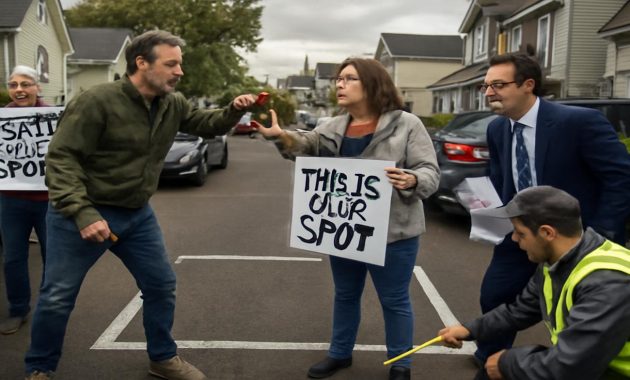
The first time anyone noticed the space, it was just a nameless gap in a line of parked cars—an unremarkable slice of asphalt under a maple tree, dusted with yellow leaves and the faint chalk drawings of children who hadn’t yet learned where the sidewalk ends and the street begins. It had always simply been there, open more often than not, a kind of shared neighborhood exhale. People used it without thinking, the way they used the shade of the tree, or the quiet that settled over the block after dinner. No one owned it. No one needed to. Until, very suddenly, somebody did.
The Day the Cones Appeared
It started on a Tuesday, the kind of late-summer day when the air hums with heat and the smell of lawn clippings. By four in the afternoon, kids on scooters had claimed the sidewalks, the UPS truck had made its daily slide down the hill, and the ice cream truck’s distant jingle floated somewhere between memory and reality. That was when Mr. Lang, who lived in the narrow brick row house with the blue door, walked out with two bright orange traffic cones and a coil of yellow chain.
He moved differently that day—deliberate, squared shoulders, the tense determination of someone who has rehearsed a speech in their head a hundred times. Neighbors watched from porches and behind curtains as he placed one cone at the front of the open space and one at the back, then looped the chain between them. The chain clinked once, sharp and final, against the metal ring on the cone. Just like that, the public space became, in his mind at least, private.
At first, people assumed it was temporary. Maybe he was getting a delivery. Maybe a family member with mobility issues was visiting. In a neighborhood where people still borrowed sugar and knew each other’s dogs by name, the benefit of the doubt came easily. The first car to approach that new barricade did what many would: paused, looked confused, then rolled on slowly, searching for another spot under a less-ambitious tree.
But the cones didn’t leave. They were there the next day and the day after that, bright plastic punctuation marks in the middle of the block. By the end of the week, the quiet murmur of neighborly suspicion had begun.
“Can He Even Do That?”
The question spread the way rumors always do in small places—through casual conversations that start with something else. Over recycling bins dragged to the curb. Over fences where tomatoes and gossip both grew wild. In the line at the corner coffee shop, where the barista knew everyone’s drink and, it turned out, everyone’s opinion.
“Can he even do that?” a woman with a leash wrapped around her wrist asked, gesturing vaguely in the direction of the street. The dog tugged toward a discarded muffin wrapper while she recounted her failed attempt to park in front of her own house, three doors down from the cones.
“Pretty sure the street belongs to the city,” another neighbor replied, with the confidence of someone who had once skimmed a municipal code PDF. “You can’t just reserve a public spot like it’s your driveway.”
“Well,” chimed in a third, “he’s lived here for thirty years. My cousin says there’s something about long-term use. Like, you get special rights if you’ve always parked somewhere.”
By the time the sun slid behind the rooftops, the debate had taken on a familiar shape: the collision between what feels fair and what is legal, between lived history and written rules. In that tension, the story of a single parking space began to swell into something larger.
Lines on Asphalt, Lines in the Mind
The street, technically, was a public right-of-way, maintained by the city, plowed in winter, swept in spring. Property tax bills for the houses clearly stopped at the edge of the sidewalk. Yet if you walked down the block and asked each resident where “their” area ended, most would unconsciously extend their imagined boundary a few feet into the street—usually right up to where their car tended to rest at night.
In many ways, the asphalt had become an invisible commons, shaped less by regulation than by custom. Mrs. O’Malley across the way never parked in front of the yellow house because she still remembered when the old man who lived there would carry groceries up the steps with shaking hands. The young couple with the twin toddlers tried not to park directly under the maple, out of superstition more than anything else; once, a heavy limb had cracked off in a storm and crushed a car, and stories like that stick.
There was no written schedule, no roster, no formal assignments. It was a choreography of glances and gestures and slow reverses into spaces someone else had vacated minutes before. Nobody owned the spots, but over time, the block had developed a silent code: respect the elders, don’t block the hydrant, and, if at all possible, leave the space in front of each house for the people who live there.
That code worked, right up until it met the bright orange clarity of Mr. Lang’s cones.
The Map of the Block
If you were to draw it, the block would look like this: a straight, one-way run of asphalt, maple trees spaced in near-symmetry, driveways rare and prized. On a typical evening, every bit of curb would be claimed, the cars lined like tiles:
| House | Typical Car | Usual Parking Habit |
|---|---|---|
| Green Porch (#12) | Silver minivan | Front of house, school runs |
| Blue Door (#14 – Lang) | Aging sedan | Same spot under the maple, for years |
| Yellow House (#16) | Compact hybrid | Wherever open, often farther down |
| Corner Brick (#20) | Small pickup | Near corner for easy exit |
Everyone knew, without speaking it, that the spot in front of the blue door—under the generous maple—felt like “his.” Not legally. Just historically. For three decades, people had watched him parallel park there with military precision, seen him wash the car with slow, almost meditative care, hose water cutting bright rivers through the dust on the pavement.
So when newcomers arrived—remote workers, nurses with late shifts, young professionals with compact SUVs—and the pressure for parking grew, the quiet equilibrium wobbled. “My spot” went from emotional shorthand to something like a claim.
From Cones to Confrontations
The real trouble started when someone moved the cones.
It was a Thursday evening, muggy, a hint of rain in the air that you could taste before you felt. Sara, who had just moved into the yellow house and worked nights at the hospital, circled the block three times after a twelve-hour shift. Every time she came past, that chained-off space stared back at her—empty, useless, a patch of perfectly available nothing.
On the fourth pass, she pulled over, eased out of her car, and, with the exhausted decisiveness of someone who’d had enough of everyone else’s emergencies, lifted the cones onto the sidewalk. The chain scraped along the asphalt with a sound that made the house lights blink on up and down the street.
She parked. Cut the engine. Sat there for a moment—heart thudding a little faster than she wanted to admit—then gathered her bag and walked toward her door under a sky that had turned the color of steeped tea.
She had almost made it when the blue door opened.
“Excuse me,” came a voice, firm and incredulous. “That’s my spot.”
The conversation that followed would later be retold a dozen different ways, the exact wording shifting like light on water. But the bones of it were always the same: his assertion that he’d parked there “for thirty years,” her insistence that the street is public, his complaint about “new people with no respect,” her retort about “public good and public space.” Two people, both bone-tired in different ways, standing on the same stretch of concrete and seeing two entirely different maps of belonging.
By the time the argument had drawn a loose semi-circle of neighbors to their stoops, the words “rights,” “entitled,” and “selfish” had surfaced. The air felt thicker, as if the coming rain had moved into their voices first.
When the City Steps In
The next morning, someone called the city. No one admitted to it at first, as though dialing a number were a betrayal of the unwritten rule that neighborhood problems should stay on neighborhood porches. But soon enough, a small white city vehicle rolled up, hazard lights blinking. A parking enforcement officer stepped out, glanced once at the cones, once at the addresses, and pulled out a handheld device.
By lunchtime, the cones were gone, confiscated as “unlawful obstruction of public right-of-way.” A notice was left taped to the blue door, the paper rippling slightly in the damp air. Legally, it was clear: the street did not belong to any one resident, no matter how many years their tires had worn the same patch of ground.
Yet clarity did not calm anything. Instead, it rearranged the battlefield. If the law said nobody owned that space, then every car that slid into it carried a faint electric charge of defiance or vindication, depending on who was watching.
The War Expands: Notes, Cameras, and Quiet Retaliations
What followed was less a single war than a series of small, overlapping skirmishes.
First came the notes. Tucked under windshield wipers, they ranged from polite to pointed:
- “Please consider parking in front of your own home. We have elderly residents here.”
- “Public street or not, common courtesy still exists.”
- “This isn’t your private driveway. We all live here.”
Someone started parking inches from bumpers, making it just difficult enough to get out without risking a scrape. A new doorbell camera appeared on one porch, angled just so it caught the disputed space. Another neighbor installed a motion-sensor light that flared on every time a car door opened after 10 p.m., flooding the night with accusing brightness.
Conversations grew clipped. People who’d once traded zucchini over the hedge now stared straight ahead when passing each other on the sidewalk. Kids absorbed the atmosphere in the way children do, quick and wordless. They began narrating the comings and goings of cars like weather reports.
“He took Mr. Lang’s spot again,” one whispered to another, noses pressed to the window.
“It’s not his,” came the automatic reply. “Mom said so.”
Property Rights vs. Public Good
Underneath the daily frictions, an older, bigger question had surfaced: What does it mean to live together in a place where your private life is bordered on all sides by shared space?
On paper, the boundaries were simple. Title documents and city maps showed thin black lines: the lot lines where private property ended and the public world began. The sidewalk and street were part of a larger network owned by everyone and no one, held in trust by a city bureaucracy that existed mostly as emails and distant office buildings.
But lived experience rarely matches lines on paper. For people like Mr. Lang, decades of habitual use had blurred that border. If you sweep the gutter leaves every fall, shovel the snow from the curb every winter, and cultivate the tree lawn with care, doesn’t that give you some extra claim on the space you’ve tended? If the public doesn’t show up to share the labor, doesn’t the private step into the void by default?
For newcomers, though, the reverse felt true. They paid the same taxes, walked the same cracked sidewalks, circled the block the same number of weary times. To them, public meant open access and equal standing, a shared commons where tenure granted familiarity but not control.
Both arguments carried a kind of truth, and both carried a kind of blindness. The cones had simply made the invisible tension visible.
Who Really Owns the Street?
One evening, after weeks of simmering, the neighborhood association decided—somewhat reluctantly—to put “the parking situation” on their meeting agenda. They gathered in a church basement perfumed with old coffee and floor polish, folding chairs squeaking as people shifted, papers rustling in hesitant hands.
A city representative had been invited. She arrived with a stack of brochures about “Residential Parking Policy” and the practiced calm of someone who had seen far worse disputes over far less asphalt.
“Let’s start with the basics,” she said, clicking open a ballpoint pen. “Nobody owns the street. The city holds it as a public asset for the benefit of all residents.”
Murmurs rose; she held up a hand.
“That said, how you all choose to share this space—respectfully or not—shapes your daily lives more than any ordinance I can quote.”
The room exhaled, slightly.
She went on to explain the difference between legal rights and social agreements. The law could prohibit private objects like cones from blocking a public way. It could establish rules—no parking near hydrants, street cleaning times, permit zones. But it could not, on its own, create courtesy, patience, or the sense of mutual investment that makes dense living bearable.
“You’re not just deciding where to put your cars,” she said. “You’re deciding what kind of street you want to live on.”
In the back row, someone scribbled that sentence down, underlining it twice.
The Street as a Living Thing
Stepping outside afterward, the block looked different, though nothing had changed materially. The same maple trees stood guard, their branches now heavy with the late-season rustle of drying leaves. The same patchwork of vehicles lined the curb—a silver minivan, an aging sedan, a compact hybrid, a small pickup—all cooled by the same night air.
But if you listened closely, the street sounded less like a battleground and more like what it had always been: a lived-in place. A teenager on a skateboard rattled past, wheels cracking over uneven seams. Somewhere, a television laughed behind a thin wall. The faint smell of someone’s dinner—onions and garlic, maybe—slipped into the air, mingling with the metallic tang of cooling engines.
The street was more than infrastructure. It was a corridor of shared stories: the time the snowstorm stranded everyone and the block turned into a shovel brigade; the baby who took his first wobbly steps between a parked car and the curb; the lost cat posters taped to lampposts; the chalk hopscotch grids that began in the driveway and ended in the traffic-calmed lane.
Ownership, in that sense, was not a deed but a relationship. Everyone owned the street, and nobody did, and the health of the place depended not on asserting dominance over a single space but on maintaining a web of small, everyday reciprocities.
After the War: What Really Changed
The conflict never ended with a grand truce. Real neighborhood wars rarely do. Instead, it softened by degrees, erosion rather than explosion.
After the meeting, a few residents proposed a simple, almost old-fashioned solution: a conversation. They invited Mr. Lang and the newer neighbors to sit on a porch, share iced tea, and talk about schedules—who needed to come and go at late hours, who had mobility issues, who could reasonably park a bit farther out most evenings without hardship.
The first gathering was awkward. Words stumbled. Someone made an offhand comment that landed wrong. But amid the prickliness, details emerged that hadn’t fit into the blunt shape of “my rights” vs. “your entitlement.”
People learned that Mr. Lang’s back had been giving him trouble, making the walk from farther down the block genuinely painful on bad days. They learned that Sara’s shifts rotated unpredictably, leaving her creeping home at 2 a.m., bone-weary, scanning for any slip of open curb. They learned that the couple at the corner often left early for work and wouldn’t mind if their regular spot was used by someone who needed it later.
None of this erased the tension completely, but it did something more useful: it replaced abstraction with faces, needs, and names.
Over time, patterns evolved. No one wrote them down, but you could feel their rhythm: Mr. Lang’s car often still rested under the maple, yet on nights when he knew he’d be in, he sometimes chose a different spot, gesturing up the block to where he’d seen Sara’s hybrid circling the previous week. Once, quietly, he even texted her: “Lots of space near my house tonight, in case you’re getting off late. I’ll leave the front open.”
The street remained public, legally unchanged, but the sense of ownership shifted—from opposition to something nearer to stewardship. People still muttered occasionally when they had to park farther away than they wanted. But they were also more likely to look up, notice who else was home, and adjust.
What This One Parking Space Reveals About All of Us
In the end, the story of that single parking space is not really about parking at all. It’s about the fragile line between what we can claim and what we must share. It’s about how modern life, with its private mortgages and locked front doors, still depends on a lattice of common ground—streets, sidewalks, air—that no one house can fence in.
As our cities and neighborhoods grow denser, those shared spaces feel tighter. Every square foot of curb, every patch of shade, becomes freighted with meaning. We bring our anxieties to them: about safety, about aging, about newcomers, about being seen and respected in the place we call home.
When that meaning collides—when one person’s “I’ve been here forever” meets another’s “I have as much right as you”—the conflict can flare fast and hot. Cones appear. Notes multiply. Laws are invoked like weapons rather than guides.
Yet somewhere beneath the static of anger is a quieter question: What sort of neighborhood do we want to build out of this shared asphalt and air?
Do we want a street defined by tiny, defended fiefdoms—each parking space or patch of grass a contested border? Or can we imagine something else: a street that feels collectively held, where ownership is less about exclusion and more about responsibility?
It doesn’t take grand policy shifts to move in that direction. It takes small acts: moving your car a little sooner than you need to. Sweeping the gutter in front of the house down the block. Asking a neighbor when they most need the closer spot, instead of assuming your need is louder. Remembering that the rustle of leaves above your windshield is part of a canopy that belongs to everyone.
The next time you circle your own block, searching for that one perfect space, you might feel the tug of irritation when you see it occupied—or blocked, or claimed in some unofficial way. You might feel the flare of that inner lawyer, ready to mutter, “You don’t own the street.”
You’d be right. But you also don’t own the story of that street alone.
You share it—with the person who lived there long before you and the one who just arrived, with the kids drawing chalk galaxies on the pavement, with the dog walkers and late-shift nurses and aging backs and small triumphs that play out every day along the curb. The street belongs, in the end, to the fragile web between you all.
Sometimes, recognizing that is the most radical act of ownership there is.
Frequently Asked Questions
Can a homeowner legally reserve a public street parking space with cones or signs?
In most cities, no. Public streets are managed by the municipality, and placing cones, chairs, chains, or homemade signs to claim a space is typically considered an unlawful obstruction. Enforcement varies, but legally, you usually cannot convert shared right-of-way into a private spot.
If I’ve parked in the same place for years, do I gain any special rights to it?
Generally, no. Long-term habit does not create formal property rights in public streets. While neighbors may informally respect “your usual spot,” that courtesy is social, not legal, and it can’t be enforced as ownership in most jurisdictions.
What should I do if a neighbor blocks off a public parking space?
Start with a calm conversation if it feels safe. Many conflicts come from misunderstandings or unspoken needs. If that fails or the obstruction is persistent, you can contact your city’s parking or public works department, which is typically responsible for enforcing rules around public right-of-way.
How can neighbors reduce conflict over limited street parking?
Open communication helps more than any rule book. Discuss schedules, mobility needs, and recurring patterns. Consider informal agreements—like leaving certain spots open for people with health issues or late shifts—and be willing to adjust habits. Kindness and flexibility go farther than strict “first come, first served” in close quarters.
Does paying property taxes give me special rights to the space in front of my house?
Not in the way many people imagine. Property taxes fund services that support the whole community, including streets, but they don’t usually grant exclusive rights to the curb in front of your home. That curb is part of a shared system, even though it sits just beyond your front steps.