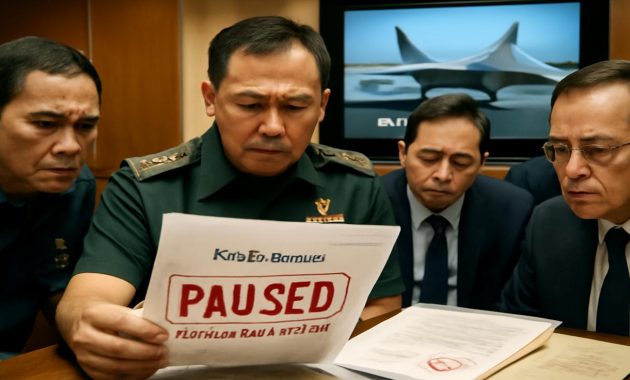
The rain had already turned the Jakarta airfield into a glistening mirror when the news began to ripple through the defense circles: Indonesia was quietly stepping away from Turkey’s Kaan fighter jet program. Not with a door slammed, but with a condition laid gently yet firmly on the table—come back when there are zero U.S. components in that aircraft. For a country used to living at the crossroads of global trade winds and military rivalries, it was a bold line to draw in the tropical humidity.
A Fighter Jet Caught in a Monsoon of Geopolitics
On paper, the Kaan project looks like the kind of sleek, future-facing machine that would stir the imagination of any air force planner. A fifth-generation stealth fighter under development by Turkey, designed to be muscular, agile, and packed with advanced avionics—something that could glide invisibly above maritime boundaries and contested shoals. For Indonesia, with its chain of more than 17,000 islands scattered across some of the world’s busiest and most contested sea lanes, that kind of capability is not a luxury. It’s strategy made metal.
Yet as conversations between Ankara and Jakarta deepened, another reality floated to the surface: the ghostly fingerprints of the United States in Kaan’s components list. Electronic systems, software, technologies that might originate—directly or indirectly—from U.S. suppliers or be subject to U.S. export rules. To many in the Indonesian defense establishment, that was not just a technical detail. It was a potential leash.
Indonesia carries old memories in its institutional bones. In the 1990s, U.S. sanctions over human rights concerns strangled the country’s ability to maintain certain aircraft and equipment. Spare parts became political messages. For generals and planners who watched their fleets silently grounded not for lack of engineering know-how but because of distant political decisions, those memories sting like salt in a wound that never fully healed.
So when Turkey came to the table with an invitation to join the Kaan program, interest sparked quickly—but so did caution. According to officials cited in multiple defense analyses, Indonesian negotiators made it clear: no U.S. components, no deal. The aircraft might be built in Turkey, but Jakarta does not want Washington’s shadow in its hangars.
The Quiet Logic Behind Indonesia’s “Zero U.S. Components” Demand
On the surface, it may sound like a hardline, even stubborn, demand. Yet underneath, there is a certain quiet logic that fits Indonesia’s long quest for strategic autonomy. The country sits not just at the equator, but at the junction of power projection from China, the United States, Australia, Japan, and India. Its airspace and waters are more than routes; they are corridors of influence.
Being dependent on any one power—especially for something as fragile and vital as air combat capability—feels like handing over the keys to your house along with the hinges on your doors. Indonesia has tried to escape that trap for years, hedging its bets, buying weapons from Russia, South Korea, Europe, and the U.S., and flirting with domestic production and joint-development programs.
The Kaan proposal, in theory, offered something bigger than a simple off-the-shelf purchase. Co-development. Sharing technology. Building industrial skills that would not evaporate with the end of a maintenance contract. Yet for that vision to be palatable, Jakarta wants more than just invitations; it wants insulation from foreign political pressure. U.S. components can trigger export controls, sanctions risk, restrictions on upgrades—or sudden silence when diplomatic winds turn icy. “Zero U.S. components” is not only a technical condition; it is a shield against the kind of leverage Indonesia has already experienced.
In a modern fighter jet, though, components are not like visible planks of a floor that you can simply swap. They are layered systems: radar, navigation, mission computers, flight control software, engine parts, data links, ejection systems. Many of these pass through complicated global supply chains, where American-origin technology or intellectual property can be embedded deep beneath the surface. Unraveling that web to produce a truly U.S.-free fifth-generation fighter is no small feat for Turkey—or any country.
How Kaan Fits Into Indonesia’s Wider Airpower Puzzle
Indonesia’s fighter fleet today is a patchwork quilt. Russian-built Su-27s and Su-30s, American-made F-16s, older aircraft fading into retirement. For years, officials talked about the need for a next-generation leap: something stealthier, more networked, better suited for vast surveillance missions from Sumatra to Papua. That need hasn’t vanished just because Kaan talks have stalled.
Jakarta has shown interest in France’s Rafale, South Korea’s KF-21 Boramae, and other options. Each one is packaged with different kinds of strings—political, financial, industrial. U.S. influence seeps in even when the aircraft is not American-built: many European and Asian defense programs rely on U.S.-origin components or must navigate U.S. export rules.
The Kaan, in contrast, was sold as a more independent venture. Turkey itself knows what it means to fall foul of U.S. sanctions and restrictions; its own ejection from the F-35 program over its S-400 missile purchase still sends aftershocks through its defense industry. In some ways, Turkey and Indonesia share a similar desire: to step out from under overbearing Western control, to build something that cannot be switched off by a line in a sanctions document.
But shared desire does not automatically mean shared capability. The question hanging over the Kaan project is whether Turkey can realistically purge all U.S. content while still fielding a jet that lives up to its fifth-generation ambitions. Engines, avionics, weapons integration—each carries hidden dependencies and decades of accumulated expertise that are hard to replace.
Under the Skin: What “Zero U.S. Components” Really Means
Strip away the acronyms and the contract language, and the demand becomes almost visceral. Imagine an aircraft on a rain-drenched runway somewhere in eastern Indonesia. A pilot climbs the ladder, checks his systems, and knows that in an emergency his survival, and his country’s defensive posture, depend on strangers’ decisions continents away—or do not. That quiet certainty is what Indonesia is bargaining for.
“Components” in this context is not just hardware—it includes software libraries, encryption systems, data link protocols, targeting pods, even the digital tools used to design and simulate the aircraft. If any of these are American-made or fall under U.S. intellectual property, they may be subject to export regulations. That’s how a single chip, a line of code, a guidance module can become a veto in disguise.
For Indonesia, avoiding that vulnerability means insisting on a clean break. But for Turkey, it may mean rethinking parts of its entire supply chain. Turkey has been working hard to localize critical technologies: homegrown avionics, sensors, even engine projects. Yet, like many emerging defense industries, it still taps into Western components in places where domestic solutions are not yet mature or cost-effective.
The result is a kind of engineering puzzle table, laid out under harsh fluorescent lights in Ankara’s research labs. For every American-origin item, there must be a local alternative or a non-U.S. partner willing to step in. European firms, maybe; Asian suppliers, perhaps. But every substitution brings new costs, delays, and complexity. Every new partner introduces their own political and export constraints.
| Aspect | Indonesia’s Concern | Impact on Kaan Negotiations |
|---|---|---|
| U.S. Components | Risk of sanctions, export controls, and political leverage. | Demand for “zero U.S. parts” before talks advance. |
| Technology Sovereignty | Desire for long-term independence in operations and upgrades. | Push for deeper tech transfer and co-development. |
| Maintenance & Spares | Avoiding past scenarios where spare parts were cut off. | Insistence on secure, politics-free supply chains. |
| Regional Balance | Maintaining neutrality between major powers. | Careful choice of partners to avoid alignment perception. |
| Industrial Growth | Building domestic aerospace capacity. | Interest in production roles, not just buying jets. |
When a Pause Isn’t Just a Pause
Indonesia’s decision to stall the talks is less a dramatic rupture and more a deliberate slowing of pace, like a pilot circling in a holding pattern, waiting for better visibility before landing. Ankara has not been shut out; it has been handed a challenge. If Turkey can meet it, the runway may yet clear.
In the meantime, though, this pause reverberates. For Turkey, courting international partners is crucial to sharing the immense costs of developing a fifth-generation fighter. Partners bring more than money—they can bring legitimacy, political shielding, and export opportunities. Losing or delaying a partner like Indonesia, a big player in Southeast Asia with a fast-growing economy, means greater strain and uncertainty for Kaan’s business model.
For Indonesia, the pause is a message broadcast to more than just Ankara. It tells Washington, Moscow, Beijing, Paris, and Seoul that Jakarta is not content to be a customer at someone else’s arms bazaar. It wants to shape its own path, even if that means walking more slowly, even if that means some short-term gaps in capability.
The stakes are not abstract. Over the South China Sea and nearby contested waters, Chinese coast guard vessels shadow Indonesian patrols. Airspace sometimes fills with uninvited guests—unidentified aircraft, surveillance planes testing responses. Every time an Indonesian pilot straps into an aging jet, the question of what comes next hums louder.
The Human Texture of High-Tech Decisions
Under all the strategy papers and procurement figures, there are people. Engineers in Ankara, hunched over CAD models of Kaan’s fuselage curves, are trying to reconcile aerodynamic ideals with stealth requirements and manufacturing realities. Bureaucrats in Jakarta sift through evaluation reports, eyes red from late-night briefings. Pilots, both Turkish and Indonesian, scroll through mock-up cockpit layouts, imagining how the aircraft will feel when it becomes more than a drawing.
Those pilots might not talk about export controls when they’re off duty, but they know, in a practical way, what it means when a foreign supplier pulls the plug on parts. Older Indonesian aircraft have sat cannibalized on the tarmac, stripped for parts to keep their sisters flying. In the humid air, that kind of dependence is not a theoretical vulnerability; it’s a lived one.
There is also a quiet pride at stake. Indonesia has long seen itself as more than a buyer of weapons. With its own aerospace company, PT Dirgantara Indonesia, it dreams of being an active player in regional and even global manufacturing networks. To sign onto Kaan simply as a checkbook would feel like a step backward. To join as an equal, or something close to it, operating a fighter free from U.S. strings, would instead feel like a step toward the self-reliant identity it has been carefully building.
That identity, though, is constantly tested by the sheer cost and complexity of high-end defense technology. Standing firm on principles like “no U.S. components” can mean slower access to cutting-edge tools, or higher price tags. In a world where budgets must also answer to schools, hospitals, and infrastructure, every delay and every extra dollar invites domestic scrutiny.
Turkey’s Dilemma: Between Independence and Interdependence
Turkey, too, lives at a crossroads. Its Kaan program is as much about national pride and strategic independence as it is about hardware. After the F-35 fallout, Ankara’s appetite for being beholden to Washington’s decisions shrank dramatically. Kaan is a statement: if we are pushed out of the club, we will build our own club.
Yet fighter jets in the twenty-first century are rarely pure expressions of sovereignty. They are ecosystems. Even if Turkey removes every direct U.S. part, other partners—European, Asian, or regional—may themselves rely on American technology somewhere deep in their supply chains. Absolute purity may be more aspiration than reality.
For Ankara, Indonesia’s demand is thus both validating and vexing. It validates the idea that there is a market for aircraft unshackled from Western political constraints. But it also highlights how difficult and expensive it will be to deliver that dream at full strength. Every time a potential partner like Indonesia pauses, investors and planners ask harder questions about timelines, capabilities, and economic viability.
Some in Turkey might argue that decisions like Indonesia’s show why Ankara itself needs to double down on full-spectrum domestic capability: engines, electronics, armaments, software, everything. Others might quietly worry that insisting on absolute independence will slow Kaan down so much that it risks arriving late to a crowded battlefield of other fifth-generation platforms.
What Comes After the Stall?
For now, the conversation between Turkey and Indonesia sits in a kind of suspended animation. The official stance from Jakarta is measured: talks can resume, but not until the “zero U.S. components” benchmark becomes more than a promise. The door is not locked; it is slightly ajar, waiting for proof.
There are several potential futures written faintly in the clouds above this pause. In one, Turkey manages to reengineer the Kaan’s supply chain enough to credibly claim that no U.S. components remain. Indonesia returns to the table, and the two countries move toward a co-development framework that gives Jakarta a real industrial role. Years later, Indonesian-built Kaan variants could be taking off from airbases in Java or Sulawesi, their engines roaring over rice fields and coral reefs.
In another future, the technical and financial weight of cutting out all U.S. content proves too heavy. Turkey offers partial compromises; Indonesia, wary of hidden dependencies, declines. Jakarta turns more decisively toward other platforms—Rafales, KF-21s, upgrades to existing fleets. The Kaan program moves on without Southeast Asia’s largest country on board.
And there is a middle path, hazier but perhaps more likely: long, drawn-out negotiations where each side whittles down obstacles bit by bit, trading transparency for trust. Along the way, global politics might shift again. Sanctions regimes could change. New technological breakthroughs might alter how much “independence” is technically and economically achievable.
Whatever unfolds, the core of Indonesia’s stance tells us something important about the emerging world of defense cooperation: no longer is it just about buying the fastest or the stealthiest jet. It is about who holds the off-switch—legally, politically, and technically. In the steamy, crowded airways of the Indo-Pacific, that question matters as much as thrust-to-weight ratios or radar cross-sections.
Frequently Asked Questions
Why did Indonesia stall its talks on Turkey’s Kaan fighter jet?
Indonesia paused the discussions because it wants firm guarantees that the Kaan fighter will contain no U.S.-origin components. Jakarta is wary of becoming vulnerable to U.S. export controls or sanctions, which could limit access to spare parts, upgrades, or operational freedom in the future.
What does “zero U.S. components” actually mean in this context?
It means Indonesia wants the aircraft free from any hardware, software, or embedded technologies that are made in the United States or fall under U.S. export regulations. This includes avionics, engines, electronics, software code, and other systems that could be affected by U.S. political decisions.
Why is Indonesia so sensitive about U.S. components and sanctions?
Indonesia has experienced restrictions and sanctions in the past that affected its access to spare parts and support for U.S.-made equipment. Those episodes left a lasting imprint on its defense planning, driving a desire to avoid similar dependence and political vulnerability in the future.
Can Turkey realistically build a fifth-generation fighter with no U.S. parts?
It is technically possible but extremely challenging. Modern fighters rely on complex global supply chains, and many advanced components have U.S. origins or intellectual property. Turkey would need to localize or source alternatives for a wide range of systems, which would increase costs and potentially delay the program.
Does this mean Indonesia will not participate in the Kaan program at all?
Not necessarily. Indonesia has paused, not permanently withdrawn. Talks could resume if Turkey can demonstrate that Kaan is free from U.S. components or offer a solution that satisfies Jakarta’s concerns about autonomy and sanctions risk.
What other fighter jets is Indonesia considering?
Indonesia has shown interest in platforms like France’s Rafale and South Korea’s KF-21 Boramae, along with potential upgrades to existing fleets such as F-16s and Russian-origin aircraft. Each option comes with different political and industrial implications.
How does this decision affect Turkey’s Kaan program?
Indonesia stepping back, even temporarily, removes a potential partner and investor from the Kaan project. That adds financial and political pressure on Turkey, which is seeking international partners to share development costs and open export markets. However, it may also push Ankara to accelerate efforts to reduce foreign dependence in its supply chain.