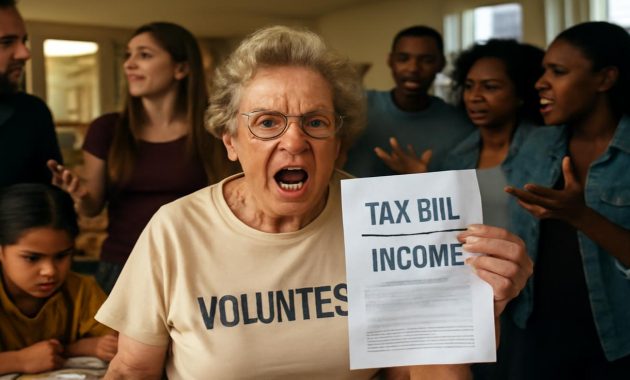
The bell still rings in her head some mornings. Not the one in her quiet, terraced street where the post arrives at ten past eleven, but the shrill, metallic clang that once meant “Year 9, period four, bring your wits.” For thirty-eight years, Margaret stood at the front of classrooms, raising eyebrows and expectations in equal measure. Now, in retirement, she stands in a different doorway: the side entrance of a cramped literacy charity office, arms full of exercise books and cheap biros, ready to teach again—for free.
She doesn’t sign in with a staff card anymore, just a biro on a clipboard. No salary, no department meetings, no performance management targets. Just a small team, a kettle that rattles when it boils, and a noticeboard full of photos of volunteers grinning at summer fairs. But one thing has followed her into retirement that she never expected: the taxman.
Because for all that she works for nothing, Margaret is paying for the privilege. Her pension is modest but taxable. The bus fares, the printer ink, the coffee she buys for tutees who turn up hungry—none of it is reimbursed. The government calls it “personal choice”. Margaret calls it something else entirely.
When Free Work Isn’t Really Free
The first time Margaret realised that her volunteering came with a bill was a rainy Tuesday in February. She was sitting at her kitchen table, letters spread out beside a half-eaten slice of toast, doing what she’d done every year since her first payslip: trying to understand her tax code.
Her state pension and scaled-down teacher’s pension nudged her just past the tax-free threshold. That much she had expected. But the creeping sense of injustice came from a different calculation: the simple, stubborn arithmetic of time.
Two days a week—sometimes three—spent volunteering at the literacy charity. Conservatively, fifteen hours a week. No paycheck, no perks beyond the satisfaction of seeing a teenager suddenly understand a paragraph that had been a wall only moments ago. Yet these hours still took the same bus journeys, the same energy, and competed with the same cost-of-living pressures as any job.
She found herself wondering: if she were paid even minimum wage for this work, would she accept the tax bill more easily? Probably. Would she feel less resentful about the money that left her account each month? Almost certainly.
But as a volunteer, she earns nothing—and still loses something. The equation feels upside down. “Working for nothing and paying for it,” she mutters to a friend over tea, and the phrase catches, is repeated, shared on local forums, stirring something much bigger than one teacher’s annoyance.
Is It Still ‘Real Work’ If No One Pays You?
Questions that once lived quietly in the background of civic life suddenly step onto the stage. If a retired teacher plans lessons, marks work, and supports learners in a donated classroom, is that “real work”? Or has it become, by virtue of zero pay, a hobby—a pastime, like gardening or baking sourdough?
It depends who you ask.
To the teenagers who arrive red-eyed from late shifts stacking shelves, Margaret is absolutely working. She’s the one who leans over their shoulder, pointing out where sentences break or meanings change. She is the difference between a failed exam and a second chance. That’s work.
To her pension provider and the tax office, her income is abstract numbers in boxes, entirely detached from what she does to fill her days. The system doesn’t recognise that part of the reason she can’t take on paid tutoring to offset her bills is because she’s already teaching for free.
Yet the more she talks, the more it becomes clear that this isn’t just about tax codes or spreadsheets. It’s about something deeper: how society decides what counts as work, and who gets to do it.
The Quiet Privilege of “Being Able to Help Out”
When people praise volunteers, they often choose the same phrases: “giving back”, “getting involved”, “helping the community”. But tucked inside those warm words is something sharper, something that bristles when the gas bill arrives.
Volunteering, at least in its current form, assumes that people can afford to give their time away. That they have pension income, savings, or another household wage to cover the basics. That bus fares, lunches, and a decent coat for winter shifts at the food bank won’t break them.
For some, this is true. There are retired professionals with generous pensions who can and do give their time freely, and good on them. But for others, like Margaret—who raised three children alone and never quite caught up financially—volunteering doesn’t feel like a harmless pastime. It feels like a decision with very real costs.
“People say, ‘You’re lucky you can do this,’” she says, “but sometimes it doesn’t feel like luck. It feels like I’m quietly subsidising the state.” If the literacy charity that relies on her and others like her had to pay a going rate for teaching, their budget would implode overnight. The work would either vanish or be squeezed into a few underfunded hours covered by a single, overworked staff member.
That is the uncomfortable truth at the heart of the debate: unpaid work often props up systems that would shudder and possibly collapse if they had to count its true value.
The Numbers We Pretend Not to See
It’s easy to talk about this issue in the abstract, so let’s put some rough figures on the table. Imagine the hours, the cost, the invisible economy surrounding volunteers like Margaret.
| Item | Estimated Value (per week) | Who Pays? |
|---|---|---|
| Margaret’s volunteer hours (15 hrs at modest teaching rate) | £225 | No one (unpaid) |
| Travel costs | £15 | Margaret |
| Materials (printing, stationery, snacks) | £10–£20 | Mostly Margaret |
| Tax on pension income | Varies, but taken regardless of volunteering | Margaret |
In brutal, economic terms, the government and the charity get a trained, experienced teacher’s labour for free, while Margaret effectively pays twice: once in foregone earnings, again in direct out-of-pocket costs and tax on her limited income. This is not illegal, nor hidden. It is simply how the system is built. But once seen, it is hard to unsee.
Between Hobby and Lifeline
Scroll through social media on any given day and you’ll see two very different pictures of volunteering.
On one side: glossy, well-lit photos of retirees planting community gardens, smiling in matching T-shirts at charity fun runs, sharing cheerful posts about “finding purpose” after leaving full-time work. This is the volunteering that looks, sounds, and behaves like a hobby—something fulfilling, optional, comfortably framed as “choosing to stay busy”.
On the other side: a quiet army of people doing work that looks almost indistinguishable from paid roles. Former nurses triaging at overstretched clinics. Ex-administrators running the back offices of shelters. Retired teachers like Margaret planning curriculum, dealing with safeguarding concerns, and supporting complex emotional needs. Without them, services would crumple.
The tension arises when these two pictures are flattened into one story. If volunteering is painted solely as a wholesome pastime, then anyone who questions the fairness of its economics risks sounding ungrateful, even churlish. “You chose to do this,” critics might say. “No one forced you.”
But that argument ignores the reality for those who feel morally compelled to help. Margaret doesn’t volunteer because she’s bored. She volunteers because she sees what happens when no one does.
“If I walk away,” she says, “those students don’t just lose a nice ‘extra’. Some of them lose their only real shot at passing an exam. That isn’t a hobby to me.”
Anger, Guilt, and the Cost of Saying No
As conversations about unpaid work spread, something messy and human rises to the surface: emotion. Not in the abstract policy sense, but in the everyday friction between principle and survival.
Retired professionals like Margaret often carry a heavy sense of responsibility. They know the landscape. They know that waiting lists are long, funding is scarce, and staff turnover is high. They also know their own skills. When you’ve spent decades learning how to calm a classroom or comfort a frightened patient, it’s hard to pretend those abilities have no social value just because your payslips have stopped.
So they do what they’ve always done: they show up. But as the cost of living climbs and tax thresholds catch more modest pensions in their net, showing up starts to sting. There is anger—at the state, at policymakers, at a culture that gently applauds them while quietly saving money off their backs.
There is also guilt. Guilt when they consider cutting back on volunteer days to protect their budget. Guilt when they see headlines about crumbling public services and wonder if they are abandoning people who have even less than they do.
This push-and-pull—between wanting to help and needing to live—is not easily solved by spreadsheets or slogans. It is lived, daily, in the small decisions: Do I take on another shift? Do I say no? Do I admit that free work is costing me more than I can justify?
Where Policy Meets Humanity
The fury that flares whenever stories like Margaret’s reach the news is rarely about a single tax bill. It’s about what that bill represents.
On one level, income tax on a pension is straightforward. Governments tax income to pay for services. The thresholds apply to everyone. The tax office doesn’t (and probably can’t) track how many volunteer hours each taxpayer contributes. To the system, a retired teacher who spends her days in the garden and one who spends them running literacy classes look exactly the same.
But on another level, the current setup sends a complicated message: your unpaid work may be essential, but it is officially invisible. Your decision to spend your retirement filling the gaps left by austerity, staffing shortages, or underfunded programs is treated no differently than if you chose to spend every afternoon doing jigsaw puzzles.
Some argue that this is exactly how it should be. Volunteering, they say, must remain voluntary—motivated by altruism, not financial incentives or tax breaks. Once governments start putting a price tag on it, the purity of it changes.
Others see it differently. They argue that not recognising the economic and social value of unpaid work devalues it—and entrenches inequality. If only those with comfortable pensions or independent wealth can afford to donate large chunks of time without any support or recognition, then entire sectors of civic life risk becoming the domain of the already-privileged.
Some countries experiment with partial solutions: small stipends, travel reimbursements, or tax credits for certain types of volunteering. These schemes wobble on a fine line—offering enough support to widen access without turning volunteers into underpaid, semi-official staff. But even then, they can become patchy, bureaucratic, or politically contentious.
What Would Fairness Look Like?
Ask ten people what a fair system would look like and you’ll hear ten different answers, but certain themes repeat.
- Reimbursement for basic costs: Travel, materials, and essential out-of-pocket expenses covered as standard, not as ad hoc favours.
- Clear protection of paid roles: Safeguards to stop organisations from replacing staff with volunteers in anything but truly supplementary functions.
- Better data: National recognition and measurement of volunteer hours, making visible just how much unpaid work holds communities together.
- Targeted relief: Modest tax relief or credits for lower-income volunteers contributing substantial, regular hours, so that support goes where it is most needed.
None of these ideas is perfect. Each carries administrative challenges and political trade-offs. Yet ignoring the issue altogether is becoming harder as more stories like Margaret’s surface, threaded with the same quiet mix of pride, fatigue, and resentment.
Beyond Margaret: A Mirror for All of Us
In a way, Margaret’s story is less about a single retired teacher and more about a mirror held up to the culture we live in. It asks awkward questions: Who keeps our libraries open on Saturdays? Who sits with the dying when overstretched nurses can’t? Who teaches English to new arrivals after dark in borrowed rooms above churches? And what does it say about us that we allow so much of this labour to go unpaid, uncounted, and unprotected?
There is a risk, always, of romanticising volunteers as tireless heroes, as if a functioning society can be built on gratitude alone. There is an equal risk of reducing everything to numbers and ignoring the profound human satisfaction many people find in unpaid service.
Somewhere between those extremes lies a quieter, more honest truth: volunteering is both gift and labour. It can be joyful and draining, freely chosen and quietly compelled by conscience. It can feel like a privilege one day and a burden the next.
For Margaret, the answer is not simple. She still walks to the charity each week, shoulder bag bulging with worksheets. She still stays late when a student finally “gets it” and wants to try just one more paragraph. But she has also started talking—loudly—about the cost.
“I don’t want a medal,” she says. “I just don’t want the system to pretend I’m doing nothing.”
In that simple demand lies the heart of the argument. Whether we call it work or a hobby, a calling or a contribution, unpaid labour like hers is shaping the daily lives of thousands of people. If we care about fairness—about who can participate, who gets left out, and who quietly pays—we can no longer afford to treat it as invisible.
Frequently Asked Questions
Do volunteers have to pay income tax on their volunteering?
No. Volunteers do not pay tax on the hours they give away because they are not being paid for that time. The tax issue usually arises from other income, such as pensions or part-time jobs, which may be taxable regardless of volunteering.
Can volunteers claim tax relief or deductions for their expenses?
In many systems, volunteers can receive reimbursement for genuine expenses (like travel or materials) without paying tax on those repayments. However, claiming personal tax relief for unreimbursed volunteer expenses is often limited or not permitted. Rules vary, and many volunteers simply absorb the cost.
Why is unpaid work sometimes seen as a “privileged hobby”?
Because volunteering assumes you can afford to give time without being paid. People with comfortable pensions, savings, or another household income find this easier than those on tight budgets. When only the financially secure can participate fully, unpaid work starts to look like a privilege rather than a universal option.
Is it wrong for charities to rely heavily on volunteers?
Not necessarily, but it becomes problematic when volunteers are effectively doing full professional roles without pay, support, or safeguards. Ethical practice means using volunteers to supplement, not replace, paid staff—and being honest about the value and limits of unpaid labour.
What could be done to make volunteering fairer for retired people?
Fairness could include consistent reimbursement of expenses, clearer boundaries so volunteers are not quietly replacing staff, better recognition of volunteer contributions, and targeted support—such as modest credits or relief—for those on lower incomes who give substantial time. The aim is to ensure that volunteering is a choice available to many, not just to the comfortably well-off.