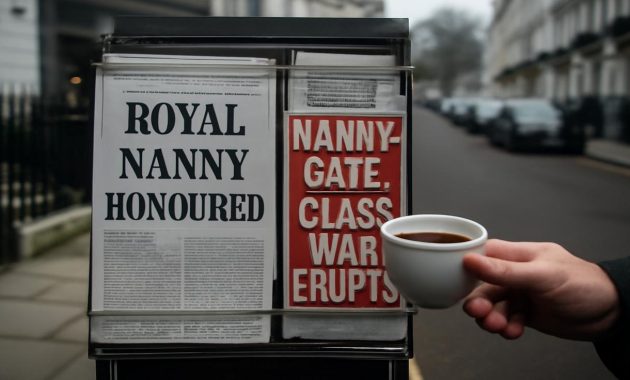
The first time you notice her, you probably don’t notice her at all. She’s in the blurred margin of the photograph, just outside the sharp-edged frame of royal glamour: a navy coat, a neat bun, a hand quietly but firmly on a small royal shoulder. Cameras strain for a prince’s grin or a princess’s wave, but she is there anyway—watching, anticipating, absorbing mischief and meltdown before it ever reaches the public eye. And now, in a twist that unsettles Britain’s carefully varnished ideas about class and care, this woman in the margins has been pulled sharply into focus.
A Medal for Invisible Work
Her name is Maria Teresa Turrion Borrallo, though most people still call her, with an almost storybook simplicity, “the royal nanny.” She has served the Prince and Princess of Wales for years, moving in and out of the public gaze like a shadow that knows the choreography better than the dancers themselves. If you’ve watched Prince George clutch someone’s hand at a royal airport arrival, or seen Princess Charlotte scooped up just before tears broke the surface, you’ve probably seen her, even if you didn’t know it.
Recently, she was awarded a rare royal honour—an official recognition from the very institution that has long benefited from her discretion. In a palace world where medals are more often pinned on uniforms or shimmering gowns, this particular decoration is heavy with symbolic weight. It honours not a general, not a celebrity philanthropist, but a nanny. A woman whose professional life is about wiping noses, soothing fevers, orchestrating bedtime, and teaching small heirs to say “please” and “thank you” while the world watches.
There is something quietly radical in that image: a nanny standing in one of the grand state rooms, the gold leaf and oil portraits bearing silent witness, as a member of the royal family thanks her for service that happens mostly behind closed doors. The kind of service that, historically, was expected but never really celebrated. It’s like someone turned up the dimmer switch on an entire category of invisible labour, if only for a moment.
The Unspoken Contract of Care
To understand why this matters to so many, you have to picture the daily choreography of royal life. The Wales household is not simply a family; it’s a working institution laced with centuries of ritual, protocol, and scrutiny. From the outside, it’s tiaras and state banquets. Inside, it’s also homework folders, lost shoes, sibling squabbles, stomach bugs, and a child refusing to wear anything but the superhero T-shirt on a day that requires a blazer.
In the middle of that storm stands the nanny. She is the one who remembers which child hates peas but will eat them if disguised under mashed potato. She knows which stuffed animal must never be left behind at a hotel, which bedtime story calms which nightmare, and which public duties risk overstimulating which small royal. She must be half security guard, half therapist, half logistics manager, and fully invisible in the final photograph.
When the Prince and Princess of Wales step onto a balcony or into a school gates photo-op looking serene, it is often because someone like Maria has already spent hours smoothing the chaos that precedes the calm. The award she has now received is, in one sense, a simple thank you for years of competence and affection. But to a watching public, it lands differently. It asks a tricky question, quietly: why do we so rarely honour the people who raise other people’s children for a living?
The Class Fault Line Under the Royal Carpet
The reaction to the nanny’s honour has split along lines so old they’re practically carved into Britain’s cultural bedrock. For some, the award is a charming recognition of devoted service. “She’s practically part of the family,” people say, with real warmth. They point out that this is the modern royal family—a working couple trying to balance duty and parenting in a goldfish bowl—and that elevating their nanny is a way of showing that care work matters.
For others, the news presses on a bruise. It throws a spotlight on a class system that still, in unguarded moments, seems to suggest that looking after children—cleaning their faces, folding their clothes, absorbing their tantrums—is a job for someone else, someone “below stairs,” no matter how affectionately they are treated. The honour doesn’t float in isolation. It hovers over a landscape where countless childcare workers, nursery staff, childminders, and live-in nannies slog through exhausting, underpaid shifts without a hint of a medal, let alone a palace ceremony.
The class debate swirling around Maria’s award is not truly about her at all. It’s about what she represents: the complicated intersection of love, labour, loyalty, and hierarchy. The royal household becomes a magnified mirror, reflecting a wider culture in which some kinds of work are celebrated, while others are folded quietly into the background, as if they are simply part of the furniture.
The Nanny as National Archetype
Britain has long been haunted by a particular figure: the nanny who holds up the scaffolding of the upper classes. From Mary Poppins floating down with her umbrella to the strict, starched nurses of period dramas, the idea of a well-trained, “good” nanny is baked into the country’s storytelling. She is nurturing yet firm, devoted yet professional, part of the family but not of the family. She comforts tears in the nursery while the adults host dinner parties downstairs.
Maria’s training at Norland College—a storied institution that practically manufactures this archetype—only deepens that mythology. Norland nannies, with their distinctive uniforms and reputation for near-military competence, are like a brand in themselves. They are known for teaching future dukes and CEOs to tie their shoes and say their prayers while holding a mental map of security protocols and emergency drills.
But mythology has a way of smoothing over uncomfortable truths. The “perfect nanny” story hides the power imbalance at its core. However beloved she may be, the nanny’s affection is still bound up in a contract. Her nights are disturbed by her employer’s children, not her own. Her holiday plans are shaped by the family calendar. Her legacy lives in photographs where she appears in the corner, blurred.
When such a figure is suddenly singled out for royal recognition, the country’s unease with its own class ghosts flares to life. Is the honour a progressive nod to the importance of care work, or a gilded thank you note from the very apex of a system that still expects women—often lower-paid, often from different backgrounds—to absorb the emotional and physical labour of raising the privileged?
A Quiet Power, A Visible Medal
Imagine the ceremony itself. The muted clink of medals being readied, the rustle of uniforms, the thick hush of centuries-old stone. Her footsteps echo slightly as she walks in. She has attended these rooms before, but most likely as staff moving swiftly out of sight. Now she is the reason people are gathered. Her name is read aloud. She steps forward, and for a moment, the roles tilt. The caregiver is being formally cared for by the institution she has served.
It’s a strange inversion. For years, her job has been to anticipate the needs of others before they even recognise them: the quick hand with a water bottle, the whispered reminder of what to say, the bit of comic distraction that prevents a very small prince from melting down under the hot gaze of global media. Now, for just a sliver of time, the institution anticipates her. The medal, the citation, the polite words of thanks—they’re a ceremonial version of what she has been doing in miniature, day after pressured day.
Yet the medal is also a symbol heavy with contradiction. It acknowledges importance while quietly reinforcing difference. It says, “We see you,” but also, “We see you in this particular way—through the lens of service.” Her work is vital, but it is still classified as support, not centre stage. Even in celebration, the class scaffolding remains visible, like the bones of an old house beneath fresh paint.
| Aspect | Royal Nanny | Typical Childcare Worker |
|---|---|---|
| Visibility | Occasionally in global media, mostly in the background | Local, often invisible beyond families they serve |
| Recognition | Formal royal honour, public acknowledgement | Rarely honoured, thanks usually private and informal |
| Working Context | Royal household, high protocol, intense public scrutiny | Homes, nurseries, schools, often with limited resources |
| Symbolic Role | Represents tradition, loyalty, continuity of monarchy | Represents essential but undervalued social infrastructure |
When people scroll past headlines on their phones—“Royal nanny honoured with rare award”—they’re not just consuming a feel-good story. They’re being nudged to think about who gets recognised and why. Some feel warmth and a kind of vicarious pride. Others feel that familiar tug of frustration: the sense that the system is once again congratulating itself for kindness while leaving the underlying inequalities undisturbed.
Behind One Medal, a Crowd of Unseen Hands
Strip away the palace details, and the story of the honoured royal nanny lands in the middle of a broader, more urgent conversation: who does the care work that keeps the world turning, and how do we treat them? During the pandemic, people clapped on doorsteps for key workers. For a moment, nursery staff and childminders were mentioned in the same breath as nurses and delivery drivers. Then life sped up again, and much of that gratitude evaporated into the everyday hum of busyness.
This medal, pinned discreetly to a navy dress or suit, is like a tiny flare in the dusk. It says: this work matters. The emotional steadiness, the patience, the capacity to absorb other people’s storms—all of it has value. Yet it also risks being a rarefied exception. If one nanny in a palace can be honoured, what about the thousands of others whose alarm clocks ring at 5:30 a.m. so they can be at a stranger’s house before sunrise? What about the nursery worker who knows thirty children’s allergies by heart? The grandmother minding toddlers on a council estate while their parents work back-to-back shifts?
The class debate sharpened by Maria’s award is as much about gender and economics as it is about aristocracy. Care work—professional or domestic—still falls overwhelmingly to women. It is often underpaid, often insecure, and yet absolutely foundational. The royal nanny’s recognition throws that reality into starker relief. In celebrating one person’s contribution, it casts a long shadow in which many others stand, unrecognised, holding the same kinds of invisible weight.
A Royal Family Trying to Look More Like a Family
It is impossible to separate this honour from the larger project of the Prince and Princess of Wales to position themselves as “modern” royals. They talk frequently about mental health, about childhood, about the pressures of parenting. They are photographed on school runs, at sports days, at parents’ evenings. The image is carefully calibrated: yes, this is a royal couple, but they are also, insistently, mum and dad.
Within that narrative, spotlighting the nanny is both sincere and strategic. It underlines the message that they take their children’s wellbeing seriously enough to surround them with professional, stable care. It hints at humility: we can’t do this alone, and we won’t pretend otherwise. It also dovetails neatly with broader campaigns about early years development, a cause the Princess has championed with visible passion. By honouring the person who helps bring those principles into everyday practice in their own home, they close a kind of symbolic loop.
At the same time, this gesture opens them up to scrutiny. If they, sitting near the top of the social pyramid, are seen celebrating childcare work, what responsibility do they have to advocate more loudly for better pay and conditions for all who do it? Does a medal without a matching push for structural change feel, to some, like handing out ribbons on a sinking ship?
Still, the image of a royal couple thanking their nanny publicly is not nothing. It is a subtle but notable departure from their ancestors, who might have kept such gratitude strictly private, lest it blur the line between family and staff. In their world, every small evolution is encoded with significance. This one signals, however modestly, that the emotional labour of raising royal children is not just assumed—it is honoured.
What We Choose to Honour
Step back from the palace gates for a moment and imagine your own personal honours list. Who would be on it? The teacher who noticed when you were struggling? The neighbour who checked in on you during a hard winter? The exhausted nursery worker who somehow still knelt down to your child’s level and listened, properly listened, to the story about the broken crayon?
On one level, the royal nanny’s award is just another line in the Court Circular, another small gleam in the endless scroll of royal news. On another, it invites a more intimate reckoning. If a monarchy—an institution not exactly famed for radical egalitarianism—can pause to pin a medal on a nanny, what does that say about what the rest of us could be doing? Are there people in our orbit whose quiet, daily acts of care we have allowed to become background noise?
Honours have always been about more than the individuals who receive them. They are storytelling devices in metal form, tiny portable myths about what a society claims to admire. A medal for a nanny says: loyalty matters, patience matters, the raising of children matters. It also, whether intentionally or not, says: this labour is still something done for those at the top by those a few rungs down.
Between those two truths—genuine appreciation and persistent hierarchy—Maria Teresa Turrion Borrallo now walks, as she has always done, with careful poise. She will return to her routines: the school runs, the bedtime routines, the long flights with overexcited children. The medal will probably live in a box, brought out occasionally, shown to old friends and future grandchildren. The class debate it stirred, however, will linger in the air much longer, like the echo of footsteps down a palace corridor.
Frequently Asked Questions
Why is the Prince and Princess of Wales’s nanny receiving a royal honour?
The nanny has been recognised for years of dedicated service to the Wales family, supporting the upbringing and wellbeing of the royal children. The honour acknowledges her professionalism, loyalty, and the crucial—often unseen—role she plays in the functioning of a high-pressure royal household.
Is it common for royal nannies to receive official awards?
No. While long-serving staff members sometimes receive honours, it is relatively rare for a nanny’s role to be highlighted in this way. That rarity is part of why the award has attracted so much attention and debate.
Why has the award sparked a class debate?
The honour has reignited questions about who does care work in Britain, who benefits most from it, and how unequally it is valued. Some see the award as a positive step in recognising childcare; others view it as a gesture that highlights the privileges of the few while most childcare workers remain low-paid and unrecognised.
Does this recognition change the nanny’s position in the royal household?
Formally, her role remains the same: she is still an employee, responsible for the care of the royal children. Symbolically, however, the honour raises her public profile and signals that her contribution is considered significant by the royal family and the wider institution.
What does this mean for other childcare workers and nannies?
Practically, it doesn’t alter pay scales or working conditions for other childcare workers. Symbolically, it may contribute to a broader conversation about valuing care work and recognising the people who provide it. Whether that conversation leads to meaningful change depends on how governments, institutions, and families choose to respond.
Is the royal family trying to send a message with this award?
Many observers believe so. The Prince and Princess of Wales have emphasised the importance of early childhood, mental health, and modern family life. Honouring their nanny aligns with that narrative by underlining that raising children is shared work and that professional care is central to their family’s stability.
How should we interpret this honour in the bigger picture?
It can be seen as both a sincere gesture of gratitude and a revealing symbol of ongoing class and gender dynamics. It invites us to ask who we celebrate, whose labour we overlook, and what it would mean to truly honour the people who hold our most vulnerable years in their hands.