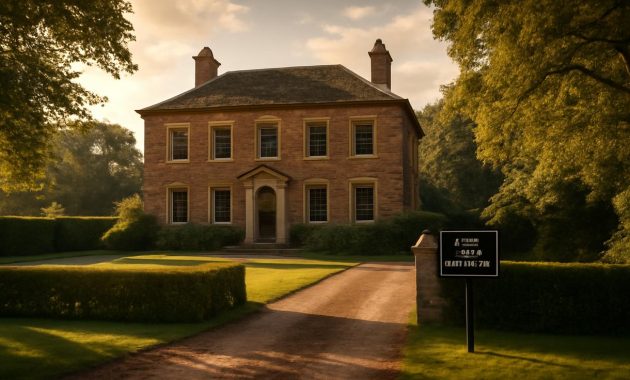
The lane narrows almost imperceptibly just before you reach the gates. Hedges thicken, the air cools by a few gentle degrees, and Norfolk’s wide, unhurried sky seems to lean in, as if curious. Ahead, the sweep of gravel appears—not ostentatious, not grand in the way of a palace, but assured, timeworn, and quietly self-possessed. This is not merely another handsome English house coming to market. This is the Norfolk home where the grandmother of Diana, Princess of Wales, once moved through the rooms, where summers pressed themselves into the curtains and winters settled around the fireplaces like old friends.
A House That Remembers
Step over the threshold and the first sensation is not visual at all—it’s acoustic. The house has that particular hush you find only in older country homes, a silence textured by the faintest creaks and whispers: the tick of an old clock, the distant sigh of wind nudging against leaded windows, a muted thud as pipes shift behind thick walls. It feels, instantly, like a place that remembers more than it shows.
The hallway stretches out with the sort of effortless symmetry that Georgian and early Victorian architects seemed to summon as easily as breathing. Light spills in from a fanlight above the door, pooling across the flagstone floor, illuminating scuffs worn by generations of boots and dancing shoes. Somewhere in that patina of use you can’t help but imagine a young Frances Burke Roche—later Frances Shand Kydd, Diana’s mother—arriving to visit her own mother. And in that imagined scene, hovering just beyond the years, the ghost of a blonde little girl with an uncertain shy smile, trailing behind the grown-ups, taking in the grown-up world of polished banisters and rustling silk.
The Norfolk countryside has a way of folding time in on itself. Outside, tractors move along their routes with quiet modern efficiency, and yet the lane, the big skies, the way mist clings to the low fields at dawn—all of it feels almost unchanged from the world in which Diana’s grandmother lived here. The house, too, seems to have chosen evolution over reinvention: improved, lightly modernised, but never stripped of its memory.
The Quiet Elegance of a Norfolk Estate
In a region dotted with stately piles and sleeping farmhouses, this house occupies a rare, middle place. It is grand enough to host weekends that stretch into Monday, yet human enough that you can imagine living here without a household staff, simply slipping into its rhythm the way you might into a favourite jacket.
The drawing room, long and generous, is the heart of that feeling. Sunlight moves slowly across its walls over the course of a day, catching on the gilt edges of picture frames, warming the soft weave of old rugs. On an overcast afternoon, you can picture heavy curtains drawn just enough to keep the draught away, logs cracking in the fireplace, the faint scent of woodsmoke threading through the air. There are countless English rooms like this on paper, and yet this one bears an extra, almost imperceptible charge: here, perhaps, letters were opened carrying royal crests; here, conversations took a more careful, lowered tone when the subject turned to Sandringham or Buckingham Palace.
Norfolk itself plays its part like the most accomplished supporting actor. Step outside and you are met not with the manicured, almost theatrical perfection of some show estates, but with a more lived-in, breathable landscape. Lawns loosen at the edges into wilder borders. A kitchen garden, perhaps a little too ambitious one exuberant spring, has grown into a charming patchwork of herbs and soft fruit. Apple trees lean slightly, as if listening, their trunks thick with age, their branches still determinedly productive.
There is an authenticity to it all that feels increasingly rare in the age of stage-managed country living. This is not a house made to be photographed; it is a house that just happens to photograph beautifully because it has earned every line, every softened corner.
When History Lives in the Floorboards
Houses with royal connections often suffer a particular fate: stripped down, polished up, turned into shrines to a past that visitors are expected to whisper about. Here, that hasn’t happened. The connection to Diana feels less like a marketing hook and more like a quiet thread woven through the daily fabric of the place.
Imagine evening here in the mid‑20th century. Before mobile phones, before constant noise, there is the clink of china as tea things are cleared, the rustle of broadsheets, the faint crackle of the radio in a distant room. Somewhere upstairs, a little girl might be put to bed, listening to the low murmur of adult voices floating up through the floorboards. Perhaps she is Diana’s mother. Perhaps, later, one of Diana’s siblings on a childhood visit. The fabric of the house has absorbed such scenes; you sense it in the way the staircase curves, inviting slow, thoughtful descents.
Today, standing on that same staircase, the world beyond the windows is both unrecognisable and exactly the same. Birds still trace the same paths over the fields; late afternoon still glows the same amber in October. Somewhere between the handrail—soft as satin from decades of touch—and the dust motes drifting through the light, you become acutely aware that you are not just looking at history, you are standing inside it.
And yet, nothing here feels like a museum. There are radiators that hum gently in winter, evidence of wiring that can accommodate the inevitable clutter of modern life: laptops, chargers, the hidden clutter of 21st‑century habits. The kitchens, too, tell the story of a house that has welcomed repeated reinvention. Old beams might meet newer cabinetry; a range cooker might hum companionably alongside an antique dresser, its drawers swollen slightly with age.
The Rooms Where Life Happens
Country houses are often described in reverent lists: so many bedrooms, so many reception rooms, this many acres. Useful, yes—but it misses the point. We don’t fall in love with square footage. We fall in love with the way a room makes us feel the instant we step inside.
Here, the rooms seem to have been shaped by the natural habits of family life. There is a small sitting room that feels designed for Sunday evenings, for books left half-finished on armrests, for dogs snoring obliviously in front of the fire. In a corner, by a window overlooking the garden, you can almost see the outline of a favourite armchair—the place someone always chooses, the place where news is shared, where quiet tears are allowed, where laughter tends to erupt without warning.
The bedrooms, reached by that gently curving staircase, don’t announce themselves with drama. Instead, they unfold with quiet confidence: high ceilings for air, sturdy walls for warmth, windows that frame Norfolk’s changing moods. On a bright day, the landscape stretches out like a painting: fields, copses, perhaps a faint line of distant farm buildings. On mistier mornings, the view feels secret, as if you have woken in your own private world, muffled and self-contained.
In one room, it is easy to imagine a young Diana visiting her grandmother for the holidays, lying awake and listening to the particular silence of the countryside. The only sounds might be the rhythmic hoot of an owl, or the wind worrying the trees. For a girl who would later become the most photographed woman in the world, these Norfolk nights must have offered a rare kind of anonymity—just a child, in a quiet bedroom, in a house that knew how to hold silence kindly.
| Feature | Atmosphere & Experience |
|---|---|
| Entrance Hall | Soft echoes, worn stone, and a gentle hush that carries the weight of family arrivals and farewells. |
| Drawing Room | Long light-filled afternoons, crackling fires, and the sense that important conversations once happened here. |
| Gardens & Grounds | Mature trees, half-wild borders, and the quiet companionship of the Norfolk countryside on all sides. |
| Bedrooms | High ceilings, shifting light, and the deep country silence of long, restorative nights. |
| Family Spaces | Cosy corners, lived-in comfort, and rooms that feel ready for muddy boots, shared meals, and lazy Sundays. |
A Royal Connection, Gently Woven
There is a particular moment, walking through the house, when you understand the difference between a property with a famous owner and one with a famous story. The Norfolk home of Diana’s grandmother belongs firmly in the latter category. The royal association here is not an ornamental crest above the fireplace; it is a more diffuse presence, like the scent of something faintly floral lingering in a room just after someone has left.
Diana’s lineage on her mother’s side ties her to a web of country houses, rectories, and comfortable estates that formed the backdrop of a certain slice of mid‑century British life. This Norfolk house was one of those anchor points—a place where the ordinary rhythms of country living intersected unexpectedly with the extraordinary arc of a future princess’s life. Here, family dynamics played out away from the flashbulbs, long before the world cared to watch.
It is tempting to romanticise that connection, to picture Diana herself running down the lawn, hiding behind trees, feeding crusts to ducks at a pond’s edge. The truth, as always, is more nuanced, bound up in the complexities of her parents’ marriage, in shifting custody arrangements, in the emotional weather of a divided childhood. But even acknowledging that, there is something undeniably poignant about this particular house now seeking a new chapter.
For any future owner, that story becomes part of the inheritance. You do not buy a title, of course; you buy rooms, land, brick and slate. And yet you also acquire an invisible archive of associations. Guests will ask, perhaps a little shyly at first: “Is this the house that…?” You will nod, hand them a drink, gesture toward the garden, and watch as their gaze begins to braid their own imagination together with facts and remembered headlines.
Life Beyond the Gravel Drive
To understand the pull of this house, you have to step beyond the gravel and follow one of the paths that leads out across the land. Norfolk, at first glance, appears almost simple: flat, open, easy to read. But walk it, and you begin to understand why writers and painters have gravitated here for generations.
On a crisp morning, the air tastes faintly of salt carried inland from the coast. Larks rise abruptly from the fields, stitching invisible patterns in the sky. A tractor hums in the distance, its progress slow, methodical, slightly hypnotic. Hedgerows shift with the seasons: frothy with hawthorn blossom in spring, heavy with blackberries and rosehips as the year leans towards autumn.
From the house, these changing scenes are like a living, breathing art installation. From the kitchen window, you measure the year not by calendar months, but by the return of swallows, by the first frost on the paddock, by the precise shade of green the fields achieve in late May. In winter, the landscape pares itself back to essentials: flocks of birds etching themselves against a bleached sky; trees holding their ground in the wind, skeletal and determined.
For anyone seeking escape from the compressed tempo of city life, this Norfolk home offers not just space, but tempo. Days stretch and unspool differently here. Mornings invite lingering: coffee taken standing in the doorway, watching weather roll across the fields. Evenings lend themselves to ritual: the slow laying of a table, the walk to the gate to close it as the light drains quietly away.
A New Chapter Waiting to Be Written
What does it mean, in 2026, to become the custodian of a house like this? The word “owner” feels suddenly inadequate. You can repaint walls, you can change the kitchen, you can reimagine the planting in the garden—but you cannot outshout the story already humming quietly in the background. The more humbly you approach it, the more it offers in return.
Perhaps you are someone who has always dreamed of a country home with history, but been wary of the weight that such history might carry. This house, with its royal brushstrokes and its human-scale intimacy, might be the ideal compromise. It has pedigree without pomposity, atmosphere without stiffness. It invites you to host Christmases, to raise children or grandchildren, to gather friends for long weekends where phones are forgotten and dogs take centre stage.
You might choose to lean into the story, framing a discreet photograph of Diana’s grandmother in the hall, keeping a slim volume of royal biography on a side table. Or you might let the connection live mostly in your guests’ imaginations, mentioned once, then quietly left alone, like a secret shared among friends.
Because in the end, the house’s future cannot depend solely on its past. It will need new layers of memory: the slightly chaotic first summer after moving in, when boxes still sit half-unpacked in the back hall; the unexpected snowstorm that cuts off the lane for a weekend, forcing neighbours to become instant allies; the birthday dinner when power fails and the entire evening takes place by candlelight and shared blankets, becoming one of those stories everyone tells for years.
When a Home Becomes a Story You Step Inside
Standing once more at the edge of the gravel, looking back at the façade, you might try to sum it all up: a Norfolk country house with royal connections, the former home of the grandmother of Diana, Princess of Wales, now looking for its next steward. But that bare description feels like a black‑and‑white sketch of something that, in person, lives in full colour.
There is the way the late sun catches on the windowpanes, turning each into a small square of liquid gold. There is the smell of cut grass mingling with the cool, damp earth at the borders. There is the almost tangible sense that, behind the bricks and slate and plaster, this house has known laughter and tears, departures and arrivals, quiet grief and unexpected joy—and has absorbed it all without judgement.
And there is, underlying everything, that faint, unshakable awareness: somewhere in the tangled genealogy of this place is a little girl who grew up to be a global icon. She did not live her whole life here, nor was this house the stage for the drama that followed. But it is part of her prelude, part of the unseen landscape of her becoming. To live here is, in some small way, to inhabit one of the quieter footnotes in one of the loudest stories of the late 20th century.
As the house comes to market, estate agents will dutifully list its features. They will talk of bedroom counts and acreage, of outbuildings and potential, of good broadband and proximity to local schools. All of that matters. But for the person who ultimately turns the key in the door and calls this place home, it will be something else that seals the decision: a moment of unspoken recognition, standing in the hallway or by an upstairs window, when you feel the house looking back at you as clearly as you are looking at it.
Not everyone wants to live in a story. Some prefer newbuilds, blank pages, unmarked by other people’s sentences. But for those who sense that the richest lives are layered rather than pristine, this Norfolk home offers something rare: the chance to add your own chapter to a tale that began long before you—and will, if you care for it well, continue long after.
Frequently Asked Questions
Is this house officially part of the royal estate?
No. While the property is closely associated with Diana, Princess of Wales, through her maternal grandmother, it is a private home rather than an official royal residence or part of the Crown Estate.
Did Diana, Princess of Wales, actually stay at this house?
Historical accounts indicate that Diana spent time at various family houses in Norfolk and beyond during her childhood. While precise visit records are private, it is widely understood that this home was part of the wider family landscape she moved through growing up.
Has the house been heavily modernised?
The property has been sensitively updated over time—modern enough for comfortable, year‑round living, but with its architectural character, proportions, and sense of age carefully preserved.
Is the royal connection likely to affect daily life for the new owner?
In practical terms, no. The house is set in typical Norfolk countryside, and the royal association is a point of historical interest rather than an everyday intrusion. Occasionally, it may spark curiosity from visitors, historians, or journalists, but day‑to‑day life remains essentially private and rural.
Who is the “ideal” buyer for this property?
Someone who values both history and home: a person or family seeking a lived‑in, welcoming country house with depth and story, rather than a showpiece. The ideal buyer will see themselves not just as an owner, but as the next caretaker in a long, evolving narrative.