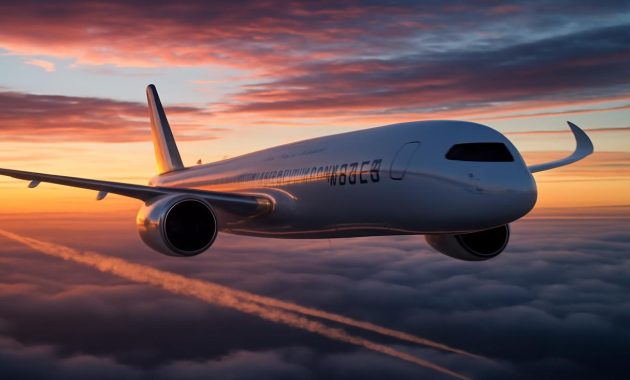
The runway lights at Toulouse flicker in the damp evening air, casting long reflections on the gleaming fuselage of the newest Airbus jet. A light mist hovers just above the tarmac, swirling in the wake of service vehicles and restless wind. Somewhere inside this vast, silver body, seats are wrapped, screens are dark, and fuel tanks—enormous, meticulously engineered fuel tanks—are waiting to be filled for the kind of journey humans once only dreamed of: a non-stop flight that all but erases the map under its wing.
The Longest Night in the Sky
Close your eyes and imagine settling into a seat, expecting not a few hours in the air, but nearly an entire day. The safety video plays, engines spin up with that familiar, comforting roar, and as the aircraft lifts free of the ground, so does any sense of local time. Onboard the new Airbus ultra-long-range jet—designed to push non-stop flight farther than ever before—the idea of “here” and “there” becomes strangely elastic.
For decades, long-haul travel meant compromise: stopovers, fuel breaks, and bleary-eyed transfers in anonymous terminals where the air smells of coffee, perfume, and jet fuel. Now, Airbus is pushing the boundaries of what it means to go non-stop, turning entire oceans and continents into a single, smooth arc. This isn’t just an engineering experiment; it’s a quiet revolution in how we experience distance.
On these record-stretching flights, passengers watch the world’s time zones flow by like mile markers on an invisible highway. Dawn chases dusk, and somewhere between them, a new kind of journey is born—one less about endurance and more about immersion. Airbus isn’t just racing numbers; it’s rearranging the emotional landscape of travel: how it feels to be away, how it feels to arrive, and what it means to cross the planet in one unbroken breath.
The Machine Built for Distance
The new ultra-long-range Airbus jet—descended from the sleek A350 family—looks, from a distance, like any other long-haul aircraft. But come closer and the details begin to whisper a different story. The wings, gently flexed even at rest, are sculpted like a seabird’s, designed to slice the sky with the least possible resistance. Their tips curl upward in a graceful, almost organic gesture that’s more about physics than beauty, yet achieves both.
Under the wings, engines hang like polished obsidian, deceptively calm. These are next-generation powerplants, tuned for efficiency instead of brute force, built to sip fuel instead of guzzle it. Every rotation of their vast fans is an argument for patience: go slower, burn less, fly farther. Inside the wings and hidden in the belly, fuel tanks stretch longer than ever, feeding an endurance that lets this aircraft chase the horizon across multiple hemispheres.
The fuselage is a patchwork of advanced composites and alloys, carefully selected not just for strength, but for weight savings measured in mere kilograms that, when multiplied across the structure, mean hundreds of additional miles of range. Even the windows, subtly tinted and precisely spaced, are part of the long-range calculus, commanding more natural light for tired eyes while keeping the cabin cooler and more energy-efficient.
On paper, the capability is startling: ranges in excess of 9,000 nautical miles, flights that take you from Europe deep into the Pacific basin, or from Asia to the eastern reaches of the Americas in one single, seamless stretch. But statistics alone don’t quite capture the experience of stepping aboard a machine that treats the globe as less of an obstacle and more of an invitation.
The Quiet Revolution Inside the Cabin
If older long-haul jets often felt like a test of patience and posture, Airbus’s latest long-range design approaches the cabin as a kind of travelling ecosystem. Walk down the aisle, and you’ll notice the air first: cooler, crisper, less dry. The cabin is pressurized to a lower equivalent altitude than traditional planes, which means less of that dull pressure behind your eyes, fewer headaches, legs that don’t feel as heavy when you stand.
Noise levels hum at a gentle, almost domestic murmur. The dull roar that used to fill your ears for hours is tamed, allowing you to pick out the soft click of seatbelts, the clink of ice in a glass, the near-whisper of the cabin crew conferring behind a curtain. LED mood lighting subtly shifts through a carefully rehearsed palette that mimics the rising and setting of the sun, coaxing tired bodies toward a new time zone with more kindness than a brusque “local time is” announcement.
Seats, even in economy, are optimized not just for space but for micro-movements: adjustable footrests, improved recline mechanics, and sculpted cushions that anticipate long hours of shifting and resettling. In premium cabins, the experience edges closer to a personal cocoon—doored suites, lie-flat beds, and textiles chosen for touch as much as for durability. The entertainment screens gleam with pin-sharp clarity, but equally important are the lulls: moments when the darkness of the cabin, the steady drone, and the softened light conspire to make you forget you’re confined within an aluminum and carbon fiber tube miles above the ocean.
Designing for a 20-Hour Day in the Sky
Pushing the limits of non-stop flight isn’t just about fuel and engines; it’s about human bodies and minds enduring a journey as long as a working day plus a full night’s sleep. For Airbus engineers and designers, the question wasn’t merely “How far can we fly?” but “How well can we live while we’re doing it?”
Imagine boarding at midnight in a humid coastal city. Outside, the air clings to your skin; inside, the cabin greets you with a different climate entirely. The air is filtered and refreshed with a rhythm that’s almost biological. Advanced environmental control systems constantly adjust humidity and temperature, aimed at reducing that classic long-haul feeling of waking up with lips like parchment and skin that feels several sizes too small.
Lighting is choreographed with care. Shortly after takeoff, cabin lights dim gradually, fading through aubers and indigos rather than snapping off. Later, when it’s time to nudge passengers towards the time zone of their destination, warm golden tones seep back in. This is circadian science applied at 40,000 feet—small, subtle interventions that, over a 17 or 18-hour marathon, add up to something like comfort.
Even the layout of galleys and lavatories is reconsidered. Quiet corners give space to stretch or stand, to lean against a bulkhead and stare out at the endless black sheet of ocean below. Crew rest compartments are hidden behind inconspicuous doors, but their design is crucial: a rested crew is a calmer cabin, more watchful and more capable of making such a long journey feel less like a siege and more like a slow, measured crossing.
The Numbers Behind Ultra-Long-Range Flight
For those who love data as much as daydreams, the new Airbus jet operates at a crossroads of mathematics and imagination. Every drop of fuel, every kilogram of weight, and every degree of temperature has been modeled and re-modeled to stretch what’s possible without overstepping the edge of practicality.
| Key Aspect | Ultra-Long-Range Airbus Jet |
|---|---|
| Typical Range | Over 9,000 nautical miles (approx. 16,700+ km) |
| Typical Flight Duration | Up to ~18–20 hours non-stop, flight-plan dependent |
| Passenger Capacity | Optimized for fewer seats to allow extra fuel and comfort |
| Cabin Pressure | Lower equivalent altitude than traditional long-haul jets |
| Materials | High-percentage composite fuselage and wings for weight reduction |
Each of these numbers hides a thousand smaller decisions: how to route cables more efficiently, where to trim a fraction of a millimeter of thickness from a panel without sacrificing strength, how to tune the flight control software so the aircraft rides the air with minimal wasted motion. Long-range aviation has always been about trade-offs. This time, the balance tilts towards endurance without entirely turning its back on comfort or sustainability.
Redrawing the Map of the World
There’s a quieter kind of drama unfolding behind these technical achievements: the slow rewiring of global geography as we feel it. For travelers, the rise of ultra-long-range flight is more than a bragging right about “the longest flight I’ve ever taken.” It changes the way we think about what’s near and what’s far.
Imagine boarding in a European city as leaves begin to yellow and fall, and stepping out into the lush humidity of a Pacific island without having once set foot in a transit terminal. Or leaving a dense Asian metropolis long after midnight and arriving in a North American city in time for a late evening walk, knowing you haven’t had to sprint down any foreign corridors or scan departure boards in a bone-tired haze.
Airlines see new possibilities: city pairs that once felt too far, too fragmented by stopovers, now appear as single, unbroken lines on route maps. Business relationships tighten, family ties stretch more easily across oceans, and even tourism begins to drift into more remote corners of the globe. That untouched coastline you saw in a travel magazine? It’s suddenly closer, not by distance, but by the number of steps it takes to get there.
Yet there’s a paradox here. As the world shrinks in terms of time, the flights themselves grow longer, deeper, more immersive. Connectivity onboard—Wi-Fi, real-time messaging, live news—means that being in the air no longer equals being absent. You can work a full day’s schedule, fall asleep, and wake to a new continent. The line between departure and arrival blurs, and the journey becomes its own small chapter rather than a blank space to be hurried through.
The Weight of Distance: Environment and Responsibility
Pushing the limits of non-stop flight also pushes us to confront uncomfortable questions. What does it mean to build a jet that can stay aloft almost continuously for the better part of a day? How do we balance the wonder of near-seamless global movement with the urgency of reducing aviation’s environmental footprint?
Airbus has wrapped this ultra-long-range evolution in layers of efficiency: more economical engines, aerodynamics fine-tuned in computer simulations and wind tunnels, lightweight materials that let you carry more distance with less fuel. The new jet burns significantly less per passenger-kilometer than earlier generations of long-haul aircraft. Some operators pair these advances with sustainable aviation fuels, slowly nudging the emissions curve downward.
And still, an uncomfortable truth remains: longer flights mean more fuel, more emissions per journey, regardless of how optimized the machinery becomes. Engineers and policymakers know this, and the new Airbus jet finds itself serving in two roles at once—proof of what’s technically possible today, and a testbed for the kind of solutions tomorrow will demand. Blended fuels, hydrogen experiments, more efficient flight paths, and even lightweight onboard systems are all part of an unfolding story.
There’s a strange, compelling honesty in sitting by the window at cruise altitude, peering down at the thin, distant ribbon of coastline and the velvet-black stretch of ocean. You are suspended in a machine that both connects the world and weighs upon it. The new Airbus jet doesn’t fully resolve that tension. It simply shows how far we can go, and invites us to decide how wisely we’ll use that power.
Inside the Longest Crossing
Some hours into an ultra-long-range flight, the cabin settles into a peculiar rhythm. The initial bustle fades, the clink of meal service gives way to the hush of sleep. The screens glow here and there with the soft blues of moving maps, tiny icons inching across seas with almost comical slowness. Flight attendants move like practiced ghosts, checking belts and curtains while most people dream or doze behind eye masks.
Walk down the aisle and you notice the contrasts. A child awake at the wrong side of the world’s clock, clutching a toy and staring curiously out of a window onto pure darkness. A business traveler, documents strewn on a tray table, trying to turn this suspended time into an advantage. A couple quietly watching the same movie, heads leaning closer than the seat design strictly expects.
Somewhere behind closed doors, the pilots are engaged in a different kind of endurance. Long-range flying is as much about management as it is about control. Carefully plotted tracks over remote oceans, constant monitoring of fuel, weather patterns evolving hundreds of miles ahead, and the steady choreography of rest cycles to ensure someone is always sharp, always thinking two or three steps into the future. The new Airbus jet cushions their work with automation and advanced avionics, but it doesn’t trivialize it. The sky, after all, still demands respect.
Hours pass. Maybe you sleep, maybe you fail to. At some point, the cabin lights stir to life again, this time with a gentle, pinkish hue, as if suggesting a distant sunrise. The map on your screen shows cities you once considered remote now uncomfortably close. Breakfast appears. Conversations resume in quiet bursts. You become aware that, impossibly, you’ve crossed entire latitudes while doing nothing more than adjusting a blanket and scrolling through movies.
When the aircraft finally tilts its nose down toward a new land, there’s a peculiar sensation of surfacing. The world outside shifts from an abstract concept on your screen back into something tactile: fields, rivers, roofs glinting in the early light. The Airbus jet, which has been your entire world for nearly a day, now feels suddenly small against the breadth of the landscape it’s traversed.
Where the Horizon Moves Next
As aviation’s story continues to unfold, the new Airbus jet sits at a threshold. It represents the outer edge of what current materials, fuels, and aerodynamics can reasonably achieve without rewriting the rules entirely. It shows that non-stop flight can span almost any two points on the globe, for those willing to spend the hours and the fare.
But perhaps the most enduring legacy of this aircraft won’t be a single record-breaking route or a breathless headline about “the world’s longest flight.” Instead, it may lie in how casually, one day, we talk about journeys that cross the entire planet in one sitting. It will lie in the way young travelers grow up thinking of Australia-to-Europe or Asia-to-America not as epic odysseys, but as long, manageable jumps with decent meals and some sleep in between.
The horizon is always moving. In a decade, we may see hydrogen-powered prototypes carving silent paths through the sky, or hybrid concepts that rethink the shape and function of aircraft completely. For now, the new Airbus ultra-long-range jet flies at the leading edge of today’s technology, an elegant question mark against the canvas of the sky: how far is far enough—and what will we do with a world that feels this close?
Some evening soon, another one of these aircraft will ease away from a gate somewhere, its engines low and steady, its destination almost half a world away. Passengers will settle, doors will close with a muffled thump, and the runway will unspool beneath them. And as they rise into the thinning air, the familiar earth falling away below, they’ll be carried not just by thrust and lift, but by decades of dreaming about what it means to stretch a single, unbroken line across the globe.
Frequently Asked Questions
How long can the new Airbus ultra-long-range jet fly non-stop?
Depending on configuration, payload, and weather conditions, the latest ultra-long-range Airbus variants can fly over 9,000 nautical miles, translating to roughly 18–20 hours of continuous flight on certain routes.
What makes this Airbus jet different from earlier long-haul aircraft?
It uses advanced composite materials for lower weight, highly efficient engines, optimized aerodynamics, and expanded fuel capacity. Inside, it offers improved cabin pressure, higher humidity, quieter noise levels, and lighting designed to reduce jet lag on very long flights.
Are ultra-long-range flights more uncomfortable because of their length?
They can be physically demanding due to the duration, but Airbus and airlines design these cabins specifically to ease the strain: better air quality, more comfortable seating, thoughtful lighting, and curated service patterns all aim to make very long flights more livable.
Are these flights worse for the environment than regular long-haul routes?
An individual ultra-long-range flight uses a significant amount of fuel, but on a per passenger-kilometer basis, these new jets are often more efficient than older models. They allow travelers to avoid extra takeoffs and landings from connecting flights, which can also reduce total emissions for some journeys. Still, aviation remains carbon-intensive overall.
Will non-stop flights eventually connect almost any two cities in the world?
Technically, we are approaching that possibility for many major city pairs, especially with aircraft like the new Airbus ultra-long-range models. However, commercial viability, passenger demand, crew logistics, and environmental goals will all influence which ultra-long routes actually become part of regular airline networks.