The first time I watched a dinosaur walk, it was on the flickering screen of a small-town cinema, feet propped on the sticky floor, popcorn salt under my fingernails. The T. rex thundered onto the scene, each step a seismic event, water in nearby puddles jumping as if in fear. Years later, mammoths joined this mental parade—vast, shaggy bulldozers churning up Ice Age tundra in slow‑motion stampedes. We didn’t just watch these creatures; we felt them. Everything about their imagined lives was big, loud, fast, and dramatic.
But now, a group of Spanish researchers has quietly slipped into this noisy theater of the prehistoric mind and, with a few pages of data and some careful analysis, turned down the volume. According to their work, many of these giants—both dinosaurs and mammoths—didn’t barrel through their worlds the way we’ve long believed. They moved more slowly, more carefully, and, in some ways, more gracefully than the blockbusters ever allowed.
It doesn’t make them less impressive. If anything, it makes them more real. And a lot more interesting.
Rewriting Footprints: The Spanish Team Steps In
The story begins not with roaring monsters, but with something far quieter: footprints. In outcrops and quarries across Spain, from dusty uplands to limestone layers folded like forgotten pages, scientists have been kneeling down in the dirt, measuring ancient tracks left behind by animals that vanished millions of years ago. What they found there—pressed into stone—has been challenging what we thought we knew about how fast these giants really moved.
Footprints are time slowed down into stone. A foot lands, mud deforms, water seeps in, sediments settle, and eventually the whole fleeting moment hardens into a durable memory. For decades, paleontologists have used these memories to estimate speed, using formulas that connect the length of a step and the size of an animal to how fast it was likely moving. Bigger strides usually mean faster movement; shorter, tighter steps suggest slower pacing.
Yet those formulas were built with many assumptions, some borrowed from modern animals that look nothing like a sauropod or a woolly mammoth. The Spanish researchers—working with dinosaur tracksites on the Iberian Peninsula and mammoth footprints preserved in Ice Age sediment—suspected that much of the old math was too simple for such complex creatures.
So they rebuilt it. Instead of imagining these animals as oversized versions of modern elephants or birds, they dug into biomechanics: how bones bear weight, how muscles trade speed for stability, how tendons and ligaments store and release energy. They integrated 3D models of skeletons, new measurements of fossil bones, and more nuanced understandings of how giant bodies interact with soft ground.
When they fed all this into new models and cross-checked it with the fossil trackways, an unexpected pattern emerged: the speeds were consistently lower than earlier estimates. The thunder, it turned out, had been turned up a bit too loud in our stories.
How Slow Is “Slow”? A New Look at Prehistoric Speed
If your mental image of a dinosaur is a blur of scales and teeth hurtling across a fern‑filled plain, this might feel like a betrayal. But “slow” here doesn’t mean clumsy or weak—it means something more like deliberate, balanced, and efficient.
Across several sites in Spain and beyond, the team found that many large dinosaurs were walking at speeds closer to a brisk human hike than a sprint. Massive sauropods—long-necked, pillar-legged giants—often ambled along at only a few kilometers per hour. Big theropods, the carnivorous two‑leggers, weren’t usually doing any high‑speed chase either; the majority of their preserved tracks suggest controlled, moderate walking or, at most, steady jogging.
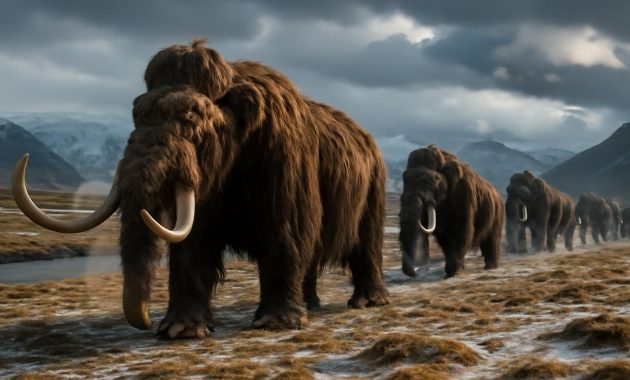
Then came the mammoths. On Ice Age landscapes that would one day become parts of Europe, they left broad, deep impressions in wet ground. Those footprints tell a similar tale: families of mammoths moving together at walking speeds, not thundering herds in full gallop. It makes sense when you really think about it: multi‑ton bodies, including infants and elders, crossing uneven ground, often on snow or mud. For them, a fall could mean more than a bruise—it could be fatal.
Consider this simplified comparison, based on the range of speeds estimated by the Spanish researchers and other recent studies:
| Animal / Scenario | Typical Movement | Estimated Speed Range | Modern Human Equivalent |
|---|---|---|---|
| Large sauropod dinosaur (walking) | Steady, energy-saving walk | 2–5 km/h | Casual stroll to easy hike |
| Large theropod dinosaur (walking/jogging) | Controlled, balanced gait | 3–8 km/h | Fast walk to slow jog |
| Mammoth herd (family group) | Group movement, elders + calves | 2–6 km/h | Family hike pace |
| Short bursts (predatory or escape) | Occasional higher-speed effort | Likely higher but brief | Short sprint, not marathon |
What vanishes in this table is the myth of perpetual sprinting. What appears in its place is an image that feels more like real life: animals conserving energy, pacing themselves, aware of their weight, the terrain, and each other.
The Quiet Drama of a Slower World
Strip away the cinematic roar, and something subtler emerges. Picture a Cretaceous riverbank at dusk. The air is thick with the smell of wet clay and crushed vegetation, dragonflies tracing lazy arcs over still water. In the near distance, a small herd of hadrosaurs—the duck‑billed plant‑eaters—moves along a game trail. They aren’t running. They weave around tree trunks, stop to browse, listen, and then move on, their bodies swaying with each careful step.
Farther upslope, a theropod watches. The old narrative would have it charge in a blur of teeth and speed, the chase compressed into seconds. But a predator this large is playing a long game. Every burst of speed comes at a cost, every misstep risks injury. So it waits, tests the wind, tracks not just prey but the ground itself. The moment, when it comes, will be chosen, not constant.
Now shift scenes: Ice Age Europe, a wind‑scraped plain under a pewter sky. Snow squeaks underfoot, and the light feels thin, metallic. A line of mammoths appears at the horizon: adults in front and rear, juveniles clustered between them. At a distance, their pace might look leisurely, even unhurried, but once you notice the ruts they carve into the slush, you see the truth. Each step is a negotiation with gravity and ground. They are not slow because they are lazy; they are slow because their lives depend on caution.
This is the drama of heaviness. To be huge is to be in constant conversation with the earth: Can you hold me here? If I push off with this much force, will you give way? That silent conversation is etched into every footprint the Spanish team has been measuring. Each trackway is a record of not just where an animal went, but how carefully it chose to get there.
Why We Wanted Them Fast
It’s tempting to ask: how did we get it so wrong for so long? Part of the answer lies with our own storytelling instincts. We like our monsters in motion. “Fast” is exciting, cinematic, easy to sell in a trailer. A slow giant doesn’t seem as thrilling—until you sit with it for a while.
For much of the 20th century, dinosaurs were portrayed as lumbering, tail-dragging creatures, cold-blooded and dim. Then came a scientific revolution in the 1960s and 70s: evidence for faster metabolisms, more active lifestyles, even feathers. Paleontology swung hard in the opposite direction. Suddenly, dinosaurs were athletes, hot-blooded, birdlike, sprinting and leaping and chasing.
That correction was necessary—but like many pendulum swings, it may have gone a bit too far in the public imagination. The Spanish research nudges the needle toward a more nuanced middle ground: dinosaurs as active, dynamic animals that nevertheless spent much of their time walking rather than running, conserving energy in an unpredictable world.
The same psychological bias colored how we envisioned mammoths. They inherited some of the drama reserved for dinosaurs—a kind of Ice Age echo of Jurassic energy. But when you look closely at the data, the Ice Age giants seem more like patient travelers than stampeding hordes.
Reading the Ground: The Science Behind the Slowness
At the heart of this reevaluation lies a deceptively simple question: when you see a trail of footprints, what exactly are you seeing? Not just direction or number, but rhythm. Paleontologists measure stride length—the distance between consecutive footprints of the same foot—and combine it with estimates of hip height derived from bones. Using refined equations, they can express speed as a function of that stride relative to limb length.
But the Spanish researchers went further. They folded in ideas from biomechanics that weren’t adequately reflected in older formulas. For very large animals, muscle and tendon strength, joint loading, and even the flexing of the spine can change how efficiently they move at different speeds. A pace that might be trivial for a deer could be dangerous for a 30‑ton sauropod.
They also accounted for the type of ground. A fast‑moving animal on soft mud is more likely to leave elongated, distorted prints—evidence of slipping or pushing off hard. Many of the tracks they studied showed deep but clean impressions, with minimal signs of sliding or explosive force. These weren’t marks of a sprint; they were signatures of careful, weight‑conscious walking.
For mammoths, similar logic applies. The depth and spacing of prints, combined with the distribution of smaller and larger tracks (calves and adults together), suggest relaxed, group‑paced movement. A herd cannot move faster than its smallest or frailest members without fracturing. The tracks do not show frantic scattering; they show cohesion.
Prehistoric Lives, Reframed
When you change how animals move, you change how they live—at least in our imagination. And imagination is not a trivial thing here; it shapes the questions scientists ask and the way the public engages with deep time.
Slow mammoths are not less majestic. They become more relatable. Their days lengthen: longer walks between feeding grounds, more time spent in the borderlands between safety and exposure. Slower dinosaurs are not less fearsome; they become strategists rather than sprinters, predators that pick their moments carefully and prey that gamble on early detection rather than outrunning danger.
This view also reshapes landscapes. If most movement is measured in careful steps instead of constant rush, then the prehistoric world begins to feel less like an endless stampede and more like what we see today on a savanna at mid‑afternoon: animals scattered across space, most of them simply walking, grazing, resting, listening. Moments of violence and speed still happen, but they are punctuation marks, not every sentence.
Why Slowness Is Its Own Kind of Wonder
One of the quiet gifts of this research is that it invites us to pay attention to slowness itself. In a culture that tends to prize velocity—fast news, fast travel, fast change—it’s easy to associate speed with importance. But the prehistoric tapestries we’re only now beginning to see clearly were woven mostly in slow time: sun crossing sky, migrations measured in months, footstep after footstep pressing into mud.
Standing at a tracksite in Spain, you might see three parallel lines of sauropod footprints curving gently across a rock face. At first, they look like a repeating pattern—left, right, left, right—nothing dramatic. But if you let your eyes adjust to the scale, each “step” might span a meter or more. What you’re actually looking at are minutes of movement solidified into stone. Not a chase, not a fight, just a quiet, purposeful crossing of a floodplain. It is the prehistoric equivalent of a long walk home.
In that sense, the Spanish researchers haven’t really reduced the grandeur of dinosaurs and mammoths. They’ve traded one kind of spectacle for another: less explosion, more endurance. Less sprint, more journey. The awe shifts from what these animals could do in a few seconds to what they sustained for years, even decades—growing, migrating, surviving.
What This Means for the Stories We Tell
Science is, at its core, an evolving story about how the world works. Each new study doesn’t erase what came before so much as redirect the narrative light, casting different parts of the scene into focus. When we slow our monsters down, we’re not draining them of magic. We’re exchanging mythic speed for something subtler: the weight of reality.
Maybe the next generation of documentaries and museum exhibits will reflect this shift. Fewer perpetual chases, more scenes of watchful stillness and deliberate travel. A mammoth calf stumbling slightly in melting snow but being buffered by the adults around it. A theropod turning its head slowly, deciding whether today is a day for risk or restraint.
On some level, we’re also telling a story about ourselves. In learning that the ancient world moved more slowly than the movies taught us, we’re reminded that much of life—then and now—unfolds at walking pace. Growth, migration, change in ecosystems, even evolution itself: all of it mostly happens one slow step at a time.
Frequently Asked Questions
Did dinosaurs and mammoths ever move fast at all?
Yes. The Spanish research doesn’t claim that these animals were incapable of higher speeds—only that most preserved trackways reflect moderate, energy‑efficient walking. Short bursts of speed likely occurred during hunts, escapes, or social conflicts, but those moments were relatively rare compared with the countless hours spent walking.
Does this mean dinosaurs were weak or clumsy?
No. Moving more slowly is not a sign of weakness; it’s an adaptation to size and environment. Very large animals today, like elephants, also tend to move carefully. For multi‑ton creatures, stability and energy conservation are crucial for survival, and that means favoring controlled gaits over frequent sprinting.
How do scientists estimate speed from footprints?
Researchers measure stride length (the distance between successive prints of the same foot) and estimate leg length from fossil bones or track dimensions. Using biomechanical equations, they calculate likely speeds that match those proportions. The Spanish team refined these formulas to better account for the unique mechanics of very large animals.
Are popular movies about dinosaurs now “wrong”?
Movies prioritize drama, so they often exaggerate speed and constant action. While they can be inspired by science, they’re not documentaries. The new findings suggest that everyday dinosaur life was less like nonstop chasing and more like the rhythms we see in modern ecosystems—lots of walking, punctuated by shorter, intense events.
What does this change about our understanding of prehistoric ecosystems?
Recognizing slower, more deliberate movement affects how we think about territory size, energy needs, predator–prey interactions, and social behavior. It suggests that many animals planned their movements around efficiency and safety, which in turn shapes how we imagine migration routes, herd dynamics, and the use of landscapes over time.