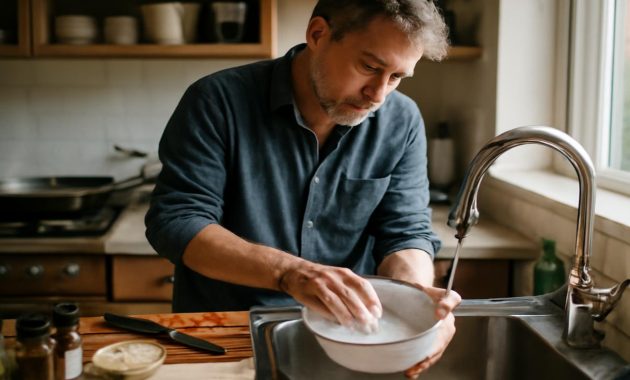
The pan hisses, the wooden spoon scrapes, and the smell of garlic rises in a warm, buttery cloud. In the middle of this tiny storm of sound and scent, one small decision quietly reveals more about you than you might guess: do you leave flour dusted across the counter and onion skins curling in the sink “for later”… or do you wash the cutting board while the soup simmers, wipe the spill before it dries, and stack dishes in a neat, soapy queue?
Psychologists would say that question isn’t really about cleanliness. It’s about how your mind works, how you meet the world, and how you navigate chaos and comfort. Because people who clean as they cook consistently share a cluster of distinctive traits—habits of thinking and feeling that show up far beyond the kitchen. In the rhythm of rinse, chop, stir, wipe, there’s a quiet map of personality tracing itself out in real time.
The Quiet Ritual of Cooking and Cleaning
Picture two kitchens at dinnertime.
In one, every surface is a collage of activity: half-peeled carrots, a knife glistening with tomato juice, spice jars uncapped, and a pan threatening to overboil. The cook moves in quick, inspired bursts, promising themself that “once this is in the oven, I’ll deal with it.” Cooking is an event, mess and all.
In the other, there is movement—but it feels like a practiced dance. The cutting board is rinsed the moment the vegetables hit the pan. The same knife is wiped and reused. Bowls that once held measured spices are already in warm, sudsy water. A kitchen towel sweeps past like a soft brushstroke, erasing little accidents before they become permanent marks.
Psychology doesn’t say one is morally better than the other. It simply observes that those who move naturally toward this second way—cleaning as they cook—tend to share eight recognizable traits. These traits don’t require perfection. They’re patterns, leaned into more often than not, and they say something quietly profound about how someone organizes their inner life.
1. A Subtle, Steady Sense of Self-Control
Impulse control isn’t always dramatic. Sometimes it looks like choosing to rinse a dish instead of dropping it in the sink “for later” while a timer counts down in the background.
People who clean as they cook often score higher on measures of self-regulation. They are practiced at delaying gratification in small, nearly invisible ways. Yes, it would feel more immediately rewarding to just focus on the sizzling pan or the unfolding recipe. But there’s a part of their mind that whispers: If I take 30 seconds now, I’ll thank myself in 30 minutes.
This habit tends to spill out into other parts of life. The same person is more likely to send the difficult email before they relax for the night, or to file receipts as they go instead of waiting until tax season becomes a quiet panic. They understand that future comfort is built from dozens of tiny, unglamorous moments of present discipline.
Psychologically, this is tied to what researchers call “executive function”—the mental skill set that lets you plan, focus, and juggle tasks. Cleaning as you cook is, in many ways, a live-fire exercise in micro-planning: stirring the sauce with one hand, rearranging the drying rack with the other, timing your movements so nothing burns and nothing piles up.
2. High Sensitivity to Environmental Mood
For some people, mess is just mess. For others, it’s almost a physical sensation, like background static in the nervous system. Those who instinctively tidy as they cook are often more sensitive to the emotional “tone” of a room—and to how physical clutter changes that tone.
Their brain registers small environmental cues: the sticky handle of a drawer, the faint smell of something forgotten in the trash, the way a stack of dirty dishes seems to lean into the room like a quiet accusation. Neuroscience suggests that people with this kind of sensory and emotional sensitivity can become overstimulated more quickly in chaotic settings. They’re not being “picky”; their nervous system is simply picking up more signals.
Cleaning as they cook becomes a form of real-time emotional regulation. Wiping a counter isn’t just about sanitation—it’s about softening the mental noise so their inner world can breathe. They know, perhaps from experience, that walking away from a delicious meal into a crowded sink and stained stovetop can puncture the pleasure they just created. So they manage the mood as they go.
3. A Future-Oriented, “Pre-Thankful” Mindset
There’s a peculiar kind of kindness in washing a pan you’re done with while the pasta finishes boiling. It’s a kindness toward your future self—the version of you who will be tired, full, and not remotely interested in scrubbing baked-on sauce.
Psychologists call this “prospection”: the ability to imagine and care about your future state. People who clean as they cook don’t just foresee the mess; they emotionally connect with it. They can feel, in some low-level way, that later ache of “I really don’t want to do this now.” So they take a small, preventative step.
This mindset shows up elsewhere in their life as well. They may pack tomorrow’s bag the night before, set out workout clothes where they’ll be hard to ignore, or schedule reminders for gentle but necessary tasks. They’re not living in constant anxiety about the future—but they have a habit of meeting it halfway, with small acts of preparation that reduce future friction.
In many ways, they live in partnership with their future selves, not in constant negotiation.
4. Comfort with Structure—Without Losing Creativity
There’s a stereotype that orderly people are rigid and uncreative. But watch someone who cooks well and cleans as they go, and the story looks different.
They chop freehand instead of measuring every cube. They taste the sauce and add a pinch of something unscripted. Yet, in the middle of this improvisation, they keep their tools in orbit: knife back to its place, peels in a bowl, towel folded on the oven handle, trash taken out in one fluid movement while waiting for water to boil.
This dance reflects what psychologists call “structured flexibility.” These people can hold a framework in mind (a tidy kitchen, a finished meal, a calm cleanup) while staying spontaneous within it. The structure doesn’t choke creativity; it gives it a reliable stage.
Outside the kitchen, you might see this in the way they work on projects. They’ll have a rough plan, some kind of outline or workflow, but inside that skeleton they may jump between ideas, try new angles, and shift approaches—always returning to a central order that keeps things from collapsing. It’s a sign of mental agility anchored by an internal sense of organization.
5. A Tendency Toward Quiet Responsibility
There’s something quietly generous about not leaving a tornado of dishes for the end—not just for yourself, but for anyone who shares your home or your kitchen. Cleaning while cooking often reflects a deep, almost automatic sense of responsibility: If I am creating this activity, I am also creating its consequences.
This doesn’t mean the person never gets overwhelmed or never leaves a dish undone. But their default is to clean as part of the act, not as an afterthought. In psychological terms, this overlaps with what’s called an “internal locus of control”—the belief that your actions significantly shape outcomes.
Instead of thinking, “Someone will deal with this later,” their mind more naturally thinks, “I’m already here; I might as well leave this better than I found it.” In shared living spaces, they’re often the ones who wipe down the stovetop no one admitted to splattering, who rinse the pan that technically “wasn’t their mess.” They may not announce it, but their behavior keeps the shared environment from silently deteriorating.
This trait can be a strength—and a vulnerability. These same people might overextend themselves, picking up emotional or practical slack in relationships and workplaces. They become the unofficial tidy-uppers of both physical and psychological spaces, sometimes without being asked, sometimes without being thanked.
6. Micro-Mindfulness in Motion
Mindfulness is often framed as sitting still, eyes closed, watching your breath. But there’s another kind that happens right in the middle of motion—awake, aware, and deftly engaged.
People who clean as they cook often practice a quiet form of this. They notice what’s in their hands, what’s on the stove, what’s under their feet. Their eyes skim across the counter and pick up on a knife too close to the edge, a puddle that could become a slip, or a spoon that will harden with sauce if left untouched. They respond, almost without drama, by nudging the knife back, dabbing the surface dry, rinsing the spoon.
This isn’t perfect Zen. They may still over-season once in a while or burn the bread. But behind their actions is a mild, persistent presence: an awareness that connects sensations, tasks, and choices in a fluid stream.
In psychological research, this can intersect with “situational awareness” and certain forms of attentional control. They can split their focus just enough to track several small demands at once, without completely losing touch with their body or their environment. Cleaning as they cook becomes a kind of moving meditation: soap, water, scent, texture, heat, all moving through their senses in a slow, conscious rhythm.
7. The Deep Desire for a Gentle Landing
Underneath all these traits—self-control, future-thinking, sensitivity, structure—there is a softer, more emotional thread: the wish for endings to feel as kind as beginnings.
For people who clean as they cook, the meal isn’t the only destination. The moment after the meal matters too—the walk from table to sink, the look back at the kitchen, the way the evening opens out after the plates are cleared. They are, in a sense, designing that future feeling in advance: the feeling of being able to sit down, full and satisfied, without a looming mountain of mess humming at the edge of their awareness.
Psychologically, this is a form of what some therapists call “self-soothing by design.” Instead of waiting to be overwhelmed and then trying to calm themselves, these individuals gently reshape the conditions of their life so that overwhelm is less likely to arrive. The clean-as-you-go habit is one of many small, protective rituals that make emotional recovery quicker and easier.
Of course, not everyone who leaves the kitchen messy is careless or chaotic. Some people genuinely thrive in the creative sprawl, and their minds work differently. But for those who tidy as they stir and wash as they simmer, the act is often less about perfectionism and more about building a soft place to land—over and over, meal after meal, day after day.
How These Traits Often Show Up Beyond the Kitchen
When psychologists talk about everyday behavior revealing deeper patterns, this is the kind of thing they mean. To make it clearer, here’s a simple view of how this “clean as you cook” habit often echoes outward into other areas of life:
| Kitchen Behavior | Psychological Trait | Likely Pattern in Daily Life |
|---|---|---|
| Rinsing dishes while food simmers | Self-control & planning | Starting tasks early, avoiding last-minute rushes |
| Keeping counters clear mid-recipe | Sensitivity to environment | Preferring tidy desks, calmer workspaces |
| Putting tools away as soon as you’re done | Structured flexibility | Balancing creativity with routines and systems |
| Wiping spills immediately | Responsibility & care | Taking ownership in relationships and group tasks |
| Finishing with minimal mess left | Future-oriented kindness | Designing life to reduce future stress, not just reacting to it |
When You Don’t Clean as You Cook—And What That Means (or Doesn’t)
If your kitchen looks like a minor disaster zone every time you make scrambled eggs, it doesn’t mean you’re doomed to chaos in every corner of life. Personality is more like a weather system than a fixed label—many factors, many patterns, lots of change.
Some people leave messes because they prioritize immersion. They want to be fully inside the act of cooking and will happily deal with consequences later. Others grew up seeing cleanup as a separate chore, not part of the creative process. Some are managing fatigue, mental health struggles, caregiving, or work demands that make any kind of real-time tidying feel impossible. Psychology lives in context, not in judgment.
But if you’re curious—if a small part of you wonders how it might feel to adopt even a fraction of the “clean as you go” mindset—you can treat it not as a moral upgrade, but as an experiment in self-understanding. What shifts in you when you rinse one extra dish before you sit down? What happens to your mood the first time you finish a meal and realize you don’t dread walking back into the kitchen?
These aren’t just questions about soap and sponges. They are questions about how you want your days to feel at their edges—the beginnings and endings, the before and after.
Turning the Kitchen Into a Small Psychological Laboratory
You don’t have to become someone else overnight. But the next time you cook, you might listen more closely—to the hiss of the pan, yes, but also to the quieter voice beneath it. The one that decides, over and over, between “I’ll deal with it later” and “I’ll give myself a gentler later by doing this now.”
Psychology suggests that, in those small decisions, a handful of deep traits are at play: self-control, environmental sensitivity, future orientation, structured creativity, quiet responsibility, and the desire for a soft landing at the end of the day. People who clean as they cook aren’t just neat. They’re telling a story—with sponge and towel and the rhythmic clink of dishes—about the kind of inner life they’re building.
And if your story, so far, has been one of glorious, sauce-splattered aftermaths and heroic, end-of-night scrubbing sessions, that’s fine. But you might find that with one rinsed pan, one wiped counter, you begin to write a slightly different chapter: one where the meal doesn’t just taste good, but the evening feels lighter, too.
FAQ
Does cleaning as you cook mean you’re a perfectionist?
Not necessarily. Many people who tidy while cooking care less about perfection and more about comfort. Their goal is a manageable, pleasant space, not a spotless, magazine-ready kitchen.
Can you train yourself to clean as you cook if it doesn’t come naturally?
Yes. Start small—like rinsing one pan while something simmers or wiping the counter once during each meal prep. Over time, these actions can become automatic habits supported by your brain’s reward system when you notice how much easier cleanup feels.
Is it bad if I prefer to leave everything until the end?
It isn’t inherently bad. Some people genuinely focus better when they contain cleanup to one dedicated block of time. Problems arise only if the aftermath regularly overwhelms you, causes conflict with others, or adds to your stress.
What if I live with someone whose style is the opposite of mine?
That’s common. The key is open conversation about expectations and stress points. You might agree on small compromises—for example, one person cooks more while the other does more of the final cleanup, or you both commit to a few shared tidying habits during cooking.
Can this habit really affect mental health?
On its own, cleaning as you cook won’t cure deep mental health issues. But small acts of order in daily life can reduce background stress, support a sense of control, and create micro-moments of calm—especially valuable when your emotional world feels crowded.