The sirens had finally fallen silent, but the echo of them still seemed to hang in the air—a thin, electric hum that clung to the city’s streets and to the people moving carefully through them. Candles flickered in paper cups. Flowers lay in soft, uneven mounds at the base of public steps and railings, stems bending under the weight of grief and gratitude. This was a country holding its breath, trying to make sense of a national tragedy that had left everyone a little quieter, a little more aware of how fragile ordinary days can be.
A Night When Everything Changed
It had started like any other day—a weekday folding into evening, buses groaning to stops, shop shutters sliding down, people heading home with plastic bags and tired faces. Then, in the space of a few terrible minutes, normality tore open. News alerts raced faster than anyone could think: images, shaky phone footage, voices cracking on live broadcasts.
On that night—like too many others woven into the country’s recent memory—emergency responders ran toward the unthinkable. Firefighters pushed through smoke and broken glass. Paramedics knelt on cold concrete, hands moving with practiced precision as chaos raged around them. Police officers shouted directions, formed barriers with their own bodies, tried to bring order where there was only confusion and fear.
There were no rehearsed speeches, no grand gestures. Just high-visibility jackets flashing in dim light, radios crackling, the sharp chemical tang of disinfectant mixing with exhaust fumes and the metallic scent of blood. People tended to strangers because that is what they do. It was, in many ways, a familiar British story—the kind that repeats far too often, yet still manages to astonish: ordinary people stepping into extraordinary roles without expecting applause.
By the time the worst of it had passed and dawn crept in—a pale, tired light—the country had changed again. Not forever, perhaps, but meaningfully. Streets were taped off. Reporters whispered their pieces to camera. Families who had slept poorly scrolled through the news with a dread that felt heavy in the chest. And in hospitals, fire stations, and police canteens, those who had been on the front line simply washed their hands, changed their uniforms, and prepared to go back out again.
“Your Courage Defines This Country”
When Prince William stepped up to speak in the days that followed, there was a noticeable hush—the particular kind reserved in Britain for those uncanny moments when public grief meets the Royal Family’s steady, ceremonial calm. He did not arrive as a distant figure detached from frontline reality. His years as an air ambulance pilot had left him with a visual memory of trauma that doesn’t wash out easily. He knows, in a way few public figures do, what it is to hover above scenes of devastation and have only minutes to make decisions that mean life or death.
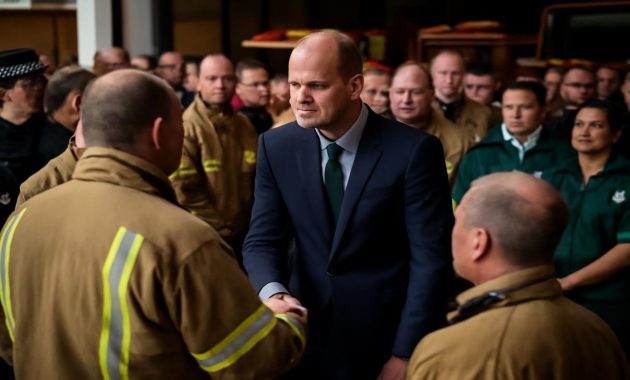
Looking out across a room filled with uniforms—neon yellow jackets, navy blues, epaulettes and badges—he chose words that were simple, but carried a certain weight: “Your courage,” he said quietly, “defines this country.”
There was a kind of stillness as those words landed. Not dramatic, not cinematic, but deeply human. Some responders stood with hands folded in front of them, others with arms behind their backs; most wore expressions that slid between pride and discomfort. Many of them did not think of themselves as heroes. They were simply people who had been trained to act, and had done so because that is what the job, and their conscience, demanded.
Yet William pressed the point. He spoke of how, in moments when everything feels broken—when a country’s sense of safety fractures and the headlines fill with horror—it is their instinct to run forward that holds the line. Not just physically, keeping people alive or leading them away from danger, but symbolically. They remind everyone watching that fear can be met with something stronger and quieter: duty, courage, and the stubborn refusal to give up on one another.
In that room, his tribute didn’t sound like a royal formality to tick off. It sounded like one first responder speaking, from a different vantage point, to others who know the same late-night adrenaline, the same long shifts, the same sleepless decompression at home where they say, “I’m fine,” even when they’re not.
The Human Cost Behind the Uniforms
It is easy, from a distance, to talk about emergency responders as a single, solid block: “the police,” “the paramedics,” “the fire service.” In the days after the tragedy, the public language was full of such terms—broad, sincere, but impersonal. William’s speech tried to cut deeper into that anonymity by acknowledging something that often goes unsaid: heroes still go home with shaking hands.
Behind each uniform is a private life that has to absorb public trauma. The paramedic who cradled a stranger’s head as sirens wailed might later sit at a kitchen table, staring at a mug of tea gone cold, unable to shake the memory of the eyes looking up at them. The police officer who stood between crowds and danger may spend the next week hearing phantom echoes of shouted orders in the quiet of their own bedroom. The firefighter who pushed through smoke could find the smell following them, clinging to their hair and clothes long after the fire was out.
William, in his remarks, acknowledged this unseen weight. He spoke not just of bravery in the moment but of resilience in the aftermath. Of the families who wait for their loved ones to come home from a shift—with a nervous eye on the clock when the news is bad. Of the partners who gently ask, “Do you want to talk about it?” and know, from experience, that sometimes the answer will always be “No.”
His tribute stretched outward, beyond the sharp focus of a single horrific night, into the long, flat days that follow. He urged the country to remember that courage is not just an action; it is the willingness to return to the job the next day, to answer the next call, to put the uniform back on even when memories still feel raw.
In that framing, the emergency services stopped being abstract protectors and became something far more fragile and meaningful: people whose courage is remarkable precisely because they feel fear, exhaustion, and doubt—and show up anyway.
Moments the Cameras Missed
Most of the public saw only the wide shots and headlines: aerial views of cordoned-off streets, sombre commentators, a running banner of updates at the bottom of the screen. The raw centre of those hours—the tiny human gestures that hold communities together—rarely make it past the cutting room floor.
There were the officers who quietly helped an elderly man call his family, their gloved fingers carefully navigating his phone’s cracked screen. The paramedic who took one extra second to cover a crying survivor with a silver foil blanket, tucking it in at the shoulders like a parent might. The firefighter who paused to comfort a child whose world had tilted violently out of place, offering a soft-voiced promise that “you’re safe now,” even as alarms still howled nearby.
Prince William’s tribute, though it could never name these specific moments, seemed to gesture toward them. He spoke of “small acts of kindness amid horror,” of “hands that steadied others when the world was shaking.” Phrases like that threaded his speech with a kind of quiet reverence—not just for the dramatic rescues that capture headlines, but for the lesser-seen work of holding someone’s gaze and saying, with or without words, “You are not alone.”
The nation’s response mirrored that sensitivity. Along the fences and railings near the site of the tragedy, handwritten notes began to appear. Some were addressed to the victims; others, unexpectedly, were addressed to the responders themselves.
| Voice | Message to Responders |
|---|---|
| Child’s note on a paper heart | “Thank you for being brave when I was scared.” |
| Local shopkeeper | “You ran past my window into danger. I will never forget that sight as long as I live.” |
| Survivor’s family | “Because you didn’t give up, our daughter came home.” |
| Stranger from another city | “I don’t know your names, but this country is safer and kinder because of you.” |
In those scribbled lines, the formal words of a prince met the informal gratitude of everyday people. Together, they formed a chorus that pushed back against the darkness of what had happened. They said, in different ways, something similar: courage is not just about what you did. It’s about what you gave back to us when everything felt lost—hope, order, a reason to believe in one another again.
When a Nation Watches Itself
Moments of national tragedy reveal more than just the capacity for harm; they also reveal, sometimes unexpectedly, what a country chooses to value. In the hours after the incident, social media feeds filled with a familiar mix: fear, anger, confusion. But amid the noise, images of responders kept rising to the top—faces streaked with soot, backs bent under the weight of equipment, eyes focused and alert.
When William said, “Your courage defines this country,” he was speaking into that swirl of public emotion. He was drawing a circle around the people in high-visibility jackets and saying, effectively, “This—this is what we stand for.” In a time when national identity is often debated in political slogans, here was a quieter proposition: perhaps what truly shapes a country is not its arguments, but its instincts in a crisis.
The tribute dovetailed with something many people already felt but hadn’t articulated. Watching responders in action, they recognised a version of themselves they wanted to believe in—practical, calm, compassionate under pressure. The kind of people who would, metaphorically or literally, hold the door open for someone else, even when smoke was pouring through it.
That recognition, however fleeting, mattered. It shaped the memorials that sprang up in parks and city squares. It changed the tone of conversations on buses and in offices. It turned the phrase “emergency services” from a line in a budget document into something more like family—a term woven with stories and sacrifices.
William’s words, backed by the quiet authority of someone who has climbed into a helicopter not knowing what he would find at the end of the flight, gave permission for that public feeling to solidify. It was as if he were saying: “You are right to be proud of them. You are right to see them as the best of us.”
Courage Beyond the Spotlight
Tributes are, by nature, moments. They flare, they move people, they are shared widely—and then the news cycle spins on, hungry for the next story. But courage, the kind William was honoring, does not exist only in those bright, televised instants.
After the cameras left, the responders went back to work. The same people who had been on the front pages began answering routine calls again: minor car accidents, smoke alarms turned out to be burnt toast, an elderly person who had slipped in the bathroom. The adrenaline faded; the grind resumed. And yet, inside that everyday rhythm, the same readiness remained—the readiness to confront whatever might be waiting when a call turns out not to be routine at all.
William’s tribute pointed, quietly, to this ongoing, often invisible labor. He spoke of “the countless days when nothing makes the news, but you still stand ready.” He acknowledged that courage is not only summoned for historic, nationally watched events. It is exercised each time a responder knocks on a stranger’s door, not knowing exactly what they will find on the other side.
The country, stirred by the tragedy and the tribute alike, found small ways to respond. Coffee shops near hospitals and stations offered free drinks to anyone in uniform. Children in school drew thank-you cards covered in hand-drawn sirens and big, blocky letters spelling out “THANK YOU.” Neighbours who had never thought to ask what their paramedic or firefighter neighbour actually did started leaving notes or saying, “We’re grateful for you,” on the pavement outside.
Prince William did not create that gratitude. But by articulating it at a national level—by looking a roomful of tired, battle-hardened professionals in the eye and saying their courage defines an entire country—he amplified it, legitimised it, turned it into something people felt they could act on.
The Quiet Legacy of a Public Tribute
In the weeks after his speech, life began, as it always stubbornly does, to fold back into its familiar creases. The flowers around the memorials wilted. The candles burned down to soft puddles of wax. News tickers moved on, announcing storms, elections, scandals, sports results. Only those whose lives had been directly altered by the tragedy continued to live in its shadow every waking day.
And yet, some things had shifted. The image of Prince William standing before rows of emergency responders lingered, not as a grand political moment but as a human one—a reminder of a particular alignment of grief, gratitude, and recognition. For the responders themselves, the speech became part of the story they carried: one more thread in the complex tapestry of difficult nights and the rare, validating moments when someone publicly says, “We see you.”
For the rest of the country, the phrase “Your courage defines this country” settled into the lexicon, quoted in articles, recalled during later crises, repeated at local award ceremonies. It was, on the surface, a simple compliment. But beneath that lay a quiet challenge: if their courage defines us, how do we live in a way that honors that definition?
Perhaps that is the true work of such a tribute. Not only to praise, but to provoke reflection. To make a nation ask itself whether it is worthy of the people who run toward danger in its name. To encourage it to offer better support—mental health care, fair pay, adequate resources—to those whose bravery is too often taken for granted.
In the end, the story of that night, and of William’s words, is not only a story of tragedy. It is also a story of hands reaching out in the dark: responders taking hold of the wounded and frightened, a prince taking hold of a microphone on behalf of a grateful public, strangers signing condolence books with trembling pens. It is the story of a country that, at its most broken, found its reflection in the courage of those who refused to look away.
And somewhere in a control room, or at the edge of a cordoned street, another responder waits. The phone will ring, the radio will crackle, and they will answer. Not for applause, not for royal tributes, but because, deep down, they believe in the simple, stubborn idea that we owe something to one another. In that belief, as Prince William reminded us with quiet certainty, lies a definition of this country that tragedy cannot erase.
Frequently Asked Questions
Why did Prince William’s tribute resonate so strongly?
His words resonated because they came from someone who understands emergency work firsthand and because they gave language to what many people already felt: that the quiet bravery of responders represents the best of the nation in its darkest hours.
How has Prince William’s experience as an air ambulance pilot influenced his views?
Serving as an air ambulance pilot exposed him to traumatic scenes, split-second medical decisions, and the emotional strain of frontline work. This experience deepened his respect for responders and shaped the empathy and authenticity behind his public tributes.
What did he mean by “Your courage defines this country”?
He was suggesting that the character of the nation is seen most clearly in how people act under pressure. The willingness of responders to run toward danger, protect others, and keep going despite fear reflects values many believe lie at the core of the country’s identity.
How do emergency responders typically cope after a national tragedy?
They rely on training, peer support, formal counselling where available, and the routines of everyday life. Many quietly carry emotional burdens, which is why recognition, mental health resources, and public understanding are so important.
What can ordinary people do to support emergency responders?
Small acts matter: expressing thanks, supporting policies that fund and protect emergency services, checking in on responders in your community, and advocating for better mental health care and working conditions. Respect for their work, day in and day out, is itself a powerful form of support.