The first raindrops arrived like a rumor. A soft patter on tin roofs. A darkening of dust. Women stepped out of doorways, palms upturned, laughing at the sky as if greeting an old friend who’d disappeared without a word. Children raced barefoot across the yard, stamping muddy crescents into the earth. Someone shouted from a distant field, “It’s back! The rain is back!”
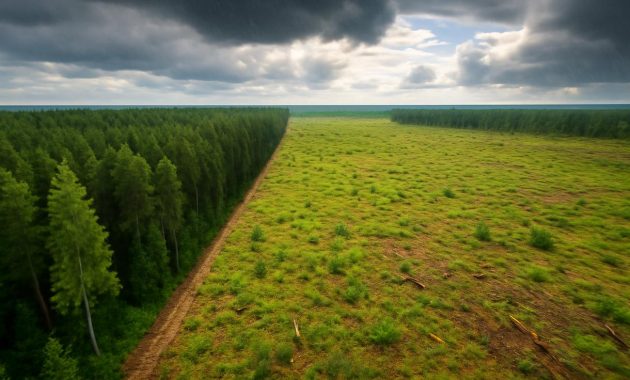
For years, rain had been a memory told in the future tense here—something that used to happen, and something that might return if enough prayers or policies aligned. The land, once quilted with deep green forest, had been shaved down to stubble: ranches, roads, charred clearings, and scraped hillsides. Rivers that had once brimmed with brown, churning water shrank into thin, hesitant streams. The clouds, once dependable visitors, began to pass over without stopping, like trains that no longer honored their old station.
Then, somewhere between desperation and determination, the chainsaws finally went quiet.
The Day the Forest Was Given Time
It did not happen overnight. Deforestation never does, and mercy rarely arrives in a single stroke. At first there were small bans, local moratoria, hesitant lines on maps. A hillside here protected. A valley there spared. Forest guards—real people with real fears—walked through the remnants of trees that still stood like sentinels, paint cans in hand, marking trunks for survival instead of removal.
The community meetings were tense. Loggers worried about their jobs. Farmers worried about their yields. Politicians worried about being remembered as either heroes or fools. But what everyone worried about most, though few would say it out loud, was the sky.
Rainfall, once patterned as faithfully as a heartbeat, had turned erratic. When it did arrive, it came in violent bursts that tore the topsoil from fields and scoured gullies deeper into the land. Years would swing like a pendulum between drought and flood, but what had quietly disappeared was the gentle, predictable rain in between—the kind that allows roots to deepen, seeds to risk sprouting, and people to plan more than a season ahead.
Scientists tried to explain it with terms that felt oddly distant from the crackled earth: “evapotranspiration,” “moisture recycling,” “regional convection patterns.” But the elders had their own language for it. “The trees talk to the clouds,” they would say. “We silenced them.”
When the last major logging concession expired and wasn’t renewed, there was no single celebration, no fireworks to light up the clearing. Instead, there was a different kind of quiet—the sort of quiet that lets seeds germinate, and gives roots the courage to push deeper. The forest, for the first time in decades, was given what it needed most: time.
How Trees Teach the Sky to Remember
You could watch the change, if you were patient enough and willing to measure time in leaves instead of headlines. In the first wet season after deforestation slowed, the difference was subtle. Saplings took hold in abandoned fields. Birdsong, once confined to the shrinking islands of forest, began to spill outward at dawn. The air, especially in the late afternoons, felt slightly heavier, as if quietly holding its breath.
What was happening above and below was nothing short of choreography. The young trees fanned out their leaves like solar panels, drinking in light and exhaling invisible rivers of vapor back into the air. Their roots stitched into the soil, binding it together, holding on to moisture like a secret. Insects returned, then frogs, then the night calls of mammals that had gone silent for years. Each living thing was both a symptom and a driver of change.
Forests do not just stand there; they move water. A single large tree can release hundreds of liters of water into the atmosphere each day through evapotranspiration. Scale that up to a hillside, a valley, a region, and you are looking at a living, breathing pump that lifts moisture from the ground and sends it skyward to seed clouds.
Once, satellite images had shown this region as a patchwork of gray and brown, with green clinging to the ridges like a last attempt at grace. Now, those same satellite eyes watched as the green slowly fused, fragment by fragment. Long corridors of regrowth began to reconnect the old forest cores, like veins finding their way back to a heart. As the canopy thickened, something almost miraculous—but entirely physical—unfolded: the atmosphere above it started changing.
Meteorologists, who had been carefully tracking humidity and temperature profiles through slender weather balloons, noticed the shift first. The air above the recovering forest was becoming cooler and more humid in the afternoons. Convection—the upward movement of warm, moist air that eventually builds clouds—was gradually intensifying over the green patches, and weakening over the barren lands.
The trees were teaching the sky to remember its old habits.
Listening to the New Rhythm of Rain
At ground level, the first to notice were not the scientists, but the people who lived by rivers and planted by hand. Farmers, who had quietly maintained meticulous notebooks of planting dates and rainfall totals, began to whisper about a subtle regularity returning. The storms still came, but they were less likely to arrive as destructive tempests scouring the land. Instead, more days brought moderate, soaking rains—the kind that fall with patience, sinking into the soil instead of racing across it.
The village teacher, a woman named Lila, used to time her lessons to the sudden roar of downpours on the school’s tin roof. “We’ll pause here,” she would say when the rain became too loud for learning, resigning herself to yet another surprise disruption. Some weeks had no rain at all. Others had days swallowed by water and thunder. It was impossible to plan science experiments that depended on the weather; the weather had stopped respecting the calendar.
Three years after the last big clearing, Lila noticed something uncanny. The rains were not just more frequent—they were becoming predictable again. Not perfect; nature rarely is. But close enough that she could start telling her students in early May, “By the time exams arrive, the second big rains will be here.” And she was almost always right.
Fishermen reported that river levels were now rising and falling with a softness that felt familiar, more like they had when they were young. Reservoir managers, once forced to open floodgates in panic or stare at bare concrete in despair, began to see smoother curves in their seasonal charts. The yo-yoing extremes were easing into a more reliable pulse.
The hydrologists’ data confirmed what everyone on the ground was feeling in their bones. Annual rainfall totals had not doubled, or tripled, or done anything flashy enough to make international headlines. But the distribution through the year—the timing, intensity, and pauses between storms—had stabilized dramatically. The old monsoon windows, once stretched or broken, were tentatively snapping back into place.
What the Numbers Whispered About the Forest
For those who prefer numbers to stories, the transformation looked something like this. One regional study team, working from a small, solar-powered field station, compiled a decade of rainfall and forest cover data. Over cups of black coffee that tasted faintly of woodsmoke, they began to see patterns emerge.
The following table, adapted from their notes, captures a simplified version of what they observed across a representative watershed as deforestation halted and regrowth took hold:
| Year | Forest Cover (%) | Annual Rainfall (mm) | Days of Extreme Drought | Days of Flash Flood Alerts |
|---|---|---|---|---|
| Year 0 (Peak Clearing) | 38% | 960 | 41 | 27 |
| Year 3 | 46% | 1,010 | 29 | 22 |
| Year 6 | 54% | 1,050 | 21 | 15 |
| Year 9 | 60% | 1,080 | 15 | 11 |
The total amount of rain increased, yes—but moderately. The real story was in the shrinking tails of the curve: fewer days when the land was bone-dry and cracked, fewer days when the sky seemed intent on drowning everything in sight. As forest cover rose, the variability eased. The region wasn’t just getting “more rain”; it was getting rain in the right doses, at the right times.
The scientists, careful not to overclaim, wrote in their report about “strong evidence that halting deforestation and initiating regrowth contributed substantially to the stabilization of regional rainfall cycles.” The farmers summarized it another way: “When the trees came back, the sky calmed down.”
From Bare Soil to Breathing Landscape
To stand on a ridge ten years after the last great wave of clearing is to stand inside a different kind of silence. The ground beneath your boots is no longer loose dust and scattered stumps. It is springy with layers of fallen leaves and the fine, intricate mesh of root networks. Termites and beetles have resumed their tireless work of disassembly and renewal, turning dead matter into fertile soil. Mushrooms, small and defiant, press up from the forest floor after each rainfall, brief flags in the continuous campaign of life.
You can feel the air here. It is cooler by a few degrees than the air over the treeless fields down in the valley, and it holds a faint, persistent wetness, like the memory of last night’s rain clinging to a shirt. On some afternoons, you can actually watch the process that was once only a diagram in a textbook: mist rising from the canopy, merging quietly into low-hanging clouds that thicken, darken, and eventually let go.
Beyond the sensory beauty, there is a more practical change unfolding. Springs that had dried to a trickle now run year-round. Wells hold their levels deeper into the dry season. Downstream, sediment loads in rivers have fallen, because raindrops—now buffered by branches and leaves before reaching the soil—arrive with less violence. Instead of hammering bare ground into degraded crusts, the rain filters slowly through litter and roots, feeding groundwater and smoothing the spikes of floods.
The entire landscape has become less brittle. In a brittle system, small disturbances can trigger collapses: one missed rainy season, one intense storm, one landslide that carries away a hillside. In a more elastic system—one with layered vegetation, richer soil, more stable rainfall—the same disturbances register as bruises, not broken bones.
People, too, begin to live less brittly. With more predictable rains, farmers diversify their crops. Insurance agents recalculate their risk models. Local governments can design roads and bridges to withstand a future that looks like a nuanced version of the past, rather than a roulette wheel of extremes. Children grow up knowing that planting calendars are not folklore—they are functional tools again.
The Human Choice Inside the Climate Story
If this sounds like a small miracle, it is worth remembering how fragile and deliberate it was. For every hill that was allowed to regrow, there was a budget line that had to be defended, a community that had to be convinced, a ranger who had to say “no” at a lonely checkpoint to a truck full of freshly cut logs. Halting deforestation is as much a social act as it is an ecological one, and the stabilizing of rain is as political as it is physical.
In public debates, climate and weather are often described as abstract forces bearing down on us from some distant global system. But at the scale of a region, the climate is not something that merely happens to us; it’s something we help shape, leaf by leaf, field by field, policy by policy. The forest does not decide on its own to stand or fall. That choice lives inside zoning maps, incentives, enforcement, and the daily decisions of people whose livelihoods brush up against the tree line.
In the early years, some argued that halting deforestation would mean sacrificing development. They pointed to graphs of projected timber revenues, to quick profit from cattle or cash crops. What these numbers rarely captured were the hidden subsidies that stable rainfall provides: reduced irrigation costs, lower disaster losses, healthier aquifers, cooler cities, and fewer crop failures. The forest was not an obstacle to prosperity; it was a quiet infrastructure of water and shade and reliability, amortized over generations.
The children who chased the returning rains across the yard that first day are old enough now to ask harder questions. They sit beneath trees that did not exist when they were born and learn, in school and from the land itself, that their region’s climate did not simply “fix itself.” It responded, in complex but understandable ways, to a human decision to stop cutting and start healing.
They grow up with a double awareness: the sky is both beyond them and intimately tied to them. They know that if the chainsaws were to roar again at the scale they once did, the newly steady rhythm of their seasons could easily stumble back into chaos.
Rain as a Form of Memory
Walk through the forest now on a day when the clouds are gathering, and you can hear a kind of layered conversation. Cicadas hum in waves. The distant rumble of thunder rolls in, low and patient. Leaves flicker and twist as the wind picks up. Somewhere, a stream rushes a little louder, fed by the last storm working its way through soil and stone.
It is tempting, in such a place, to imagine that the rain remembers. Not in a mystical sense, but in the very real way that systems carry traces of their past. The pattern of today’s storm is shaped by yesterday’s tree, last year’s cleared field, last decade’s policy. When deforestation halted here, the region did not simply gain more trees; it rewrote its conversation with the sky.
This story has been unfolding, in various forms, across multiple corners of the world. In West African watersheds where savannas are being restored. In parts of the Amazon where strict protections have allowed forest edges to creep back into former pasture. In hillside communities in Southeast Asia that have traded slash-and-burn cycles for terraced agroforestry. The details differ, but the principle echoes: once deforestation halts and the land is allowed to recover, regional rainfall cycles begin to calm, to center, to remember the old songs of wet and dry.
We often talk about climate in terms of temperature curves and carbon budgets, but to the people living inside these recovering landscapes, the most immediate sign of hope is far more intimate. It is the sound of rain arriving when it is supposed to. It is the smell of damp soil rising at the right moment in the planting season. It is the end of that anxious scanning of the horizon for clouds that never come, or for storms that arrive like punishment.
In the end, stabilizing rainfall is not just about molecules of water moved from ocean to land and back again. It is about the restoration of trust—between people and their seasons, between forests and the sky, between the stories we tell about what is possible and the evidence of our own senses.
The day the forest was given time, the rain did not rush back. It tiptoed. It tested. It adjusted. And then, slowly, it settled in again, as if relieved to find a landscape capable, once more, of holding its rhythm.
Frequently Asked Questions
How does halting deforestation actually stabilize rainfall?
When deforestation stops, existing trees remain and new ones can grow, restoring the forest’s ability to move water. Trees draw water from the soil and release it into the air through evapotranspiration. This moisture helps form clouds and supports local and regional rainfall. As forest cover recovers, the air above becomes cooler and more humid, promoting more regular cloud formation and gentler, more frequent rains instead of extreme floods and droughts.
Does stopping deforestation increase the total amount of rain?
In many regions, total rainfall increases modestly, but the biggest impact is on when and how it rains. Halting deforestation tends to reduce extremes—fewer very dry days and fewer intense downpours—and restores more stable seasonal patterns. This reliability is crucial for agriculture, water supply, and ecosystems.
How long does it take for rainfall cycles to stabilize after deforestation stops?
It varies by region, climate, and how degraded the landscape is. Some shifts in humidity and local showers can be detected within a few years of regrowth. More pronounced stabilization of seasonal rainfall patterns can take five to ten years or more, especially if large areas need to reforest and reconnect. The more continuous and extensive the forest cover becomes, the stronger the stabilizing effect.
Is regrowth as effective as old-growth forest for influencing rain?
Mature, old-growth forests are usually more powerful “water engines” because they have taller canopies, deeper roots, richer soils, and more complex ecosystems. Young regrowing forests still help, but their impact is smaller at first. Over time, as regrowth matures and patches connect, its influence on humidity, cloud formation, and rainfall patterns becomes increasingly significant.
Can stabilizing regional rainfall through forest protection help with climate change?
Yes, in several ways. Healthy forests store large amounts of carbon, helping to slow global warming. At the same time, they moderate local and regional climates, making communities more resilient to climate extremes like droughts, heatwaves, and floods. While forest protection alone cannot solve climate change, it is one of the most effective actions for both mitigation and adaptation at regional scales.