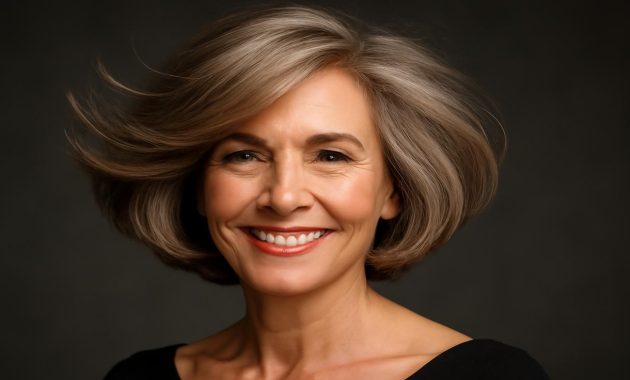
The first thing she noticed was the way the wind suddenly mattered again. On a mild afternoon, standing outside the salon with a paper coffee cup warming her fingers, Linda reached up and touched her hair out of habit, bracing for the familiar collapse. But it didn’t fall flat. It floated. It moved. It had shape, like it remembered something it had been trying to tell her for years. A stranger actually glanced twice as he walked past. For the first time since her late forties, she didn’t duck her head or automatically smooth the crown to hide the limpness. Instead, she let the breeze have it. Fifty-eight and, against all odds, her hair had volume.
Why Flat Hair After 50 Isn’t Your Fault
“It’s not you,” her hairdresser had said firmly, tugging on a fine, silvered strand at the sink. “It’s biology.” That sentence has been repeated a thousand times in salons across the world because, eventually, almost every woman with fine hair watches it change. Texture softens. Individual strands get thinner. The once-reliable round brush and mousse combo… just stop delivering.
Hormonal shifts play a starring role. Estrogen levels dip, and with them goes some of the thickness and shine that were easy to take for granted in your thirties. The scalp can become more visible; the part line widens. Hair that once held a wave all day now caves in before lunch. Add in years of coloring, heat styling, sun exposure, and a life fully lived, and you’ve got a recipe for flatness that no “extra hold” hairspray can really fix.
But something else happens around fifty that’s just as important: your face changes, too. Cheekbones stand out more as volume shifts downward. The jawline softens. The proportions you unconsciously tailored your hair to in earlier decades have shifted, and a cut that used to feel like “you” can start to feel a little like a costume you’ve forgotten how to wear.
So when women say, “My hair is just sad now,” stylists will often look not only at the strands but at the silhouette, the way hair wraps the face like a frame. And that’s where, again and again, they land on the same answer for fine hair over fifty:
The right bob. Not just any bob. The one built for movement, lift, and kindness to fine, aging hair.
The Bob Hairdressers Keep Recommending for Fine Hair
Spend time in a busy salon and you’ll start to hear a refrain from stylists to their fifty-plus clients with fine hair: “Let’s talk about a layered, chin-to-collarbone bob.” Their voices sharpen a little on the word “layered,” because the secret isn’t simply to cut it shorter. It’s to let the cut do the heavy lifting, so your hair doesn’t have to.
This isn’t the severe, blunt bob of runway photos—no poker-straight curtains that cling to the head and advertise every flat spot. And it isn’t the stiff, over-teased helmet of a bygone era. The bob that hairdressers are adamant about for fine hair over fifty has a few non‑negotiable traits:
- It lives between the chin and the collarbone.
- It has subtle, invisible layers where they matter most.
- It keeps the ends looking full, not stringy.
- It is shaped around your unique face, not a generic template.
Picture a bob that just brushes the jaw in front and lightly grazes the nape in back, with the shortest, softest layers hidden underneath the top sections. When lifted with a round brush, these layers act like tiny scaffolding, pushing the hair above them away from the scalp just enough to create a gentle, natural-looking lift. Nothing crunchy. Nothing shellacked into place. Just air and architecture.
Some stylists call this a “softly stacked” or “graduated” bob. Others refer to it as a “volume bob” or “French bob grown out a little.” The exact name is less important than the intention: build in movement while preserving as much density as possible at the ends.
Because here’s the truth: cutting layers into fine hair can be a disaster if the stylist carves them too aggressively. It’s like thinning out an already delicate fabric—suddenly you can see right through it. But when the layers are strategic and minimal, especially around the crown and just behind the ears, they act more like subtle pleats that help the fabric drape beautifully.
The Power of Length: Chin, Jaw, or Collarbone?
This is where the consultation chair becomes just as important as the cutting chair. The “best” bob for fine hair over fifty is the one that works with your bone structure and lifestyle.
| Length | Best For | Why It Works on Fine Hair |
|---|---|---|
| Chin-length bob | Petite faces, defined jaws, neck-lengthening effect | Shortest option adds instant body, keeps weight off ends so hair doesn’t collapse |
| Jaw-length bob | Soft or rounded jawlines, fuller cheeks | Hair skims the jaw, creating lift right where faces can start to soften with age |
| Collarbone bob (lob) | Those wanting some length, broader shoulders, taller frames | Still short enough for volume, but long enough to tie back; gentle graduation keeps ends from looking wispy |
Many hairdressers quietly steer fine-haired clients away from anything past the collarbone once they hit their fifties—not as a rule, but as a gentle suggestion. Past that point, fine hair tends to go stringy and lifeless. A well-cut lob (long bob) at the collarbone, with almost imperceptible layers at the back, lets you keep a sense of length without sacrificing lift.
Layers, Fringe, and Texture: The Volume‑Building Details
The magic of this bob lies in details you might not notice at first glance, but you’ll absolutely feel in the mirror at home. Hairdressers talk about weight distribution the way architects talk about load-bearing beams, and in fine hair, every millimeter matters.
The “Invisible” Layers
Ask any stylist who regularly works with fine, mature hair, and they’ll tell you: less is more with layering—but zero is a mistake. Completely blunt, one-length hair on a fine texture often clings to the head like damp silk. A few well-placed internal layers—where the shorter pieces are hidden beneath the longer outer veil—allow air to get in and roots to lift.
These layers are often concentrated:
- At the crown, to prevent that telltale flat spot at the back of the head.
- Just behind the ears, to stop the hair from collapsing inward.
- Occasionally, around the face, to soften lines and add movement.
When done correctly, you don’t look “layered.” You look like you just happen to have naturally thicker, more cooperative hair than you did yesterday.
The Right Kind of Fringe (Or None at All)
Bangs on fine hair over fifty can be both blessing and curse. Cut too heavy, they can steal precious density from the rest of the hair. Cut too wispy, they can cling to the forehead and separate unflatteringly.
For many, the sweet spot is a soft, side-swept fringe that begins higher on the head than you might expect. The weight is distributed so that some pieces are shorter and airy, while longer ones blend into the bob and create the illusion of fullness around the temples—a zone that often thins over time.
If your hairline is very fine or receded, stylists might skip bangs altogether and focus instead on a strong side part and slight lift at the front. The goal is always the same: draw the eye up and out, never down and flat.
Texture: The Gentle Undone Finish
“Polished, but not perfect,” one stylist says as she scrunches a tiny amount of volumizing cream into a client’s ends. Over-fussy hair can age you just as quickly as neglected hair. The volume bob for fine hair thrives on a finish that feels touchable, a little airy, a little lived-in.
A slight bend created with a round brush or a wide curling iron (set on low heat) can make the ends of a collarbone bob move instead of hang. Not tight curls; think more “I slept in a silk pillowcase and somehow woke up with cooperative hair.” Tiny imperfections—one piece flipping out, another tucked in—are your allies. They trick the eye into seeing body where there may be very little naturally.
Styling Secrets: How to Keep Your Bob from Falling Flat
The best cut for fine hair after fifty is one that doesn’t require a 45-minute styling ritual and three different gadgets. Hairdressers who swear by this bob know that if it’s too hard to maintain, you won’t. So they build in shortcuts.
In the salon, they’ll often do a “test dry” mid-cut, rough-drying your hair with their fingers, not a brush, just to see where it naturally wants to lie. This reveals where the hair collapses and where it stubbornly sticks out—clues they use to make tiny adjustments to the layers and length.
At home, the routine can be surprisingly simple:
- Product restraint: Fine hair can’t handle heavy creams or oils, especially near the roots. A lightweight volumizing mousse or foam applied at the scalp and a small amount of flexible cream on the ends is often enough.
- Directional drying: Dry the roots in the opposite direction you want them to fall, then flip them back once they’re mostly dry. This sets built-in lift at the scalp.
- Round brush, not roller set: A medium round brush, used just at the ends for a slight bevel, keeps volume soft rather than stiff.
- Cool-shot habit: Finishing each section with the “cool” setting on your dryer helps lock in the shape without extra product.
“I always remind my clients: gravity wins,” one stylist laughs. “So we trick it. We give the hair a head start by drying it up and away from the scalp. The cut then keeps it there with minimal effort.”
For those who truly hate styling, the layered bob is still surprisingly forgiving. On low-maintenance days, letting it air-dry with a bit of volumizing spray and then just lifting sections at the crown with your fingers as it dries can be enough to keep it from going completely limp. The architecture of the cut does most of the work.
Color, Shine, and the Illusion of Fullness
Volume isn’t just about shape; it’s also about light. The way color dances across your hair can create the illusion of density, even if the number of strands on your head hasn’t changed a bit. After fifty, when silver and white threads often weave themselves through your natural shade, color becomes a quiet superpower.
That bob the hairdressers insist on? It pairs brilliantly with dimensional color.
Strategic highlights and lowlights—barely a shade or two apart—give fine hair the depth it often lacks. Light pieces near the crown can make lift look more dramatic, while slightly deeper tones at the nape underscore the shape of the bob. The overall effect is like subtle contouring for your hair.
Silver and white hair, when embraced, can look astonishingly thick with the right bob cut. The uniformity of the color can actually work in your favor, allowing the lines of the cut and the reflection of light on the surface to do the volumizing for you. A clean, chin-to-jaw bob with invisible layers and glossy, well‑conditioned silver hair is one of those combinations that can stop a room—precisely because it radiates confidence rather than apology.
Shine, too, changes everything. Fine hair that’s dull can look flat even when it isn’t. Lightweight, rinse-out conditioners; regular clarifying to remove product build-up; and occasional deep-conditioning treatments focused on the mid‑lengths and ends keep the surface of the hair reflective rather than coated. A glossy surface bounces light and creates the suggestion of more hair, more health, more vitality.
It’s Not About Looking Younger—It’s About Looking Like You Again
Somewhere between the first grey hair and the first grandchild, many women begin to feel like they’re slowly disappearing in photographs. The clothes feel harder to choose. Makeup feels optional one day, necessary the next. And hair—faithful, expressive, emotional hair—can either support you or sabotage you.
When hairdressers insist on this particular bob for fine hair after fifty, it’s not because they’ve sworn allegiance to a trend. It’s because they’ve watched hundreds of women walk in looking tired of negotiating with limp hair and walk out, shoulders back, eyes brighter, saying things like, “I feel like myself again. Just… clearer.”
Linda, standing outside the salon that breezy afternoon, touched her new jaw-grazing bob again, more out of fascination than fear this time. It felt thicker somehow, though she knew it wasn’t. It framed her cheekbones and opened up her neck, made her scarves look chic instead of necessary. Her silver streak at the temple had been left untouched, slicing through her side-swept fringe like a deliberate stroke of paint.
She caught her reflection in the darkened window of the boutique next door. Not thirty, not forty, not an echo from a past decade. Just herself, now—hair moving lightly in the wind, as if happy to have been finally, mercifully, set free from the weight it had been trying to carry for too long.
The right bob for fine hair after fifty doesn’t ask you to go back. It meets you exactly where you are: with hair that’s changed, a face that’s lived, and a life that deserves a frame as dynamic, light, and full of movement as you are.
FAQs
Is a bob really the best option for fine hair after 50?
For many women, yes. A well-cut, lightly layered bob between chin and collarbone can create built-in lift and movement that longer, heavier styles often can’t achieve on fine, aging hair. It’s not the only option, but it’s one of the most reliably flattering and manageable.
Will layers make my fine hair look thinner?
Too many or poorly placed layers can, but subtle, internal layers are designed to do the opposite. When done by a stylist experienced with fine hair, they add movement at the roots while keeping the ends looking full and dense.
How often should I trim a bob to keep the shape and volume?
Most stylists recommend every 6–8 weeks for fine hair. Because fine hair shows split ends and shape changes quickly, regular trims help maintain the crisp outline and light layering that give the bob its volume.
Can I still wear bangs with a bob if my hair is very fine?
Yes, but the type of bangs matters. Soft, side-swept fringes or light, textured bangs are usually better than heavy, blunt ones, which can steal density from the rest of your hair. Your stylist can tailor the fringe to your hairline and thickness.
What if I hate blow-drying—will this cut still work for me?
It can. While a quick blow-dry gives the most lift, the right bob with subtle layering can still air-dry nicely. Using a lightweight volumizing product and lifting the roots with your fingers as it dries will help keep it from falling flat.
Is this bob suitable for naturally wavy or slightly curly fine hair?
Absolutely. Natural wave can enhance the movement and volume of a layered bob. Your stylist may adjust the length and layering to work with your curl pattern so it dries into a soft, flattering shape with minimal effort.
Do I need to color my hair for it to look fuller with a bob?
No, but soft, dimensional color can enhance the effect of the cut. Gentle highlights, lowlights, or simply embracing your natural silver with a glossy finish can all help create the illusion of thicker, more voluminous hair.