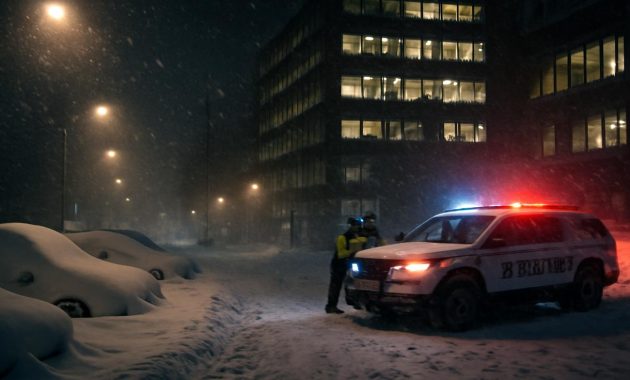
The first flakes arrive the way secrets do—quiet, hesitant, as if they’re not sure they’re welcome. By the time the evening news cuts to the meteorologist—smiling too tightly under studio lights—those shy flakes have grown confident. The radar screen behind her blooms with dense swirls of blue and purple, curling over the region like a great, slow-motion wave. The word she uses is “historic,” and everyone at home leans a little closer to the screen, trying to decide if that word is thrilling or terrifying.
When the Forecast Turns into a Warning
Outside, the sky is already lowering, flattening into that heavy winter gray that looks less like weather and more like a decision. The cold carries a new sharpness. You can feel it on your teeth when you breathe in.
On the television, the meteorologist traces the storm’s projected path with her fingertip. The colors deepen in the overnight hours, the way they always do, but tonight there’s something different in her voice. Less theatrical, more insistent. She clears her throat.
“We’re looking at the potential for record-breaking overnight snowfall,” she says. “We’re urging everyone to be off the roads by late evening. Emergency officials are discouraging all non-essential travel.”
In living rooms and kitchens, in gas station break rooms and office cubicles where someone has left the TV on, people glance at each other. Non-essential. It’s a phrase that became familiar in other crises, but in this moment it lands like a small stone in the gut. Somewhere, a phone buzzes with an email from a manager reminding staff that the office “remains open as scheduled.” Somewhere else, a shift supervisor shakes his head and mutters, “We’ll see,” knowing full well that payroll and policy rarely consult the weather.
What the Sky Is Trying to Tell Us
The thing about a truly big storm is that you can feel it building long before the first snow sticks. Meteorologists read it in the data: in the moisture streaming in from the south, in the arctic air lunging down from the north, in the pressure systems locking together like teeth in a zipper. But everyone else feels it in subtler ways.
Dogs pace more. Birds vanish from the feeder an hour earlier than usual. The air smells oddly clean, as if the world has already been washed and is now just waiting for the rinse cycle. Streetlights flicker on over asphalt still mostly dry, but the halos around their heads thicken, glow, blur. The forecast calls for twelve, maybe eighteen, maybe more inches overnight—words that sound almost whimsical until you picture your car swallowed up to the wheel wells, the snowplow berm sealing your driveway like a wall.
At the emergency operations center on the edge of town, fluorescent lights hum over a long table. Maps are spread flat. Coffee cups ringed in brown half-moons gather near elbows. Phones chirp, radios crackle. Screens show the same storm spiraling in different forms—radar, satellite, prediction models. The language here is clipped, serious: banding, blizzard conditions, whiteout risk.
They’ve seen this kind of system before, just not quite like this. The models align, stack, insist. Overnight totals that rarely show up outside of once-in-a-decade events. Winds that could take that snow and sculpt it into drifts taller than the average person. It’s not the kind of night you go out in unless you must.
The Long Shadow of “You Still Coming In?”
Yet, as the afternoon drains into early evening, another kind of storm gathers in inboxes and employee group chats. Some employers, wary of losing a day of productivity, send carefully worded memos.
“We are monitoring the situation.”
“We remain committed to serving our customers.”
“Employees are expected to report to work unless otherwise notified.”
For people whose jobs can’t be done remotely—grocery clerks, warehouse staff, line cooks, nurses, delivery drivers—“unless otherwise notified” feels like a dare. The forecast is one thing; the paycheck is another. Snow may blanket everyone, but its risk does not fall equally.
In a third-shift nurse’s small kitchen, a pot of soup simmers while she checks her messages again, hoping for the miracle of a cancellation that never comes. Her hospital can’t close, and she knows it. Patients will still need care, even if the roads are empty. In another home, a young retail worker scrolls through group texts as coworkers trade rumors: “My cousin said the highway is already slick,” “They won’t close, they never do,” “If we call out, it’s a point on our record.”
On the local news, an emergency official appears next to the meteorologist. His jacket is reflective, his voice measured but firm. “We are strongly discouraging all non-essential travel after 9 p.m.,” he says. “If you don’t have to be on the roads, please don’t be.”
That last line hangs in the air. Please don’t be. But what counts as “have to,” and who gets to decide? For some workers, that answer is written into policy manuals and attendance trackers that never once consider the shape of a snowdrift.
Inside the Blizzard of Decisions
There’s a kind of choreography that happens as a storm approaches: the quiet panic of grocery aisles stripped of bread and milk, the soft whine of snowblowers being tested in driveways, the rhythm of shovels dragged from backyard sheds. Children press their faces to windows, not caring about commute times or power grids. They see only the dream of snow days, sleds, a world turned briefly into a storybook.
But behind that dream, adults are doing mental arithmetic with a different set of variables: miles to work, reliability of the car, the age of the tires, how many sick days remain, whether the boss will remember this storm when performance reviews roll around.
Let’s imagine three people in the path of this historic snow:
- A single parent working in a distribution warehouse thirty miles from home, where every absence is docked in pay.
- A small business owner who knows closing for a day might cut deeper into already thin margins.
- An EMT who doesn’t have the luxury of asking whether the trip is “essential”—when the call comes, the answer is always yes.
They’re all watching the same forecast, but the choices facing them feel wildly different. The storm doesn’t see that difference. The road doesn’t either.
| Time | Forecasted Snowfall | Travel Risk Level |
|---|---|---|
| 6 p.m. | 1–3 inches | Moderate – Roads becoming slick |
| 9 p.m. | 4–6 inches | High – Reduced visibility, plows struggling to keep up |
| Midnight | 8–10+ inches | Very High – Whiteout bursts likely, emergency travel only |
| 3 a.m. | 12–16+ inches | Extreme – Drifts, stranded vehicles, delayed emergency response |
Those numbers, read from a forecast model, don’t capture the feeling of a steering wheel vibrating in gloved hands as tires lose traction on an invisible sheet of ice. They don’t reflect the way snow can suddenly erase the lines on the highway, turn familiar exits and landmarks into a flat white blur. There’s a point in every big storm when the map in your head stops matching the world in front of your windshield.
When Officials Say “Stay Home” and Reality Says “Go”
As dusk seeps in, emergency officials stand in front of microphones, behind podiums branded with city seals. They’ve heard the pressure too. Business groups call, nervous about lost revenue. School districts wrestle with whether to announce closures early or wait in the hope the models are wrong. No one wants to be accused of overreacting; no one wants to read the next day’s headlines about preventable crashes and stalled ambulances.
The officials repeat the message anyway: “We’re discouraging all non-essential travel after dark. We need the roads open for plows and first responders.”
In that one sentence, there’s an entire philosophy of what travel is for: life, health, safety first; profit and productivity somewhere further down. It’s a message that runs counter to the everyday drumbeat of deadlines and sales targets. A city saying, out loud, that your life matters more than your shift.
But this is not a perfect world. In that imperfection, people will still climb into cars tonight because they don’t want to be written up, because they’re new and probationary, because the rent is due and storms don’t stop the calendar from flipping another page.
Emergency managers know this. They’ve taken the calls, seen the footage, watched the live helicopter shots of jackknifed trucks and spinning taillights and miles of stranded commuters. They’re not just asking people to stay home for the sake of order; they’re asking so they won’t have to risk more lives to rescue the ones who felt they had no choice but to leave.
The Science Behind a “Historic” Night
Somewhere behind all of this—the worry, the arguments, the texts from bosses—there is the deep, steady machinery of the atmosphere at work. Cold air from the north, dense and heavy, is sliding in close to the ground like a sheet of invisible glass. Moist, warmer air from the south is riding up and over it, expanding and cooling as it climbs, wringing out snow crystal by crystal.
Meteorologists have spent days watching this setup take shape. Their computers chew through millions of calculations per second, but there’s still a very human process at the end: someone looking at a screen, weighing experience against models, deciding which number to put in the forecast strip along the bottom of your TV.
They know that “8–12 inches” means one thing. “Up to 20 inches” means another. They know that words like “historic” and “record-breaking” change behavior—they can close schools, empty office towers, stock pantries, or make someone decide to work from home who might not have otherwise.
So they choose their language carefully. Tonight, the word is historic. Not because it sounds dramatic, but because it’s backed up by data: snowfall rates that could reach two or three inches per hour, visibility dropping to nearly nothing in swirling gusts, the kind of snow that even well-prepared cities struggle to keep ahead of.
Historic doesn’t just mean “a lot of snow.” It means a kind of snow that changes the shape of a night, and maybe, briefly, the shape of our priorities.
The Quiet Power of Staying Put
By late evening, the world outside has transformed into a slow-motion storm of white. Streetlights are soft moons, each with its own private halo. Fallen snow erases footprints nearly as fast as they are made. The city hum quiets, replaced by the sift and whisper of flakes landing on flakes.
Inside, where people have chosen—or been allowed—to stay home, there’s a different kind of soundscape. A kettle beginning to sing. The crackle of a fireplace, or the steady whoosh of a forced-air heater kicking on again. The faint background murmur of the TV with its endless loop of storm coverage, radar imagery cycling through the same animated spin.
In these houses and apartments, staying put is not laziness or fear. It is a small, tangible contribution to safety. Each person who decides not to drive tonight is one less car that could skid sideways and block a plow’s route, one less minivan that might need rescue at 2 a.m. with kids shivering in the back seat. It is a community-level act, almost invisible, that ripples outward in ways we rarely bother to measure.
The plow drivers know this. They sit in high cabs that rattle and roar, watching heavy curtains of snow pour into their headlights. They angle their blades and push, mile after mile, grateful for every empty lane. The EMTs know it too, eyes narrowed against blowing powder as they steer ambulances through ghosted neighborhoods. Fewer cars means straighter, faster paths to the people who truly cannot wait for morning.
Listening to the Storm—and to Each Other
There’s a paradox at the heart of a big snowstorm: it is at once a social event and a deeply solitary experience. Everyone in a region shares the same forecast, but once the flakes begin in earnest, each person’s relationship with the storm is intimate and specific—a view from this particular window, the ache in these particular knees while shoveling, the crunch of these particular boots on the buried sidewalk.
Yet underneath those individual encounters, there is a shared story being written. Will the narrative of this night become another cautionary tale about commuters stranded on highways, about workers forced to risk their safety to prove their dedication? Or will it be remembered as the time the city listened—to meteorologists, to first responders, to the quiet instincts that say, “Tonight, home is where you belong”?
The contrast between employers who say “business as usual” and emergency officials who say “stay home if you can” is more than just mixed messaging. It’s a reflection of what, and who, we value. Does the day’s revenue outweigh the cost of a single life, of a single car lost in a snow-choked ditch waiting for help that is slowed, then slowed again, by all the other cars that felt they had to be out there too?
On nights like this, nature leaves us little room for pretending we’re in control. The snow falls, indifferent to sales goals and quarterly projections. What remains within our control is how we respond—not only individually, but collectively, in the way institutions and leaders align their choices with the realities unfurling outside their windows.
Morning After: What the Drifts Remember
By the time the sky begins to pale with morning, the world looks remade. Cars are reduced to smooth, rounded mounds; mailboxes wear high white hats; tree branches sag under the weight of crystalline cargo. The measurements come in from backyards and official stations, rulers plunged into drifts: eighteen inches here, twenty-one there, a local pocket with nearly two feet.
The phrase “historic snowfall” becomes, in retrospect, simply accurate. Records are broken. Photographs are taken. Kids who have never seen snow this deep wade through it with the delighted clumsiness of astronauts on a new planet.
The storm will soon turn into stories. Where you were. How bad it got. Whether the power held. Who shoveled which side of the driveway. It will be described in inches, in hours without electricity, in the time it took for the plow to finally rumble down your street.
But beneath all that, there’s a quieter ledger, one that doesn’t appear on weather maps or city dashboards: the close calls that never happened because someone decided not to get behind the wheel. The ambulance that arrived on time because the driver wasn’t navigating a maze of stalled sedans. The plow that made three extra passes on a main artery because it wasn’t rerouted around a pileup.
We don’t usually tally those invisible victories. Maybe we should.
When meteorologists warn of historic nights like this one, and emergency officials ask us to stay put, it can feel like an overabundance of caution pitched against an undercurrent of economic anxiety. But this storm, like every storm, doesn’t negotiate. It doesn’t yield to pressure from employers to remain open, or to the stubborn human belief that we can will our way through any hazard by sheer routine.
Listening—to the data, to the people who read the sky for a living, and to the officials who see what happens when we don’t—is an act of humility in the face of something larger than us. Staying home, when we’re able, becomes not a retreat but a kind of quiet solidarity with everyone whose essential work requires them to go out anyway.
Tonight’s snow will melt. The drifts will shrink back into the soil, into rivers, into clouds. The records set will be etched into climate logs and then overshadowed someday by another storm, perhaps bigger, perhaps stranger. But the choices made in nights like this linger longer than the flakes themselves. They teach us, in small, accumulating ways, what it means to live together in a world where the sky can still surprise us—and where our response to that surprise can be measured not just in inches, but in lives unharmed.
FAQ
Why do meteorologists sometimes call a storm “historic” before it happens?
They use terms like “historic” when multiple reliable models agree on snow amounts, wind speeds, or timing that are rare for a region. The word is meant to signal unusually high impact so that people and institutions take early action, not to create drama.
What makes overnight travel during heavy snowfall especially dangerous?
At night, visibility is already reduced, and heavy snow can quickly erase lane markings and hide ice. Plows may not keep up with rapid accumulation, and if you get stranded in the dark and cold, rescue can be slower and more hazardous for first responders.
Why do emergency officials discourage “non-essential” travel instead of issuing full bans?
Travel bans can be legally complex and may not be necessary in every situation. Discouraging non-essential trips allows room for critical services while strongly urging the public to avoid risks that strain emergency resources and road crews.
How can workers balance job expectations with safety during severe storms?
When possible, discuss remote work options or adjusted schedules with employers before the storm. Document forecasts and official advisories you’re relying on. If driving is unsafe, prioritize your safety and that of others on the road; no job is worth life-threatening risk.
What can communities do to better prepare for historic snowfall events?
Communities can invest in robust plowing and emergency response systems, encourage employers to adopt flexible severe-weather policies, create neighborhood support networks for vulnerable residents, and communicate clearly and consistently about risks before storms hit.