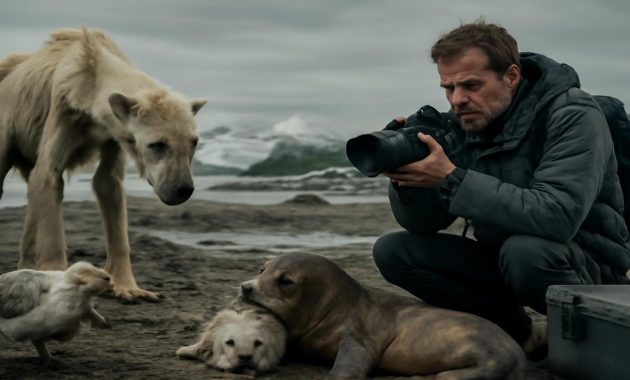
The first hint that something was off came not from a satellite or a sensor, but from a sound that shouldn’t exist in February: the thin, crystalline trickle of meltwater running beneath a sky still the color of deep winter. On a remote Arctic shore, where the air should have been knife-cold and dry, a soft, almost springlike breeze swept over a thin rind of snow. A researcher, pausing to wipe fog from her glasses, heard a gull cry overhead—weeks too early—and felt the strange, unnerving sensation that the season itself had slipped a gear.
When Winter Forgets It’s Winter
In early February, the Arctic is supposed to be locked into its longest, darkest sleep. Temperatures should be so low that breath hangs in the air like glass dust. Sea ice should be tightening its grip over the ocean, building toward its maximum extent. Animals should be burning fat, not energy, hunkering down rather than wandering. That’s the old rhythm—the one that guided everything from microscopic plankton to polar bears for thousands of years.
This year, however, meteorologists staring at anomaly charts saw something that made them lean closer to their screens. Surface temperatures in some parts of the Arctic were swinging 10, even 15 degrees Celsius above the long-term February average. Pressure systems were kinking like bent wire, pulling warm, moisture-laden air deep into the polar night. Sea ice, already thinner and more fractured than it used to be, was stalling in its growth. In some pockets, it was even retreating.
Weather forecasters are used to wild days; the atmosphere is a restless creature. But what unnerved them this time was not just the warmth—it was the timing, the depth of winter at which these signals appeared, and the way they intersected with something darker in the biological data. When they shared their initial findings with Arctic ecologists and wildlife biologists, the reaction was instant, visceral. A few used the same phrase, over and over:
This feels like a tipping point.
The Arctic’s Delicate Calendar Begins to Slip
The Arctic has always lived by a strict calendar. Light and dark arrive in great slabs of time. Life has evolved to anticipate these shifts with exquisite precision. Caribou move according to the timing of spring green-up. Seabirds return when the ice edge pulls back and plankton blooms surge. Polar bears time their hunting to the freeze and thaw of sea ice, the floating platform from which they stalk seals.
That calendar is now out of sync. And February—normally the deep anchor of Arctic winter—is starting to wobble.
In the past decade, scientists have watched the shoulder seasons, spring and autumn, stretch and smear. Freeze-up comes later. Thaw comes earlier. But this year’s early February signals felt different: a sudden looseness in winter itself. Snowmelt was observed on low-lying coastal zones weeks ahead of schedule. Melt ponds, which typically glimmer on sea ice in late spring, flickered in satellite imagery like ghosts in the wrong season. And in a few places, wildlife responded as if they had read the wrong script.
A small number of seabirds showed up early at traditional nesting cliffs, only to find exposed rock and treacherous conditions. In some regions, ringed seals were spotted near breathing holes ringed with slush instead of solid ice. On the tundra, Arctic foxes were tracked roaming farther and earlier, sniffing out food in a landscape that smelled confused—patches of bare soil mingling with snow that should have been immovable.
Each of these details might seem minor. Weather is noisy. Animals are opportunistic. But the patterns are starting to rhyme in unsettling ways. The more scientists compare notes, the more they see a shared storyline: the core rhythm of freeze, stabilise, and slow is being eroded from the inside.
When Weather Patterns Collide with Living Systems
From the vantage point of meteorologists, the explanation begins high above the ocean, in the twisting highway of air we call the jet stream. As the Arctic warms faster than the rest of the planet, the temperature contrast between pole and equator weakens. That contrast is one of the forces that keeps the jet stream tight and fast. Weaken it, and the jet starts to meander, like a river losing its banks.
This winter, those meanders grew especially pronounced. Warm air surged north through looping ridges, while cold air spilled south in jagged troughs. To people in some mid-latitude cities, that meant sudden deep freezes and snowstorms. To the Arctic, it meant invasions of warm, moist air that punched holes in the middle of winter.
For most of us, these dynamics are abstractions—lines on maps, colors on charts. For wildlife living on the edge of what is physiologically possible, they are the difference between a survivable season and a deadly one.
Consider a pregnant polar bear out on the sea ice. She has timed her entire year to give birth in a den when snow is deepest and the landscape is still and cold. She will emerge with tiny cubs in late winter or early spring, just as the ice is still firm enough to support her hunting for seals. But if midwinter warmth makes the snowpack unstable, her den could collapse. If the ice thins or fractures earlier, the vast white platform she depends on becomes a mosaic of gaps—longer swims, more energy spent, less food caught. It is not just a bad year; it is a broken contract.
For meteorologists and wildlife biologists alike, what is so unsettling about the current signals is that they are not one-off events. They sit on top of a long-term trend of shrinking sea ice, warming oceans, and changing snowfall. The weather spikes are like pushes on a door that has already been unlatched.
Signals of a Biological Tipping Point
In ecology, a tipping point is that terrifyingly quiet moment when a system crosses an invisible threshold and reorganises into something new—often abruptly, often irreversibly on human timescales. A lake suddenly turns from clear to murky. A forest shifts from a dense canopy to scattered scrub. In the Arctic, one of the most feared tipping points involves the interplay between climate, sea ice, and the creatures that depend on it.
The early February data triggered a rush of comparisons across disciplines. Sea ice specialists pulled decades of thickness and extent records. Marine biologists dug into long-term studies of seal haul-outs and whale migration routes. Ornithologists combed through nesting success rates and arrival times for seabirds. On land, caribou herds, musk oxen, lemmings, Arctic hares—each species offered its own thread in the tapestry.
What emerged was not a simple “before and after” picture, but a sense of acceleration. Changes that had crept forward year by year now seemed to be clustering and amplifying one another. Snow-dependent species were encountering more frequent rain-on-snow events that encased the ground in ice, locking away food beneath an impenetrable shell. Sea ice was forming later in autumn, giving less time for seals to establish stable lairs and for bears to pack on fat. The timing of algal blooms beneath the ice, which feed the entire marine food web, was beginning to decouple from the life cycles of the animals above.
One wildlife biologist described it as “watching the gears of a clock begin to slip their teeth.” Individually, each missed connection might be survivable. Collectively, they suggest a machine that could soon jump to an entirely different operating mode.
Voices from the Ice: What Scientists Are Seeing
The warnings coming from the Arctic are not just lines in peer-reviewed papers; they are also voices on static-filled satellite calls and weather-hardened faces squinting against unexpected drizzle.
On a research vessel nose-deep in patchy ice, a marine ecologist describes seeing thin sheets breaking and buckling under wind that, in other years, the ice would shrug off. “You begin to feel,” she says, “like you’re standing on the memory of winter rather than winter itself.” She talks about spotted seals hauled out on floes that look too small, too transient, as if the animals are clinging not just to ice but to a vanishing way of life.
Far inland, an Indigenous hunter traveling a route his grandparents taught him finds slush where there once was land-fast ice, the kind that locks to the shore and can be trusted. Travel becomes a gamble. So does traditional knowledge—the deep, respectful understanding of snow, wind, and animal behavior that has guided Arctic peoples for millennia. He reports caribou arriving along new paths, some in poor condition, their hooves scraped raw from punching through crusted layers of ice to reach buried lichen.
From a stationary weather station perched in a valley, data loggers record an unsettling sequence: a sharp thaw, rain, then a flash freeze. To a computer, they are just numbers. To an Arctic fox hunting for rodents beneath the snow, they mean hearing scurrying life just below an iron-hard layer it cannot crack. To a reindeer, it means starvation with food only centimeters away.
A Quick Glance at the Signals
At a glance, the shifts scientists are seeing look like this:
| Indicator | Recent February Observation | Potential Impact on Wildlife |
|---|---|---|
| Air Temperature | 10–15°C above long-term average in key regions | Midwinter thaws, unstable snow dens, increased energy use |
| Sea Ice Growth | Stalling or slight retreat instead of steady thickening | Reduced hunting platforms for polar bears, altered seal habitat |
| Snowpack Stability | More rain-on-snow and crust-forming events | Blocked access to forage for caribou and reindeer, higher winter mortality |
| Wildlife Timing | Early arrival of some seabirds and altered migration routes | Mismatch with food availability, failed breeding attempts |
| Extreme Events | More frequent warm intrusions into polar night | Stress on all cold-adapted species, disruption of traditional travel routes |
Each row in that table is a story of lives subtly or dramatically changed. It is important to remember that Arctic wildlife is already living close to the edge. These animals are not generalists; they are specialists, honed to a particular, once-reliable script of snow and ice. When the lines in that script blur, resilience has limits.
The Cascading Web of Consequences
One of the more unsettling lessons of ecology is that nothing changes alone. In the Arctic, sea ice is not just frozen water; it is architecture. It supports algae that grow on its underside, which feed zooplankton, which feed fish, which feed seals, whales, seabirds, and ultimately the large predators whose faces appear on conservation posters. When the foundation shifts, the walls and roof don’t just sag—they reorganise.
As sea ice recedes and thins, open water absorbs more sunlight, warming further and delaying future freeze-ups. Warmer water can alter nutrient mixing, shifting the timing and composition of plankton blooms. Some species will find opportunity in this new regime; others will be stranded, their life cycles misaligned with the new calendar.
On land, shrubs are marching north, darkening the surface and helping it absorb more heat. Red foxes, larger and more aggressive than Arctic foxes, push their way into new territories, outcompeting their smaller cousins. New diseases and parasites, once held at bay by deep cold, arrive with their own timetable, preying on animals accustomed to other enemies.
The early-February anomalies amplify all of this by eating into what used to be the safest, most reliable part of the year. Winter was the season you could count on to reset the board: to kill off pests, to lock in travel routes, to stabilise dens and lairs. When even this anchor month becomes slippery, the entire web above it vibrates.
What “Tipping Point” Really Means Here
It is tempting to think of a tipping point as a single dramatic day when everything suddenly breaks. In reality, especially in a vast system like the Arctic, it is more like a series of quiet clicks. Some are already audible.
- Sea ice is now multi-year in fewer places, replaced by seasonal ice that behaves differently under stress.
- Key species show signs of nutritional stress, shifting ranges, or declining reproduction in certain regions.
- Human activities—shipping, resource exploration, tourism—are following the retreat of ice, adding pressure just as natural buffers erode.
The “biological tipping point” scientists fear is not simply the loss of one charismatic species, but the crossing of a threshold where the old Arctic—white, cold, predictable in its extremes—gives way to a new constellation of ecosystems. Some animals will adapt or move. Others will disappear from places they have defined for generations. The concern raised by this February’s warmth is that we may be much closer to that threshold than the models once suggested.
Why This Faraway Shift Matters at Home
It can be hard, standing in a city far from snow and ice, to feel the urgency of a fox failing to find food under a frozen crust or a polar bear pacing the edge of thinning floes. The Arctic seems abstract, almost mythical—a place of documentaries and distant maps.
But in a very real sense, the Arctic is one of Earth’s great stabilisers. Its snow and ice reflect sunlight back into space, helping to cool the planet. Its cold, dense waters drive ocean currents that shape weather thousands of kilometers away. Its atmospheric patterns influence storms and droughts in places that may never see the northern lights. When the Arctic’s rhythms falter, the echo touches agriculture, infrastructure, and economies elsewhere.
Meteorologists worry because a less stable Arctic means a more capricious jet stream, and with it, more erratic weather: heatwaves where they don’t belong, floods following droughts, winter storms that roar out of season. Biologists worry because the biological fabric of the Arctic is a sensitive indicator of how quickly our climate is shifting—like a canary in a coal mine, but on a planetary scale.
And beyond the metrics and models, there is an ethical weight. Arctic wildlife is not simply a resource or a barometer; it is a collection of lives evolved to fit an ice-bound world we have altered in a geological blink. The early-February signals are a reminder that our combustion and consumption have reached into the dens of sleeping bears and the migratory maps written in the brains of birds.
Standing back, breathing in whatever air your own February carries—wet, dry, warm, cold—it is worth imagining that soft, impossible trickle of meltwater under an Arctic sky that should be hard with frost. That sound is a quiet alarm. The question it leaves hanging in the air is whether we will treat it as background noise or as the signal it truly is: that one of Earth’s great wild clocks is beginning to strike a new, uncertain hour.
Frequently Asked Questions
What exactly do scientists mean by a “biological tipping point” in the Arctic?
A biological tipping point is a threshold beyond which Arctic ecosystems reorganise into a new state. Instead of gradual, linear change, species distributions, food webs, and seasonal patterns shift abruptly. Once crossed, these changes are very hard, sometimes impossible, to reverse on human timescales.
Why are early February weather signals so concerning?
February is normally the cold, stable core of Arctic winter. Wildlife time their survival strategies—denning, migration, hibernation—around the reliability of this period. Unusual warmth and unstable ice or snow in February mean even the most “trustworthy” part of the year is now in flux, increasing stress on already vulnerable species.
How does unusual Arctic warmth affect animals like polar bears and caribou?
Polar bears rely on thick, stable sea ice for hunting seals. Warmer winters slow ice formation and weaken existing ice, forcing bears to travel farther and expend more energy for less food. Caribou and reindeer depend on digging through soft snow to reach plants; rain-on-snow events can create ice layers that block access to forage, leading to starvation events.
Are these changes just part of natural climate variability?
Natural variability does influence Arctic weather from year to year, but the long-term trend is clear: rapid warming, shrinking and thinning sea ice, and more frequent warm intrusions into the polar region. The recent February anomalies sit on top of—and amplify—this human-driven trend, rather than fitting within past natural patterns.
Does what happens in the Arctic really affect people living far away?
Yes. The Arctic helps regulate the planet’s climate through its reflective ice, cold oceans, and influence on the jet stream. As it warms and loses ice, weather patterns become more erratic, contributing to extreme events such as heatwaves, heavy storms, or unusual cold snaps in mid-latitude regions.
Can Arctic wildlife adapt to these rapid changes?
Some species may adjust their ranges or behaviors, but many Arctic animals are highly specialised for cold, ice-bound environments. The pace of current change is far faster than typical evolutionary timescales, meaning adaptation may not keep up, especially for large mammals with slow reproduction rates.
Is there anything humans can realistically do to prevent crossing this tipping point?
The most important action is reducing greenhouse gas emissions quickly and substantially, which slows further warming and buys time for ecosystems to adjust. Protecting critical habitat, limiting new industrial impacts in the Arctic, and supporting Indigenous-led stewardship can also help wildlife weather the changes already in motion.