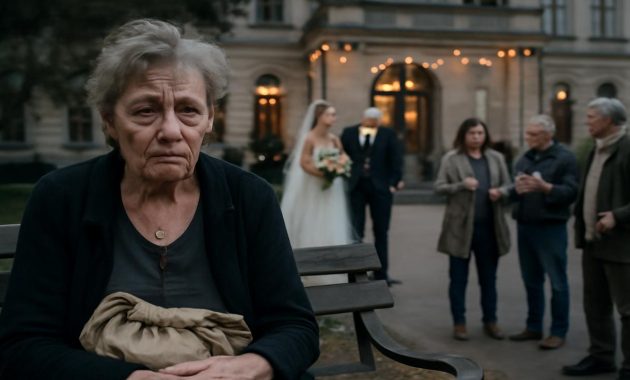
The for-sale sign went up on a windy Tuesday, the kind of day when the clouds drag slowly across the sky like something reluctant to move on. Neighbors saw the sign first—its jaunty red letters hammered into the patch of earth where geraniums usually stood in summer. By evening, phones were buzzing all over the small town of Willowglen: “Did you hear? Maria’s house is on the market.” In the photos online, the modest yellow bungalow looked brighter than it had in years, the rooms freshly staged, the kitchen counters cleared of the chipped mugs and pill bottles that usually sat there. Only one thing was missing from the picture—the woman who had given away part of her body to keep her son alive, and who now had no idea that the house she slept in every night was no longer hers.
The Day the Paper Arrived
It started, like big endings often do, with a thin paper envelope. Maria found it wedged in her mailbox between a grocery flyer and a charity appeal. No logo, just her name written in print that was too neat to be junk and too cold to be friendly. She walked back up the path slowly, her knees aching, the hem of her cardigan brushing the tops of dandelions. Inside, she set the envelope on the kitchen table, next to the salt shaker shaped like a lighthouse that her son, Daniel, had made in third grade.
She boiled water for tea, the kettle screaming its old familiar whistle, and tried not to think about how often letters like this meant trouble. Property taxes, insurance renewals, notices disguised as “important information.” The house smelled like chamomile and lemon oil from the furniture polish she still used every Saturday. Outside, a car rolled by with music pulsing through its doors, some pop song about chasing dreams and never settling.
When she finally tore the envelope open, the legal language blurred together into a gray fog: transfer of property, notification of sale, vacate, finalized. The words didn’t make sense at first. They floated above the page like smoke. She checked the name twice. Her address three times. The phrase that hit her like a slap was simple and merciless: new owner.
Her tea went cold as the truth arranged itself in her mind. She hadn’t signed anything recently. No meetings, no appointments, no strangers in suits. But there had been one person, one face she trusted so completely she never thought to question the papers he slid under her nose. “Just routine stuff, Ma,” he’d said a few months back, one hand on her shoulder, the other pointing roughly where she needed to sign. “Bank wants things updated, you know how it is.” She’d squinted at the lines but the print was small, and her son was in a hurry, and they needed to get to his fiancée’s cake-tasting appointment.
By the time she reached the end of the letter, the hand that had written his science-fair posters and signed his permission slips had also, somewhere, signed away her home.
The Mother, the Scar, and the Promise
Long before there were contracts and signatures and wedding registries, there was a hospital room heavy with disinfectant and grief. Daniel was 24 when his kidneys failed. Fluorescent lights hummed overhead, and the machines around his bed beeped like distant, indifferent birds. Doctors spoke in loops of medical jargon that never quite touched ground. Dialysis. Waiting list. Uncertain.
Maria remembered the exact moment the doctor mentioned living donors. The air in the room seemed to thicken, sound receding except for that one phrase. She looked at her son, pale and bloated from fluid retention, and saw not a grown man but the baby she’d once carried through nights of colic, pacing the narrow hallway of this same house. “Is it possible?” she’d asked. Her voice surprised her with how steady it sounded.
Tests were arranged. Blood was drawn. She lay on a paper-covered exam table while a nurse tied a rubber band around her arm, hunting for a vein. “You’re brave,” the nurse said kindly. Maria didn’t feel brave. She felt terrified. Not of the surgery, but of the alternative: a world that kept spinning without Daniel in it.
She was a match. Sometimes life hands you a number in a lottery you’d do anything not to win—and yet you cling to it. The doctors outlined the risks. She signed consent forms with a calmness she manufactured moment by moment. The day before the operation, Daniel cried for the first time since his diagnosis. “Ma, what if something happens to you?”
She cupped his face the way she had when he was small. “Then you’ll live,” she told him. “And you’ll make it worth it.”
The scar that ran along her side afterward was brutal, angrier than she’d expected. For weeks, she walked bent over, each step an argument with gravity. The house became a maze of small obstacles: the dip between hallway and kitchen, the stairs to the bedroom, the low shelf where she kept the pots. She never complained. When neighbors brought casseroles, she brushed off their concern. “I’m just glad he’s okay,” she’d say.
And Daniel was okay. His color returned. He joked again, devoured plates of food like a man making up for lost time. At family gatherings, people stared at them with a mixture of awe and unease: two lives now welded together, one body forever missing a piece for the sake of the other.
“I owe you everything,” he told her once, clearing the table after Sunday dinner. He hugged her from behind, arms wrapped carefully around her fragile torso. “I’ll never forget it.”
People say things like that all the time. They mean it, in the moment. They mean it with their hearts full and their eyes wet. What no one tells you is how memory dulls when confronted with day-to-day convenience, how gratitude can bend under the weight of new desires, shinier dreams, louder voices.
The Wedding That Ate the Future
By the time Daniel met Lila, the town was used to seeing him back on his feet. He’d walk past the bakery where Maria once bought him birthday cakes and never thought about how close he’d come to never tasting another slice. He worked in sales, the kind of job where appearance is currency. A good watch. The right shoes. A leased car that seemed just a bit too nice for someone in his tax bracket.
Lila belonged to another world. Or at least that’s how it looked from Willowglen’s cracked sidewalks. She’d grown up in a larger city, used to rooftop bars and shared rides and brunches that somehow cost more than freshly cooked dinners. When Daniel introduced her to Maria, she arrived with a bouquet wrapped in white paper and an apology for her “messy” hair that, to Maria’s eye, looked deliberately undone.
They were polite to each other, at first. Lila complimented the lemon chicken. Maria noticed the way her eyes slid past the faded wallpaper and the crooked cabinet doors. On the drive home, Maria imagined Daniel and Lila in some gleaming apartment with marble countertops and silent neighbors. She wouldn’t say she felt threatened; that would be too dramatic. But she understood that there was a widening gap between the life she’d given him and the life he was beginning to want.
The engagement was announced with the usual flurry of photos: a park at golden hour, a ring held up to the camera, Lila’s fingers tipped with flawless polish. The caption spoke of soulmates, second chances, and “building our dream future.” Comments poured in, a digital chorus of heart emojis and exclamation marks.
Then came the planning.
There is wedding planning, and then there is wedding curation. Lila spoke of “experiences” rather than decorations, “telling their story” rather than simply exchanging vows. The venue she fell in love with had stone arches and string lights, overlooking a lake that glimmered like a movie set. It also had a price tag that made Daniel’s throat constrict.
“We could do something simpler,” Maria offered one night, stirring soup while Daniel stood at the counter scrolling through price lists. “The church here is nice. Aunt Celia could make the cake.”
He smiled, distracted. “Ma, it’s just once, you know? People fly to Italy for less.”
Conversations shifted, almost imperceptibly, into something sharper. Budget spreadsheets with more red than black. A florist who used words like “installations” and “immersive.” An open bar that cost more than Maria’s first car. And always, an undercurrent: the need to impress, to match what friends had done, to “not look cheap” in the photos that would live online forever.
When Daniel mentioned a loan, Maria frowned. “Debt for a party?” she asked. “You’ll be paying it off when your kids are starting school.”
“You don’t get it,” he said, and there was a flicker of something hard in his eyes. “This is how things are now. It’s not just a party. It’s… it’s what sets you up. The images, the network, the perception. It matters.”
“Your health mattered more than any of this,” she wanted to say. “This house mattered when you needed a place to come home to after surgery.” But the words stuck. She’d never been good at asking for her own importance to be acknowledged. She’d done the things mothers do: silently, thoroughly, without a spotlight.
The Signature That Changed Everything
The day he brought the papers, it was raining. Drops ticked steadily against the kitchen window, making the world outside look blurred and far away. Daniel came in with damp shoulders and a sheaf of documents folded in his messenger bag. He leaned over the table, spreading them out between the salt and pepper shakers, the crumbs from Maria’s breakfast toast.
“Bank stuff,” he said. “I’m helping you restructure some things so it’s easier for you later. Just to make sure everything’s in order, you know, in case… well, just in case.”
No one wants to think about their own death, but aging teaches you to coexist with the idea like an unwelcome roommate. Maria nodded slowly. “You talked to someone about this?”
“Yeah, yeah, I’ve got it handled.” He tapped the page where a yellow sticky flag jutted out. “Here, and here. Initial, then sign. They use the house as collateral mostly, so you don’t have to worry about confusing paperwork down the road.”
The words slid over her like oil. Collateral. Restructure. In order. He spoke quickly, as if he were late for something. His phone buzzed twice in his pocket—messages from vendors, from Lila, from a world that communicated in fragments and expectations. Maria reached for her reading glasses but they weren’t on the table. Didn’t she usually leave them there? She glanced around. Daniel checked his watch.
“Ma, I really have to go. The lawyer broke this down for me already, it’s fine. It just protects you, okay?”
She trusted him. The boy who had once clung to her hand crossing the street, who had cried into her shirt after losing a soccer game, who had promised, under the haze of post-surgery medications, to “make it worth it.” Her signature, once so rarely requested, flowed across the page like water.
Weeks later, when the first real estate agent’s car appeared outside, shiny and polite, it felt like something out of a stranger’s life. “I’m just taking a look,” he said, walking through the rooms with professional detachment, noting square footage and light sources, while Maria trailed behind him, confused.
“Are you… sure you’re in the right place?” she asked.
He smiled, the way people smile at lost children. “Mrs. Alvarez, the paperwork’s all in order. I’m just doing the preliminary evaluation. Your son said you’d be expecting me.”
She wasn’t. But by then, the ink was long dry.
The Town That Took Sides
News travels differently in small towns. It’s not a headline; it’s a murmur that starts in line at the post office, a raised eyebrow at the hair salon, a sigh over coffee at the diner. By the time the moving boxes appeared on Maria’s porch—cheap cardboard, edges soft from years in storage—the story had already fractured into versions.
To hear one group tell it, Daniel was a monster in slim-fit suits: a son so consumed by status that he’d traded his mother’s roof for a weekend of curated perfection. “She gave him a kidney,” people hissed at the supermarket. “Can you imagine?” An older man at the hardware store shook his head. “Used to be blood meant something,” he told anyone within earshot.
Others framed it differently. “Look, she’s elderly,” said a woman in yoga pants, loading organic greens into her canvas bag. “Maybe she doesn’t need a whole house. He’s just being practical. The money goes where it matters most now. A wedding, a future. You can’t live in guilt forever.”
At the café, someone scrolled through Daniel and Lila’s wedding website on their phone: photos of the venue at dusk, the lake catching the last light, a menu boasting truffle gnocchi and champagne towers. Under the “Our Story” section, there was a brief mention of Daniel’s health scare years ago, framed as a hurdle that made them “stronger, more grateful, more focused on building a life filled with beauty and intention.” There was no mention of the woman packing her life into boxes while that story played out in filtered images.
Maria left the house quietly. One late afternoon, when the sun slanted across the living room in that honeyed way she loved, she paused by the doorway and touched the spot on the wall where Daniel’s growth marks were still penciled in faintly: age 6, age 8, age 12. Just small lines and dates. Proof of upward motion. She considered erasing them, then left them there. Let the new owners wonder.
She moved into a small room in a subsidized senior complex on the other side of town. The walls smelled of fresh paint trying to cover old lives. The window looked out onto a parking lot and, beyond that, a strip of scrubby grass where teenagers sometimes cut across, eyes fixed on their phones.
Daniel visited once, weeks after the move. He brought a potted plant and a tightness around his mouth. “It won’t be forever,” he said, glancing around at the narrow bed, the singular chair. “Once things settle, we’ll figure out something better.”
“You sold the house,” Maria said, not accusing, not softening. Just saying the thing that sat between them like another piece of furniture. “You didn’t tell me what those papers were.”
He let out a breath. “I did what I had to do. The market’s insane, Ma. That house was just… sitting there. This wedding, it’s an investment. You don’t understand how this works now. The images, the guest list, it opens doors. It’s… it’s how we move up.”
Her hand went unconsciously to her side, to the scar that had faded to a pale rope over the years. “I thought I was your investment,” she said quietly. “When I gave you this body. I thought that meant I’d always have a place with you.”
He looked away. “You’ll always have me,” he said, but even he seemed to hear the hollowness in it.
A Table of What Was Given and What Was Taken
| Aspect | Mother (Maria) | Son (Daniel) |
|---|---|---|
| Life Decision | Donated a kidney, risking her life | Sold family home for wedding funds |
| Motivation | Unconditional love and protection | Status, social image, “investment” in future |
| Immediate Outcome | Saved her son’s life | Funded luxury wedding, left mother homeless |
| Long-Term Cost | Chronic pain, reduced health, financial strain | Broken trust, fractured family, public judgment |
| Moral Lens | Sacrifice rooted in old-fashioned duty and love | Brutal pragmatism shaped by modern priorities |
Monster, Mirror, or Messenger?
In the weeks that followed, Willowglen adjusted itself around the story the way a forest grows around a fallen tree. People chose their positions and dug in. At the pharmacy, a clerk muttered, “If my kid ever pulled something like that, I’d change the will that same day.” At the co-working space in the nearest city, a group of twenty-somethings debated over laptops and cold brew.
“Look, it’s awful,” one said, “but homes are assets. You expect sentiment to trump strategy? That’s not how you build a life now.”
“But she saved his life,” another replied. “Doesn’t that count as… something you repay?”
“He’s not obligated to live in a museum of her sacrifices,” came the answer. “Our parents gave us stuff so we could go further, not so we’d be tied to their nostalgia.”
Some people saw Daniel as a villain, proof that modern culture had rotted something essential. Others saw him as a harsh voice of reality, doing what many silently consider but never dare act on: prioritizing personal advancement over inherited obligation. In the middle of this tug-of-war sat a scarred woman in a small room, making tea on a single-burner stove.
Is he a monster? Or is he a mirror, reflecting a time when weddings are treated like startups and parents like early investors whose emotional capital is assumed, not honored? He spoke openly, even proudly, to a few friends about what he’d done. “She was sitting on value,” he said. “It’s not like she was out on the street. There are programs. Systems. We have to be smart with what we’ve got.”
Brutal honesty about modern priorities, perhaps, doesn’t sound like honesty at all when you’re the one being deprioritized. To Maria, the language of strategy and optimization felt like a foreign dialect used to justify something much simpler: forgetting who held your feverish hand at 3 a.m., who lay on a cold hospital bed so you wouldn’t have to.
What We Really Inherit
Stand outside Maria’s old yellow house now and you’d never know what happened there. The new owners painted the door a fashionable charcoal gray. The geraniums were replaced with sleek planters of ornamental grasses. Inside, the growth marks on the wall have likely been sanded down and painted over. The scar on Maria’s side remains, though. Some things can’t be remodeled.
Stories like this flare up online for a day or two—shared, condemned, defended, forgotten. But underneath the outrage and the shrugs lies a harder question: what do we really owe the people who made our lives possible? And what do we owe ourselves in a culture that constantly whispers more, shinier, louder?
The easy answer is to declare Daniel a villain and move on. The harder one is to see the system that shaped him: a world where milestones are content, where debt is normalized for the sake of appearances, where aging parents are often seen as logistical challenges rather than living archives of love and labor.
Maria never wanted a statue or a plaque. She wanted, in the simplest sense, not to be erased. To know that the body she altered forever for her son would at least have a steady place to rest at night. To be part of his future not as a line item in a spreadsheet, but as a person whose existence mattered beyond what could be liquidated.
In quiet moments, she does what she’s always done: she remembers the soft weight of baby Daniel sleeping on her chest, his small back rising and falling. The organ inside him now beating and filtering and cleaning—a piece of her, busy saving his life every minute of every day. That, she thinks, is the real luxury. Not the venue, not the photos, not the buzz of admiration from people whose names he’ll forget in ten years.
Whether the town decides he is a monster or a messenger may matter less, in the end, than this: somewhere between the clink of champagne glasses and the rustle of moving boxes, we are all being asked which we value more—what looks good for a weekend, or what held us together for a lifetime.
Frequently Asked Questions
Was the mother legally aware that she was selling her house?
According to the documents, she signed the papers that enabled the sale, but she did so believing they were routine banking forms. She was not fully informed that her signature would transfer control of the house and allow it to be sold.
Did the son technically break the law by selling the house?
On paper, likely not. If her signature was on the documents and there’s no clear evidence of coercion or forgery, it falls into a gray area of ethics rather than straightforward criminality. Legally valid does not always mean morally defensible.
Why did the son feel justified in using the house to fund his wedding?
He framed the decision as “smart use of assets,” seeing the house as untapped value and the wedding as an “investment” in his social and professional future. His worldview prioritized status, perception, and long-term networking over his mother’s attachment to the home.
Could the mother have protected herself from this outcome?
With independent legal advice, a clear understanding of every document she signed, and possibly a power of attorney arrangement that required multiple approvals, she might have avoided unknowingly surrendering her home. But trust in family often overrides caution, especially for older parents.
Is this story unique, or does it reflect a wider trend?
While the organ donation element is extreme, the core conflict—adult children monetizing family assets while aging parents lose stability—is increasingly common. Rising housing costs, consumer pressure, and shifting values are creating more situations where “practical” financial decisions collide with loyalty and care.
Is the son simply a bad person, or a product of modern culture?
Both interpretations coexist. His choices were deeply hurtful and ethically troubling, but they were also shaped by a culture that normalizes using everything—homes, relationships, life events—as leverage for status and advancement. He is less a cartoon villain and more a stark example of where those values can lead when empathy falls away.