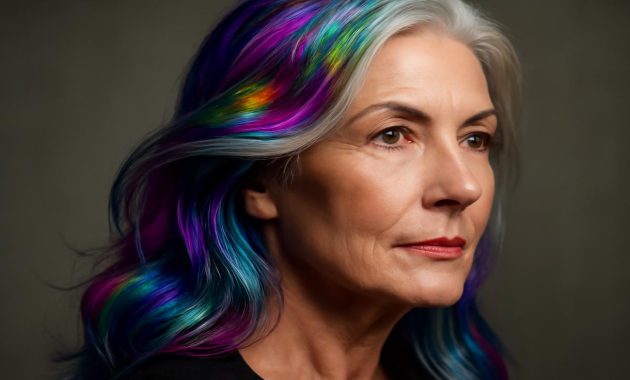
The first silver hair doesn’t arrive with fanfare. It appears one morning in ordinary light: a cool glint near your temple, catching the mirror just so, thin as spider silk and bright as a secret. You might tilt your head, squint, and lean closer, wondering when it slipped in. Maybe you pluck it. Maybe you don’t. But after 50, the silvers tend to multiply, a quiet constellation softening the color you once knew so well. And suddenly, there you are, standing in the bathroom, holding a box of dye in one hand and reading glasses in the other, asking a question that feels bigger than hair: What now?
The Moment You Realize Your Hair Has Its Own Plans
For many people, the realization doesn’t happen all at once. It might be an old photo that does it—the sunburned vacation shot, decades-old, where your hair looks impossibly dark and thick, or that wedding picture where your curls were the exact color of wet coffee beans. Then you look up at your reflection today. The roots are brighter, ashier. The part that used to vanish against your scalp now gleams like a discreet lightning bolt across the top of your head.
Past 50, hair feels less like an accessory and more like an autobiography. It tells where you’ve been—late nights, early mornings, stress that drilled itself deep into your follicles, joy that made you toss your head back laughing, years of ponytails and blowouts and box dyes bought in a rush before dinner guests arrived. The gray doesn’t ask for permission. It simply shows up and shifts the story.
For some, the shift is welcome. Silver streaks can look like moonlight woven into hair, a soft halo that catches compliments in grocery store aisles. For others, the change is jarring: the harsh root line between dyed hair and new growth feels like a barcode of aging, stamped across your scalp every four to six weeks when the color grows out. Covering it becomes a repeating cycle—color, fade, line, repeat.
Stylists have a name for this growing fatigue: color exhaustion. And more and more, their clients over 50 are walking into the salon and saying the same thing in slightly different ways: “I don’t want to spend my life chasing my roots, but I also don’t want to look like I’ve given up.”
Why Traditional Dye Starts to Feel Wrong After 50
Hair professionals will tell you: what works at 30 doesn’t always work at 55. Your skin tone shifts, your natural hair pigment fades, your texture might become finer, drier, or more fragile. The dense, single-shade color that once looked rich and glossy on you can start to seem flat, harsh, or even aging.
Permanent root touch-ups—especially in dark shades—create a high-contrast border between your natural gray regrowth and the colored length. The line is sharp, obvious, and oddly unforgiving. It’s like drawing a thick pen stroke across an otherwise watercolor painting. Every few weeks, your hair points with a glowing neon arrow to the exact place time is showing up.
There’s also the emotional layer. Sitting in a salon chair repeatedly “fixing” your gray can begin to feel like a quiet tug-of-war with yourself. You’re not anti-aging, exactly. You’re just pro-looking-like-you. But the routine of hiding your own hair color can begin to feel oddly out of step with everything else you’ve come to accept and even appreciate about yourself at this stage in life.
Colorists have been listening. And out of that listening—and a lot of experimentation—came a softer solution with a poetic name, one that sounds less like a chemical service and more like an art project: stained glass hair.
Stained Glass Hair: Nature’s Camouflage with an Artist’s Touch
Walk into a sunlit church or an old train station with stained glass windows, and you’ll see why professionals reached for this metaphor. Light passes through those multicolored panes and spills across the floor in broken, glowing fragments—no single shade, but a blend of gently overlapping tones. It feels alive, moving, impossible to flatten into one color.
That’s the idea behind stained glass hair. Rather than fighting gray with a solid, opaque wall of dye, colorists use a scattering of translucent and semi-translucent tones, allowing your natural grays to become part of the design instead of a mistake to be corrected.
Stylists describe it as a “veil” of color, or a “wash” that moves with the hair. Think of it as soft filters layered over your own shade. The result isn’t “brown” or “blonde” or “red” in an obvious way. Instead, it’s a mosaic: muted caramel flickers here, cool mushroom beige there, a whisper of rose gold infused into the gray at the temples, light smoky ash shadows near the nape. When your hair moves, the colors show and hide like changing glass in the light.
Most importantly, stained glass hair doesn’t erase your gray. It uses it. The lighter hairs become the brightest panes in the window, catching and reflecting color more vividly. The darker hairs provide depth. Together, they create something that feels…unexpectedly alive. Not young, exactly. Just beautifully current.
How the Technique Actually Works
Professionals usually approach stained glass hair as a layered process. Rather than coating everything, they work with small, irregular panels and glazes, customizing color density and transparency. It is not a one-size-fits-all procedure; it’s more like tailoring a suit directly onto your frame.
Below is a simplified snapshot of how stained glass differs from traditional gray coverage techniques, especially for hair after 50.
| Approach | Traditional Full Coverage | Stained Glass Hair |
|---|---|---|
| Goal | Hide all gray, create a uniform color | Blend gray, create natural multi-dimensional color |
| Coverage | Opaque, solid, single shade | Translucent glazes, several soft tones |
| Maintenance | Frequent root touch-ups every 3–5 weeks | Lower maintenance visits every 6–10 weeks |
| Grow-Out Line | Strong, visible root band | Soft, diffused grow-out with minimal root line |
| Ideal For | Anyone who wants solid, uniform color | People embracing gray partially or gradually |
In practice, your stylist might use:
- Very fine, scattered highlights to soften darker areas and create “panes” of lighter hair.
- Demi-permanent glazes that add tone and shine without aggressively lifting or damaging the hair.
- Lowlights in muted, natural shades to support contrast if your gray is very dense.
- Tonal overlays (for example, cool beige, smoky taupe, or soft champagne) that allow individual gray strands to catch the light.
The magic is in imbalance: not every section gets the same treatment. Gray around the face might be tinted with a slightly warmer glow to soften the skin, while the crown gets cooler, deeper tones for dimension. The hair becomes more like a landscape in late afternoon: shadows and highlights, never flat noon light.
Why Pros Love It for Hair Over 50
Ask ten colorists why stained glass hair has become their secret weapon for clients over 50, and you’ll hear many of the same reasons:
- It respects your natural color story. Instead of treating gray like a problem, it treats it like a design element.
- It’s kinder to aging hair. Demi-permanent and translucent colors are often less damaging, preserving texture and shine.
- It saves time and emotional energy. Longer stretches between appointments mean less urgency, less frantic scheduling around “bad root days.”
- It softens, instead of sharpens, your features. Multi-tonal color can reflect more light back into the face, making skin appear fresher and less sallow.
And perhaps the biggest reason: stained glass hair often looks more believable. When done well, people notice that you look good, but they can’t quite pinpoint why. There’s no obvious “just had my roots done” line. Just a sense that your hair and your face are having the same conversation again.
Finding Your Stained Glass Palette
There’s no one formula for stained glass hair, particularly after 50, because no two heads of gray are identical. Grays can be icy white, soft silver, smoky steel, or a pepper-and-salt sprinkle over your original color. Your stylist’s job is to read that pattern—like a map—and choose tones that enhance, rather than smother, what’s already there.
Professionals often begin with a few key questions:
- How much gray do you have, and where? Is it concentrated at the temples, scattered throughout, clustered at the crown?
- What was your natural color? Natural brunettes, redheads, and blondes interact differently with translucent overlays.
- What’s your skin undertone now? Skin often becomes cooler, more neutral, or more delicate with age, changing how warm or cool hair tones appear.
- What’s your maintenance tolerance? Do you mind coming in every 6 weeks, or would 10–12 weeks be ideal?
From there, they build a stained glass “palette” customized to you. To give you a sense of the artistry, here are a few imaginary but very real-world examples.
- Sandra, 58, former dark brunette: About 60% gray at the temples, scattered silver through the crown. Her colorist uses very fine, cool beige highlights and smoky lowlights, then a translucent mushroom-brown glaze. The result: the gray becomes soft shimmer instead of harsh contrast, and her roots grow in almost invisibly.
- Elaine, 63, natural dark blonde: Lots of bright white around the face, a “frosted” look through the part. Her stylist keeps the front almost untouched, then adds tiny warm honey glazes in the mid-lengths and lowlights at the nape. The effect is airy and sunlit, like naturally weathered beach hair.
- Rita, 71, embracing bold silver: Almost fully gray, with a few darker patches. Instead of adding brunette or blonde, her colorist uses violet-silver and pearl glazes to make the gray look intentional and luminous, like polished metal under soft light.
In each case, the technique is the same: let the grays guide where to add color, not the other way around. You’re not painting over the canvas. You’re tinting the glass that’s already there.
Words to Use with Your Stylist
Not every salon will have “stained glass hair” listed on the menu—but most experienced colorists know some version of it under different names: gray blending, soft dimension, translucent glazing, multi-tonal veiling. What matters is how you describe what you want.
Here are phrases professionals say are genuinely helpful to hear:
- “I want to blend my gray, not completely cover it.”
- “I’d like softer grow-out, with no harsh line at the roots.”
- “I’m okay with seeing some gray, but I want it to look intentional and dimensional.”
- “Please use more translucent, gentle colors rather than solid, opaque dye.”
- “I’m aiming for natural, like my hair could have done this on its own in good lighting.”
Bringing photos helps. Look for images where gray is present but blended—hair that looks like warm glass in sunlight rather than a single solid block of color. Your stylist will decode the tones and translate them into something that works for your own texture and pattern.
Living with Stained Glass Hair: Maintenance, Texture, and Daily Life
Stepping into stained glass hair is as much a mindset shift as a color shift. Instead of measuring your life in weeks-between-root-touch-ups, you start noticing different things: how your hair glows in late-afternoon light, how much more interesting your ponytail looks, how the silver around your face catches candlelight at dinner.
Maintenance becomes less rigid and more responsive. Most professionals suggest touch-ups or refreshes every 6–10 weeks, depending on your hair’s texture, porosity, and how bold your tones are. Because the technique relies on scattering tones rather than painting a strict border at the roots, grow-out is softer and more forgiving. If you stretch your appointment an extra couple of weeks, the difference is there, but it’s rarely alarming.
On a practical level, stylists often recommend a few gentle habits:
- Use color-safe, sulfate-free shampoo. Stained glass tones are delicate; harsh cleansers strip away the translucent glazes faster.
- Protect from heat. Aging hair is already more vulnerable. A heat protectant mist and tools on lower temperatures preserve both your color and your texture.
- Embrace shine products—strategically. Light serums or creams on the mid-lengths and ends can amplify that stained glass gleam without weighing hair down.
The emotional maintenance might be the biggest change. There’s a subtle but powerful relief in realizing you’re no longer at war with your roots. The first time your gray grows out and you find yourself shrugging instead of planning an emergency appointment, you might feel something shift inside you—quietly, but unmistakably.
Is Stained Glass Hair Right for You?
Professionals are clear: stained glass hair is not about pushing you toward gray if you’re not ready. It’s about giving you options besides all or nothing. If any of the following resonate, it might be worth a conversation with your stylist:
- You’re tired of visible root lines but not ready to go fully natural.
- You want your hair to look rich and dimensional, not flat or “helmet-like.”
- Your hair feels drier, and you’re worried traditional dyes are making it worse.
- You’d like to see how your gray could look if it were highlighted rather than hidden.
On the other hand, if you love your solid dark brown, your fiery copper, or your inky black, and it still feels authentically you, that’s valid too. The point of stained glass hair isn’t to nudge you away from what you love—it’s to expand the palette of what’s possible when your reflection starts to shift with age.
Gray Hair as an Evolving Landscape
Somewhere between your first gray hair and your hundredth, the stakes change. Hair becomes less about youth and more about continuity—how you carry your history on your head, in full view of the world. The stains of time, the glass of experience.
Stained glass hair, at its heart, is an invitation to see aging as color rather than erasure. It’s a technical solution, yes—a clever, low-maintenance way to camouflage gray naturally. But it’s also something subtler: a new language for beauty after 50, one that doesn’t insist you choose between surrender and battle.
Picture yourself a few months from now, walking out of a salon after your second or third stained glass session. The wind lifts your hair. In the reflection of a car window or a café door, you catch sight of the colors: not a single shade, but a shifting pattern of light and shadow, silver and smoke and warmth. It doesn’t look like the hair you had at 25. It looks like the one you earned—carefully tended, softly lit, comfortably your own.
You turn your head. The gray is still there, but it’s quiet now, woven into a story instead of standing alone as a headline. You know it will keep changing. And, finally, that feels like part of the design.
FAQ: Stained Glass Hair and Gray After 50
Does stained glass hair completely cover gray?
No. Stained glass hair is designed to blend gray, not erase it. Some gray will remain visible, but it will be softened and tinted so it looks intentional and dimensional rather than stark.
Is this technique damaging for aging hair?
Generally, it’s gentler than traditional full-coverage coloring. Stylists often use demi-permanent glazes and very fine highlights, which can be less aggressive than frequent, all-over permanent dye. Still, proper care and a skilled colorist are important.
How long does stained glass color typically last?
Most people refresh their stained glass color every 6–10 weeks. The translucent tones gradually soften rather than leaving a hard line, so you can often stretch appointments without your hair looking obviously “overdue.”
Can I try stained glass hair if I’ve colored my hair dark for years?
Yes, but it might take a few sessions. Your colorist may need to gently lift some of the dark pigment or add strategic highlights and lowlights before applying translucent glazes. The transition can be done gradually to keep you feeling comfortable at each step.
Is stained glass hair only for women?
Not at all. Anyone with gray hair—regardless of gender—can benefit from a soft, multi-tonal blending approach. The technique is about working with your natural pattern, not about a particular identity.
What if I eventually want to go fully gray?
Stained glass hair can actually make that transition easier. Because it keeps your natural gray involved from the beginning, there’s no abrupt switch. Over time, your stylist can simply reduce the intensity and frequency of the glazes, allowing more of your natural silver to shine through.