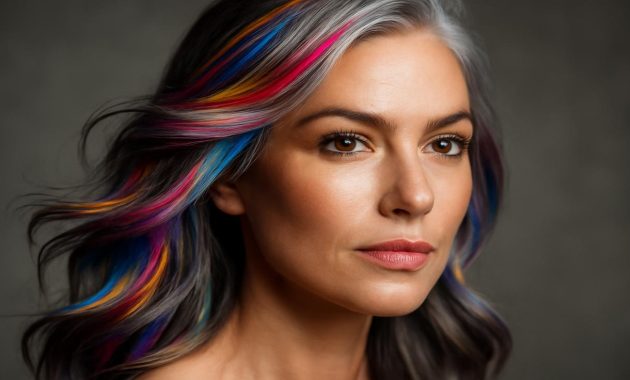
The woman in the salon chair is doing something quietly rebellious. She isn’t reaching for the usual plastic cape and the reassuring smell of developer and ammonia. Instead, she’s lifting a strand of her silver hair to the light, turning it between her fingers as if it’s a new material she’s learning to trust. Around her, foils crinkle, bowls clink, and the low murmur of blow dryers fills the room. A stylist passes behind her carrying a tray of shimmering color, then stops, curious. “So… we’re really going to leave it?” she asks. The woman nods. “We’re going to work with it,” she says. “Not against it.”
When “Covering Up” Started to Feel Old
For decades, hair dye has been one of the most loyal tools in the beauty arsenal—a silent accomplice in the mission to sidestep time. There was an unspoken contract: you noticed the gray, panicked a little, called your stylist, and walked out two hours later as if nothing had changed. “Covering your roots” became as routine as buying groceries.
But something’s shifting. In bathrooms lit by harsh vanity bulbs and in salon mirrors across cities and small towns, a question is surfacing: what if the answer to looking younger isn’t to bury every gray, but to use it?
It sounds almost contradictory at first. How could gray hair—herald of age, stress, and stubborn genetics—possibly make anyone look fresher or more vibrant? Yet more people are quietly discovering that harsh, flat color can make faces look older, not younger. Heavy dark dye against softer, evolving skin tones often emphasizes lines and shadows instead of smoothing them. Meanwhile, cleverly blended natural grays, diffused with lighter tones, can brighten eyes, lift cheekbones, and soften features like a real-time filter you don’t have to swipe on and off.
So the new trend isn’t rejecting gray or worshipping dye; it’s about rethinking what “covering” means. Less camouflage, more collaboration. Less war, more truce.
The Subtle Art of “Gray Blending”
Without a heading in a magazine spread, it might sound like a quiet technical footnote, but in salons, the phrase “gray blending” is starting arguments. Gray blending is not just skipping color. It’s an intentional, careful strategy to make gray hair look like it belongs—because it does.
Instead of painting over the hair with one dense hue, stylists use tools like lowlights, soft highlights, teasylights, and sometimes semi-permanent glazes to mix natural gray strands with carefully chosen shades. The eye stops seeing “roots” and starts seeing texture and shine. The goal? To make the hair look alive, multi-dimensional, and purposeful, rather than driven by panic appointments every four weeks.
Imagine a woman with 40% gray, whose natural shade used to be a deep espresso brown. If she keeps forcing that flat brown across every strand, the contrast between hair and skin may become harsh. Her under-eye area might look more pronounced; her jawline might appear heavier. But if a stylist weaves in cool beige highlights around the face, lets some of the natural gray shine through, and adds lowlights a shade or two softer than her original color, her features suddenly breathe. Light dances. The gray becomes part of the story, not an intruder to wrestle with every month.
It’s this shift—from hiding to harmonizing—that feels radical, even though it’s as gentle as a change in tone.
The Salon Debate: Art or Betrayal?
Of course, not everyone is clapping. Inside the professional world, stylists are deeply divided. Some see gray blending and “goodbye hair dye” conversations as an exciting evolution of their craft. They talk about it like color jazz—subtle improvisations instead of blasting the same note on repeat. They relish the challenge of mapping hair like a landscape, reading each client’s pattern of gray, face shape, and lifestyle to design something intensely personal.
Others feel something closer to betrayal, or at least loss. For them, covering gray has long been a cornerstone of their work and income, a backbone of predictable touch-ups and loyal clients. When a regular customer walks in and says, “I think I want to grow out my gray,” it can sound like, “I think I’m about to see you a whole lot less.” For stylists who built entire careers on the ritual of root coverage, that’s not just a trend; it’s a potential rewriting of their livelihood.
And then there’s pride. To many colorists, the art of anti-gray transformation is proof of skill: taking coarse, stubborn white strands and convincing them to submit to a warm chocolate or glistening black. To walk away from that feels like walking away from a superpower they spent years honing.
Yet even among the skeptics, curiosity is creeping in. Clients are asking for something different: “I don’t want to be all gray, but I also don’t want to be locked into this every three weeks. Can we… soften it?” The answer is no longer a simple yes or no. It’s another question: “Are you ready to rethink what looking ‘young’ actually means for you?”
Why “Younger” Doesn’t Always Mean “Darker”
Under the fluorescent glare of a drugstore hair aisle, it’s easy to internalize a blunt message: younger equals darker, richer, shinier. But step outside, into afternoon light, and take a look at the way color really behaves on people moving through the world. Skin shifts with age, yes, but also with lifestyle, sun, stress, sleep, and genetics. A dense, flat wall of dark dye can sometimes sit on the head like a helmet—separate from the person wearing it.
Gray blending, or strategic transition away from constant full coverage, plays a different game. It leans into the idea that softness can actually read as youth. Lighter, cooler tones can blur the edges where hair meets skin, reflecting light around the face the way a well-placed lamp softens a room.
Consider the way a child’s hair often contains natural variation—sun-kissed pieces, deeper threads underneath, a lighter fringe around the face. As adults, we sometimes forget that this variation is what makes hair look inherently alive and “young.” Flat, one-note color rarely occurs in nature; it’s something we create with insistence and chemicals.
Think of this trend as a rewilding of hair, guided by expert human hands. Not abandoning beauty, but allowing a more natural ecosystem of tones to return. Then, refining it so that it supports your specific features. A soft silver halo around the temples might make blue eyes explode with brightness. Threads of pewter running through charcoal brown can echo the flecks in dark irises. What once was labeled “going gray” starts to look suspiciously like custom couture.
The Emotional Half-Grow-Out: Identity in the In-Between
None of this, however, erases the sheer awkwardness of the transition phase. Talk to anyone who’s tried to ditch traditional all-over dye and they’ll tell you about the months of mirror negotiations: the demarcation line marching down their scalp, the hats that suddenly become best friends, the way they search old selfies to see who they “used to be.”
The practical truth is that not everyone wants that hard line between dyed lengths and new gray growth. This is where gray blending becomes both technical craft and emotional balm. Instead of a cold turkey grow-out, stylists can soften that line with carefully placed highlights or lowlights. Some use “reverse balayage,” painting in darker tones that are less severe than the old color, to ease the leap from one identity to another.
There’s also the surprising psychological effect of seeing your real hair color for the first time in years, sometimes decades. Many people discover they haven’t actually known themselves fully in natural light. The gray is not pure silver, but a tapestry of whites, gunmetal, soft browns, and unexpected champagne threads. The mirror introduces you to someone you’ve been becoming in secret while the dye was busy insisting you stay who you were at 28.
And with that introduction can come grief, relief, excitement—or all three in the same week. Some days, the new you feels bold, modern, powerful. Other days, you catch your reflection on a video call and feel older than you’d like, wondering if you’ve made a mistake. The trend may be “in,” but your emotions don’t always follow a trend line. They zigzag.
A Closer Look: How the New Gray Strategies Compare
For anyone contemplating the leap—whether to full silver, soft salt-and-pepper, or just a more forgiving approach to gray—understanding your options helps. Here’s a simple snapshot of the landscape that many colorists now walk their clients through:
| Approach | What It Is | Maintenance | Vibe |
|---|---|---|---|
| Full Gray Coverage | Single, opaque color used to hide all gray hairs. | High – touch-ups every 3–6 weeks. | Polished, traditional, sometimes harsh with age. |
| Gray Blending | Mix of highlights/lowlights and natural gray for a seamless look. | Medium – visits every 8–12 weeks. | Soft, modern, dimensional. |
| Transition Coloring | Short-term strategy to help grow out dye with less contrast. | Temporary – more visits at first, then fewer. | Adaptive, “in-between,” experimental. |
| Embracing Natural Gray | No permanent dye; focus on cuts, glosses, and care for shine. | Low – upkeep is mostly haircuts and conditioning. | Confident, authentic, striking when well-maintained. |
There’s no moral hierarchy here. Choosing full coverage doesn’t make someone vain; choosing natural gray doesn’t make someone automatically enlightened. The real shift is that we now have language and techniques for the middle ground—where most people actually live.
Stylists on the Line: Strong Opinions, Soft Hair
If you sit in enough salon chairs and ask enough stylists what they think about this “goodbye hair dye” wave, you’ll hear the full spectrum of feelings.
Some stylists light up. “When a client decides to work with their gray, I feel like we finally get to play,” one might say, towel wrapped around her wrist, eyes bright. “It’s not just about hiding the thing they hate; it’s about highlighting what makes them unique. Their gray pattern becomes part of my canvas.” They’ll tell you about clients who look ten years lighter—not younger in the calendar sense, but freer, less burdened by constant upkeep.
Others are wary. They’ve seen trend cycles before, watched people enthusiastically grow out their natural color only to come running back in six months saying, “I can’t stand this, make it brown again.” They worry that social media glamorizes the “after” shots of silver transformations without showing the emotional toll of the “during.” They remind you that not all gray grows in equally—some is patchy, some is yellow-tinged, some is coarser than anyone expected.
Then there’s a practical concern: not every stylist has been trained in advanced gray blending. It requires a different eye and different formulas—a shift from blanket coverage to hyper-customized sections. For some, this means re-education, investment, time. For others, it’s simply not their artistic passion. They lovingly steer clients toward colleagues who live for this kind of nuanced work.
So when you walk into a salon and say, “I want to embrace my gray but still look fresh and young,” you’re not just making a personal choice. You’re stepping into an ongoing conversation inside the industry itself—a conversation about identity, economics, artistry, and time.
Redefining “Young” on Your Own Terms
Under all the foils and formulas, what’s really at stake is a cultural script that’s been slowly losing its grip. The old story said youth was a look you could purchase, maintain, or lose, and that gray hair was the villain in that story. The new story is messier, but also more generous. It says youthfulness is partly about energy, curiosity, and the way your features are supported—not frozen in a single decade.
This is why you see people who have fully embraced silver hair but somehow appear more vivid, more present, than when they were chasing the same brunette box dye year after year. They’ve stopped fighting their reflection and started styling it instead. They might wear bolder lipstick now, sharper glasses, earrings that catch the light near their newly brightened temples. Or they might lean into minimalism: clean skin, soft sweaters, an easy ponytail with threads of moonlight running through it.
None of this is to say that hair dye is suddenly the villain. For some, a deliciously rich chestnut or a glimmering copper is exactly what makes them feel alive. They aren’t hiding; they’re expressing. The real trend is less “goodbye hair dye forever” and more “goodbye, obligation to cover every trace of gray at all costs.” What’s growing in its place is choice.
If your choice is to keep covering, you might do it more softly now—slightly lighter, less opaque, more forgiving between appointments. If your choice is to let some gray shine, you might work with a stylist to place color where it flatters you most, rather than everywhere indiscriminately. And if your choice is to go fully natural, you might invest the energy you once gave to dye into deep conditioning masks, sharp haircuts, and products that polish silver into a quiet spotlight.
Listening to the Mirror, Not the Trend
Trends are loud. They shout from magazine covers, scroll past in perfectly lit videos, and slip into conversations at dinner parties: “Did you see so-and-so? She stopped dyeing her hair and looks amazing.” It’s tempting to treat them as directives, proof you should do the same, immediately.
But the most grounded decisions about gray, dye, and everything in between come from a quieter place. They come from standing alone in your bathroom, hair damp from the shower, and asking: Who do I want to see in this mirror for the next few years? Not forever—just for now.
You might envision yourself with a luminous silver bob, crisp and unapologetic. You might feel a visceral no to gray for yourself and a just-as-valid yes to rich color that makes your eyes blaze. You might feel not ready, but curious—interested in a slow experiment rather than a grand declaration.
This is where a good stylist becomes not just a technician, but a guide. Someone who doesn’t just say, “We can cover that,” but instead asks, “What are you hoping to feel when you look at your hair?” And then they translate that feeling into formulas, foils, or, sometimes, the radical suggestion to do less.
Because maybe “looking younger” is less about chasing the absence of gray and more about chasing the presence of ease. The ease of not being afraid of your next root. The ease of hair that fits your life instead of dictating it. The ease of running your fingers through strands that tell the truth about your years—and still sparkle when the light hits them just right.
As the woman in the salon chair finally stands, her hair has changed but not in the way the old scripts promised. The stylist has woven in pale highlights that echo her natural silver, toned away the brass, shaped the ends into a soft, healthy curve. No one would describe her as “letting herself go.” If anything, she looks more here. As she catches her reflection, she smiles—half at herself, half at the stranger she’s just met. “It’s me,” she says. “But updated.”
FAQ
Will embracing or blending my gray hair automatically make me look older?
Not necessarily. Harsh, overly dark dye can sometimes age the face by creating strong contrast and emphasizing lines. Thoughtful gray blending or well-maintained natural gray can actually soften features and brighten your overall appearance.
How long does it take to transition from fully dyed hair to a gray-blended look?
It depends on your hair length, how much gray you have, and your starting color. For many people, the shift can take anywhere from a few months to a year, especially if you choose a gradual, low-stress approach rather than an abrupt grow-out.
Is gray blending less damaging than full gray coverage?
It can be. Because gray blending often focuses on selective areas and softer formulas, your hair may experience less frequent all-over processing. However, any chemical service carries some degree of damage, so using good care products and spacing appointments is key.
Can I go back to full coverage color after trying gray blending or natural gray?
Yes. Your decision isn’t permanent. You can always shift back to more opaque color, or adjust the level of blending as your taste and comfort change. Just be sure to work with a professional to minimize damage and uneven tones.
What should I ask my stylist if I’m curious about this trend?
You might start with: “I’m interested in working with my gray instead of fully covering it. What options would flatter my skin tone and lifestyle?” Bring photos of hair you like, and be honest about how much maintenance you’re willing to commit to.