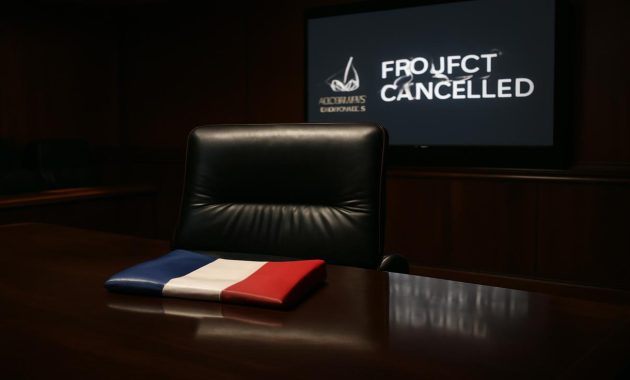
The news broke just after sunrise, the way the biggest stories often do—quietly, like a sudden change of wind that only later reveals it has upended the whole sky. In Paris, the city was just shaking off sleep when the first alerts began to ping across phones and newsroom monitors: the much‑anticipated €3.2 billion fighter jet deal—Rafale’s next big victory—had vanished overnight. Somewhere between one day’s certainty and the next day’s hesitation, a last‑minute U‑turn had been made. A different jet was chosen. France, and Dassault’s Rafale, had lost.
A Deal That Seemed All But Signed
For months, the deal had been treated as a foregone conclusion. Defense analysts walked through television studios with the quiet assurance of weather forecasters who see clear skies on radar. Journalists spoke of “when,” not “if.” Rafale, France’s agile, combat‑proven multirole fighter, appeared perfectly positioned to win this contract—slated for around €3.2 billion, a figure that carried within it not just money, but prestige, influence, and strategic footholds.
Inside meeting rooms in Paris and the buyer’s capital—whose name was whispered more often than officially pronounced—negotiations had edged steadily forward. Draft contracts were refined and re‑refined. Teams of lawyers toggled between English and French, working through dense paragraphs of legal prose. Military officials swapped PowerPoint slides filled with range circles, weapons loadouts, stealth considerations, maintenance costs, and delivery schedules.
It wasn’t just a commercial transaction; it was a political handshake, a diplomatic narrative, and a technological alliance wrapped together. In the corridors of France’s defense ministry, there was an almost tangible sense of forward motion. Officials imagined joint training exercises over sapphire coastlines, Rafale silhouettes gliding across foreign skies, and tricolour flags fluttering discreetly over signed cooperation agreements.
Yet, even in the balmy air of near‑certainty, there were whispers—the murmured what‑ifs that circulate around every arms deal. Other manufacturers were still in the running. Other governments were still making calls. And somewhere beyond the polished conference tables and prepared statements, another storyline was quietly gaining traction.
The Anatomy of a Last‑Minute U‑Turn
The reversal did not come with drama. No emergency press conference, no breathless late‑night leak. It unfolded instead like one of those barely noticeable turns in a river’s current—the kind you only recognize when you look back and see the water has taken a different path entirely.
According to those close to the talks, the warning signs began as subtle delays. A postponed technical review. An unexplained rescheduling of a high‑level call. A request for “just a bit more time” to finalize offsets—those industrial and economic side deals that accompany large defense contracts. In defense diplomacy, time is never neutral. It is either momentum or drag. And, slowly, the current began to drag.
In the buyer’s capital, a different set of conversations was accelerating. Military planners revisited their long‑term threat perceptions. Treasury officials sharpened their pencils over lifetime operating costs. Political advisers measured not just performance and price, but how each choice would rewire the country’s web of alliances—in ten years, in twenty, beyond any election cycle.
Somewhere in this tangle of interests, the balance tipped. A rival jet—which had, until recently, been framed as an impressive but secondary contender—suddenly moved to the center of the stage. Perhaps it offered more generous technology transfer. Perhaps the financing terms were sweeter, the delivery schedule tighter, or the political backing louder. Perhaps, too, it carried with it the shadow of a larger strategic umbrella—a security relationship that reached beyond the cockpit.
By the time Paris fully grasped the shift, the decision had already been made. The U‑turn came not as a sharp screech of tires, but as a composed announcement: after thorough consideration, the government had chosen a different aircraft. The phrase “strategic realignment” floated through statements like a polite apology.
Rafale: A Jet That Flies With Stories Attached
For those who follow aviation, Rafale is more than a hardware label. It is a narrative—a French response to a world where fighter jets are as much symbols as they are machines. Sleek and compact, with its delta wing and canards like poised shoulders, the Rafale seems to pull a thin line between elegance and menace. To see one cutting across a blue sky is to see decades of engineering, doctrine, and national ambition made visible.
On paper, the Rafale is a multi‑role workhorse, able to duke it out in aerial combat, strike ground targets, survey wide swaths of land and sea, and even deliver nuclear payloads as part of France’s deterrent posture. In reality, it carries with it something more intangible—a story of autonomy. Unlike many other jets that swim in multinational supply chains and alliance structures, Rafale is deeply, defiantly French. It is national pride, machined into composite and metal.
In recent years, it had become something of an export star. Deals in the Middle East, in South Asia, in parts of Europe had burnished its image. Each new contract was not just another revenue stream for Dassault and its partners, but an incremental proof that France could still compete in the high‑stakes, high‑tech marketplace of air power. With every signed agreement, Rafale seemed to be writing itself into more skies, more doctrines, more futures.
Perhaps that’s why the loss of this €3.2 billion deal felt less like a missed sale and more like a book abruptly closed mid‑chapter.
The Invisible Stakes: Jobs, Supply Chains, and Futures
Behind the sleek promotional videos and diplomatic handshakes lies a quiet, sprawling ecosystem of human lives. On a grey morning in a French industrial town, a technician tightening bolts on a fuselage may never read the headlines about last‑minute U‑turns. But the ripples reach them all the same.
Each Rafale contract extends the life of production lines, stabilizes subcontractors, and justifies investments in research and innovation. A single aircraft is, in some sense, a flying archive of thousands of jobs—from engineers hunched over CAD models to machinists coaxing precision from raw material, to logistics teams mapping the choreography of parts flowing in and out of assembly halls.
Losing a major deal doesn’t instantly plunge this world into crisis, but it changes the temperature. Plans drawn up in optimism suddenly require red ink. Hiring forecasts must be revised, expansion schemes slowed, development schedules stretched. In offices decorated with scale models of aircraft, whiteboards fill with questions nobody yet has tidy answers for: How do we make the next bid more irresistible? Which markets can be reopened, revisited, re‑imagined?
At a national level, the calculation is broader. France has long seen defense exports not only as financial assets but as instruments of geopolitical influence. Selling a fighter jet is not like selling a car; it establishes decades of maintenance contracts, training partnerships, shared doctrines, and sometimes intelligence cooperation. To lose a deal is, in a way, to lose a possible relationship, a possible future conversation, a seat at a strategic table that might have been.
On the Other Side of the Fence: Why Buyers Change Their Minds
If you step away from Paris for a moment and slip, imaginatively, into the shoes of the buying country, the story feels different. Here is a government watching its security environment shift like dunes in a restless desert. Threats emerge not in simple shapes, but in nested layers—cyber, airspace, sea lanes, internal stability, external deterrence.
When such a government chooses a fighter jet, it isn’t simply shopping for the fastest, sleekest machine. It is buying time, leverage, and insurance. It is paying for ways to sleep at night.
In that light, a last‑minute U‑turn becomes less a betrayal and more an act of recalculation. Perhaps a neighboring country’s procurement suddenly altered the balance. Perhaps a new alliance promise came with conditions. Perhaps domestic politics demanded a choice that could be sold to the public as part of a broader, more visible partnership with a superpower or regional bloc.
There is also the quiet power of logistics. A jet is only as strong as the ecosystem that keeps it flying: spare parts, pilot training, upgrades, warranties, future‑proofing against emerging threats. A rival offering that folds these promises into a single, persuasive package can be irresistible, even if the aircraft itself is only marginally superior—or in some ways, not at all.
And then, of course, there is the calculus of cost. A table of numbers, as unsentimental as stone, may hold more weight than all the soaring test‑flight footage in the world.
| Key Factor | Rafale Offer (Indicative) | Rival Jet Offer (Indicative) |
|---|---|---|
| Acquisition Cost | Higher unit price, premium package | Slightly lower unit price, flexible options |
| Lifetime Operating Costs | Competitive but complex logistics chain | Emphasis on reduced maintenance footprint |
| Technology Transfer | Selective, tightly negotiated | Broader industrial participation promised |
| Political Backing | Strong French and EU diplomacy | Linked to wider security umbrella |
| Delivery Timeline | Phased, aligned with existing orders | Accelerated, with interim support options |
This isn’t a real negotiation sheet, of course, but it mirrors the types of trade‑offs that often decide multibillion‑euro deals. On such a battleground, every number, every footnote, is a potential turning point.
France Between Pride and Pragmatism
In Paris, the reaction to the lost contract was a quiet blend of disappointment and resolve. There were no public laments, no grandstanding accusations. Instead, officials spoke of “regret,” of “respecting sovereign decisions,” and of “continuing dialogue.” The tone was carefully measured; this is how you speak when you still hope to do business with the same partners tomorrow.
Inside the private conversations, though, a more raw assessment took shape. Had France leaned too heavily on Rafale’s recent string of successes, assuming momentum would carry the day? Had it underestimated the pull of other geopolitical players, or overestimated how much weight a purely European solution now carries in a fractured world?
The Rafale program has long been a study in balance—between independence and interdependence, between national pride and the relentless arithmetic of the global market. Each setback tightens that balance. France must prove, again and again, that its technology can match or surpass that of larger defense exporters, while also threading the needle of diplomacy in regions where allegiances are swayed by pressure, promises, and sometimes, plain old fear.
Yet this is also a country with a long memory and a habit of thinking in decades rather than news cycles. A lost deal hurts, but it also reveals. It shows where the sales pitch resonates and where it doesn’t. It shows which arguments—about sovereignty, about interoperability, about cost—land with customers, and which drift away like contrails on a hot afternoon.
Within this introspection lies potential energy. Rafale is not a static artifact; it is an evolving platform. New avionics, updated sensors, smarter weapons, refined cockpits—all of these will continue to shape its trajectory. What this U‑turn does, more than anything, is sharpen the questions guiding that evolution.
The Broader Sky: What This Says About the World
Pull back far enough and this story—France and Rafale losing a €3.2 billion deal at the last moment—becomes less about a single aircraft, or even one government’s fortunes, and more about the atmosphere we all live under.
It is an atmosphere thick with competing futures. Countries are hedging their bets, aligning with one power here, another there, trying to weave a security blanket from threads that may or may not hold. New technologies—drones, hypersonic missiles, artificial intelligence—have scrambled the old hierarchies of air power. A fighter jet is now only one voice in a much louder, more crowded choir of capabilities.
In such a world, every major procurement decision is almost literary in nature; it writes a country into certain stories and not others. To choose Rafale is to fold into a narrative of European defense autonomy, of French strategic culture, of a specific approach to industrial partnership. To choose another jet may be to step more firmly into the orbit of a different power, or to signal membership in a particular regional club.
And hovering above this, almost unspoken, is a quieter question: how many more of these gleaming, lethal birds will we send into the air before the logic of deterrence and dominance gives way to some other system of security? For now, though, nations continue to buy, and sell, and compete, and lose—and in doing so, they sketch the outlines of the coming decades.
In a hangar somewhere in France, a Rafale sits under bright white lights, its canopy reflecting the ceiling’s industrial geometry. It is ready—for the next test flight, the next demonstration, the next bid. Metal does not know disappointment. It waits. It flies when told. It becomes what politics, money, and fear decide it will become.
For the people whose work and hopes follow the arc of this aircraft, the story is not over. A lost contract is a bend in the path, not the end of it. There are other skies, other deals, other capitals where the arguments will be made again. And somewhere out there, above clouds that make borders look like the faintest of pencil lines, the air remains indifferent—vast, blue, and waiting for whatever wing cuts through it next.
Frequently Asked Questions
Why was the €3.2 billion Rafale deal considered so important for France?
The deal represented more than revenue. It would have supported thousands of jobs, extended Rafale production lines, strengthened France’s diplomatic influence, and deepened a long‑term strategic relationship with the buying country through training, maintenance, and future upgrades.
What are the main reasons countries make last‑minute changes in fighter jet deals?
Late reversals usually stem from a mix of factors: revised threat assessments, political pressure from allies, more attractive financing or technology‑transfer terms from rivals, domestic political shifts, or fresh analysis of long‑term operating and maintenance costs.
Does losing this contract mean Rafale is becoming less competitive?
Not necessarily. Rafale remains a highly capable, combat‑proven aircraft with several recent export successes. Losing one major contract highlights how fiercely competitive the fighter market is, but it does not signal the end of Rafale’s export prospects.
How do such deal reversals affect workers and local economies in France?
They can slow hiring, delay investments, and create uncertainty for companies in the supply chain. While one lost deal rarely causes immediate crisis, it changes long‑term planning and can influence which regions benefit from future industrial activity and innovation.
What happens next for France and Dassault after this setback?
France and Dassault will reassess their export strategy, refine offers for future tenders, and continue upgrading the Rafale platform. They are likely to double down on promising markets, strengthen diplomatic engagement, and adjust industrial or financial terms to stay competitive in upcoming bids.