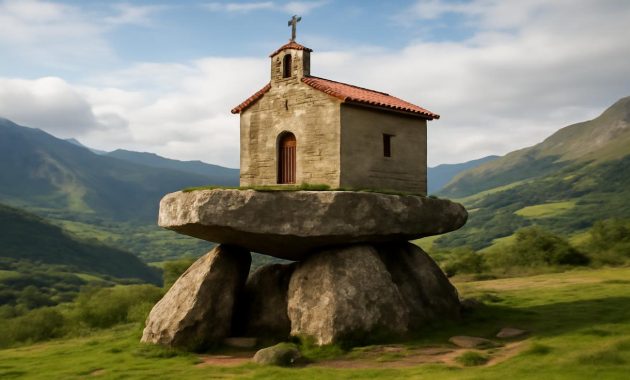
The road curves like a question mark through the green folds of Asturias, climbing past stone farmhouses and fields that smell of wet earth and apples. Morning mist hangs low, whitening the valleys and softening the jagged silhouettes of the mountains. You pass more cows than cars. Your phone signal stutters, then disappears. And then, suddenly, there it is—perched on a low rise like a quiet secret: a tiny white chapel that seems to hover above the grass, dainty and improbable against the ancient land that holds it up.
A Little White Chapel on a Very Old Bone
From a distance, the chapel of Santa Cruz in Cangas de Onís looks almost toy-like. Its whitewashed walls catch whatever light the Asturian sky decides to offer, often a pearly grey, sometimes a startling surge of blue between moving clouds. The red-tiled roof peeks out above surrounding trees, as if the whole building were shyly eavesdropping on the town below.
Most visitors pull over because it’s pretty. Photogenic. A perfect stop on the way to the better-known shrines and mountains of the Picos de Europa. They snap a few photos, murmur about how charming it is, perhaps light a candle, and then continue on—never guessing that this modest chapel is standing on bones older than writing, older than Rome, older than the very stories that built medieval Spain.
What looks like a typical Asturian chapel is, in truth, a mask. Beneath its floor lies a Neolithic dolmen, a megalithic tomb more than 5,000 years old. Long before Cangas de Onís was a royal capital, before Christianity spread through the valleys, before the first stone of the chapel was laid, people were already coming here with their dead, carrying stones that weighed as much as small cars and dreams that weighed even more. They built a house for the afterlife where now stands a house for prayer.
You wouldn’t know it by simply walking up to the small wooden door. The dolmen hides in the dim space underneath the chapel like an old animal resting under a porch. Yet once you learn its presence, the whole place changes. The air seems thicker, quieter. The chapel becomes less a destination and more a thin crust over something deep and living.
The Daylight Above, the Stone Below
Step inside on a cloudy morning and your eyes need a second to adjust. The interior is simple. A few wooden benches, an altar dressed in white cloth, small offerings of flowers, the faint scent of wax and damp stone. The quiet is so complete you can hear your own pulse in your ears. Sunlight filters through the window behind the altar in pale shards, falling onto the floor that hides the dolmen beneath.
Here is the strangest sensation: you feel as if the chapel is floating. Knowing the dolmen lies below alters your perception. You can’t see it right away, but the floor becomes a sort of veil. You picture the thick slabs of stone arranged in a circle, the giant capstone resting like a petrified wave over still air. You imagine the first builders, their hands chalky with dust, arranging their world around death and memory. Now, centuries later, the choir of their silence meets the whispered prayers of the faithful above.
The chapel, in its current form, is relatively young compared to its foundations. Over the centuries, it has been built, rebuilt, damaged, and reconstructed; time and politics have left visible fingerprints. Yet the dolmen endures below, stubborn and quiet, like a truth nobody can quite erase. While empires have come and gone, flags changed and languages evolved, this cluster of stone has stayed, anchoring the present to a deeper timeline.
When you walk over the tiles, you cannot help but wonder whose bones once rested here. What did they believe about this hill? About the sky above them? Did they light fires at night, the orange glow flickering against the stone, telling stories around the burial site? Did they feel, as many visitors feel today, that this place is somehow in-between—earth, but not entirely; sky, but not completely either?
The Secret Beneath the Altar
For locals, the existence of the dolmen is no myth. Many children in Cangas de Onís grow up hearing that their pretty chapel is “different,” that it shelters something very old. But for the passing traveler, the discovery can feel like stumbling into a chapter of prehistory by accident.
Stand by the altar and look closer. The floor does not shout, it whispers. Somewhere beneath your feet, stone has been shaped not with chisels and blueprints but with intuition, trial, and communal effort. No one knows the exact stories that once wrapped around those stones, but their physical presence is undeniable. Archaeological work has revealed the dolmen, documented it, studied it—but the experience of knowing you are atop a 5,000-year-old burial monument is far more visceral than any report could convey.
In the dimness, you become acutely aware of the layers of human presence here, stacked like geological strata: Neolithic builders kneeling in the mud; medieval masons raising walls and setting beams; modern pilgrims clutching rosaries; curious tourists shifting their weight and staring, their sneakers squeaking on the tiles. All gathered, unknowingly or not, around the same sacred coordinates on earth.
Asturias: A Landscape of Quiet Extremes
When you step back out, the brightness of Asturias rushes at you. Even on overcast days, the green here is almost aggressive in its vividness. The grass around the chapel is slick with dew or recent rain—you can rarely tell which in this damp, Atlantic corner of Spain. The air smells of moss and smoke from distant chimneys. Church bells from the town drift up lazily, followed by the low, conversational mooing of cows.
Asturias calls itself a “Natural Paradise,” and for once the tagline doesn’t feel like marketing bravado. Rugged mountains, wild beaches, forests that seem designed for fairy tales—it is a place where nature doesn’t apologize for taking up space. Yet much of its human history remains tucked away, eclipsed by more famous monuments in other parts of Spain. While crowds pour into the monumental cathedrals of León or Santiago de Compostela, Santa Cruz and its dolmen remain mostly in the margins, visited by those who take the time to wander off the most theatrical routes.
The paradox is delicious: in a region bursting with dramatic, postcard-ready vistas, one of its most extraordinary sites is a building the size of a small house and a hidden ring of stones older than most European cities. Tourism here is growing, but it still lacks the intensity of Spain’s more flamboyant coasts and cities. That means, for now, you can often find yourself almost alone here in the early morning or late afternoon, with only the wind and the chapel for company.
Why So Few People Know
Part of the reason this place stays under the radar is that it doesn’t scream for attention. There’s no colossal signboard announcing the ancient treasure underneath. No flashy visitor center towering over the landscape. Cangas de Onís is better known as the gateway to the Picos de Europa and as the site of Spain’s first major Christian victory over Moorish forces in the 8th century. Postcards show the iconic Roman bridge more often than this little chapel.
So most visitors walk in with one mental map and leave with another. They came here for the picture-perfect Asturian chapel; they walk away wondering about stone circles and ritual burials, about how we decide which past we honor visibly and which we allow to remain quietly buried. The surprise is part of the charm. Santa Cruz rewards those who linger, who ask questions, who feel that tug whenever a place seems to be hiding something around the edges.
When Time Layers Become Personal
There comes a moment, maybe on your second lap around the chapel, when the intellectual fact—“this sits on a 5,000-year-old dolmen”—sinks from your head into your body. You lean on the outer wall, feel the coolness of the stone, and realize that people have been revering this same patch of ground for fifty centuries or more. The spiritual language has changed; the practices have shifted; but the instinct is the same: this place matters.
Think about your own markers of time: a grandparent’s house, a childhood park, a city skyline changing with each visit. Forty, fifty, eighty years feel big. Now stretch that sense over five millennia, over a river of generations who kept returning to this bump in the land. Suddenly, your own presence feels fragile and enormous at once—tiny in the sweep of history, yet incredible in its continuity with all that came before.
In the hush around the chapel, it’s easy to imagine how the Neolithic builders may have chosen this spot. Perhaps the hill offered a view of stars that mattered to them, or the river’s curve below suggested a threshold between worlds. Maybe the stone itself, drawn from nearby quarries, had a quality they considered sacred. Centuries later, Christian builders often sought out pagan sites for their churches, not only to “baptize” older traditions but also because those spots were already considered powerful by local communities.
Santa Cruz joins these impulses into a single, tangible story: humans sensing that some places are somehow more charged, more open, more able to hold our hopes and griefs than others. You might walk away without having lit a candle or whispered a prayer, but it’s hard to leave without feeling that sensitivity pulsing under the surface.
Seeing the Invisible
Of course, most of what we imagine about the dolmen is speculative. Archaeology can map stones, date artifacts, catalogue human remains. It can reconstruct how the tomb was built, when it was used, and how the chapel later colonized its space. But it cannot give us back the hum of voices around a burial, the crackle of torches, the soft thud of offerings placed on cold stone.
That’s where your own senses come in. As you walk slowly around the chapel, try to notice small, easily overlooked details: the way moisture darkens the base of the walls; the unevenness of the nearby ground hinting at what lies beneath; the shifting quality of sound when you move from one side of the building to the other. It’s not about inventing ghosts. It’s about letting the physical clues awaken a curiosity that feels older than any guidebook.
For many travelers, this is where the enchantment of Asturias quietly blooms. The region is dotted with such layered sites—Roman roads beneath modern paths, prehistoric cave art under farmland, medieval sanctuaries tucked in rocky clefts. Santa Cruz is one of the clearest examples of how time here doesn’t line up neatly; it stacks and folds, like multiple stories told at once in different voices.
A Tiny Stop That Redraws the Map
You may only spend half an hour at Santa Cruz. You might arrive by car, stay long enough to take some pictures, circle the chapel, read a small sign, and continue onward toward the lakes of Covadonga. On paper, it’s a short stop. Yet places have a way of taking up more space in memory than on itineraries.
Later, when you recall Asturias, the grand views might blur slightly: green slopes, white peaks, roads zigzagging into mist. But the small white chapel above a Neolithic tomb—this is the kind of detail the mind clings to. It becomes the doorway through which you remember the entire journey: the cool, damp air on your skin; the distant echo of cowbells; the strange thrill of realizing that your modern holiday has brushed up against someone else’s eternity.
Travel is often measured in distances, but some of the most meaningful journeys are vertical rather than horizontal. At Santa Cruz, you move not only through space—from town to hill, from outside to inside—but also through time, from the 21st century down into prehistory in the space of a few steps. That vertical drop into the past, compressed into a quiet chapel, is why this unassuming building deserves a place among Asturias’ most remarkable sights.
And the irony is delicious: what makes Santa Cruz extraordinary is also what keeps it hidden. It does not command the landscape like a mountain-top fortress. It does not boast the vastness of a cathedral. It whispers instead of roars, and you must lean in close to hear it.
A Place to Practice Paying Attention
In an age when travel can feel like a checklist—must-see views, must-taste dishes, must-post photos—Santa Cruz offers something gentler. It invites you to slow down, to accept that the most profound elements of a place might be neither obvious nor Instagram-friendly. There is no dramatic reveal here, no guided sound-and-light show over the dolmen. There is only you, a little white chapel, and a layer of stone beneath, older than most of the ideas that shaped Europe.
You leave with more questions than answers, but they’re good questions: How many other sacred sites lie hidden in plain sight? How much of the world’s history rests beneath buildings we walk past without a second glance? What might change in us if we learned to see landscapes as palimpsests—texts written over older texts, never quite erasing what came before?
On the road away from Cangas de Onís, the chapel soon vanishes from the rearview mirror. The hills close around you, the mist lifts or thickens, the cows keep chewing their cud. Life goes on as if nothing extraordinary had happened. But somewhere under that red-tiled roof and whitewashed wall, the dolmen keeps holding its silence, as it has done for thousands of years, quietly reminding anyone who cares to listen that the ground beneath our feet is rarely just ground.
Key Impressions from Santa Cruz and Its Ancient Dolmen
| Aspect | Experience |
|---|---|
| First Sight | A small white chapel on a green hill, modest and almost shy against the Asturian landscape. |
| Hidden Reality | A 5,000-year-old Neolithic dolmen tucked beneath the chapel floor, unnoticed by most tourists. |
| Atmosphere Inside | Dim, quiet, intimate; a sense of walking above something older and deeper than the visible space. |
| Surrounding Landscape | Lush green hills, mist, distant bells and cowbells—classic, almost cinematic Asturias. |
| Emotional Impact | A slow-burning awe as the layered history sinks in, turning a simple stop into a lingering memory. |
Frequently Asked Questions
Is the dolmen under the chapel of Santa Cruz visible to visitors?
Access and visibility can vary depending on conservation decisions at any given time. In many cases, visitors primarily experience the dolmen by knowing it is there and standing above it inside the chapel rather than viewing it as an open excavation. The key experience is the awareness of the ancient structure beneath your feet.
How old is the dolmen beneath Santa Cruz?
The dolmen is estimated to be over 5,000 years old, dating back to the Neolithic period. That places it long before Roman times and many millennia before the Christian chapel was constructed above it.
Why was a Christian chapel built over a prehistoric dolmen?
Throughout Europe, early Christian builders frequently chose sites that had already been considered sacred in older, pre-Christian traditions. Building a chapel over a dolmen both appropriated and continued that sense of sacredness, linking the new faith to places that communities already revered.
Is Santa Cruz in Cangas de Onís very crowded with tourists?
Compared with more famous Spanish landmarks, Santa Cruz is relatively quiet. Cangas de Onís does receive visitors—especially those heading toward the Picos de Europa or Covadonga—but the chapel and its dolmen rarely feel overwhelmed, particularly outside peak summer holidays or midday rushes.
What makes this chapel and dolmen special compared with other sites in Asturias?
While Asturias is rich in ancient caves, Roman vestiges, and medieval churches, Santa Cruz condenses thousands of years of spiritual history into one small building. The combination of a modest, working chapel and an invisible but monumental Neolithic tomb beneath creates a uniquely intimate encounter with deep time and human continuity.