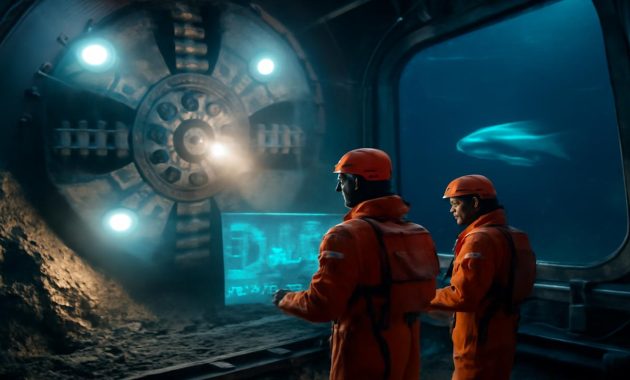
The first time I saw the proposal, it looked like science fiction—a luminous blue line stitched across the digital map of the ocean floor, connecting two continents like a thread through dark fabric. Today, that line is no longer a dream. Engineers have confirmed what once sounded impossible: the construction of an underwater rail line, running through a vast deep sea tunnel, is moving from concept to reality. Not in a distant century. Not in the pages of speculative novels. In our lifetime.
A Line Drawn Across the Deep
Picture this: you walk into a station at dawn. The air smells faintly of coffee and machine oil, that clean, metallic tang of a place built for movement. Overhead, sleek departure boards flicker with destinations that used to belong to airports, not train platforms. You scan the list and there it is—a city across the ocean, reachable not by plane, but by rail.
By the time you sink into your seat and feel the train hum to life, you are stepping into a new kind of story. Outside, the world you know retreats. Inside, the cabin glows soft and quiet. What lies between here and there is no longer sky, but water—thousands of meters of it, pressing down on a tunnel of steel and concrete and human ambition.
This underwater rail line will, if completed as planned, become one of the most audacious engineering projects in history: a deep sea tunnel stretching hundreds of kilometers beneath the ocean, linking two continents that, until now, have only been joined by fiber-optic cables and flight paths. Engineers from a coalition of nations have spent years drilling, mapping, modeling, and arguing, and now, after exhaustive simulations and a battery of safety tests, they have confirmed: it can be done. And so the work begins.
The Ocean’s Quiet Cathedral
The first thing to understand is where this tunnel will live. The ocean floor is not a flat, empty plain. It is a landscape—raw, sculpted, and almost unimaginably remote. Down there, daylight has never truly existed. The pressure is crushing, the water near freezing. Strange, translucent creatures drift like slow thoughts through the dark.
Engineers describe the chosen route in calm, technical language—a corridor through stable bedrock, a careful weave between undersea mountain ridges and sediment plains. But if you close your eyes and follow their maps in your mind, it’s like tracing a path through an ancient, submerged cathedral. Basalt pillars. Trench shadows. A silence so complete it has its own texture.
To build here, humans have had to design machines that look more like visiting spacecraft than construction equipment. Autonomous submersibles, all smooth curves and glowing sensors, scout ahead. They whisper data back to surface ships and floating command centers. Their work is methodical: scan the seabed, sample sediment, measure micro-movements of the crust. Even a millimeter of shift, multiplied over hundreds of kilometers, matters.
It’s easy to romanticize this, to turn it into a tale of brave machines and bold explorers. But out on the wind-lashed decks above, it is mostly hard, repetitive labor. Engineers in heavy jackets stare at screens filled with numbers. Technicians coil thick cables in the cold. The sea doesn’t care about timetables or political announcements. It heaves, it breaks, it freezes fingers. Yet still, the vision holds.
How Do You Build a Tunnel Under an Ocean?
Stand near any deep construction site and you’ll feel it first in your chest: the distant, dull thud of the tunnel boring machine chewing through earth. Now scale that up—deeper, longer, and under the relentless weight of the sea. That’s the challenge this rail line faces.
At its heart, the tunnel will combine several advanced methods: long stretches drilled directly through bedrock and sections formed by massive prefabricated segments lowered and sealed into specially dredged trenches. Think of it as threading a needle and laying a buried necklace at the same time.
The core questions were simple, even if the answers were not. Could a structure withstand pressures at these depths? Could it be made resilient against earthquakes, landslides on the seafloor, and the slow, shifting creep of the Earth’s crust? To get to “yes,” engineers ran millions of computer simulations, subjecting digital versions of their tunnel to everything from magnitude 9 earthquakes to century-scale corrosion models.
Inside, the train will move through a pressurized environment, more like a modern aircraft cabin than a traditional subway. Emergency refuges—reinforced spaces with independent air, power, and supplies—will be embedded along the length of the tunnel. Ventilation systems will circulate air like a carefully tuned lung. Multiple parallel tubes, separated but closely linked, will create redundancy: if one tube is compromised, others can serve as evacuation routes.
The rail system itself will likely be high-speed, potentially maglev, with trains gliding on magnetic fields rather than rolling on wheels. At full speed, a journey that once took many hours in the air could be compressed into a quiet, smooth trip of a couple of hours below the sea. No turbulence. No clouds. Just the deep constant hum of motion.
| Feature | Deep Sea Tunnel Rail Line |
|---|---|
| Estimated Length | Hundreds of kilometers, crossing an entire ocean basin |
| Depth Below Sea Surface | Up to several thousand meters at deepest points |
| Travel Time Between Continents | A few hours, comparable to or shorter than flights when including airport time |
| Primary Train Technology | High-speed or maglev with pressurized cabins |
| Key Safety Features | Parallel tubes, emergency refuges, seismic dampers, advanced monitoring systems |
| Environmental Focus | Minimized seabed disturbance, habitat-aware routing, low-emission transport |
The Quiet Revolution Under the Waves
Beyond the blueprints and bold claims, this project signals something more intimate: a subtle restructuring of how we imagine distance. We have grown used to the idea that crossing an ocean means surrendering to the sky—security queues, jet engines, a strip of land seen from far above. The underwater rail line rewrites that ritual.
Imagine a future journey. You board at twilight, stepping from the cool dusk of one continent into the warm, filtered light of the terminal. The train doors close with a soft sigh. There’s no roar of takeoff, no sudden tilt. Instead, there is a steady acceleration, pressing you back against your seat just enough to notice. The city blurs, then vanishes as the train dives into the earth and then, eventually, passes beneath the seabed.
For much of the trip, you could almost forget where you are. You read a book, sip tea, answer messages. Maybe a subtle augmented display on the cabin wall shows a glowing line and, beyond it, small dots marking the locations of deep-sea vents or whale migration routes far overhead. A quiet reminder: above this shell of steel, an entire ocean passes.
This, perhaps, is the quiet revolution. Not just speed, but a new kind of continuity. Land to land, station to station, without ever leaving the surface of the planet’s skin. It compresses mental maps. That distant foreign city feels less like “over there” and more like “down the line.” Trade changes. Tourism changes. Families divided by oceans reconsider what is possible.
Listening to the Ocean While We Build
No human project on this scale arrives without a shadow. The ocean is not empty space to be tunneled through at will, even if the route runs deep below most known ecosystems. Every drill, every anchor, every vibration sends ripples through a realm we barely understand.
Marine biologists and oceanographers have joined the planning teams, sometimes as advocates, sometimes as skeptics. They raise questions that echo through meeting rooms filled with 3D models and cost projections. How will construction noise affect whales and other animals that navigate by sound? Will the heat and subtle electromagnetic fields from the tunnel’s systems alter migratory patterns of sensitive species? What happens to sediments, to deep corals, to ancient microbial communities when we carve a corridor under their world?
Some answers lie in careful route selection—threading the tunnel under more stable, less biodiverse regions of the seabed. Other solutions are technological: sound-dampening protocols for undersea machinery, timing loud operations to avoid peak migration seasons, designing systems that leak as little stray energy into the environment as possible.
There’s also a growing commitment to transparency. Continuous monitoring networks—an unintended gift of the project—will line the tunnel and surrounding seabed: arrays of sensors listening to vibrations, temperatures, currents, and even the calls of marine mammals. They will provide a kind of EKG of that patch of ocean, data that scientists have dreamed of for decades.
No one can honestly claim the impact will be zero. The more honest promise is that it will be understood, minimized, and held accountable. The tunnel is, in a sense, a test of whether we can build something colossal in a way that still recognizes the ocean as a living, intricate system rather than a blank slate.
The Politics of a Shared Tunnel
An underwater rail line that bridges continents is not just a technical feat; it is a political statement. To lay tracks under an ocean, you need collaboration above it: treaties, shared funding, joint safety standards, and long-term agreements about who maintains what and who gets to ride.
Engineers working on the project tell stories of long nights in glass-walled conference rooms, where delegates from multiple countries argue over details that sound minor until you remember the scale. Whose standards govern evacuation procedures? How are construction jobs allocated? What languages will appear on emergency signage? In the story of this tunnel, even the fonts carry meaning.
Yet there is also a sense of common purpose. Climate commitments push nations to reconsider high-emission air routes. Economic planners see a future where goods and people move more efficiently. Scientists see a rare chance to gain deep-time monitoring of a major ocean basin. Artists and writers feel the tug of symbolism: a literal connection between far-flung shores.
In the best moments, the politics of the tunnel seem to echo the physics that keeps it safe: multiple supports distributing pressure, no single point of failure, strength emerging from interconnected parts. The risk, of course, is that old rivalries and short-term interests could buckle that structure before it is fully set. For now, though, the confirmation of construction suggests that, at least for this chapter, cooperation has the upper hand.
Living in a World Stitched Together
Try, for a moment, to imagine the world that will grow around this tunnel once it is finished. Picture new timetables pinned in small stations thousands of kilometers from the sea, showing connections that now cascade seamlessly: your local train, then a high-speed corridor, then the undersea line, then another local train on the far side of the world. Where once there was a gap—a psychological cliff labeled “ocean”—there is now a simple, continuous chain.
Young people in coastal cities may grow up thinking of weekends abroad not as luxury flights but as overnight train adventures. Freight that once waited in container yards for the right ship might instead roll directly into pressurized cargo trains, slipping under storm systems rather than braving them. Corporations will adapt; so will families, students, artists, wanderers.
Rail culture might experience a new renaissance. Sleeper cabins with wide seats and fold-down beds. Dining cars where chefs from both continents share a menu. Quiet zones where the only sound is the low rush of speed and the murmur of fellow travelers, speaking in accents from all along the line. The tunnel will not just shorten distances; it will change the textures of our journeys.
And yet, if the planners are wise, the tunnel will also serve as a reminder of limits. To build it, we will have had to approach the ocean with humility, to recognize that we are threading a needle through a planet that can shrug us off if we are careless. Every safe, comfortable crossing will rest on a thin shell of engineering and an ocean’s reluctant tolerance.
One day, generations from now, a child might press their hand against the wall of a train speeding through that deep sea tunnel and ask, “What’s out there?” The answer will be both simple and vast: an ocean, an entire world above us, and a long story of how we learned to pass through it without trying to own it.
Frequently Asked Questions
Is the underwater rail tunnel really going to be built?
Engineers and international partners have confirmed that the project has passed key feasibility and safety assessments, and construction has been approved to begin. While large infrastructure projects can face delays, this tunnel has moved beyond speculative design into the implementation phase.
How safe will it be to travel through a deep sea tunnel?
Safety is central to the design. The tunnel will use multiple parallel tubes, reinforced structures, seismic dampers, redundant power and ventilation systems, and regular emergency refuges along its length. Extensive simulations and testing aim to ensure that the tunnel can withstand extreme conditions, including earthquakes and high external pressure.
How long will it take to cross the ocean by train?
Exact times will depend on the final route and train technology, but the goal is to make the journey comparable to or faster than current flights when you include airport transfer and security time. A full ocean crossing could take only a few hours on high-speed or maglev trains.
What about environmental impacts on the ocean?
Planners are working with marine scientists to minimize harm. The route is being chosen to avoid especially sensitive habitats where possible, and construction methods are being adapted to reduce noise, vibration, and sediment disturbance. Continuous monitoring systems will track environmental conditions before, during, and after construction.
Will this replace air travel between continents?
It is unlikely to replace air travel entirely, but it could significantly reduce demand for certain high-traffic routes. The rail line offers a lower-emission alternative and a different kind of travel experience, especially attractive for passengers and freight moving between major coastal hubs.
Who will be able to use the underwater rail line?
The tunnel is planned as public infrastructure, intended for ordinary passengers and freight, not just elite or specialized travelers. Ticket prices and access will depend on national policies and agreements, but the intent is to integrate the tunnel into existing rail networks on both continents.
When might the tunnel open to the public?
Deep sea tunneling on this scale can take many years, even decades. While specific timelines vary by phase and political decisions, the confirmation of construction signals that the first operational sections could open within a generation, with full capacity developed over time.