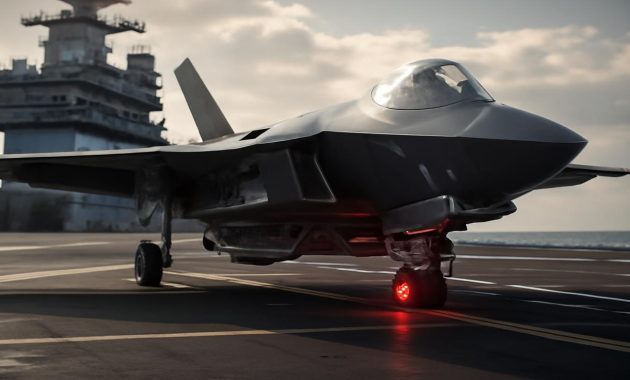
The sea is calm when the Fujian slips into view, a floating city of gray steel cutting the water like a slow, deliberate blade. On its wide deck, the future of Chinese naval air power is supposed to live and breathe—a sleek, sharp-edged stealth jet, the J-35, crouched like a predatory bird. Cameras linger on its angular wings and dark canopy; state media calls it a symbol of a “world-class navy.” But as the ocean breeze rolls over the carrier’s deck and sailors pose for carefully framed photos, there is a question hanging in the salt air that no glossy broadcast can wash away: what if this flagship stealth fighter is, in a real war, almost useless?
Fujian: A Giant That Changed the Silhouette of the Sea
When China launched the Fujian, its first modern “catapult carrier,” naval watchers around the world felt the shockwave. Here was a ship that looked, for the first time, like a true peer to American supercarriers—enormous, bristling with sensors, and equipped with electromagnetic catapults instead of the old ski-jump ramps. It wasn’t just a new hull; it was a declaration.
On paper, Fujian is the stage on which the J-35 is meant to shine. Catapults allow heavier, stealthier jets to launch with full fuel and weapons loads—something earlier Chinese carriers couldn’t manage with their ski-jump design. This promised to unlock a new era of Chinese carrier aviation: longer range, stealth penetration, more complex missions.
It’s easy to see why this matters. China looks out from its coastline across a neighborhood packed with tension points: Taiwan, the South China Sea, Japan, the Philippines, U.S. carrier groups that habitually cruise nearby. Air power at sea is the decisive hand in that high-stakes card game. The J-35, especially when framed against Fujian’s massive tower, was advertised not just as a new fighter, but as proof that China had arrived at the center of the world’s blue-water stage.
But ships and planes are not just about metal and engines. They’re about what happens when chaos arrives—the scramble launches, the electronics failures, the unexpected weather, the jammed catapults, and the missiles coming in low over the horizon. And it’s here, in the gap between ceremonial launch videos and the grimy, exacting demands of actual combat, that doubts circle the J-35 like shadows.
The Promise and Problem of the J-35’s Stealth
Look at the J-35 and you can see its ambitions carved into every surface. Canted tailfins. Saw-tooth edges. Internal weapon bays hidden beneath smooth panels. It’s clearly designed to echo the silhouette of Western fifth-generation jets like the F-35 and F-22. To the casual eye—and to a drone’s camera from 200 meters away—it looks every bit the part of a cutting-edge stealth predator.
But stealth is a dark art, and it’s the details that separate a silent hunter from a very loud, very expensive target. True low observability isn’t just about the shape of the airframe. It’s about the coatings that cover it, the precise engineering of panel gaps, the quality of radar-absorbent materials, and the hellish maintenance routines that keep those materials intact. It’s about the engine face hidden just so from radar, the shape of the nozzles, even how screws and fasteners are aligned.
Here, China faces a dilemma that no parade can hide. All signs suggest that Beijing has moved faster in appearances than in the quiet, brutal work of refinement. The J-35 may very well be “stealthier than older jets,” but stealth is not a binary switch. On a battlefield saturated with long-range radars, networked sensors, and electronic warfare, being “less visible” is not enough. You need to be nearly invisible at key frequencies and angles—or you’re still just a blip worth shooting at.
Analysts following satellite imagery, photos, and rough performance estimates see clues that the J-35’s stealth profile may be shallow compared to its Western counterparts. Panel lines look more pronounced. Engine nozzles appear conventional. Air intakes and bay doors hint at compromises that may have been made to keep production moving. If that’s true, then in a conflict, especially against U.S. or Japanese forces, the J-35 might be detected well before it closes to a lethal range.
Stealth is like a cloak woven from thousands of invisible threads. China has clearly acquired the loom. The question is whether the fabric is still too thin to stand up to a storm.
Engines: The Heartbeat That Isn’t Quite There Yet
Walk underneath any modern fighter and you feel its power as much as see it—those engines, welded in heat and violence, are the real organs that turn sleek shadows into combat machines. Here, China’s story becomes more fragile, more human. Because engine design is not something you can sprint through, no matter how much money or political will you pour into the furnace.
China has been wrestling with advanced jet engines for decades. It has prototypes, testbeds, and incremental improvements. But reliable, high-performance, carrier-capable engines that can match Western standards? That’s where the machinery begins to wheeze under pressure. A carrier fighter has to do terrible things to its engines: repeated catapult launches, brutal arrested landings, salt-laden sea air corroding every vulnerable surface. If the engine struggles, the fighter’s advertised range, payload, and climb performance all begin to wither.
Reports and open-source assessments suggest that early J-35 variants may be underpowered compared to their Western peers. If the engines don’t produce enough thrust, or if reliability is questionable, the J-35’s paper specifications shrink quickly when confronted with real mission profiles. Shorter range means carriers must sail closer to danger. Poor fuel efficiency means fewer combat options and less time on station. Even basic tempo—the drumbeat of launches and recoveries—slows if maintenance crews have to baby engines that were rushed into service.
This is where the phrase “ahead of itself” becomes painfully literal. Beijing wanted a fifth-generation carrier jet to match its shiny new Fujian. It built the jet. It painted it. It parked it on the deck for cameras. But if the engines inside that beautiful shell are not yet truly world-class, the fighter becomes less a war-winning tool and more a stage prop in a strategic play.
Table: Comparing the J-35 to Its Peers
| Feature | J-35 (China) | F-35C (U.S.) | Rafale M (France) |
|---|---|---|---|
| Generation (claimed) | Fifth | Fifth | 4.5 |
| Primary Role | Multirole, stealth strike | Multirole, stealth strike | Multirole |
| Stealth Maturity | Unproven, developing | Combat-proven | Limited (shaping, ECM) |
| Engine Tech | Domestic, evolving | Advanced, high reliability | Mature, proven |
| Operational Status | Testing / early integration | Fully operational | Fully operational |
Software, Sensors, and the Invisible Nervous System
Even if the J-35’s airframe and engines were flawless, the real war would still be fought in screens and signals. Modern fighters are more flying computers than flying cannons. They live or die by how well they fuse radar tracks, infrared signatures, data links, jamming, and command updates into a single, coherent picture. Pilots survive because their jets see first, think faster, and whisper quietly to the rest of the fleet.
This is where China’s opacity makes evaluation tricky—and where the whispers of “nearly useless in combat” start drifting in from analysts who are paid to imagine the worst-case scenario. The questions are simple but brutal:
- How reliable are the J-35’s sensors in heavy jamming?
- How fast and secure are its data links with other aircraft, ships, and satellites?
- Can its computers smoothly fuse information and present it in a way that doesn’t overload the pilot?
- Has any of this been tested under the kind of stress American and allied jets face in real deployments?
The uncomfortable truth for Beijing is that China has little to no recent combat experience to sharpen these edges. Western jets, especially American ones, have spent decades flying real missions: no-fly zones, close air support, high-intensity target environments. Every mission returns a haul of lessons that flow into software updates, tactics, and training. Chinese jets, no matter how futuristic they look, simply have not been tempered in that same fire.
If the J-35’s software is immature—if its radar false-alarms, if its jamming is clumsy, if its datalink stutters when stressed—then in a real confrontation, its stealthy shape won’t save it. It might be flying blind while thinking it can see. And a blind stealth jet is a very expensive way to lose pilots and prestige.
Crowded Deck, Thin Experience: The Human Factor
Stand on a carrier deck at night and everything feels amplified. The roar of engines is a physical shove. The deck crew move by hand signals and muscle memory. Every light is carefully shielded. A single mistake can ripple into disaster in seconds. This is not something any navy masters quickly.
The Fujian is new, yes—but its crews are too. Carrier aviation is one of the most complex martial arts humans have ever invented. Launching, recovering, arming, and maintaining dozens of jets in a limited space, in rough seas, while under threat, is a choreography written in risk. The United States has had generations to perfect this art. China is trying to learn it in years.
The J-35, as the most advanced bird on the deck, adds another layer of difficulty. It likely demands special maintenance—stealth coatings that must be carefully managed, software that needs regular updates, engines that might not yet be fully trusted. Every extra hour of care is an hour that the jet is not flying. Every new procedure is a step where inexperience can slip through the cracks.
And then there are the pilots. Carrier landings in modern jets are terrifyingly precise operations even in peacetime. Doing it at night, in bad weather, under electronic attack, and possibly with missiles inbound? That requires not just training, but deep, generational confidence: instructors who have seen everything, doctrines refined by mistakes, and combat-tested instincts.
China is racing to build that human ecosystem. But ecosystems take time. In the meantime, the J-35 and Fujian together risk becoming symbols of ambition outpacing digestion—a navy that can build marvels faster than it can learn to fight with them.
A Paper Tiger or a Growing Predator?
So, is the J-35 from the Fujian “nearly useless in combat”? That’s a blunt claim, and reality tends to resist simple verdicts. The more honest answer is that it may be far less dangerous today than its silhouette suggests—and far more dependent on conditions, matchups, and luck.
Imagine a conflict scenario over the western Pacific. On one side: U.S. and allied forces with decades of carrier aviation, integrated air defense networks, and a mature stable of stealth jets and support aircraft. On the other: the Fujian and its air wing, centered on a new, unproven stealth fighter, backed by a still-learning carrier culture and largely untested command systems.
In that confrontation, the weaknesses we’ve walked through—possibly shallow stealth, uncertain engines, immature software, green crews—would all tilt the odds. The J-35s might struggle to get close enough without being detected. They might be limited in their payloads or mission durations. Their ability to coordinate with other platforms might falter in the thick of electronic warfare. Under that kind of pressure, they could indeed be “nearly useless” compared to what their glossy images promise.
But the ocean of time is wide. China learns quickly. It is investing heavily in everything that supports the J-35 ecosystem: better radars, missiles, engines, training infrastructure, and carrier design. The Fujian itself is a platform that can evolve. Stealth coatings can be refined. Engines can be upgraded. Software can leap forward in quiet, unseen iterations.
Today’s “ahead of itself” experiment can become tomorrow’s very real threat—if China is patient and disciplined enough to sand down the rough edges rather than simply rushing to unveil the next showpiece.
What the Fujian and J-35 Really Tell Us
In the end, the story of the Fujian and its flagship stealth jet may not be about one airplane’s combat usefulness so much as about the rhythm of power itself. Great powers love symbols, and the ocean is the most symbolic theater of all. A massive carrier slicing across the horizon, a stealth jet gleaming on its deck—these are messages, not just machines.
But the ocean is also a merciless stage. Salt and time strip paint and illusion alike. When the lights of the cameras are gone, what matters is whether the J-35 can launch at 3 a.m. in rough seas, slip through a web of hostile sensors, strike precisely, and make it back to the Fujian’s deck in one piece—over and over again.
Right now, the honest answer is that no one outside a very small circle in Beijing truly knows how close the J-35 is to that reality. The public clues point to a fighter that has leapt into the spotlight before it finished rehearsing. In the language of strategy, China’s navy seems to have placed a big bet on optics and acceleration, hoping that the substance will catch up.
Sometimes, it does. Sometimes, history is written by the powers that dared to move too fast—and then learned fast enough to survive the fall. Other times, the sea remembers who showed up unready.
Out on the deck of the Fujian, as the sun dips and the sea turns from steel to ink, the J-35’s dark outline blends into the gathering night. From a distance, it looks every bit the ghostly spearhead of a rising naval giant. The question that will haunt the next decade in the Pacific is simple, and far more practical: when the day comes that it has to fight, will that ghost have teeth?
FAQ
Is the J-35 officially in full combat service?
No. As far as open information suggests, the J-35 is still in testing and early integration stages. It may be flying from land bases and gradually from carriers like the Fujian, but it is not yet a mature, fully deployed frontline weapon in large numbers.
Why is stealth so hard to get right?
Stealth requires precise shaping, advanced radar-absorbent materials, extremely tight manufacturing tolerances, and meticulous maintenance. Every panel gap, screw, coating scratch, and engine edge can increase radar visibility. It is a constant battle against physics, environment, and wear.
How does the J-35 compare to the U.S. F-35C?
On paper, both are fifth-generation carrier-capable stealth fighters. In practice, the F-35C has years of operational experience, refined software, and a large support ecosystem. The J-35 is still proving itself, with unknowns around its stealth depth, engine reliability, and sensor integration.
Could the J-35 still be dangerous despite its shortcomings?
Yes. Even a partially stealthy, moderately advanced fighter can be dangerous, especially against less sophisticated opponents or in carefully staged scenarios. Its threat level depends heavily on who it is facing, how well it is employed, and what support systems back it up.
What makes carrier operations so challenging for new navies?
Carrier aviation is a complex system of systems: launching and recovering jets in harsh sea conditions, maintaining aircraft in corrosive environments, managing flight decks safely, and integrating air operations with surface and subsurface warfare. It takes decades of practice, doctrine-building, and cultural adaptation to master.