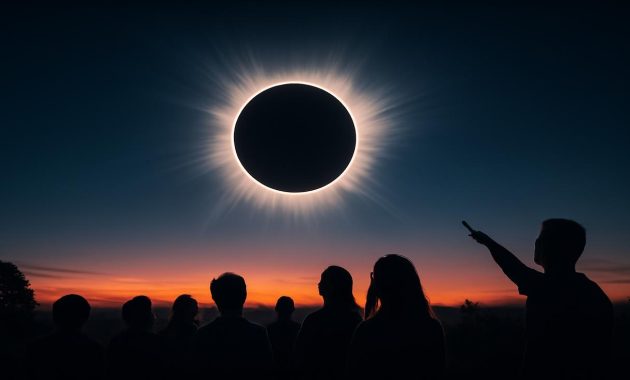
The news slipped into the world almost quietly, the way dawn slides into a sleeping city: a single date on a calendar, a thin line across a map, a prediction whispered by astronomers. And yet the promise behind it feels anything but quiet. On that day, they say, the sun will dim, then vanish, and daylight itself will fold into a strange and sudden twilight. This will not be just any eclipse; it is already being called the longest solar eclipse of the century, a rare stretch of darkness in the middle of day whose duration seems almost unreal in our hurried age. If you’ve never felt the world hold its breath, you will then.
When Day Pauses: A Date Already Written in the Sky
The most astonishing thing about a solar eclipse is not that it happens, but that we can know so far in advance exactly when, where, and for how long it will unfold. Long before any of us were born, gravity and motion had already fired off this event like a slow-moving celestial arrow. Astronomers now trace its path not with mystic predictions but with computer models and orbital mechanics, describing, with unnerving precision, the moment when the moon will slip between Earth and the sun and day will turn to night.
This particular eclipse stands apart for one key reason: duration. Most total solar eclipses offer a brief, breathless performance—two or three minutes of totality before the returning blaze of daylight. But this one will linger. In its longest stretch, along a narrow corridor of the planet, the sun will be completely hidden for an extraordinary span that outlasts typical eclipses by a wide margin. Long enough to look up, look around, feel your heartbeat slow, and realize you are watching a conversation between worlds that began eons ago.
Imagine knowing, years ahead, that on a specific day, at a specific time, the world around you will darken as if someone turned down a dimmer switch on reality. You might circle that date on your calendar, book a flight, or simply plan to step outside with a pair of eclipse glasses. You might tell your children, your friends, your future self: “Be outside then. Whatever else you’re doing can wait.”
The Strange Light of a Vanishing Sun
For those who have never stood under a total solar eclipse, it is difficult to explain how overwhelmingly physical the experience can feel. This is not just the sun slipping behind clouds or the gentle fade of sunset. This is light itself changing character, bending into something the human brain does not quite know how to categorize.
As the eclipse deepens, shadows grow sharper and stranger. A coolness slides over your skin, out of sync with the time of day. The sky takes on an odd metallic sheen, as if the world were being viewed through tinted glass. Birds shift uneasily or fall abruptly silent; crickets and night insects begin their chorus though the clock insists it is midday. Your own sense of time wobbles, untethered from the usual cues.
Then comes the moment of totality, when the last sliver of direct sunlight disappears and the sun transforms into a blackened disk wreathed in the pale, ghostly halo of its corona. It is not fully night, but it is not day either. Streetlights may blink on. Planets that normally hide in the glare of the sun—Venus, perhaps Jupiter—step out onto the stage of darkened sky. You might find yourself involuntarily whispering, as if in a cathedral.
For the longest eclipse of the century, that in-between state will hold longer than most living humans have ever felt. Instead of a fleeting gasp of darkness, it will be a sustained, deep breath. Long enough to watch the corona flicker and dance. Long enough for the temperature to drop more noticeably. Long enough to feel the hairs on your arms rise, not from cold, but from awe.
The Mechanics of an Extraordinary Shadow
Behind this sensory drama lies a simple but exquisite geometry. Solar eclipses happen because the moon, about 400 times smaller than the sun, also happens to be about 400 times closer to us. This coincidence makes the sun and moon appear almost exactly the same size in our sky. When the orbits line up perfectly, the moon’s shadow sweeps across Earth, drawing a slender track of darkness—a path of totality—over oceans and continents.
The duration of a total eclipse depends on a handful of delicate variables: how close the moon is to Earth on that day, how near Earth is to the sun, and where you happen to stand along the path. When the moon is closer to Earth in its elliptical orbit, it appears slightly larger, able to cover the sun’s disk more completely and for longer. When our planet itself is farther from the sun, the solar disk appears a bit smaller. Combine these conditions with just the right crossing angle, and the shadow slows its crawl over Earth’s surface, stretching those precious minutes of total darkness.
This century’s longest solar eclipse sits at the sweet spot of these celestial alignments. Astronomers have already calculated where on Earth the greatest duration will occur, how many minutes and seconds the totality will last, and how the length changes as the shadow moves along the path. They can map the pale, slightly curved ribbon of darkness with eerie accuracy, turning the unknown into a precise itinerary of the sky.
For many, that certainty is part of the magic. This is not a random miracle; it is the visible proof that the universe runs on patterns, cycles, and measurable motions. You are not watching something whimsical or chaotic. You are watching the quiet, precise clockwork of the solar system—a clock that, on this day, pauses the sunlight just long enough for humans to truly notice.
Chasing the Longest Shadow
Long before eclipse day arrives, another phenomenon will begin: the great migration of eclipse chasers. They are part astronomer, part traveler, and part storyteller—people who cross borders and oceans to stand beneath that narrow path of totality. For a record-setting eclipse, their numbers will swell. Airlines will see surges in bookings; remote towns along the path will find themselves, for a brief moment, at the center of the world’s attention.
Some will book specialized tours, hoping for expert guides, astronomer talks, and a clear vantage point away from city lights and crowded skylines. Others will take more improvised routes: a rented car, a camping spot, a patch of open field or a stretch of beach. There will be rooftop gatherings with eclipse glasses and makeshift pinhole projectors, and solitary watchers who slip away from city noise to be alone with the changing sky.
For many people, this eclipse will become a story they tell for the rest of their lives—a “where were you when” moment rooted not in disaster or crisis but in beauty. The longer duration of totality means more time to notice the details: how the wind changed, how the colors shifted, how the world felt at once familiar and utterly strange.
In villages and cities along the path, local cultures will mix with global curiosity. Traditional eclipse legends—of dragons swallowing the sun, of cosmic battles and omens—will share space with scientific explanations and smartphone apps counting down the seconds. Children will look up in protective glasses, their minds silently stretching to accommodate the idea that the sun itself can disappear and then calmly return.
Preparing for a Moment That Won’t Repeat
Because this will be the longest solar eclipse of the century, planners and observers treat it as something more than a typical sky event. They understand that for most people alive today, this is a once-in-a-lifetime alignment. While eclipses will continue to occur, another of this length will not come again for many decades, perhaps not until those watching now are only memories in someone else’s stories.
Preparation, then, becomes almost a ritual. Schools in the eclipse path may design lessons months ahead, building projects and science fairs around the coming shadow. Photographers will test their gear, practicing safe solar imaging and rehearsing the sequence: partial phase, diamond ring effect, totality, and the emerging sun. Amateur astronomers will calibrate telescopes and filters, hoping to capture coronal streamers and elusive solar prominences glowing like rubies at the sun’s edge.
Even casual watchers will need to prepare. Proper eye protection is not a suggestion but a requirement; looking directly at the sun without certified filters can damage vision in seconds. So there will be checklists, reminders, and shared advice about safe viewing. Families will gather eclipse glasses, plan road trips, and pick backup locations in case of clouds. Weather forecasts for the path of totality will be watched with the sort of intensity usually reserved for major storms, only this time the storm is darkness.
To help visualize what this elongated moment of night-in-day might feel like, consider the phases of an eclipse and how the unusually long totality will stretch the experience:
| Eclipse Phase | What You See | What You Feel |
|---|---|---|
| First Contact | A small “bite” appears at the sun’s edge as the moon begins to move across. | Excitement builds; light still feels normal, but you know something is coming. |
| Deep Partial Phase | Sun becomes a narrowing crescent; strange sharp shadows appear. | Air cools; sounds may quiet; a subtle unease mingles with anticipation. |
| Totality Begins | The last bead of light flashes (the “diamond ring”), then the corona blooms. | A collective gasp; a sense that ordinary rules have paused. |
| Extended Totality | Sky dark, corona steady; planets and bright stars visible in daytime. | Time feels stretched; awe settles into a deep, quiet awareness. |
| Return of the Sun | Light bursts back along the edge; the corona vanishes; daylight quickly returns. | Relief and nostalgia at once; a feeling that something rare has just slipped away. |
What the Longest Eclipse Teaches Us About Time
In a world that measures time in notifications, deadlines, and streaming episodes, a solar eclipse is a different kind of clock. It does not care about schedules or appointments. It happens whether you are ready or not, indifferent to who is watching. The longest eclipse of the century invites us to step briefly outside our usual sense of time and into a slower, older rhythm.
When the sky darkens at midday, you may become suddenly aware of your own smallness, not in a diminishing way, but in a clarifying one. The distance between you and the sun, the scale of the bodies in motion, the ancient cycles that brought this moment into being—all of it dwarfs the concerns that normally fill our hours. Eclipses have a way of shrinking the noise of daily life and amplifying its essence: who you stand beside, what you notice, what you remember.
This particular eclipse, with its extended totality, offers a somewhat rare luxury: time inside the moment. Many who witness shorter eclipses describe them as over almost as soon as they can process what they’re seeing. This time, there will be enough minutes of darkness to truly look, to shift your attention from the sky to the landscape, from your own nervous system to the reactions of others around you. You might watch how a nearby lake reflects the dimmed light, how far-off mountains fade into dusky silhouettes, how someone next to you grips your hand a little tighter.
In that drawn-out twilight, you may also feel the weight of history. People have been watching eclipses since long before there were scientific explanations, long before we could map them centuries in advance. Our ancestors saw the sky darken, felt the chill, and filled the gap in understanding with stories and myths. Some of those myths still linger in folklore today. Standing under this century’s longest eclipse, you are part of the same lineage of watchers—only now you also know the numbers and orbits that make it possible.
Holding Onto the Shadow After It’s Gone
Eventually, of course, the light will return. The corona will fade, the sky will brighten, birds will resume their calls, and the world will appear to go back to normal. Yet for many, something subtle will have shifted. A long eclipse can leave behind an imprint, a memory that glows faintly whenever you step into sunlight afterward.
You might find yourself more aware of how light falls across your daily life: how it glances off glass, filters through leaves, floods a room at a particular time. You may remember, on some random afternoon, that there was a day when the sun itself briefly surrendered the sky. And you were there to see it.
The photographs and videos you take—the wide-angle shots of the darkened horizon, the zoomed-in view of the corona’s delicate structure—will help capture a fraction of what you saw. But they will never quite replicate how it felt to stand under that shadow as it stretched across the planet. That feeling will live mostly in your nervous system, in your muscles, in the quiet of your memory.
Long after headlines move on, the eclipse will resurface in private conversations: between parents and children, between friends who traveled to see it together, between strangers who shared a field or a rooftop and a few minutes of collective silence. The longest solar eclipse of the century will become a stitch in the broader fabric of human experience—a reminder that we live on a moving world, beneath a moving moon, circling a star that can be briefly, impossibly, erased.
And perhaps, on some future evening, as dusk slides in and the first stars appear, you will look up and think of that day when noon turned briefly to night. You will remember the chill, the hush, the corona like a ring of fire, and the deep, out-of-time stillness that settled over everything. You will know, in a way you didn’t before, that our familiar daylight is not guaranteed but granted, one spinning moment at a time.
FAQ
Why is this solar eclipse considered the longest of the century?
Its length comes from a nearly ideal alignment of distances and orbital positions. The moon will be relatively close to Earth, appearing larger in the sky, while Earth will be at a point in its orbit where the sun appears slightly smaller. This combination allows the moon’s shadow to linger longer over the same region, extending the duration of totality beyond typical eclipses.
How long will totality last at its maximum?
At the point of greatest eclipse along the path of totality, observers can expect several minutes of complete darkness—significantly longer than the two to three minutes common in many total eclipses. Exact durations depend on your precise location along the centerline of the shadow.
Is it safe to look at the eclipse with the naked eye at any time?
It is only safe to look directly at the sun during the brief period of totality, when the sun’s bright disk is completely covered by the moon. During all partial phases—before and after totality—you must use proper solar viewing glasses or other certified filters. Regular sunglasses are not safe for eclipse viewing.
Do I need to travel to the path of totality to experience the eclipse?
You can see a partial eclipse from a much wider area, but to experience full darkness and see the sun’s corona, you must be within the narrow path of totality. Outside this path, the sun will only be partially covered, and the transformation of day to night will not occur.
What if the weather is cloudy on the day of the eclipse?
Clouds can obscure the direct view of the sun, but you may still notice the changes in light, temperature, and animal behavior. Serious eclipse chasers often choose locations with historically favorable weather and may keep flexible travel plans to move to clearer skies as forecasts develop.
How often do such long eclipses happen?
Long total solar eclipses are rare. While total eclipses occur somewhere on Earth roughly every 18 months, only a small fraction reach unusually long durations of totality. An eclipse of this length is typically a once-in-a-century type of event for our planet.
Can I photograph the eclipse with my phone?
Yes, but you must still protect both your eyes and your device. During the partial phases, use a certified solar filter over your camera lens, just as you would for your eyes. During totality, when the sun is fully covered, you can briefly remove the filter to capture the corona and the darkened sky, then replace it as soon as bright sunlight returns.