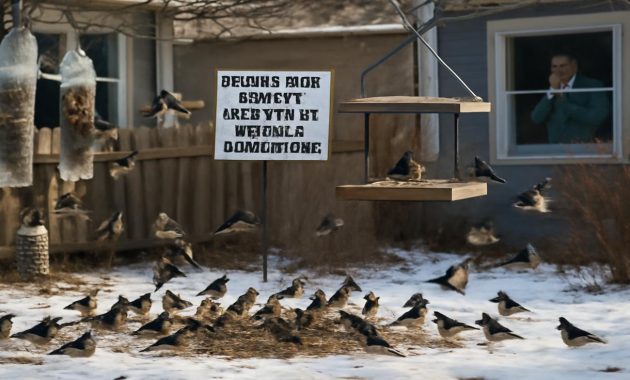
The first seed hits the frozen ground at 7:02 a.m., a soft scatter in the blue-gray light of a February morning. By 7:05, the air is beating with wings. Chickadees arrive first, then house sparrows, then a bold cardinal that perches on the rusted fence post like a drop of living fire. On the small dead-end street, the only real sound is birdsong and the muffled clink of a ceramic mug as someone nudges the back door open to watch their daily spectacle unfold.
From the second-floor window across the street, however, the scene looks less like a winter marvel and more like an organized invasion. The neighbor there sees not a nature show but a swirling, screeching mass of beaks and droppings. To her, this isn’t an act of kindness. It’s a cheap trick—an entire flock lured in by bargain birdseed, freeloading off the neighborhood ecosystem, messing with nature’s rules.
The February Feeding Ritual Nobody Agreed To
It began, like most neighborhood controversies, with good intentions and a sale bin.
Back in late January, when the cold had settled in for good and the trees clawed bare at the sky, Mark—the man with the mug and the open back door—spotted a pallet of birdseed stacked near the entrance of the hardware store. Twenty-pound bags. Plain brown labels. Half-off.
“Winter survival mix,” the handwritten sign read. Someone had doodled a little cartoon cardinal next to the price.
Mark was not, by his own admission, a “birder.” He couldn’t tell a nuthatch from a warbler. But he noticed the silence in his yard that winter, the way snow seemed to muffle even the faint rustle of wings. The kids were gone, the dog had died, and he found himself paying attention to smaller lives just to avoid the winter quiet.
He bought three bags. He dragged home a dented metal tray that had once been a plant stand, set it at the base of a scrubby maple in the backyard, and poured a generous mound of seed into it. “For whoever needs it,” he muttered, then went inside to make coffee.
By the second week of February, he was going through a bag every five days. The word was out. Every morning, the yard filled—sparrows, starlings, finches, juncos, mourning doves waddling like feathered monks beneath the chaos. By mid-morning, they’d vanish, leaving only hulls and faint claw prints pocking the snow.
At first, the neighbors smiled. Someone texted, “Heard your bird circus this morning—kind of loved it.” A kid down the block started keeping a “bird tally” on the back of a cereal box. Mark felt, for the first time in months, that he was responsible for something still soft and beating and alive.
But the flock grew. And with it, so did the complaints.
The Sound of Wings, The Smell of Trouble
The first formal objection arrived in the most neighborly format: a note, taped to his mailbox with painter’s tape so as not to leave a mark.
“Dear Mark,” it began, in carefully rounded handwriting, “I’m concerned about the bird feeding in your yard.” The letter mentioned “unnatural numbers,” “increased droppings on sidewalks and cars,” and “unnecessary dependence on human food.” Birds, the note scolded, were supposed to fend for themselves.
He folded the letter in half and left it on the kitchen table. An hour later, he heard the first argument rise sharp as breaking glass over the fences.
On one side of the debate stood those who believed that feeding winter birds was an act of mercy and a way of staying connected to a world that otherwise seemed to be slipping away: fewer insects, fewer frogs singing at night, fewer fireflies in July. If tossing out a few handfuls of cheap seed brought some life back into the picture, what was the harm?
On the other side, there were those who saw it as meddling. They argued that bird feeding—especially this kind of overflowing, all-you-can-eat spread—encouraged unhealthy flock sizes, disrupted migration patterns, spread disease, and turned otherwise balanced food webs into lopsided buffets. One neighbor, who’d read a few too many think pieces on the topic, called it “ecological freeloading.”
“You’re just bribing them to show up here,” she told Mark over the fence, her breath steaming in the cold. “It’s not real nature if you’re stocking the shelves for them.”
He stared back, his gloved hands dusted with sunflower shells. “They’re hungry,” he said simply. “I’m just giving them a hand.”
The Cheap Trick: How Budget Seed Became a Flashpoint
The birdseed itself was part of the controversy. This wasn’t boutique, hand-mixed feed with a watercolor thrush on the bag. This was the economical stuff: bulk millet, cracked corn, and sunflower fragments—good enough, but not exactly curated.
“That’s like handing out junk food,” someone muttered in the grocery store line when the topic came up. “Bird fast food.” There were whispers about pesticides in low-cost grains, about mold in damp storage, about cheap mixes that attracted “the wrong kind of birds.”
Still, every morning, the flock came. They didn’t care about the price tag. They cared about calories and survival and the way the seed hit the hard ground with a sound like hope.
From his kitchen window, Mark watched not only birds but patterns. Sparrows bullied each other with chesty bravado, only to scatter when the blue jays dropped in like quarrelsome royalty. Juncos kept to the edges, quietly gleaning what others missed. A single downy woodpecker visited the suet cage like a shy regular at a corner café.
He took mental notes—who arrived first, who stayed longest, which storms kept them away, which clear nights emptied the yard entirely as flocks moved on under star-strewn skies. Cheap seed or not, he began to suspect that you couldn’t boss nature around quite as easily as his critics feared.
But fear spreads faster than seed. In late February, when the snow briefly melted to reveal lawns slick with thawing droppings and stray hulls, a small group of neighbors started circulating an informal petition. It wasn’t framed as a ban, exactly—just a “request for moderation.”
“Our street used to be quiet,” one of them said, standing on the sidewalk with a clipboard. Overhead, a cloud of starlings looped, folded, and dropped onto the maple like a living net. “Now every morning sounds like a poultry farm.”
What the Birds Know That We Don’t
When we argue about bird feeders, we’re rarely just arguing about birds.
We’re arguing about control—who gets to decide what “natural” means in a world where almost nothing is untouched. The trees on this block were planted by a developer. The lawns are a mix of non-native grass held in place by fertilizer. The trash cans, often left open, are essentially raccoon feeders. The ornamental berries on front-yard shrubs are ecological candy for robins and waxwings.
Yet the simple act of scattering seed in February feels like tampering with some invisible contract.
Ecologists point out that bird feeding can indeed shift local dynamics. Feeders tend to favor adaptable species—sparrows, pigeons, jays, starlings—who already do well in human-dominated landscapes. That can crowd out shyer or more specialized birds. Concentrated feeding sites may increase disease transmission, especially when droppings accumulate on damp ground or perches are never cleaned.
Predators learn, too. Sharp-shinned hawks and Cooper’s hawks quickly figure out that a bird feeder is not just a cafeteria, but a menu board. To some, this feels like a violent side effect of well-meaning generosity. To others, it’s a reminder that the lines between helping and interfering are blurrier than they look from behind glass.
But the birds themselves aren’t weighed down by our moral calculations. A finch doesn’t ask whether cheap millet “disrupts the ecosystem.” It asks, in the only way it knows how: Will this get me through the night? Will this help me survive until spring insects emerge and tree buds swell with hidden protein?
On cold mornings, you can feel the need in them, an urgency stitched between every wingbeat.
February’s Edge: Survival, Sentiment, and the Need to Help
There’s something about February that frays people’s patience. Deep winter presses on the windows, the novelty of snow long since worn off. The holidays are a distant blur, and spring is still more rumor than reality. In this in-between, small things loom large.
Some neighbors found comfort in those morning flocks. A woman down the block, recently widowed, told a friend that the flutter outside her window was “like the street breathing.” Another, working remotely and rarely leaving the house, timed her coffee break to the sparrows’ arrival, letting her screen idle while she leaned on the sill and just watched.
Others experienced the birds as an assault: the patter of droppings on car roofs, the streaks on porch railings, the sudden raucous chorus right as the night shift worker finally fell asleep. Their sense of home—of calm, of privacy—felt compromised.
We like to imagine nature as something distant and pure, a pristine forest or an untouched marsh. Yet most of our contact with it happens here, in these shared scraps of habitat where wild lives and human lives overlap in messy, imperfect ways. A cheap bag of seed can act like a magnifying glass, bringing those tensions into sharp, uncomfortable focus.
Is it more “natural” to do nothing, to let bird populations sink or swim in a world we’ve already altered beyond recognition? Or is it more honest to admit that we’re part of the system now, for better or worse, and that sometimes participation looks like filling the tray and sometimes it looks like choosing not to?
Freeloaders or Neighbors? Rethinking the Flock
“They’re freeloading,” one neighbor said flatly when the conversation turned, as it inevitably did, to the birds. He was gesturing toward the maple, where a cluster of plump pigeons hunched like gray stones, waiting their turn.
“They should be finding food in the wild,” he added. “That’s the deal.”
But what does “the wild” mean in a landscape of clipped hedges, traffic noise, and runoff-slicked streams? The fields that once held midwinter weed seeds have long been turned into parking lots or townhouses. Old fence lines where climbing vines fed migrants for generations have been cleared for a “cleaner look.” We have already taken away so much of their original buffet.
To call birds “freeloaders” is to imagine that we are the hosts, the landlords of this place, and that other species owe us some kind of rent paid in silence and distance. Yet, long before property lines were traced and mailboxes nailed in place, these routes of movement and survival were theirs.
Maybe, instead of seeing them as freeloaders, it’s more honest to see them as neighbors who’ve had the neighborhood rebuilt around them without their consent. In that light, a discounted plastic bag of seed looks less like charity and more like back pay.
That doesn’t mean every feeder is harmless or that every well-meant feeding is wise. It does mean that the question is more complex than “helping” versus “interfering.” When you put out seed, you’re not just offering a meal; you’re participating in a relationship—a web of consequences that ripple beyond your fence.
A Morning of Compromise
Near the end of February, the neighbors on this little street did something unusual: they decided to talk face to face instead of through notes, posts, and muttered complaints.
They gathered in the chilly cul-de-sac on a Saturday morning, bundled in coats, boots sinking into the half-melted snow. Overhead, the usual chorus thinned to a cautious murmur as the birds watched from the higher branches, uneasy with the human congregation below.
People aired their grievances—the poop, the noise, the fear of disease. Others spoke up about loneliness, about needing some small daily reminder that the world is still alive and moving.
Someone suggested banning feeding entirely. Someone else said no one had the right to dictate what another does in their own yard. A teacher from around the corner, who’d been quietly listening, finally raised her hand like she was back in her classroom.
“What if we treated it less like a free-for-all and more like a shared project?” she said. “If the concern is about scale and mess and what’s ‘natural,’ maybe there’s a middle ground.”
They talked about reducing the amount of seed, shifting from ground-feeding to raised feeders that could be cleaned regularly, choosing higher-quality mixes that attract fewer aggressive flocks. They debated timing—feeding during the harshest weeks instead of year-round, cutting back as soon as spring insects returned.
One neighbor offered to help build a simple feeding station that was easier to maintain and less prone to creating a seed-slicked mud pit. Another volunteered to plant shrubs and native perennials come spring—a slower, less dramatic form of feeding, but one that would work with the ecosystem rather than around it.
It wasn’t a tidy resolution. Compromises rarely are. But the daily deluge of cheap seed slowed to a measured scoop. The crowds of birds thinned slightly, sorting back into smaller, more scattered groups. The maples still hosted a morning chorus, but the soundtrack softened from riot to conversation.
A Tiny Table of Trade-Offs
Some people like numbers and boxes better than stories. For them, the debate often comes down to a simple question: does feeding birds help more than it hurts? The answer, inconveniently, is “it depends.” But you can map out the trade-offs.
| Aspect | Potential Benefit | Potential Risk |
|---|---|---|
| Winter survival | Extra calories help small birds survive extreme cold and food shortages. | Over-reliance if feeding is suddenly stopped after birds adjust to it. |
| Species diversity | Feeders can support certain native species struggling with habitat loss. | Common, aggressive species may outcompete shyer or rarer birds. |
| Human connection | Daily contact with wildlife fosters empathy, curiosity, and care. | Conflicts among neighbors over noise, mess, and differing values. |
| Health and disease | Clean, well-maintained feeders can offer reliable, safe food in harsh periods. | Dirty feeders and dense flocks can spread parasites and infections. |
| Urban ecosystems | Feeding can partially replace lost winter food sources in altered landscapes. | May mask deeper issues like habitat loss, giving a false sense of “fixing” nature. |
Disrupting Nature—or Remembering We’re Part of It
In early March, as the days finally lengthened and the snow retreated in ragged patches, something subtle shifted on the street. The maples at the curb flushed with the faintest blush of bud. Crows began carrying twigs. A pair of cardinals traded call and response from opposite ends of the block, threading a future nest in their song.
The morning flock at Mark’s yard was smaller now, less of a sudden storm and more of a steady drift. He’d cut his seed use in half. He’d bought one slightly nicer mix. On weekends, he swept the sidewalk, hosing off obvious droppings once the ice melted. The argument, loud and ragged a few weeks ago, had quieted into something like wary tolerance.
Was nature “less disrupted” now? It depends where you draw your circle of concern. To the hawk that had learned to cruise the block at 8 a.m. sharp, the new scarcity of tightly packed sparrows meant a leaner hunting route. To the finch that had counted on that overflowing tray, the reduced rations required more time spent foraging elsewhere.
But nature is always in flux, adapting to us even as we argue about whether we should adapt to it.
When we accuse each other of “freeloading on local ecosystems”—whether we’re talking about birds on seeds or humans on everything—we’re really asking how much taking is too much, and how much giving is enough. We wonder who owes what to whom in a relationship that has been wildly unequal for a long time.
Maybe the better question isn’t whether putting out seed is right or wrong, but how to do it with a little more humility and a little less certainty. To notice who shows up, who disappears, and what stories our choices write into the landscape. To remember that every act of feeding, or withholding, echoes beyond the fence we can see.
On the first truly soft morning of the season, when the ground squishes instead of crunches and the air smells faintly of thawed earth, Mark pours a modest scoop of seed into the tray. A chickadee lands before he’s even finished, scolding him as if he’s late.
Across the street, a curtain shifts. Someone else is watching—the neighbor who wrote the first letter. She stands for a minute, watching the small bird flicker between branch and tray. Later that day, she’ll walk past his sidewalk and notice, without quite admitting it, that it’s cleaner than it used to be.
Neither of them has won. Both of them have changed. Above them, the birds keep their own counsel, following hunger and weather and the old, deep maps inscribed in their bones. Whether we call it freeloading or survival, disruption or adaptation, the wings keep beating the air into meaning.
FAQ
Is feeding birds in winter actually helpful or harmful?
It can be both. In harsh winters, feeders can help small birds survive by providing reliable calories when natural food is scarce. However, poorly maintained or overused feeders can spread disease, favor a few dominant species, and create neighborhood conflicts. The impact depends on how, what, and how much you feed.
Does using cheap birdseed really make a difference?
Lower-cost seed often contains a lot of filler grains like milo or cracked corn that some songbirds ignore, which can attract large flocks of less-welcome species and create more waste. It isn’t automatically “bad,” but higher-quality mixes tailored to local birds usually mean fewer leftovers, fewer crowding issues, and better nutrition.
Can bird feeders disrupt natural behavior or migration?
Feeders rarely change long-distance migration patterns on their own, but they can influence local behavior. Birds may linger in an area if food is abundant and reliable, and common adaptable species can thrive around feeders. That can subtly shift which birds dominate a neighborhood over time.
How can I feed birds without upsetting my neighbors?
Keep feeding areas clean, avoid massive quantities of seed on the ground, and choose feeders that limit waste. Talk with neighbors about their concerns, adjust placement if droppings are hitting shared spaces, and consider moderating feeding during times when it’s less critical, such as mild weather.
What are some alternatives to constant bird feeding?
Planting native trees, shrubs, and flowers is one of the best long-term ways to support birds. These plants provide natural food sources—seeds, berries, and insects—as well as shelter and nesting sites. You can also leave some leaf litter and seed heads in fall and winter instead of cleaning gardens to bare soil.
Should I stop feeding birds in early spring?
Many people scale back as natural food becomes more available. Reducing seed gradually, rather than stopping overnight, gives birds time to adjust. Insect-eating birds, especially, begin relying more on emerging bugs and buds as temperatures warm, so your feeder becomes less critical to their survival.
How often should I clean my bird feeders?
Ideally, every one to two weeks, and more often during wet weather or if you see sick birds. Use a mild bleach solution or hot soapy water, rinse thoroughly, and let feeders dry completely before refilling. Regular cleaning helps reduce the spread of disease in crowded flocks.