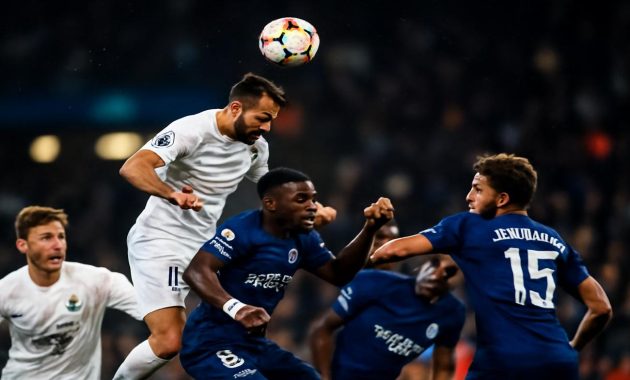
The floodlights are already on even though the sun hasn’t fully disappeared. There’s a faint mist hanging above the pitch, catching the white beams and turning them into hazy columns of light. Outside the stadiums across Europe tonight, people move like slow rivers of color: scarves knotted tight, plastic pint glasses in hand, the nervous, half-distracted chatter of supporters who know that, in a couple of hours, their season could be reborn or broken apart. This is Champions League knockout play-off night—four games, eight teams, one shared feeling: everything is on the line.
The Calm Before a Beautiful Storm
A few hours before kick-off, the biggest noise is not inside the stadium but around it. A street vendor flips sausages on a small grill, the smoke mixing with the damp air. A kid in an oversized replica shirt tugs at his father’s sleeve, asking for a name to be printed on the back—he can’t decide between the veteran striker who’s done it all, or the new young star whose highlights have filled his social feeds all season.
Inside, it’s eerily peaceful. Groundskeepers walk the touchline, inspecting the turf like surgeons before an operation. The grass is cut to perfection, each blade lying obediently in fresh stripes. Corner flags fill and tremble with every early gust of wind, like they’re shivering with anticipation. At one end, a lone camera operator tests their pan across the pitch, following an invisible ball that, in a few hours, will carry the weight of millions of hopes.
The four stadiums hosting tonight’s knockout play-off ties all share the same nervous energy. Different cities, different languages, different football cultures—but identical stakes. Win over two legs and you step into the bright, unforgiving light of the Champions League last 16. Lose, and the season suddenly feels a little colder, a little emptier. The margins are so slim you can almost see them, like frost clinging to the advertising boards.
By late afternoon, the first wave of supporters is already in their seats. They sit scattered in small clusters, watching the giant screens show classic goals from previous seasons. Last-minute winners, impossible comebacks, heartbreaking near-misses. Every club has its own chapter in this heavy, emotional archive—and every fan watching imagines a new clip from tonight being added, one way or another.
Four Matches, Eight Stories, One Ruthless Night
The beauty of a Champions League knockout round is how it compresses a season’s worth of narrative into 180 minutes. Four ties tonight, each one humming with tension—and each one a story of its own.
In one city, a fallen giant is trying to climb back to where it once belonged. Their stadium feels haunted by the ghosts of past glories: European Cups lifted in black-and-white photos, legendary managers leaning on the dugout in grainy replays, a soundtrack of names that still echo when fans talk in hushed, nostalgic tones. Tonight is not about recapturing the past exactly, but about proving they still belong among the elite. Failure here will not just sting—it will feed every story about decline and lost identity.
Across the continent, a different narrative takes shape. A rising club, backed by modern ambition and smart recruitment, steps into the glare of its biggest European night yet. They don’t have history on their side, not in the traditional sense. But they have fearless legs, fearless lungs, and players who grew up watching the Champions League anthem as a distant dream. For them, this is not pressure—it’s proof they’ve made it to the stage they always imagined. They walk out from the tunnel not with a burden on their shoulders, but with a kind of raw, youthful defiance.
Further north, the weather adds another layer of drama. The air bites. Breath clouds in front of faces, and the pitch has that slick, dangerous sheen that terrifies defenders and excites strikers. The home crowd here is close to the pitch, voices dropping like a tidal wave onto the grass. Opponents talk about the noise, the claustrophobia, the strange effect of feeling the fans almost on top of you. Today, that atmosphere is dialed to maximum. Knockout nights do that. Every chant is harsher, louder. Every whistle feels a little sharper.
And in another city—one decorated in ultra-modern glass and steel—two tacticians are preparing for a chess match disguised as football. Their teams are built around structure, detail, and relentless repetition on the training ground. Every press trigger, every run, every rotation rehearsed until it slips into muscle memory. But even here, with all the planning and data, there is no script that fully survives contact with Champions League chaos. One red card, one deflection, one slip, and all those neatly drawn lines on pre-match tactical boards scatter like confetti.
The Anatomy of Knockout Nerves
Strip away the bright marketing, the anthem, the fireworks, and what’s left on a night like this is something incredibly human: fear and courage wrestling inside 22 people at once.
When the players arrive, the dressing room is a strange mix of silence and sound. One guy sits with his eyes closed, headphones clamped, mouthing lyrics to a private playlist. Another paces the room barefoot, boots in hand, tapping them gently against his thigh like a drumbeat. A veteran checks the studs on his boots three, four, five times. He’s played in dozens of big games, but he knows that in these ties, one wrong slip can live forever in the mind.
Somebody cracks a joke. Laughter ripples through the room, but everyone knows it’s just tension trying to find a release valve. The cameras outside are already counting down. Social feeds explode with graphics: team news in bold fonts, starting elevens, formation diagrams. Fans react in real-time to line-up decisions. “Bold.” “Cowardly.” “Genius.” “Disaster.” The game hasn’t kicked a ball yet and already the judgment has begun.
In that room, though, the sound begins to narrow. The coach gathers them in a tight circle for the final words. It’s not always tactical, not now. They’ve gone over the patterns, the set pieces, the pressing traps. Now it’s heart-talk: about sacrifice, about running when there’s nothing left in the tank, about staying calm when the crowd roars for a foul or a card. The last sentence is always simple. Something like: “Leave everything out there.” It’s a cliché because it’s the only thing that really matters now.
In the tunnel, the two teams stand in parallel lines. Boots squeak faintly on the concrete. The Champions League anthem waits just beyond the corner, ready to collide with them as they walk out. Some players stare straight ahead, faces set like stone. Others glance sideways, scanning their opposite numbers, measuring posture and energy, looking for the tiniest crack in composure. The captains shake hands, the referee checks his watch—and then the world shrinks to a rectangle of grass and the roar of the first whistle.
The Fine Line Between Hero and Villain
On nights like this, the game is played in moments as much as in systems. A defender stretches one studs-length too far and clips an ankle in the box. The stadium freezes. The referee’s whistle seems to echo longer than usual. Penalty—or a perfect tackle? In a heartbeat, a player’s reputation can pivot on the decision.
For goalkeepers, the margin is even thinner. Ninety minutes of calm positioning can be erased by one misjudged cross, one shot spilled in front of a lurking striker. There’s a peculiar kind of cruelty in the position: make 10 saves and you’re doing your job; make one mistake and you’re the headline. Yet when you see a keeper step forward in a shootout, gloves wide, eyes locked on the taker, there’s something defiant and noble in the stance. They know failure will be replayed again and again, but they dive anyway.
At the other end, forwards live on risk. In regular league games, a missed chance might just be a grimace and a shrug. In a Champions League knockout play-off, a scuffed finish can feel like a betrayal. The replay plays inside their own head as the game continues—foot position, body shape, the keeper’s movement. And still, when the next chance arrives, they must step into the shot without hesitation. Hero or villain, often separated by a few square centimeters of contact.
When Tactics Meet Pure Emotion
Beneath the fever and the songs, this is also a laboratory of ideas. Each coach steps into the dugout carrying a tactical world-view, and tonight is its examination.
One team might set up with a compact low block, banks of defenders and midfielders stacked like fortifications, daring the opposition to break them down. Another might push their full-backs so high that they’re practically wingers, rotating midfielders into pockets of space to create overloads. For analysts and obsessives, this is the good stuff: little tweaks, subtle shifts, shapes turning like a Rubik’s Cube across the pitch.
But tactics don’t live in a vacuum. They collide with mood, noise, and pressure. That carefully calibrated high press suddenly frays when a couple of players hesitate, just for a second, worried about leaving space behind. The rehearsed passing pattern crumbles when a midfielder miscontrols under the glare of 50,000 impatient eyes. Data and detail can only prepare you so far for the raw, unfiltered intensity of knockout football.
Then there are the substitutions. On a night like this, the fourth official’s board becomes a kind of dramatic prop. A number goes up: is it a sign of faith in attack or fear of conceding? A winger stripping off his tracksuit sends a message to the crowd, too. They roar, sensing a twist in the plot. A player who has been sitting under a blanket on the bench, watching the game unfold, is suddenly thrust into a story moving at full speed. Sometimes, in extra time, you can see the weight in their legs even before they touch the ball—but you can also see the hunger.
Scorelines and Stakes: What’s on the Line?
Underneath all the emotion and color, the stakes of these four ties can be broken into something simple and brutal: progression or elimination. The table below captures the emotional scoreboard that hangs over each matchup before a ball is even kicked.
| Tie | Club Identity | Emotional Stakes | What Progression Means |
|---|---|---|---|
| Match 1 | Fallen Giant vs. Resurgent Challenger | Redemption vs. Validation | Either a return to status or proof of a new order |
| Match 2 | Modern Project vs. Traditional Power | Ambition vs. Legacy | Either a breakthrough or a defence of heritage |
| Match 3 | Home Fortress vs. European Specialist | Pride vs. Experience | Either a statement win or one more page in a long European story |
| Match 4 | Tactical Purists vs. Counterattacking Sharks | Control vs. Chaos | Either system supremacy or proof that moments still rule |
It’s not just about prize money or TV rights; those belong to the boardrooms and spreadsheets. For fans, progression means spring evenings under the lights, new away days, fresh memories to tell and retell. It means extending the dream just a little longer. For players, it’s about legacy: how they’ll be remembered when their boots are finally hung up, what clips will be rolled someday in a tribute video.
When the Whistle Blows and Time Starts to Run Out
There’s a particular type of silence that only exists in stadiums during the last ten minutes of a knockout game. It’s not total, of course—the chants are still there, the away end still singing through nerves—but there’s a thin layer of anxiety skimming everything.
The fourth official raises the board with added time. Three minutes. Four. Five. Each second now feels like a bead dropping on a string. The leading side suddenly can’t clear the ball far enough; the chasing side suddenly finds more energy than they had all match. A ball deflects off a defender’s thigh and spins out for a corner, and 45,000 people inhale at once.
In the studios miles away, pundits lean forward. Social timelines swarm with shaky videos taken from the stands, live reactions with captions in all caps. Somewhere, in a living room, a fan stands six inches from the TV, hands on head, muttering the same phrase over and over: “Just blow the whistle… just blow the whistle…” or “One more chance… just one more.”
When the final whistle does come, it is not a gentle end. It’s a cut. A jolt. For some, it brings an explosion of joy so sharp it almost hurts: bodies tumbling on top of each other in a chaotic pile, substitutes sprinting from the bench, coaches momentarily forgetting their carefully curated sideline persona. For others, it’s an emptiness that drops straight to the stomach. Players crumple to the turf, staring up at the sky lights, blinking as if they can’t quite process that it’s over.
This is the ruthless nature of the Champions League’s knockout stage. There’s no soft landing, no gradual fade-out. One team steps forward into the next round, into new build-ups and new nights and new possibilities. The other is left with a season suddenly short of a dream they’d been quietly carrying since the qualifying rounds or the group stage draw.
The Morning After: What These Nights Leave Behind
By the time the last supporters drift away into the dark streets, the stadium begins to empty of sound and light. Groundskeepers reappear, rolling their equipment back onto the grass, quietly erasing the traces of 90 minutes that felt like a lifetime. Somewhere inside, in a quieter corridor, a player still in full kit speaks into a camera, trying to explain what just happened in neat sentences when his emotions are frayed and raw.
The next day, newspapers and websites will carve the story into narratives: Heroes. Villains. Tactics that worked. Choices that backfired. Fans will pick apart the details: the offside line, the early substitution, the missed half-chance in the 23rd minute that might have changed everything. Coaches and players will be asked to move on quickly—there’s always another league game, another competition—but nights like these stick. They stain the memory in a way no routine 2–0 in November ever could.
For the winners, the city feels different the next morning. Office conversations drift back to the game again and again. Kids wear their scarves to school even if it’s not that cold. Street murals, bus-stop posters, and social feeds are all infused with the same message: we’re still alive in Europe. The music of the Champions League anthem hangs invisibly in the air, even when it’s not playing.
And for the neutral observers—the millions watching from their living rooms, from bars, from phones on trains and buses—this is why they keep coming back. Not for perfection, not really, but for the wild edges of nights like this. For that feeling that football, for all its planning and data, still bows occasionally to chaos, to courage, to something unquantifiable.
Four games. Eight teams. Ninety minutes each, maybe more. A ruthless, high-stakes night where the drama feels too big for the time it occupies. As the next round takes shape and the bracket tightens, one truth remains: there is nothing quite like a Champions League knockout evening, live, unfiltered, and humming with possibility.
FAQ
Why are the Champions League knockout play-off games so intense?
Because they compress massive stakes—sporting, financial, and emotional—into a very small window of time. One mistake or one moment of brilliance can decide an entire tie, which magnifies every action on the pitch.
How are these play-off ties different from the group stage?
The group stage offers room for recovery; you can lose and still progress. In the knockout rounds, especially over two legs, every goal shifts the balance instantly. There’s no long runway—just survival or exit.
Why do tactics matter so much in these matches?
Opponents are usually evenly matched at this stage, so tactical decisions—pressing intensity, substitutions, set-piece routines—often tip the scales when pure talent alone isn’t enough to separate the sides.
What makes the atmosphere on these nights special?
Fans know they are witnessing potentially historic moments. Choreographed displays, louder chants, and the sheer edge-of-seat tension inside the stadium create an intensity that regular league games rarely match.
Do players really feel the pressure as much as fans think?
Absolutely. Many describe knockout nights as emotionally and mentally exhausting. They’re aware of the stakes, the cameras, and the legacy implications—which makes their ability to perform under that weight all the more remarkable.