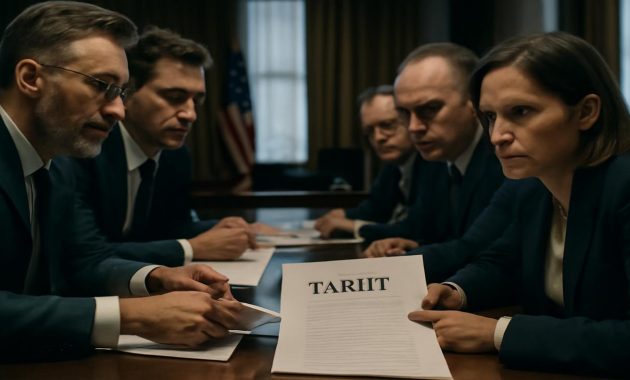
The cargo ship’s horn sounds before dawn, a low, mournful note rolling across the harbor like a warning. On the dock, under harsh white floodlights, containers swing through the air—bright metal blocks full of machines, fabrics, tiny screws, and invisible promises. Somewhere inside one of those boxes lies the future profit or the next painful loss for a mid-sized American company that’s been counting every penny since tariffs turned once-routine shipments into financial landmines. Out beyond the shipping lanes, in Washington’s polished offices, aides to a former president talk about “economic warfare” and “going further next time,” while, on the ground, businesses quietly scramble to claw back every dollar they can in tariff refunds before the next round of political fire begins.
Whispers in the Warehouse
“We might get some of it back.” That’s how it usually starts—whispers in warehouses, half-hopeful emails in inboxes, late-night calls between accountants and trade lawyers. After years of tariff battles that began during Donald Trump’s first term, businesses large and small are now turning toward a different battlefield: the refund fight.
Inside a corrugated recycling plant in Ohio, the plant manager leans against a pallet of imported steel coils. He runs his hand across the cold metal and explains how each coil costs more than it did a few years ago—tariffs layered on like invisible rust. The company swallowed those costs at first, raising prices cautiously, shaving margins, negotiating with long-time customers. But now, as legal avenues to challenge and reclaim some tariffs open up, they’ve hired a trade attorney. Hidden among purchase orders and customs forms lies a possible lifeline: proof that some of the duties they’ve paid might have been unlawful, excessive, or improperly applied.
Multiply that quiet calculation by thousands, and you begin to see a slow-motion stampede: furniture importers, auto parts wholesalers, tool manufacturers, clothing brands, tech gadget resellers—all hunting through years of entries, codes, and customs classifications in search of refunds. It doesn’t have the drama of a televised trade war announcement. There are no podium speeches or waving flags. Just spreadsheets, legal filings, and the hushed, simmering realization that businesses may have paid billions more than they should have.
How Tariffs Became Battlefield Currency
To understand why refunds matter so much now, you have to rewind the story to when tariffs were rebranded as weapons. In the late 2010s, the Trump administration framed tariffs not as dusty, technical tools of trade policy, but as blunt-force instruments of leverage—economic artillery.
Tariffs on steel and aluminum landed like a surprise attack. Then came sweeping duties on imports from China under Section 301, justified as retaliation against unfair practices: intellectual property theft, forced tech transfers, and a trade deficit that became a talking point in every rally speech. The message from the podium was simple, almost primal: tariffs mean toughness, and toughness means winning.
Inside the White House, aides reportedly described the strategy in martial terms: economic warfare, tariff battles, and the willingness to ignite a “fiery clash” with allies and rivals alike. For them, tariffs weren’t just about prices and supply chains; they were a test of national will and sovereignty, a stage for ruthless politics where the optics of confrontation mattered as much as the outcomes.
But at the loading dock level, away from the cameras, something quieter and more complicated unfolded. Prices shifted. Contracts were renegotiated. Some suppliers moved factories from China to Vietnam or Mexico, trying to dance around the tariff lines. Others simply tacked the cost onto invoices and let American buyers absorb the hit.
The result was a kind of invisible tax, distributed unevenly across the economy. A woodworking shop that imports high-quality hinges from overseas pays more. A midwestern manufacturer that buys specialty steel sees the numbers tilt against them. Consumers often feel it too, but the sharpest pain lands on businesses trapped between tariff walls and ruthless global competition.
Businesses Turn to the Courts: The Great Refund Chase
Years later, the dust hasn’t settled. It’s rearranged itself into new battle lines—this time, in the form of lawsuits, administrative petitions, and refund claims. Legal teams pore over the origins of each wave of tariffs: Were proper procedures followed? Did the government overreach its statutory authority? Were tariff lists updated fairly, or did they sprawl beyond their intended targets?
Some businesses have joined large group lawsuits challenging entire categories of tariffs, especially on Chinese goods. Others have focused on smaller, technical angles: misclassified products, errors in customs coding, or failure to apply exemptions. A packaging company might discover that a certain component qualified for a lower duty rate. A chemical importer might prove that their product falls outside the scope of a specific tariff line. Each correction becomes a potential check from the government.
In a modest office park in New Jersey, a logistics director scrolls through years of customs entry records. He’s working with a consultant who specializes in tariff recovery, a niche cottage industry born directly out of economic conflict. They highlight line items like they’re spotting constellations in a data-filled sky. Behind every eight-, ten-, or twelve-digit code sits a story—a shipment that cost more than it had to. A refund filed today could mean thousands or even millions of dollars flowing back into operating budgets tomorrow.
What makes this moment especially charged is that it’s happening while the political language around tariffs is heating back up. Trump aides—past and present—have begun hinting that, if returned to power, they would not only preserve the tariffs, but escalate. The opening round, they suggest, was just that: an opening. Future policy could go broader, tougher, more punitive. Tariffs on more countries. Higher rates. Fewer exemptions. Economic warfare, dialed up.
Businesses, alert to this shift, aren’t just chasing old refunds. They’re bracing for a second storm.
Table: How Tariffs Ripple Through a Business
| Stage | What Happens | Business Impact |
|---|---|---|
| Import Decision | Company chooses overseas supplier for cost or quality. | Baseline prices set; contracts signed assuming prior tariff levels. |
| Tariff Imposed | Government adds new duty or raises existing one on that product or origin. | Immediate rise in landed cost; margins squeezed or prices raised. |
| Operational Response | Company renegotiates, shifts sourcing, or absorbs cost. | Delayed projects, price volatility, supply chain reshuffling. |
| Legal & Compliance Review | Lawyers and consultants audit classifications and tariff basis. | Discovery of potential overpayments or exemption eligibility. |
| Refund Claim or Lawsuit | Company files for refunds or joins broader legal challenges. | Possible return of funds; long timelines; higher legal costs but crucial relief. |
Behind Closed Doors: Aides, Ambitions, and the Next Tariff War
While businesses tally losses and chase refunds, political operatives are drawing maps for the next engagement. In private strategy sessions and think-tank roundtables, former Trump advisers sketch out bolder visions: a system where tariffs become the default, not the exception. Some talk about flat tariffs on all imports, others about targeted surges against specific nations in what they openly describe as “economic warfare.”
The language is intentionally fiery. Aides frame the future as a clash between a tough, unapologetic America and a world of trading partners accused of gaming the system. They argue that past measures didn’t go far enough, that the political rewards of visible confrontation outweigh complaints from economists and trade experts. They point to how tariffs became powerful symbols on the campaign trail—easy to explain, easy to applaud, a kind of fiscal nationalism wrapped in everyday terms.
Businesses, however, live in a far less symbolic reality. In a North Carolina textile mill, the CEO walks the noise-filled floor, watching yarn spin into fabric. He’s been told by his lobbyist that another wave of tariffs could hit the imported dyes and machinery he depends on. He has no podium, just payroll. His question isn’t about ideology; it’s about survival: how to invest, whom to hire, how much to charge, when the rules of trade may be weaponized again at any moment.
This is where ruthless politics collides with fragile balance sheets. One side sees tariffs as a narrative of power; the other sees them as a line item that can erase a year’s worth of effort. And yet, many businesses are reluctant to speak loudly against tariffs. They remember how dissent was framed as weakness, even disloyalty. So they adapt, quietly lobbying for exemptions, refunds, and nuanced carve-outs while the public rhetoric stays hot and sharp.
Strategy in the Shadows: How Companies Are Bracing for Impact
Inside boardrooms, the mood is cautious, almost war-room like. Tariffs used to be a specialized concern for trade compliance staff; now they’re a core part of strategic planning. The most prepared companies are treating the current refund push as both cleanup and training exercise—a preview of the skills they’ll need if tariffs expand again.
They’re doing things differently this time:
- Building deeper trade expertise in-house: Instead of outsourcing everything, some firms are hiring customs specialists and trade lawyers full-time, turning compliance into a strategic asset.
- Rewriting supplier contracts: New deals increasingly include clauses about who eats the tariff cost if policy suddenly shifts. The days of shrugging and splitting the difference are fading.
- Diversifying sources: Companies spread production across multiple countries, betting that no single nation will face the full fury of future tariffs.
- Modeling tariff scenarios: Finance teams now run “what if” simulations: What if tariffs double? What if they expand to this category or that country?
- Early action on refunds: Instead of waiting years, businesses are moving quickly when new opportunities to challenge duties appear.
One midsize electronics importer on the West Coast describes it like building flood defenses. You can’t stop the rain, but you can control how much water pours into your living room. They’ve mapped which product lines are most vulnerable, which customers are most sensitive to price changes, which ports and brokers are best equipped to handle complex paperwork. They treat each tariff as an incoming wave and each refund claim as a sandbag added to the wall.
There’s a faint irony here: the same policies meant to punish foreign rivals have forced domestic companies to become more agile, more globally aware, more technically sophisticated. Economic warfare, in effect, has made logistics managers amateur diplomats and CFOs reluctant experts in international law.
Winners, Losers, and the Human Cost in the Numbers
In public debates, tariffs often sound like clean, decisive hits against a faceless overseas opponent. But on the ground, the story is muddier, and the winners and losers are far from theoretical.
The losers are easy to picture: a small business that can’t afford a trade lawyer, a family-run importer with a single supplier in a now-targeted country, a regional employer forced to lay off workers because a critical component has doubled in cost. These aren’t abstractions; they’re people reprinting catalogs because prices are outdated, or delaying equipment upgrades yet again.
But there are winners, too. A handful of domestic industries find themselves suddenly protected from cheaper foreign competition. A U.S. steel mill might see orders rise as import prices climb. A manufacturer that already sourced domestically might quietly enjoy new pricing power. Certain communities celebrate new investments that arrive specifically because tariff barriers make local production comparatively more attractive.
Still, even those apparent gains come with shadows. Tariff-driven investment can be fickle—what arrives under one administration’s policy can disappear under another’s. And businesses built around high, protective walls are always watching the horizon for the next political shift that might rip those walls down.
Meanwhile, the tariff refund chase underscores just how leaky and complicated the system can be. Large corporations with sophisticated advisors can navigate the maze, challenging classifications, lobbying for exclusions, and reclaiming overpayments. Smaller firms often never realize they have options. The playing field that tariffs were supposed to level sometimes tilts again—this time in favor of whoever can hire the best guide through the bureaucracy.
In that sense, the fight over refunds is not just about money; it’s about power—who gets to rewrite their story when economic warfare moves from slogans to spreadsheets.
Standing on the Dock, Waiting for the Next Signal
Back at the harbor, as evening falls, the cranes slow and the last containers are stacked like a metal skyline. The air smells of salt, diesel, and wet rope. Somewhere in that maze of boxes is a shipment that cost more because of a line in the Federal Register—and somewhere in a quiet office nearby, someone is double-checking whether that cost can be reversed, at least in part, through a carefully prepared refund claim.
This is the strange, liminal moment businesses find themselves in: looking backward to recover what was lost, and forward to anticipate the next blow. Trump aides talk openly about a future defined by bolder tariffs and more aggressive economic confrontation, and their language drips with combat metaphors—clashes, escalation, pressure. In their vision, the United States flexes its market power the way a navy might flex its fleet.
On the receiving end, businesses don’t get to choose the battlefield, only how they move across it. Some will adapt brilliantly; others will fold quietly. But almost all of them, in one way or another, are now woven into the story of tariffs as weapons, refunds as salvage operations, and trade as a front line in a broader, ruthless politics.
In this era, the sound of economic warfare isn’t just a campaign speech or a breaking news alert. It’s also the rattle of a printer as refund claims spill into a manila folder, the murmur of a late-night call with a customs broker, the steady clack of a keyboard as someone reclassifies the future of a product in a database. Policy becomes paperwork; rhetoric becomes risk.
And out at the dock, another ship approaches, heavy with goods, light with certainty. The horn sounds again. Somewhere, a spreadsheet updates. Somewhere else, a political strategist circles the word “tariff” on a memo and underlines it, twice.
Frequently Asked Questions
Why are businesses seeking tariff refunds now?
Many companies paid substantial tariffs during recent trade conflicts, especially on imports from China and certain metals. As legal challenges progress and government processes evolve, businesses are discovering that some of those duties may have been misapplied, excessive, or eligible for exemptions. Refund claims are a way to recover money that directly affects cash flow and competitiveness.
Do tariff refunds mean the tariffs were illegal?
Not always. Refunds can arise from a variety of issues: misclassification of products, overlooked exclusion requests, administrative errors, or successful legal challenges to how a tariff was implemented. In some cases, courts may rule that a particular action exceeded statutory authority; in others, it’s simply a correction of technical mistakes.
How do tariffs influence everyday prices for consumers?
Tariffs increase the cost of imported goods. Companies faced with higher costs can either absorb them—reducing profit—or pass them on to customers through higher prices. In many sectors, a portion of the tariff ultimately shows up in retail prices for items like tools, electronics, furniture, and clothing, although the exact impact varies by industry and competition.
Are all businesses affected by tariffs in the same way?
No. Tariffs are highly targeted by product type and country of origin. Some industries may feel intense pressure, while others notice very little change. Larger companies with more resources can often adapt more easily—by shifting suppliers, hedging risk, or pursuing refunds—while smaller firms may find it harder to adjust or even to recognize opportunities for relief.
What might happen if a new round of tariffs is introduced?
If a future administration expands or intensifies tariffs, businesses could face higher costs, new supply chain disruptions, and fresh uncertainty. Some domestic producers may benefit from reduced foreign competition, but many import-reliant companies would scramble again to adjust pricing, revise contracts, and seek legal or administrative relief. The current focus on refunds is, in many ways, a rehearsal for navigating that next potential wave.